


 Top Rated Course

We may not have the course you’re looking for. If you enquire or give us a call on 01344203999 and speak to our training experts, we may still be able to help with your training requirements.
Essential Filmmaking Techniques for Visual Storytelling
The Knowledge Academy 06 March 2026Essential Filmmaking Techniques use camera movement, lighting, composition, and sound to craft emotion, convey meaning, and create seamless visual storytelling. Mastering these core elements helps filmmakers shape audience perception, enhance narrative depth, and transform simple scenes into compelling cinematic experiences.

Training Outcomes Within Your Budget!
We ensure quality, budget-alignment, and timely delivery by our expert instructors.
Table of Contents

A powerful story is not only told through dialogue, but it is also crafted through every visual and auditory decision on screen. The angle of a camera can signal dominance or vulnerability; lighting can evoke tension or warmth, and carefully layered sound can intensify emotion or create subtle meaning.
In this blog, we explore essential filmmaking techniques that strengthen visual storytelling, including camera movement, shot composition, lighting design, and sound integration. You will learn how these elements work together to create mood, convey meaning, and deliver seamless cinematic experiences that captivate viewers from the first frame to the last.
Table of Contents
1) What is Filmmaking?
2) Essential Filmmaking Techniques
a) Scriptwriting: The Blueprint of the Film
b) Tell a Story Through Visual Storytelling
c) Production Design: Setting the Scene
d) Lighting Techniques
e) Camera Techniques
f) The Power of the Frame: Composition Techniques
g) The Rule of Thirds in Cinematography
h) Power of the Close-up
i) Depth of Field: Choosing What's in Focus
j) The Moving Camera: Dynamic Shots and Movement
3) Conclusion
What is Filmmaking?
Filmmaking is the art of storytelling brought to life through the combination of imagery and sound, bringing written ideas to life in lively motion pictures that touch audiences. It is a collaborative art process that involves various creative and technical steps, such as developing the idea and scripting, shooting, editing, and final production.
Filmmakers influence all stages of this process to create stories that elicit emotion, provide meaning, and engage viewers in the movie atmosphere. Let’s look into the various Filmmaking Techniques in detail.

Essential Filmmaking Techniques
In this section, you will learn some of the top Filmmaking Techniques you can use. These Cinematography techniques and tips are easy to follow:
1) Scriptwriting: The Blueprint of the Film
A script is more than words on a page. It's the blueprint of a Film. It dictates the journey that both Filmmakers and audiences will take. This is how you can also use this Filmmaking Technique for your next Film:
a) Narrative Structure: The foundational framework of the story, often following models like the three-act structure, ensuring a clear beginning, middle, and end.
b) Character Development: Crafting multi-dimensional characters with distinct arcs, motivations, and growth trajectories.
c) Dialogue: Writing conversations that sound natural, propel the story forward and reveal character insights.
d) Visual Descriptions: Providing cues for setting, wardrobe, and action, painting a picture of each scene's ambience and dynamics.
e) Conflict and Resolution: Introducing challenges and obstacles that drive the plot and engage viewers, leading to satisfying or thought-provoking conclusions.
2) Tell a Story Through Visual Storytelling
Before diving into Filmmaking Techniques, ensure you have a compelling story with a clear beginning, middle, and end. A common mistake among filmmakers is neglecting a well-structured narrative.
Creating an engaging story takes thought and effort. Simply showing your significant other walking along the beach is not a story; it’s a visual love letter. A true story involves a main character striving to achieve something, with the drama unfolding through the obstacles they encounter on their journey.
Audiences crave an emotional experience. Ensure your main character has a clear goal, and craft a narrative that includes several challenges or conflicts they must face, leading to a defined ending. Keep the story relatively simple and aligned with your movie budget, focusing more on actions than dialogue.
3) Production Design: Setting the Scene
Production design is central to film narrative, as it determines the physical and visual spaces within which the story unfolds. It transcends the aspect of decoration; it acts as a narrative device, which strengthens the identity of the characters, theme, and emotional tone. The key aspects of production design in Filmmaking Techniques are:
a) Environment Creation: The creation of a constructed or modified space that enhances the action and has the tone of the story, and is either realistic or fantastical.
b) Historical and Cultural Accuracy: Researching and designing sets, costumes, and props that reflect the time period or setting accurately.
c) Visual Tone with Colour: The ability to indirectly discern mood, conflict, harmony, or symbolism using purposeful colour schemes.
d) Functional and Symbolic Objects: Choosing props that will not only have a practical value but will also provide narrative meaning and depth of character.
e) Selection of a Real-World Setting: Selecting environments that spontaneously contribute to the sense of naturalness and minimising the amount of extensive construction.
4) Lighting Techniques
Visual storytelling will not be possible without lighting because it determines the mood, depth, and perception of the audience. The tactical use of lighting forms the emotional values and emphasises the plot. Common filmmaking lighting techniques are:
a) Three-Point Lighting: A standard configuration of key light, fill light, and back light to achieve a balance of exposure and separation of the subject.
b) High-Key Lighting: The lighting is very bright and is distributed uniformly with few shadows, mostly used in comedies or light-hearted scenes.
c) Low-Key Lighting: A high amount of contrast between the light and shadow to create drama, tension, or mystery.
d) Natural Lighting: Making use of natural daylight or useful sources to develop a sense of the real and the authentic.
e) Hard and Soft Lighting: Hard lighting is used to produce clear shadows and contrast, whereas soft lighting is used to have a more flattering effect.
5) Camera Techniques
The camera techniques are the factors that define the visual framing, as well as the experience of the story, in a visual manner. The movements, angles, and composition all join forces in order to direct the viewer's attention and emotion. Some of the common camera techniques in Filmmaking Technique are:
a) Wide Shot: Provides setting and space, frequently with the purpose of introducing settings.
b) Medium Shot: is devoted to interaction between quarrelling characters, keeping some background.
c) Close-Up: Shows facial expression and feelings.
d) High Angle Shot: This is the shot where the subject is at the ground, and the camera is above it, to imply that one is vulnerable or someone loses power.
e) Low Angle Shot: The view of the subject is made lower with the intention of showing power, dominance, or authority.
f) Handheld Shot: The natural movement is brought in to bring about realism or urgency.
Capture the world through your lens with our Photography Course- Join today!
6) The Power of the Frame: Composition Techniques
Understanding and mastering composition techniques can elevate an ordinary scene into a captivating moment, enhancing the visual storytelling prowess of any filmmaker. Here are some key Filmmaking Techniques to consider:
a) Rule of Thirds: The Rule of Thirds is perhaps the most renowned composition technique. It involves dividing the frame into nine equal segments. Placing key elements along these lines or at their intersections creates balance and interest.
b) Leading Lines: Using natural or artificial lines in a scene can direct the viewer's attention to a specific point or subject. This technique is especially useful in establishing shots or emphasizing a focal point.
c) Symmetry: Symmetry can create a sense of harmony and beauty. Iconic in Wes Anderson films, symmetrical frames are both pleasing to the eye and impactful.
d) Frame Within a Frame: Utilising elements like windows, doors, or arches can draw focus to a particular subject or scene, adding depth and layers to the shot.
e) Negative Space: Embracing the empty areas in a frame can highlight the isolation or significance of a subject. This technique can also create a sense of scale or anticipation.
f) Foreground Interest: Including elements in the foreground can add depth, context, and layers to a scene, making it more dynamic and immersive.
g) Golden Ratio: The Golden Ratio, often depicted as a spiral, is a composition technique that creates a naturally pleasing harmony and balance in the frame.
h) Juxtaposition: Placing contrasting elements side by side can underscore differences or conflicts, providing a visual commentary without the need for dialogue.
7) The Rule of Thirds in Cinematography
The Rule of Thirds is a foundational principle in visual arts, from photography to film. Its understanding and application can dramatically enhance the quality and intentionality of compositions, making scenes more captivating and coherent. For more creative inspiration, check out our Photography Ideas blog to explore how this principle can be applied to your work.
a) Grid layout: Imagine the frame divided into nine equal sections by two equally spaced vertical lines and two equally spaced horizontal lines.
b) Balance: Positioning main subjects or key elements along these lines or at their intersections, achieving visual balance and harmony.
c) Guided Focus: This rule helps guide the viewer’s eyes to primary points of interest without centring them, fostering a more natural visual flow.
d) Horizon Placement: The horizon is often aligned with one of the two horizontal lines, enhancing spatial depth.
e) Character Framing: For close-ups or mid-shots, aligning a character’s eyes with the top horizontal line can convey importance or emotion.
f) Enhanced Aesthetics: Photos and scenes adhering to this rule often feel more pleasing and balanced to the human eye.
8) Power of the Close-up
The close-up, in its concentrated intensity, becomes a Filmmaker's most chosen Filmmaking Techniques. This Filmmaking Technique offers viewers a window into the soul of a character or the essence of a moment.
a) Emotional Intimacy: Close-ups allow audiences to connect deeply with a character, observing subtle emotions and expressions.
b) Detail Highlighting: They emphasise small, crucial details that might be missed in wider shots, such as a teardrop, a twitch, or a fleeting smirk.
c) Narrative Focus: By drawing the viewer's attention to a specific element or character, close-ups can dictate the narrative's direction and emphasis.
d) Isolation: A close-up can isolate a character from their surroundings or other characters, amplifying feelings of loneliness, introspection, or vulnerability.
e) Visual Impact: The visual intensity of a close-up can enhance the impact of pivotal moments, making them more memorable.
f) Subjective Perspective: Close-ups can provide insight into a character's personal experience or perspective, creating viewer empathy or understanding.
9) Depth of Field: Choosing What's in focus
Depth of Field isn't just a technical aspect of Cinematography. It's a powerful storytelling tool. Depth of Field (DoF) refers to the range within a shot where objects appear acceptably sharp and in focus. By manipulating what's in focus, Filmmakers can subtly direct viewers' emotions and attention, shaping the narrative's visual and emotional landscape.
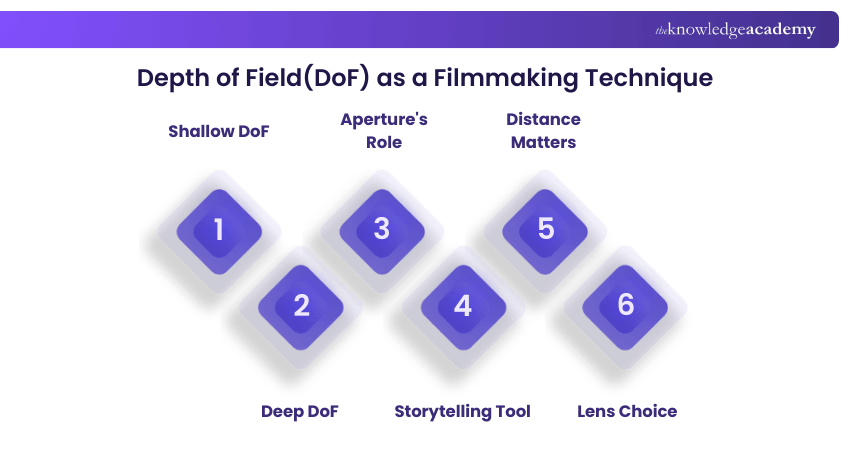
a) Shallow DoF: Utilising a small range of focus, often used to highlight specific subjects while blurring the background or foreground. This creates a dreamy or intimate feel.
b) Deep DoF: A larger range in sharp focus, capturing both foreground and background details. Often seen in landscape shots or grand cinematic sequences.
c) Aperture's Role: Larger apertures (like f/1.8) yield a shallow DoF, while smaller ones (like f/16) give a deeper DoF.
d) Storytelling Tool: Filmmakers strategically choose DoF to guide audience attention, emphasise emotions, or convey narrative elements.
e) Distance Matters: The closer the camera is to the subject, the shallower the DoF becomes.
f) Lens Choice: Telephoto lenses tend to compress space, offering shallower DoF, while wide-angle lenses can provide a deeper DoF.
10) The Moving Camera: Dynamic Shots and Movement
Harnessing the power of camera movement allows Filmmakers to infuse scenes with energy, drama, and emotion, adding dynamism to the narrative and guiding viewers through the cinematic journey. You can use this in your Cinematography & Film techniques:
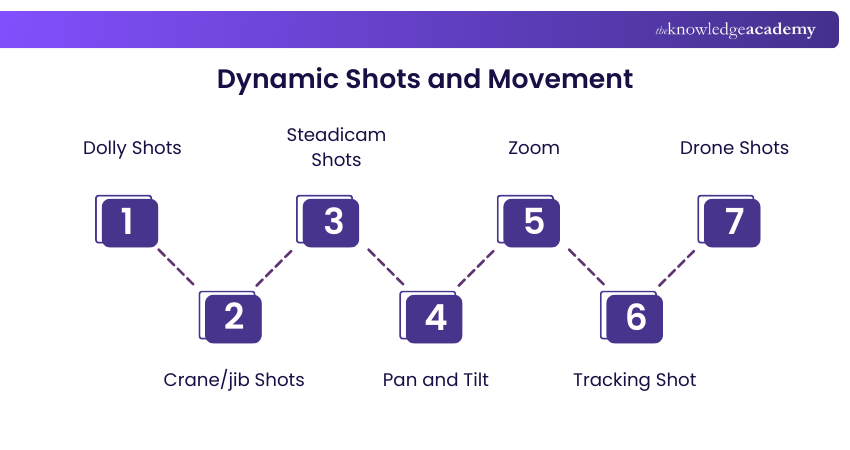
a) Dolly Shots: Utilising a wheeled platform (or dolly) to smoothly move the camera forward, backwards, or side to side, this technique brings depth and immersion to scenes.
b) Crane/jib Shots: Elevating the camera high off the ground or sweeping it through a scene provides grand, cinematic perspectives, often used to introduce settings or dramatic moments. It is one of the most important Cinematography techniques.
c) Steadicam Shots: A stabilising harness allows for fluid camera movement, following characters or action seamlessly. Notably, it is used in tracking shots or long takes to maintain immersion without the shakiness of handheld shots. When combined with techniques like the Rule of Thirds photography, it helps ensure that the subject remains well-composed within the frame, enhancing the visual appeal and storytelling of the shot.
d) Pan and Tilt: Horizontal (pan) or vertical (tilt) shifts of the camera's direction, useful for revealing elements or following a subject without physically moving the camera.
e) Zoom: Shifting lens focal lengths to approach or recede from a subject. Different from a dolly shot, zoom changes the frame without moving the camera itself.
f) Tracking Shot: Moving with or alongside the main subject, offering a continuous view of their journey or action.
g) Drone Shots: Utilising drones for aerial views, providing breathtaking overviews or dynamic, high-flying follows.
Learn sketching, draping, and styling to create your own fashion line with our Fashion Designing Course- Sign in now!
11) Acting and directing: Extracting the best performance
Extracting a captivating performance is a bridge between an actor's talent and a director's vision. When harmonised, it turns normal scenes into memorable moments, leaving lasting impressions on audiences. Mastering this skill is essential for those exploring to Become a Film Director.
a) Character Deep dive: Understanding the backstory, motivations, and arcs ensures an actor's authentic embodiment of the role.
b) Director-actor Rapport: Building trust and open communication between the director and actor fosters a safe space for exploration and vulnerability.
c) Rehearsals: Utilised to refine movements, delivery, and chemistry, ensuring that scenes are polished before the camera rolls.
d) Method Acting: Some actors immerse themselves in their characters' lives, adopting their traits, habits, and experiences to offer genuine portrayals often seen in those exploring How to Become an Actor.
e) Blocking: Choreographing movement on set, helping actors understand their spatial relations and dynamics with co-stars and the environment.
f) Feedback Loop: Offering constructive feedback post-take, enabling actors to adjust, refine, or rethink their performance.
g) Physical and Vocal Warm-ups: Preparing actors' bodies and voices to tackle challenging scenes, from intense physical sequences to emotional outbursts.
12) Sound Design: More Than Just Dialogue
Sound design is a crucial part of Filmmaking, working with visuals to craft a multi-sensory experience that deeply resonates with audiences. You can use this in your Cinematography and Film techniques:
a) Ambient Sound: Background noises specific to each scene's environment—like chirping birds in a forest or distant city traffic—provide immersion and context.
b) Foley: The art of recreating everyday sounds in post-production. Footsteps, rustling clothes, or a door creaking, foley adds depth and realism to scenes. Developing a strong understanding of sound design is a crucial step for those aspiring to Become an Art director.
c) Sound Effects: Distinct from foley, these are often dramatic or exaggerated noises, such as explosions, gunshots, or the revving of a car's engine.
d) Diegetic vs. Non-diegetic Sound: Diegetic sounds exist within the Film's world (like a character's radio playing), while non-diegetic sounds, such as a Film's score, exist outside it for the audience's benefit.
e) Low-Frequency Effects (LFE): Deep bass sounds that add a visceral feel, often used in action sequences or dramatic moments for added impact. This is a very important skill to have to use
f) Automated Dialogue Replacement (ADR): Re-recording dialogue in post-production to improve audio quality or modify line delivery.
g) Sound Motifs: Recurring sounds or audio patterns associated with a character, theme, or event, building recognition and emotion over time.
13) The Magic of Music: Score and Soundtrack
Music in Film is a powerful force, a universal language that transcends boundaries. Whether through haunting orchestral pieces or memorable pop songs, it bridges the visual and the visceral, making scenes unforgettable and emotions palpable. Here are some more points to show the importance of using these Filmmaking Techniques:
a) Original Scores: Compositions crafted specifically for a Film, enhancing its narrative and emotional depth, such as John Williams' iconic work for "Star Wars."
b) Licensed Tracks: Existing music sourced and integrated into a Film, like Quentin Tarantino's eclectic selections that shape his movie atmospheres.
c) Leitmotifs: Recurring musical themes or melodies associated with a particular character, concept, or emotion, guiding audience sentiments.
d) Diegetic vs. Non-diegetic: Differentiating between music characters can hear within the Film's world (diegetic) and background scores only the audience hears (non-diegetic).
e) Emotional Underpinning: Using music to underscore or amplify a scene's emotional content, such as tension, romance, or sorrow.
f) Musical Foreshadowing: Introducing themes or melodies in anticipation of future events, subtly priming audiences for what's to come.
Turn your sound vision into reality with our Music Production Course-Sign up now!
14) Editing Technique Mastery
Editing is used to design the end product story by modifying structure, pacing, and emotional rhythm. It defines the time, tension, and storyline development among the viewers. Key editing techniques involved in Filmmaking Technique are:
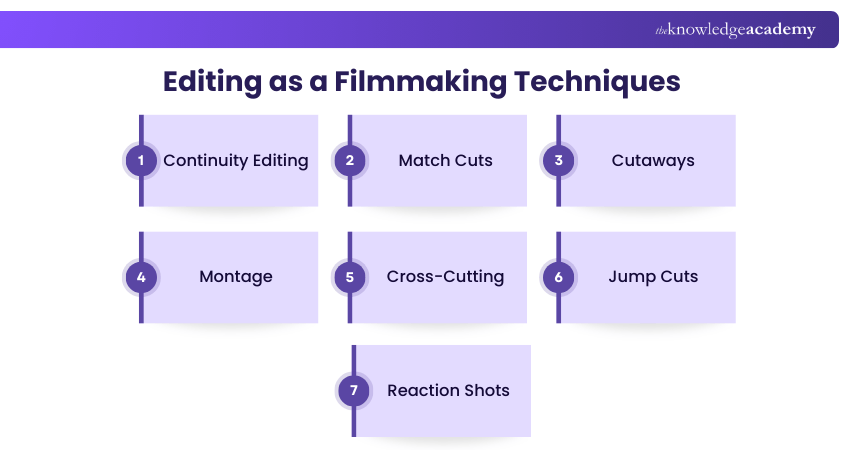
a) Continuity Editing: Organising shots in a logical manner so as to preserve space and time to guarantee a certain amount of continuity in the narrative.
b) Match Cuts: An action of moving between the visually or thematically related frames to provide the organic movement between the scenes.
c) Cutaways: Adding additional shots to provide some context, tension, or cover transitions.
d) Montage: A composition of brief clips in order to compress time, build themes, or depict change.
e) Cross-Cutting: After the parallel action, one can alternate shots to create suspense or to demonstrate parallel action.
f) Jump Cuts: The intentional discontinuity that involves establishing a sense of urgency, style, or psychological intensity.
g) Reaction Shots: Cutting to a response of a character to enhance the presence of emotions and narrative content.
15) Special Effects: Beyond Reality
Special effects, whether achieved practically or digitally, expand the boundaries of storytelling, enabling Filmmakers to visualise the unfathomable, transport audiences to otherworldly realities, and redefine the limits of cinema. Use the following Cinematography techniques and tips for your next project:
a) Practical Effects: Physical effects achieved on set, like pyrotechnics, makeup prosthetics, or controlled weather, offering tactile realism.
b) Computer-Generated Imagery (CGI): Digital creations added in post-production, from lifelike creatures to expansive, fantastical landscapes.
c) Matte Paintings: Historically painted backdrops, now often digitally created, that extend or replace live-action sets, expanding the world of the Film.
d) Motion Capture: Recording actors' movements and translating them to digital characters, allowing for lifelike animated performances.
e) Green/blue Screen: Filming against coloured screens, later replaced with digitally rendered backgrounds or effects.
f) Miniatures: Scaled-down models of larger structures or scenes, Filmed to appear life-sized, historically used in epic battles or cityscape shots.
g) Forced Perspective: A camera trick involving strategically placing objects/actors at varying distances to create an illusion of size difference.
h) Rotoscoping: Tracing over motion picture footage, frame by frame, for use in live-action and animated Films, blending reality with artistic embellishments.
16) Colour Grading: Setting the Mood
Colour grading isn't merely a technical process. It's an artistic endeavour, a subtle tool that Filmmakers wield to convey emotions, enhance storytelling, and immerse audiences deeper into the cinematic experience.
a) Tonal Adjustments: Modifying the brightness, contrast, and shadows of a scene to highlight or subdue specific elements.
b) Temperature Shifts: Manipulating the warmth or coolness of footage. Warm tones (oranges and yellows) can convey nostalgia or happiness, while cool tones (blues and teals) evoke melancholy or tension.
c) Saturation Levels: Adjusting the intensity of colours. High saturation pops with vibrancy, while desaturation can create a moody, vintage, or dystopian feel.
d) Highlight and Shadow Tinting: Applying specific colours to the darkest and brightest parts of a frame, influencing the overall ambience.
e) Film Emulation: Mimicking the aesthetic of Film stocks to give digital footage a classic, analogue feel.
f) Colour Themes: Using a limited colour palette to create a unified look or to underscore thematic elements throughout a Film.
g) Visual Consistency: Ensuring that scenes, regardless of when and how they were shot, maintain a consistent colour profile throughout the Film.
h) Skin Tone Preservation: Keeping skin tones natural and consistent, even while dramatically altering the colours of the surrounding environment.
Conclusion
Essential Filmmaking Techniques enable storytellers to turn ideas into compelling visual narratives. By combining lighting, camera work, production design, and precise editing, filmmakers shape mood, emotion, and narrative flow. These skills help creators engage audiences and deliver memorable cinematic experiences. With creativity and attention to detail, every scene can leave a lasting impact.
Explore your passions and turn curiosity into creativity with our Hobbies & Interests Courses- Join now!
Frequently Asked Questions
What is the Most Common Film Technique?

The most common film technique is the Rule of Thirds. It involves dividing the frame into nine equal segments and positioning key elements along these lines or their intersections, creating balanced, visually appealing, and engaging compositions.
What is the Purpose of Filmmaking?
The purpose of filmmaking is to tell compelling stories, evoke emotions, and convey messages through visual and auditory means. It aims to entertain, educate, and inspire audiences, creating impactful and memorable experiences.
What are the Other Resources and Offers Provided by The Knowledge Academy?
The Knowledge Academy takes global learning to new heights, offering over 3,000+ online courses across 490+ locations in 190+ countries. This expansive reach ensures accessibility and convenience for learners worldwide.
Alongside our diverse Online Course Catalogue, encompassing 17 major categories, we go the extra mile by providing a plethora of free educational Online Resources like Blogs, eBooks, Interview Questions and Videos. Tailoring learning experiences further, professionals can unlock greater value through a wide range of special discounts, seasonal deals, and Exclusive Offers.
What is the Knowledge Pass, and how Does it Work?
The Knowledge Academy’s Knowledge Pass, a prepaid voucher, adds another layer of flexibility, allowing course bookings over a 12-month period. Join us on a journey where education knows no bounds.
What are Related Courses and Blogs Provided by The Knowledge Academy?
The Knowledge Academy offers various Hobbies & Interests Courses, including the Filmmaking Course, the Music Production Course and the Photography Course. These courses cater to different skill levels, providing comprehensive insights into Creativity in Filmmaking.
Our Business Skills Blogs cover a range of topics related to Filmmaking, offering valuable resources, best practices, and industry insights. Whether you are a beginner or looking to advance your Filmmaking skills, The Knowledge Academy's diverse courses and informative blogs have got you covered.

The Knowledge Academy


Global Training Provider
The Knowledge Academy is a world-leading provider of professional training courses, offering globally recognised qualifications across a wide range of subjects. With expert trainers, up-to-date course material, and flexible learning options, we aim to empower professionals and organisations to achieve their goals through continuous learning.

Upcoming Business Skills Resources Batches & Dates
Date
 Cake Decorating Getting Started Workshop
Cake Decorating Getting Started Workshop
Fri 14th Aug 2026
Cake Decorating Getting Started Workshop
Fri 6th Nov 2026

 If you wish to make any changes to your course, please


