




We may not have the course you’re looking for. If you enquire or give us a call on 01344203999 and speak to our training experts, we may still be able to help with your training requirements.
Fictitious Assets: A Key Concept in Accounting
ByShristi RoyLast updated on: 05 October 2026
Fictitious assets are intangible, non-physical assets like preliminary expenses or losses recorded in financial statements without inherent value. These assets don’t represent real cash or property and are recorded only for accounting purposes. They are gradually written off over time. Keep reading to learn more about fictitious assets.
In a Nutshell
1. Fictitious assets traditionally refer to deferred expenses or losses with no realisable value.2. They differ from genuine intangible assets like patents, trademarks and licences.3. Older accounting practices carried some expenses forward and wrote them off over time.4. Modern standards generally recognise such costs as expenses unless they qualify as assets.5. The concept highlights the shift from historical to modern accounting practices.
What are fictitious assets, and why do they appear in financial statements? Fictitious assets are intangible, non-physical items like preliminary expenses or accumulated losses. They don’t have actual value but are recorded on the balance sheet for accounting purposes. These assets represent costs that the business needs to write off over time rather than immediately.
Understanding fictitious assets can help provide a clearer picture of a company’s financial health and long-term expenses. Want to know more about fictitious assets and their role in accounting? Read this blog to understand why they matter in financial reporting.
What are Fictitious Assets?
Fictitious assets are assets that lack physical existence and realisable value. Traditionally, certain expenses and losses were carried forward in financial statements rather than being recognised fully in the profit and loss account in the period in which they occurred.
These assets were traditionally written off in the profit and loss account by reducing their value in the balance sheet. This process could be spread over one or more accounting periods. Although the term ‘fictitious’ implies they are not real assets of the company, they are still represented in the assets section of the balance sheet.

Importance of Fictitious Assets in Financial Reporting
Fictitious assets represent costs like preliminary expenses or losses, which lack immediate value but still impact a company’s finances. Here’s why fictitious assets matter in financial reporting:
1) Tracks Initial Business Costs: Fictitious assets like preliminary expenses allow businesses to record and gradually write off start-up costs over time.
2) Improves Profitability Appearance: Spreading costs over multiple periods reduce immediate expenses, helping to show stable profits year-to-year.
3) Enhances Transparency: Recording these assets on the balance sheet ensures that all business costs, even those without immediate value, are visible.
4) Supports Financial Planning: By understanding fictitious assets, businesses can better plan for amortisation, helping in budgeting and forecasting.
5) Reflects Accurate Financial Health: Identifying fictitious assets separately from genuine assets can help users better interpret a company’s reported financial position.
Key Features of Fictitious Assets
Here are some features of fictitious assets:
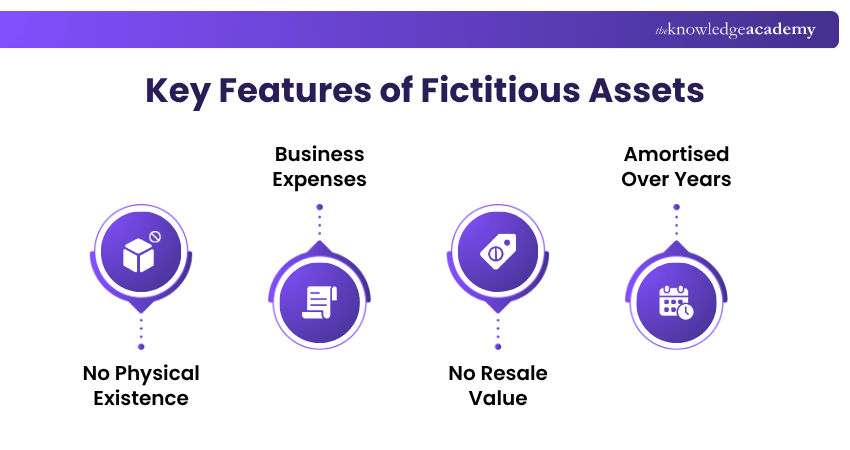
1) No Physical Existence: They have no tangible form but are not the same as genuine intangible assets.
2) Business Expenses: These are expenses incurred in running a business but were historically carried forward in the balance sheet rather than being recognised fully in the period in which they arose.
3) No Resale Value: Since they are expenses for running the company, they cannot be recovered and have no realisable value.
4) Amortised Over Years: The recognition of these expenses is spread over future accounting periods, not accounted for in a single year but over multiple years.
These simplified points capture the essence of fictitious assets and their treatment in financial statements.
Enhance your career with project accounting skills – Sign up with the Project Accounting Course now and bring value to every project.
Types of Fictitious Assets
Fictitious assets are recorded costs without physical form, like certain preliminary expenses and deferred losses. They lack immediate value but are amortised over time to reflect financial obligations accurately. Here’s a look at common types of fictitious assets:
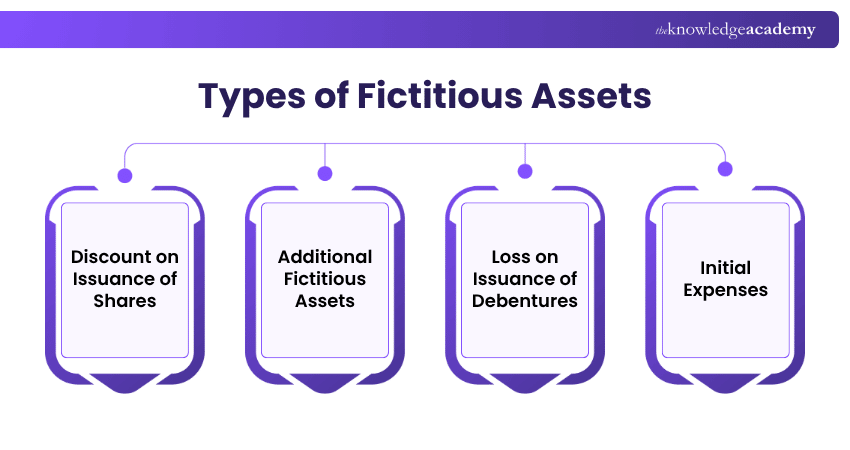
1) Discount on Issuance of Shares
If shares are distributed at a price lower than their face value, the difference is considered a discount on the issue of shares. This discount is considered a fictitious asset and amortised over the life of the shares.
2) Additional Fictitious Assets
There are other assets without physical existence that are still accounted for as assets in the balance sheet. Examples included certain underwriting commissions, promotional expenses, and other expenses that were carried forward under older accounting practices.
3) Loss on Issuance of Debentures
When debentures are distributed at a price lower than their face value, the difference is considered a loss on the issue of debentures. This loss is recorded as a fictitious asset and amortised over the life of the debentures.
4) Initial Expenses
These are costs incurred before a company starts operations, like legal fees and registration fees. Since they cannot be capitalised, they are treated as fictitious assets and amortised over time.
Learn the art of bookkeeping and make sense of finances. Join the Bookkeeping Course now!
Challenges in Fictitious Asset Valuation
Accounting for fictitious assets can be challenging because the term mainly reflects historical accounting practices rather than a recognised category of assets under modern accounting standards. Here are the main considerations:
1) Nature of the Expenditure: Determining the nature of the underlying expenditure or loss is important. Accountants need to identify what the amount represents and whether it meets the relevant requirements for recognition as an asset.
2) Accounting Treatment: The appropriate treatment depends on the nature of the expenditure and the applicable accounting requirements. If an expenditure does not qualify for recognition as an asset, it is generally recognised as an expense according to the requirements of the applicable accounting standard.
3) Historical Treatment: Under older accounting practices, certain expenses or losses could be carried forward and written off over future accounting periods. Modern accounting standards may require these items to be treated differently.
Valuing fictitious assets demands accounting expertise, as it involves assumptions, estimates, and careful consideration of various factors.
Trainer’s Tip
When distinguishing fictitious assets from intangible assets, ask one question: “Does this item represent an identifiable resource that can generate future economic benefits?” If not, it may be better understood as deferred expenditure or a historical accounting treatment rather than a true asset.
Ready to master accounting? Register with our expert-led Accounting Courses and level up your knowledge!
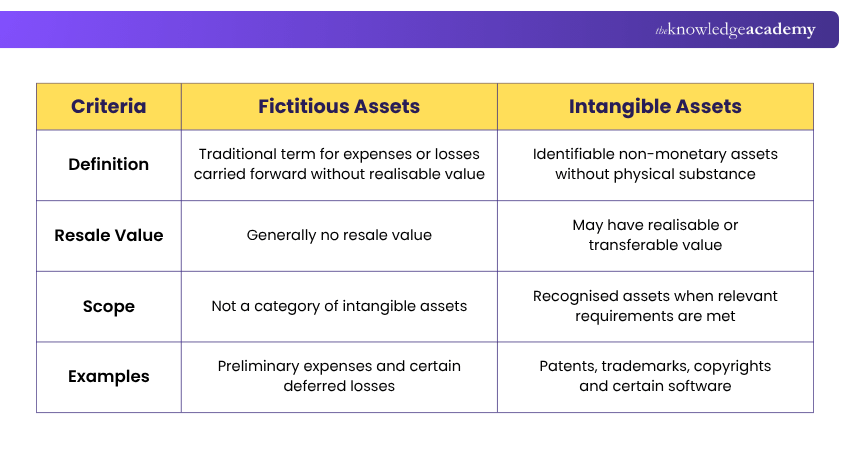
Differences Between Fictitious Assets and Intangible Assets
Here are the main differences between fictitious assets and intangible assets:
Impact of Fictitious Assets on Investment Decisions
Fictitious assets can greatly influence investment decisions and a corporation's financial health. Here’s how:
1) Nature of Fictitious Assets: Fictitious assets have no real value but are recorded on the balance sheet. They don’t generate revenue or cash flow and may be used to inflate a corporation’s value or manipulate financial reports.
2) Impact on Investors: Investors rely on financial statements for decision-making. Understanding the nature of any such balances can help investors assess the quality and composition of a company's reported assets.
3) Effect on Financing: Lenders assess creditworthiness using financial statements. Understanding the nature of deferred expenses or similar balances can help lenders assess the company's financial position more accurately.
4) Balance Sheet Analysis: Fictitious assets inflate the balance sheet. This leads to inaccurate assessments of the corporation's liquidity, solvency, and liabilities, impacting its perceived debt obligations.
5) Importance of Due Diligence: Investors should carefully review financial statements to understand the nature and accounting treatment of any deferred expenditure or similar balances. Corporations should apply the relevant accounting requirements to provide investors and lenders with a reliable view of their financial position.
Quick Knowledge Check
Question: What is the main difference between a fictitious asset and an intangible asset?Answer: An intangible asset represents an identifiable economic resource without physical substance, while a fictitious asset is a traditional term for expenditure or losses that do not represent a genuine realisable asset.
Want to take control of asset accounting? Sign up for the Fixed Assets Accounting And Management Course today.

Shristi Roy is a Content Writer with experience in journalism, article writing and web content development. Her experience researching and writing about Business Skills and Accounting and Finance enables her to communicate specialised information through clear, engaging narratives.
View Detail

 If you wish to make any changes to your course, please


