




We may not have the course you’re looking for. If you enquire or give us a call on 01344203999 and speak to our training experts, we may still be able to help with your training requirements.
What are Ethical Frameworks: A Complete Overview
ByAmelia WilliamsLast updated on: 21 September 2026
Making moral decisions in both personal and professional settings requires an understanding of ethical frameworks. This blog explores important ethical frameworks, including utilitarianism, virtue ethics, and rights-based ethics, emphasising their significance. It will help you choose the best framework for your purposes.

Quick Overview
1. Ethical frameworks provide structured ways to work through personal and professional decisions.2. Common approaches include rights-based ethics, care ethics, virtue ethics, utilitarianism, deontology and justice ethics.3. Different frameworks assess consequences, duties, rights, character, relationships and fairness in different ways.4. Applying a framework to a real dilemma follows a practical, repeatable process.5. Comparing frameworks side by side helps identify the most suitable one for a given situation.
Ethical dilemmas are an inevitable part of life, from personal decisions to business strategies. Navigating these complexities requires more than intuition; it demands a structured approach grounded in core moral principles. Ethical frameworks give individuals and organisations a structured way to work through difficult decisions rather than relying on gut instinct alone. They help weigh competing values and justify the choice that's ultimately made.
What are Ethical Frameworks?
Ethical frameworks are systematic methods for assessing and resolving ethical dilemmas by applying moral principles. They provide a structured process for evaluating what is right or wrong in various contexts.
By adopting a framework, individuals can approach ethical issues objectively, ensuring decisions are consistent and align with core values. They are crucial in law, healthcare, and corporate governance, where moral choices can significantly impact stakeholders.

Importance of Using an Ethical Framework
Using an ethical framework provides a structured way to evaluate difficult decisions and explain the reasoning behind them. It can be particularly valuable when several values, interests, or responsibilities are in conflict. Here are the benefits of it:
1) Provides Clear Guidance: An ethical framework offers a step-by-step approach for examining complex moral dilemmas. It helps decision-makers identify the key issues, consider relevant principles, and compare possible courses of action.
2) Supports Consistency: Using the same ethical principles across similar situations can promote more consistent and fair decision-making. It can also help reduce the influence of personal preferences or unchecked bias, although it cannot eliminate bias entirely.
3) Builds Trust and Credibility: Transparent and well-reasoned ethical decisions can strengthen confidence among employees, customers, clients and other stakeholders. They demonstrate that decisions are being made with fairness, responsibility, and integrity in mind.
4) Helps Reduce Risk: Ethical frameworks can help identify potential harm, conflicts of interest and wider consequences before action is taken. This can reduce the likelihood of decisions that create legal, reputational, or organisational risks.
Exploring Various Ethical Frameworks
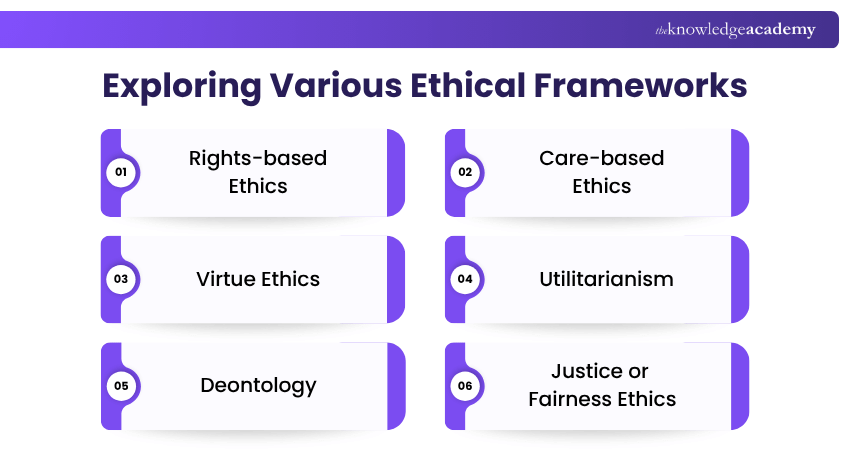
Different ethical frameworks offer distinct lenses for analysing moral questions. Below, we explore some of the most common frameworks:
1) Rights-based Ethics
Rights-based ethics centres around the belief that everyone possesses fundamental rights that should not be violated. These rights can be legal, human, or moral in nature. The focus is on respecting and protecting these rights in all decisions.
Rather than focusing mainly on outcomes, this approach considers whether an action respects the dignity and legitimate entitlements of those affected. It is especially useful in areas such as employment, healthcare, law, and data protection, where individual freedoms and protections may be at risk.
2) Care-based Ethics
Care-based ethics, often associated with feminist ethics, emphasises interpersonal relationships and the significance of empathy in moral decision-making. It values the importance of context and relationships over universal rules.
This framework is especially relevant in scenarios requiring compassion, nurturing, and consideration for the unique needs of individuals, such as in healthcare or family dynamics. Instead of focusing purely on duty or rules, it prioritises maintaining healthy relationships and caring for others.
3) Virtue Ethics
Virtue ethics shifts the focus from actions to the character and virtues of the decision-maker. Rooted in Aristotle's philosophy, this framework argues that ethical behaviour stems from cultivating virtues like courage, honesty, and compassion.
The idea is that individuals naturally make ethical choices by consistently practising virtuous behaviour, gradually developing the kind of character from which good decisions follow. Unlike rule-based models, virtue ethics emphasises moral character as the foundation for ethical decisions.
Strengthen workplace harmony with our Employee Relations Training - Join now!
4) Utilitarianism
Utilitarianism assesses actions based on their outcomes, aiming to maximise overall happiness or minimise suffering. The classic practical principle is "the greatest good for the greatest number." This approach is particularly useful in situations where decisions affect large groups, such as public policy, healthcare, business planning, and resource allocation. It encourages decision-makers to look beyond individual interests and consider the broader impact of their choices.
5) Deontology
Deontology, associated with the philosopher Immanuel Kant, is a rule-based approach that focuses on duty and adherence to ethical principles. It argues that specific actions are inherently right or wrong, regardless of their consequences.
For example, lying is morally wrong, even if it could lead to a positive outcome. Deontologists emphasise the importance of consistently upholding moral duties and principles, making this framework particularly relevant in fields like law, personal ethics, and professional ethics.
6) Justice or Fairness Ethics
Justice-based ethics focuses on fairness and equal treatment. It asks whether benefits, responsibilities, and risks are distributed fairly and whether people in similar circumstances are treated consistently.
This approach also considers whether decision-making processes are impartial and whether certain individuals or groups are unfairly disadvantaged. It is particularly useful when evaluating workplace policies, resource allocation, access to opportunities, disciplinary decisions, and wider social institutions.
Did You Know?
Ethical frameworks are now being applied directly to Artificial Intelligence. WHO identifies six principles for AI in health, covering areas such as human autonomy, well-being, transparency, accountability, equity, and sustainability. Its newer guidance on large multimodal AI models continues to build on these principles.
Selecting the Appropriate Ethical Framework for Your Needs
Choosing the right ethical framework depends on the nature of the dilemma and the context in which it arises. Here are some practical ways to select the most appropriate framework for a given situation:
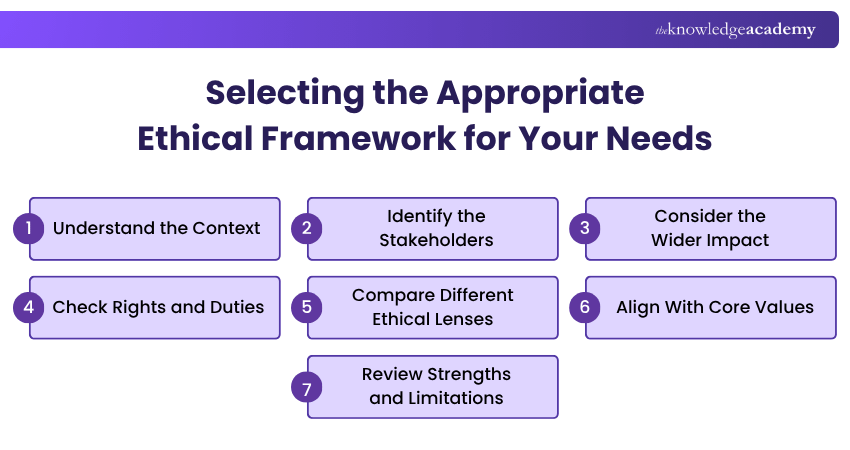
1) Understand the Context: Consider the nature of the dilemma, the circumstances involved and the values that may be in conflict.
2) Identify the Stakeholders: Determine who could be affected by the decision and how their interests, needs or rights may differ.
3) Consider the Wider Impact: Assess the possible short-term and long-term consequences for individuals, organisations and society.
4) Check Rights and Duties: Identify whether fundamental rights, professional responsibilities or moral obligations are involved.
5) Compare Different Ethical Lenses: Examine the issue through more than one framework to see whether different approaches lead to different conclusions.
6) Align With Core Values: Consider whether the decision reflects your personal values or the ethical principles and policies of the organisation.
7) Review Strengths and Limitations: Recognise that no single framework fits every situation, so weigh what each approach captures and what it may overlook.
Build effective policies that drive organisational success with our HR Policy Training - Sign up now!

Amelia Williams develops practical resources that help organisations strengthen their people practices and respond to workplace challenges. Her writing supports professionals in creating productive, inclusive environments in which employees can develop and perform effectively.
View Detail

 If you wish to make any changes to your course, please


