


 Top Rated Course

We may not have the course you’re looking for. If you enquire or give us a call on + 1-866 272 8822 and speak to our training experts, we may still be able to help with your training requirements.
Entity Component System (ECS): An In-Depth Guide
The Knowledge Academy 01 September 2026Entity Component System (ECS) is a software architectural pattern primarily used in the field of Video Game Development to represent game world objects. This blog explores the Entity Component System, outlining its core elements, advantages, drawbacks and more. So read on and expand your prospect as a Game Developer!

Training Outcomes Within Your Budget!
We ensure quality, budget-alignment, and timely delivery by our expert instructors.
Table of Contents
What does it take to be a game-changer in the field of Game Development? The answer is: Mastering the art of Entity Component System (ECS). This architectural pattern has revolutionised Game Development by decoupling data and behaviour. ECS brings a fresh wave of flexibility, scalability, and performance to the table by moving from rigid structures to a modular philosophy.
This blog is your first step towards levelling up on your ECS game, as it breaks down its core elements: entities, components, and systems. So read on, harness the power of Entity Component System and embrace the art of smarter, faster, and more adaptable Game Development.
Table of Contents
1) What is an Entity Component System (ECS)?
2) Core Elements of ECS
3) Advantages and Disadvantages of ECS
4) Entity Component System Example
5) How ECS Relates to Other Paradigms
6) How do You Create a Hierarchy in ECS?
7) Conclusion
What is an Entity Component System (ECS)?
An Entity Component System is a software architectural pattern commonly used in video Game Development to manage game world objects efficiently. It highlights the principle of composition rather than inheritance, simplifying the management and extension of complex systems. ECS facilitates flexible and efficient handling of game objects by decoupling data (components) from behaviour (systems), enabling the dynamic addition or removal of components from entities.
Overview of ECS
Think of an Entity in a game as a blank canvas, serving as a unique identifier without any data or behaviour. Its importance comes from Components, which are fundamental data types that define its attributes, such as location, health, or speed. For example, an Entity represents a player, enemy, or object, with Components describing them.
Through the prioritisation of composition over inheritance, ECS enables Developers to mix components without creating complex class hierarchies. This offers flexibility and simplifies system modification. The separation of identity (Entities), data (Components), and behaviour (Systems) ensures orderliness and ease of management. This is an absolute necessity for Game Development, where the variety and complexity of items can quickly become overwhelming.

Core Elements of ECS
ECS revolves around three main elements: Entity, Component and System. These elements drive ECS’s functionality across the entire Game Development process. Let's explore them further:
What is Entity?
In a video game, an entity refers to a single ‘thing’. It serves as an object within an artificial environment. It comes with a unique number. For example, everything visible in the Skyrim game can be considered an entity. However, entities don’t have data or behaviour of their own because they are purpose-driven. Each object in the core game is an entity with a unique ID.
What is a Component?
Components are data types that contain behaviour for an entity within a game. It is a reusable module that gives the entity a distinct behaviour, functionalities, and appearance. Components offer the necessary data to enclose a particular form. For example, you can see a Health component in games that can take on damage.
In general, components are utilised as arrays, classes, and structures. Game programmers use components to create fantasy games with attributes like ‘weight’, ‘shininess’, and ‘damage’.

What is a System?
In an ECS architecture, a system manages multiple components to execute specific low-level tasks such as mathematical computations, physics simulations, or graphic rendering. Systems offer global access, services, and control for component types, primarily working on these components to implement game logic. For example, a physics system might target entities with mass, velocity, and position components, doing physics calculations for each data set.
Systems can dynamically alter an entity's behaviour at runtime by adding, removing, or modifying components, offering a significant advantage. This flexibility avoids the complexities and maintenance issues common in deep inheritance hierarchies of traditional Object-Oriented Programming (OOP).
Take your skills to the next dimension with our 3D Game Development Training today!
Advantages and Disadvantages of ECS
While the Entity Component System architecture represents a seismic shift in Game Development, empowering Developers to create complex and efficient games, this concept has pros and cons. Let's explore them in detail
Advantages of Entity Component System
Game Developers and programmers choose Entity Component Systems (ECS) due to their various advantages. Let's explore ECS benefits:
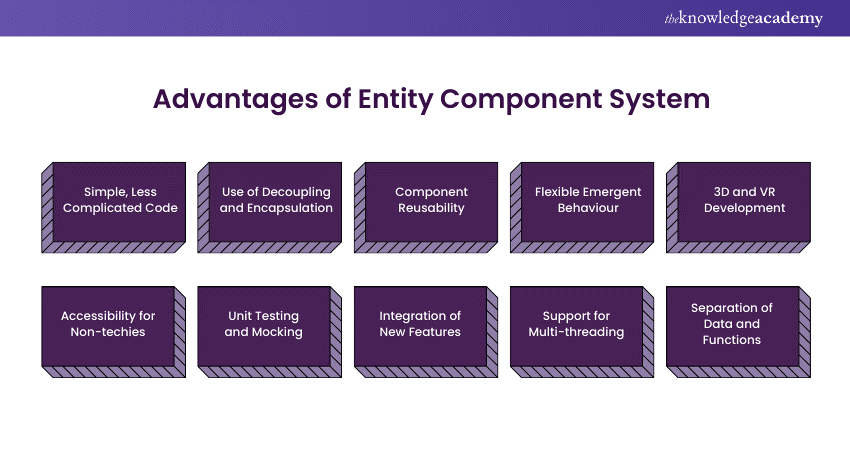
a) Simpler, Less Complicated Code: ECS inspires clear design principles, resulting in more accessible and manageable code.
b) Use of Decoupling and Encapsulation: Along with modularisation techniques, ECS boosts code organisation.
c) Component Reusability: ECS allows the combination and reuse of components, offering versatility in defining objects.
d) Flexible Emergent Behaviour: It enables adaptability and dynamic behaviour patterns within games.
e) 3D and VR Development: ECS is fit for managing complex applications in 3D and VR projects.
f) Accessibility for Non-techies: It allows users without technical knowledge to quickly script behaviour.
g) Unit Testing and Mocking: ECS is well-suited for unit testing, allowing components to be swapped out during runtime.
h) Integration of New Features: ECS makes it easier to add or improve features in a project.
i) Support for Multi-threading: ECS allow multi-threading, thus aiding in effective parallel processing.
j) Separation of Data and Functions: It efficiently separates data from the functions that operate on it, improving code clarity and modularity.
Master the art of 2D artwork and technique in the world of Game Development with our 2D Game Development Training - Sign up now!
Disadvantages of Entity Component System
No doubt, Entity Component Systems are valuable tools when it comes to Game Development. However, it comes with some disadvantages as listed below:

a) Limited Recognition: ECS recognition is limited, and only some Developers are familiar with it.
b) Lack of Standard Definition: ECS lack standard definitions, thus leading to varied implementations.
c) Difficulty in Correct Application: The application of ECS is challenging, so its misuse is common among Developers.
d) Risk of Inefficient Code: ECS demands that several small systems for entities be written, which makes code inefficient.
Entity Component System Example
Here’s an example of ECS architecture:
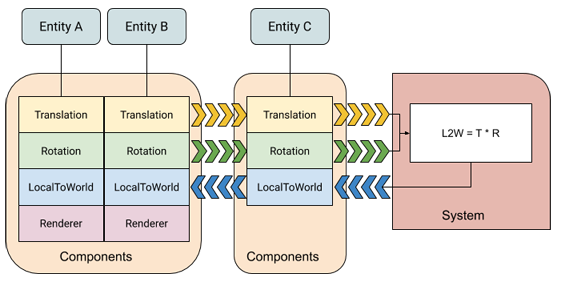
Consider a game where the ECS data flow can be divided into the following steps:
1) The gamer presses the "right arrow" key.
2) The player input system detects the key being pressed and updates the motion component.
3) The motion system identifies the movement to the right and applies the appropriate physics force.
4) The render system reads the updated position of the entity.
5) According to its new spatial coordinates, the entity is visually rendered.
Master the Gamification design framework accompanying game elements in our up-to-date Gamification Training - Sign up now!
How ECS Relates to Other Paradigms
How Does ECS Differ from OOP?
Some beginner programmers see ECS (Entity Component System) as an alternative to Object Oriented Programming (OOP). While ECS and OOP have some similarities, they also have distinct differences.
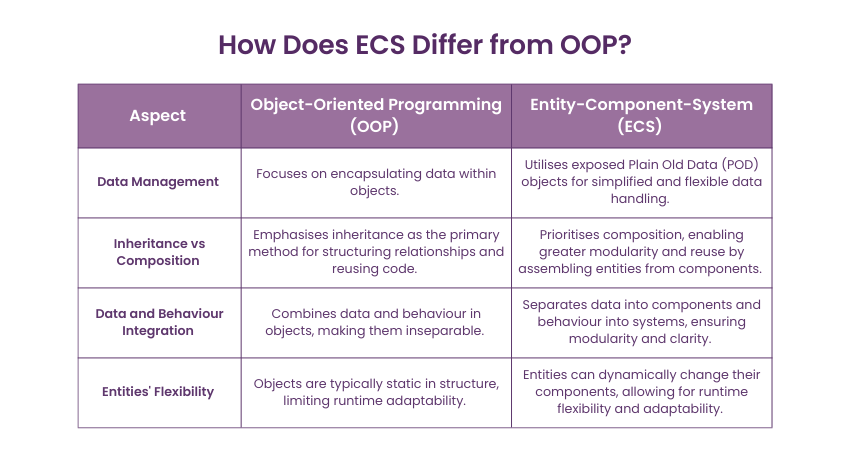
Due to these differences combining ECS and OOP can lead to complex and unpredictable outcomes. Some situations are better suited for ECS, while others may benefit more from OOP. The needs and context of the project determine the choice of the method.
Explore diverse roles in the Gaming industry in our comprehensive Game Development Training - Register now!
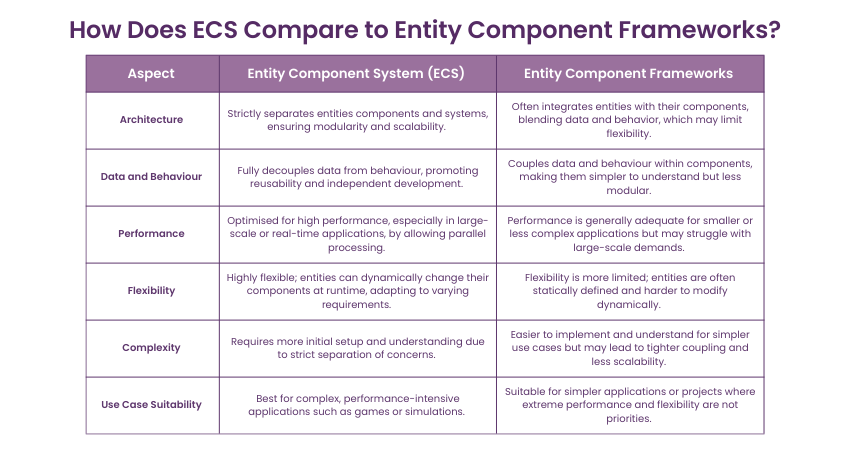
How Does ECS Compare to Entity Component Frameworks?
The differences between ECS and Entity Component Frameworks in summarised below:
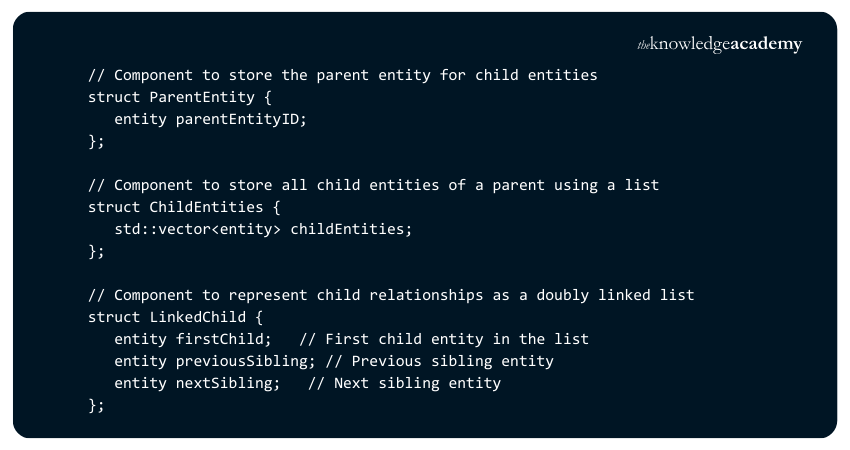
How Do You Implement Hierarchy in ECS?
This is an approach for implementing a hierarchy in an ECS:
Conclusion
In conclusion, the Entity Component System brings a transformative approach to designing scalable, high-performance systems. ECS boosts flexibility, modularity, and efficiency by decoupling data and behaviour. Whether you're developing games or simulations, gaining insight into ECS will help you build future-ready systems that can adapt to changing demands.
Unlock your creativity with our Game Development With Roblox Training- Register now!
Frequently Asked Questions
What is the Principle of ECS?

ECS embraces the principle of composition over inheritance, defining each entity by the components it possesses rather than through a type hierarchy.
Does ECS Promote Better Code Reusability?
Yes, an Entity Component System promotes better code reusability due to the following reasons:
a) Separation of data and behaviour
b) Modularity
c) Flexibility
ECS’s design principles make it a powerful pattern for creating reusable code.

The Knowledge Academy


Global Training Provider
The Knowledge Academy is a world-leading provider of professional training courses, offering globally recognised qualifications across a wide range of subjects. With expert trainers, up-to-date course material, and flexible learning options, we aim to empower professionals and organisations to achieve their goals through continuous learning.


 If you wish to make any changes to your course, please


