




We may not have the course you’re looking for. If you enquire or give us a call on 01344203999 and speak to our training experts, we may still be able to help with your training requirements.
Home
 Resources
Programming & DevOps
Domains of Artificial Intelligence (AI): Different Types Explained
Resources
Programming & DevOps
Domains of Artificial Intelligence (AI): Different Types Explained
Resources
Programming & DevOps
Domains of Artificial Intelligence (AI): Different Types Explained
Domains of Artificial Intelligence (AI): Different Types Explained
ByLily TurnerLast updated on: 24 September 2026
AI encompasses several specialised domains, each focusing on different capabilities and applications. This blog explores some major domains of artificial intelligence and how they contribute to modern AI systems.
Key Highlights
1. AI domains can overlap and work together within a single intelligent system.2. AI domains differ in the types of data, capabilities and tasks they primarily address.3. The choice of AI approach depends on factors such as the problem, available data, required capability, and level of autonomy.4. Human oversight remains important, particularly when AI supports complex or consequential decisions.5. AI capabilities continue to evolve, becoming increasingly interconnected, adaptable and multimodal.
Artificial Intelligence (AI) has evolved drastically over the years, touching various aspects of our lives. It's a technology that has not only fascinated us but also significantly impacted how we live, work, and interact with the world around us. Its capabilities now span areas ranging from learning and language processing to visual interpretation, robotics and autonomous decision-making.
According to Statista, the global AI market is expected to reach approximately £1.07 trillion by 2032, with continued growth projected in the coming years. In this blog, we will examine how these areas function, interact and continue to evolve as AI advances.
The Major Domains of Artificial Intelligence
When discussing the domains of artificial intelligence, people refer to specific areas or fields of study and application within AI. These domains encompass a wide range of techniques, algorithms, and technologies tailored to address particular challenges and tasks.
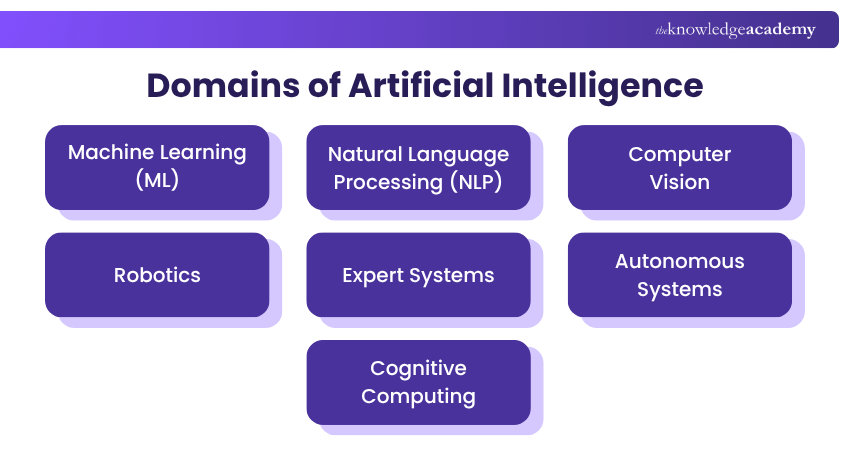
These domains have emerged as AI has matured and diversified, meeting the needs of different industries and problem-solving scenarios. Some widely recognised AI domains and related fields include the following:
1) Machine Learning (ML)
Machine Learning (ML) is perhaps one of the most well-known and widely used domains of AI. It focuses on developing algorithms and models that allow machines to learn from data and make predictions or decisions.
ML supports applications in healthcare, such as diagnostic assistance and risk prediction, and in finance, such as fraud detection. It also supports many NLP applications, including chatbots and language translation.
Real-world Example: Fraud Detection
Imagine a bank processing a large number of transactions every minute. A machine learning model can analyse patterns such as transaction amount, location, timing and previous behaviour to identify unusual activity. Suspicious transactions can then be flagged for further investigation.

2) Natural Language Processing (NLP)
Natural Language Processing (NLP) is all about enabling computers to understand, interpret, and generate human language. NLP is widely used in chatbots, translation, sentiment analysis, information extraction, and language generation, and can work alongside speech-recognition systems. NLP algorithms make it possible for AI to interact with people in a more organic and conversational manner.
3) Computer Vision
Computer vision focuses on enabling machines to analyse and interpret visual data. It's employed in applications like facial recognition, object detection, autonomous vehicles, and medical image analysis. Computer vision enables AI systems to see and interpret the visual world much like humans do.
4) Robotics
Robotics is an interdisciplinary field involving the design, construction and operation of physical machines, some of which use AI for capabilities such as perception, planning and autonomous decision-making.
This domain has given rise to robots capable of performing tasks such as autonomous navigation, picking and placing objects, and even surgery. The combination of AI and robotics has the potential to transform industries like manufacturing, healthcare and logistics.
5) Expert Systems
Expert systems aim to replicate the decision-making abilities of human experts in specific domains. These systems are created to solve complex problems by applying knowledge and rules. They are used in fields like medicine (for diagnosis and treatment recommendations) and finance (for investment advice).
6) Autonomous Systems
Autonomous systems encompass various AI domains working together to create machines or software that can operate independently without human intervention. This includes autonomous vehicles, drones and some intelligent robotic systems. These systems rely on AI to perceive their environment and make decisions in real-time.
7) Cognitive Computing
Cognitive computing is a related computing approach that combines AI technologies and other techniques to simulate aspects of human cognition, such as reasoning, learning and understanding context. It is often designed to support human decision-making when addressing complex or ambiguous problems.
Learn the fundamentals of cognitive computing and its real-world applications with our Cognitive Computing Training – Join now!
The Interconnected Nature of AI Domains
It's important to note that the various artificial intelligence domains are not isolated entities. They often overlap and work in tandem to solve complex problems. For instance, autonomous vehicles incorporate computer vision, machine learning, and reinforcement learning to drive and make decisions on the road.
Similarly, AI-powered chatbots can combine NLP, machine learning and generative AI techniques to provide efficient and context-aware customer support.
Quick Challenge
A company wants to:
A) Detect damaged products from camera imagesB) Analyse thousands of customer commentsC) Predict next month's demandD) Use a robot to move packagesAnswers:A – Computer VisionB – NLPC – Machine LearningD – Robotics
The Future of AI Domains
AI domains such as NLP, computer vision, robotics and autonomous systems are already well established, but their capabilities continue to evolve. Emerging developments are making these areas more capable, interconnected and adaptable. Here are some key directions shaping their future:
1) Multimodal AI:
Multimodal AI is already being used to process different types of information, including text, images, audio and video. Future advances are expected to improve how AI combines and reasons across these forms of data, bringing areas such as NLP and computer vision closer together.
2) Advanced Natural Language Processing:
NLP continues to advance in areas such as contextual understanding, multilingual communication and language generation. Further developments could enable more natural, accurate and context-aware interactions between humans and AI systems.
3) Smarter Computer Vision:
Computer vision is becoming more capable of recognising, analysing and interpreting visual information. Continued advances could improve its use in areas such as medical imaging, quality inspection, environmental monitoring and autonomous systems.
4) More Capable Robotics:
AI is helping robots combine perception, planning and learning to perform increasingly complex tasks. As these capabilities develop, robots could become more adaptable to changing environments and better equipped to perform tasks that cannot rely entirely on fixed, pre-programmed behaviours.
5) Agentic AI:
Agentic AI systems can plan, use tools, coordinate tasks, and execute multi-step workflows with varying levels of human oversight. As these systems mature, they are expected to become increasingly important in business processes, software systems, and autonomous decision support.
6) AI in Space Exploration:
AI is becoming increasingly crucial in space exploration, aiding in autonomous navigation, data analysis, and the search for extraterrestrial life. As space exploration expands, so does the role of AI.
How to Choose an AI Approach?
Before selecting an AI approach, check:
☐ What problem needs to be solved?☐ What type of data is available?☐ Does the task involve language, images, audio, predictions or physical actions?☐ How much autonomy should the system have?☐ Is human review required for important decisions?☐ Does the solution need one AI capability or several working together?
Understand how to perform text wrangling and cleansing of raw data with the Natural Language Processing (NLP) Fundamentals with Python Training – Sign up now!

Lily Turner transforms complex data concepts into structured resources for aspiring and established data professionals. Her writing demonstrates how analytical methods and emerging technologies can be used to investigate problems, generate insights and support informed decisions.
View Detail

 If you wish to make any changes to your course, please


