




We may not have the course you’re looking for. If you enquire or give us a call on 01344203999 and speak to our training experts, we may still be able to help with your training requirements.
Difference Between Supply Chain and Logistics: Easy Explanation
ByNilotpal SarmahLast updated on: 03 October 2026
The supply chain covers the full process from sourcing materials to delivering products, while logistics focuses on moving and storing goods within it. Together, they ensure products reach customers efficiently and reliably. Understanding both functions helps organisations improve operations and reduce overall costs.
Smooth product flow is a must for businesses; nonetheless, a lot of them suffer when it comes to identifying the different roles in that process. Supply chain and logistics are two words that are frequently confused with one another, but each has its own specific function. This blog explains how supply chain and logistics differ, walking through the essential concepts behind each function. Getting this distinction right matters, since each one plays a different role in getting a product from raw material to the customer.
What is a Supply Chain?
A supply chain refers to the collective network of suppliers, manufacturers, distributors, and retailers who collaborate to convert raw materials into final products that reach the customers’ hands. This entire process covers all stages like sourcing, production, storage, transport, and final delivery.
The interconnected processes guarantee that the products transit effortlessly from the source to the consumer. Properly managed supply chains not only cut company expenses but also improve efficiency and help keep products available at all times.

What is Logistics?
Logistics is the overall management of the movement, storage, and distribution of merchandise from its point of origin to the end-user through proper planning, execution and supervision. The objective is to get the product to the customer in the most efficient manner possible, that is, without delay and with minimal handling.
Warehousing, transport, inventory control, and order processing are all part of logistics. By employing efficient logistics practices, companies can eliminate bottlenecks, optimise their expenses, and eventually win over customers with their prompt services.
Supply Chain vs Logistics: Key Differences
There are various differences that separate logistics and supply chain from each other. Some of the major differences are discussed below:
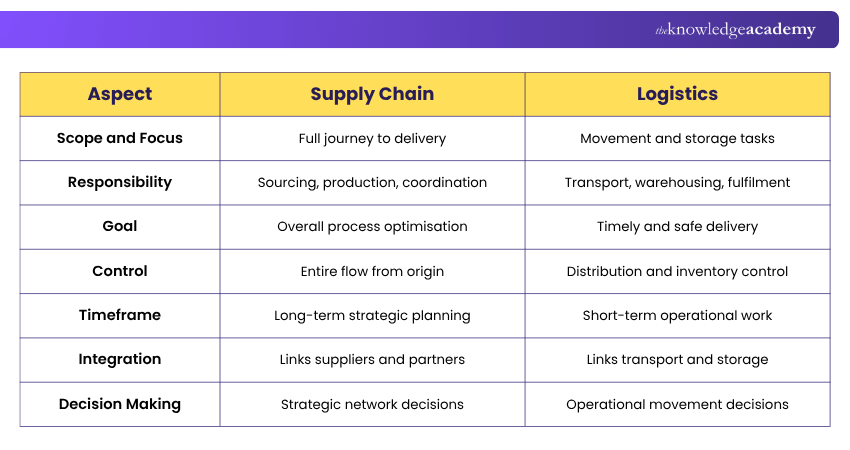
1) Scope and Focus
In a supply chain, all steps are included, starting from the acquisition of raw materials till the final sale to the consumer, whereas logistics deals with the effective transportation and warehousing of products within that network.
2) Responsibility
Supply chain manages the entire journey from raw materials to the final product, which includes production and distribution. It makes sure all stages are well coordinated. On the other hand, logistics handles the transportation, storage, and warehousing of goods. It focuses on moving products efficiently and managing inventory.
3) Goal
Supply chain works to make the whole production process smooth, efficient, and cost-effective, meeting customer needs. Good supply chain management improves overall operations. In contrast, logistics ensures goods are moved and stored efficiently, reducing transportation costs and managing inventory well. Effective logistics ensures the timely and safe delivery of products.
4) Control
Supply chain control extends across multiple organisations, an organisation typically has direct authority over its own processes, but must coordinate closely with external suppliers, manufacturers, and partners it doesn't directly manage.
Logistics control, in contrast, is usually more contained, a business can directly manage its own transport, storage and distribution operations, or clearly define these responsibilities through contracts with third-party logistics providers.
5) Timeframe
Supply chain involves long-term planning and strategy to ensure efficient production and delivery over extended periods. It aims for continuous improvement and optimisation. On the other hand, logistics often deals with short-term, day-to-day operations like managing shipments, inventory, and transportation schedules. It ensures timely delivery and efficient handling of goods.
6) Integration
Supply chain integrates various functions such as procurement, production, and distribution to create a seamless supply chain management Process. It requires coordination across different departments and external partners. In contrast, logistics integrates transportation and storage activities within the supply chain.
EXTRA INSIGHT
SAP Transportation Management, Oracle Transportation Management, Descartes Systems Group and Blue Yonder Transportation Management are some of the best-known logistics management software solutions.
7) Decision Making
Supply chain covers strategic decisions related to sourcing, production, and distribution networks. It focuses on long-term efficiency and cost-effectiveness. On the other hand, logistics includes operational decisions such as routing, warehousing, and inventory management. It focuses on optimising day-to-day activities for timely and efficient delivery.
8) Value Creation
Supply chain creates value by optimising the entire production and delivery process, reducing costs, and improving customer satisfaction. It enhances overall business performance. In contrast, logistics adds value by ensuring goods are delivered on time and in good condition, reducing transportation costs, and managing inventory effectively. It contributes to the efficiency of the supply chain.
9) Relationship
Supply chain includes logistics as part of its larger process. It connects various steps to ensure products move smoothly from start to finish. On the other hand, logistics is a key part of the supply chain, dealing with transportation and storage. It helps the supply chain by managing the physical movement of goods.
Types of Jobs in Supply Chain and Logistics
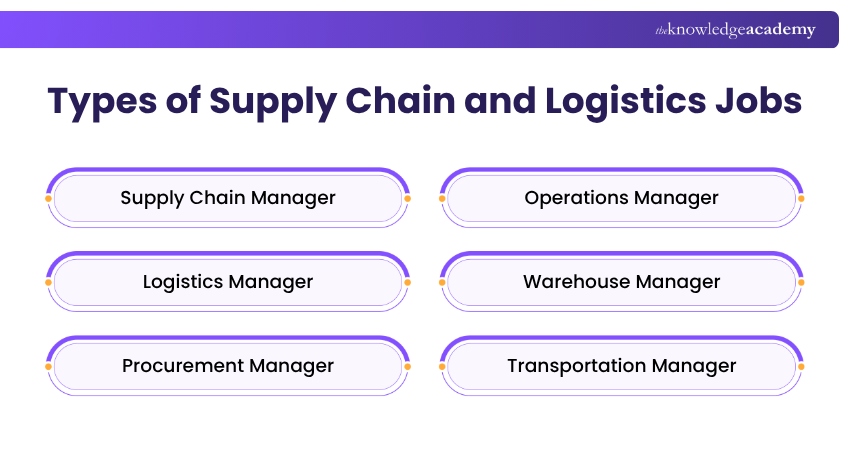
There are many career opportunities in supply chain and logistics, each crucial for the smooth and efficient movement of goods and services. Let's explore these roles:
1) Supply Chain Manager
A Supply Chain Manager oversees the strategic coordination of a complex network that includes various stakeholders, such as distributors and transportation providers, all working together to deliver a finished product to the consumer. Supply Chain Managers specialise in:
a) Aligning the supply chain with consumer demand.
b) Enhancing production and delivery efficiency while maintaining quality.
c) Forming and sustaining partnerships that benefit the company's financial health.
2) Logistics Manager
A Logistics Manager focuses on managing the movement of goods within the supply chain, which encompasses:
a) Developing business partnerships.
b) Contract negotiation.
c) Scheduling for transport logistics.
d) Keeping a robust network that includes suppliers, storage, and transport services.
KEY INSIGHT
A Logistics Manager in the UK can earn an average annual salary of £41K.
3) Procurement Manager
A Procurement Manager handles the initial stage of the supply chain, ensuring that companies have consistent sources for their products. Responsibilities include:
a) Vendor selection based on cost-effectiveness, availability, and material quality.
b) Scheduling purchases to align with market demand and supply chain trends.
c) Cost analysis and optimisation.
4) Operations Manager
An Operations Manager sits at the core of the supply chain, involving internal business management and, often, supply chain responsibilities. Key tasks involve:
a) Managing production, sales, and distribution.
b) Overseeing budget, cost, and profitability.
c) Balancing supply and demand.
d) Forecasting and staff management.
e) Operations managers may have varying degrees of supply chain involvement based on company size.
5) Warehouse Manager
A Warehouse Manager is crucial for logistics and supply chain efficiency, ensuring timely and quality delivery without increasing costs. Warehouse Managers are responsible for:
a) Inventory and staff management.
b) Enhancing operational efficiency.
c) Coordinating workflows.
d) Collaborating with logistics teams.
6) Transportation Manager
A Transportation Manager plays a key role in logistics by coordinating the transportation of goods, especially in manufacturing sectors. Transportation Managers are tasked with:
a) Selecting optimal transportation methods.
b) Setting cost and delivery expectations.
c) Working with transportation service providers.
Understand current trends and technologies with our Industry Training – Join today!
How do Supply Chain and Logistics Work Together?
The supply chain and logistics work together to move products from suppliers to the consumers in an efficient way. The supply chain deals with the planning and procurement aspects; meanwhile, logistics is in charge of the physical movement and the availability of the goods. They both help each other, thus making the operations smooth and customer service better.
Supply Chain vs Logistics: Practical Example
Consider a company that manufactures smartphones:The supply chain may involve selecting component suppliers, sourcing materials, coordinating manufacturing, forecasting demand, planning inventory and organising distribution.The logistics function may involve transporting components to factories, storing finished smartphones in warehouses, managing shipments and delivering orders to retailers or customers.
What Industries Rely Heavily on Supply Chain and Logistics?
Many sectors rely heavily on the successful and scaled-up operations of efficient supply chains and logistics systems. The most dependent ones, according to the latest statistics, are E-commerce and retail, manufacturing, automotive, pharmaceuticals, agriculture, and electronics.
a) E-commerce & Retail: Fast delivery and order fulfilment are fundamental for online stores and retailers, thus, logistics are very important to meet customers' demands.
b) Manufacturing & Automotive: These sectors depend on a quick supply of raw materials and parts, and proper distribution networks to keep the production lines smooth.
c) Pharmaceuticals & Healthcare: The safe and regulated transfer and storage of drugs and medical supplies entirely rely on trustworthy logistics and supply-chain regulations.
d) Food, Agriculture & Perishables: For these industries, due to the very strict freshness and shelf-life requirements, they need strong supply-chain and cold-chain logistics to deal with storage, transport, and delivery.
e) Technology & Electronics: Consumer goods that are highly sensitive and very often time-critical, such as electronics, take advantage of perfect synchronisation in the supply chain, warehousing, and the entire global distribution
Learn essential logistics principles and strategies with our Logistics Management Training – Join today!
Keep This in Mind
1. Supply chain covers the broader journey from sourcing to final delivery.2. Logistics focuses mainly on moving, storing and handling goods.3. Logistics is an important part of the wider supply chain.4. Supply chain decisions often involve broader planning and coordination.5. Both work together to support efficient product flow.

Nilotpal Sarmah is a Senior Content Writer with 11+ years of overall experience spanning engineering, operations and content development. His technical knowledge and extensive writing experience enable him to simplify specialised topics across IT and Tech, Business Skills, Project Management, Health and Safety, and ISO and Compliance.
View Detail

 If you wish to make any changes to your course, please


