


We may not have the course you’re looking for. If you enquire or give us a call on 01344203999 and speak to our training experts, we may still be able to help with your training requirements.
PRINCE2® vs PRINCE2® Agile: Key Differences Explained
ByNilotpal SarmahLast updated on: 10 October 2026
PRINCE2 vs PRINCE2 Agile are two widely used project management methodologies with unique benefits and structured approaches. PRINCE2 is process-based and ideal for projects that require control. PRINCE2 Agile combines structure with Agile's flexibility, ideal for adaptive projects.
What's in The Blog
1. PRINCE2 Agile builds on PRINCE2, adding agile delivery guidance while keeping PRINCE2's governance and control.2. PRINCE2 plans in stages with structured change control, while PRINCE2 Agile plans iteratively within agreed project controls.3. PRINCE2 defines clear roles, while PRINCE2 Agile fits agile roles and self-organising teams into that structure.4. The PRINCE2 7 and PRINCE2 Agile (Version 2) exams differ in format and focus, so the right certification depends on career goals.5. The right approach depends on how much agile guidance a project needs and how formal its governance must be.
Have you ever wondered which project management method is best for your team, PRINCE2 or PRINCE2 Agile? Both are powerful, but they cater to different needs. PRINCE2 provides a structured, stage-based approach to managing projects, ensuring clear governance and control throughout the project. PRINCE2 Agile brings flexibility and adaptability, making it ideal for projects that evolve quickly.
Understanding the differences can help you choose the right method for smoother project delivery and better outcomes. In this blog, we will explore the differences between PRINCE2 and PRINCE2 Agile and their unique strengths. Let’s begin!
What is PRINCE2®?
PRojects IN Controlled Environments (PRINCE2) is a project management method used widely across the world. It provides clear processes and guidelines for managing projects successfully. PRINCE2 is known for its focus on organisation, control, and clear roles for every team member involved in the project.
PRINCE2 works by breaking projects into manageable stages. Each stage is planned, monitored, and controlled to ensure everything stays on track. For example, if a company wants to build a new office, PRINCE2 would help them plan each step, from design and budgeting to construction and final handover. This makes it easier to manage risks and keep the project on schedule.

What is PRINCE2® Agile?
PRINCE2 Agile is a combination of the structured project management principles of PRINCE2 and the flexibility of Agile methodologies. It allows teams to work more adaptively while still maintaining control and organisation.
PRINCE2 Agile helps manage projects in smaller, more manageable parts, making it easier to respond to changes. By combining the strengths of PRINCE2 and Agile, this approach is ideal for projects that require flexibility and quick adjustments while keeping everything well-structured.

PRINCE2® vs PRINCE2® Agile: Key Differences
Here are the key differences between PRINCE2 and PRINCE2 Agile:
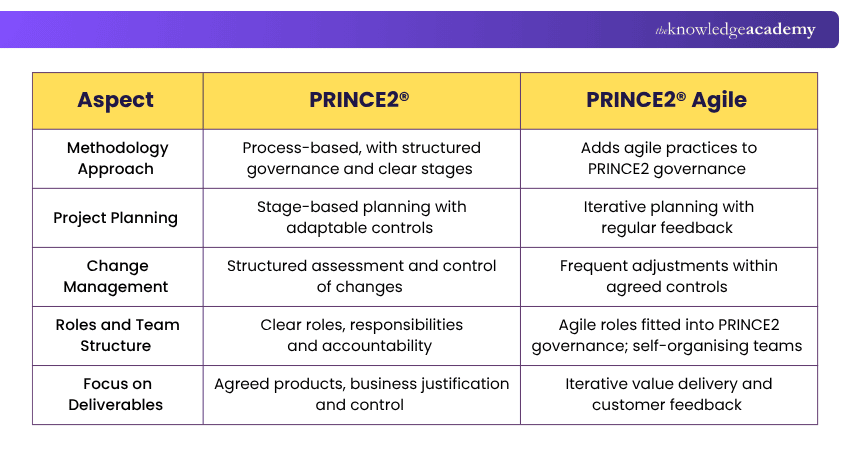
1) Methodology Approach
PRINCE2 is a process-based methodology that focuses on structured planning and clear processes to manage projects. It emphasises setting clear roles, responsibilities, and stages for project delivery.
On the other hand, PRINCE2 Agile combines this structured approach with Agile's flexibility, allowing teams to adapt to changes within established project controls. PRINCE2 can support predictive, Agile and hybrid delivery approaches, while PRINCE2 Agile provides more specific guidance for managing projects using Agile ways of working.
2) Project Planning
In PRINCE2, planning is done in detailed stages, with a strong focus on defining objectives, responsibilities and appropriate controls. Plans can be reviewed and updated as the project progresses.
On the other hand, PRINCE2 Agile allows for iterative planning, where project details are adjusted as work progresses. This makes PRINCE2 Agile particularly suitable for projects using iterative delivery and frequent feedback, while maintaining overall project governance.
3) Change Management
PRINCE2 follows a structured change management process where proposed changes are assessed and handled according to agreed decision-making responsibilities and control. This helps in controlling risks and maintaining project scope.
In contrast, PRINCE2 Agile supports frequent feedback and adjustments within agreed project boundaries. Changes can be incorporated through Agile working practices while still respecting project-level controls and objectives.
4) Roles and Team Structure
PRINCE2 defines a clear management structure, with specific roles and responsibilities such as the Project Board, Project Manager and Team Manager. Every role carries defined accountability, which makes it easy to see who makes which decisions and who is responsible for delivery. Roles can be combined or shared where needed, as long as accountability stays clear.
In contrast, PRINCE2 Agile keeps this governance structure but adds agile ways of working on top of it. Agile roles such as Product Owner and Scrum Master can be fitted into the PRINCE2 roles, depending on how the project is tailored. Delivery teams are encouraged to collaborate closely and organise their own work within the agreed project controls, which supports quicker decisions at team level.
5) Focus on Deliverables
PRINCE2 is highly focused on delivering agreed project products while maintaining business justification, quality and appropriate control over time, cost and scope.
In contrast, PRINCE2 Agile focuses on delivering value and customer satisfaction, using regular feedback and iterative delivery to refine products while maintaining the project's business objectives and governance requirements.
Advance your project leadership expertise with the PRINCE2® Practitioner Training – Join now!
PRINCE2® vs PRINCE2® Agile: Exam Details
Understanding the exam details for PRINCE2 and PRINCE2 Agile is important if you are planning to get certified. Both follow structured assessments but differ in their focus and content. Let's look at the main details for each one:
1) PRINCE2® Exam Details
The PRINCE2 7 exam focuses on project management principles, processes, and practices. It includes two levels: Foundation and Practitioner. Foundation level tests basic understanding, while the Practitioner level checks the ability to apply PRINCE2 in real-world projects.
Foundation
a) 60 minutes, 60 questions, pass mark of 60%
b) Multiple-choice questions
Practitioner
a) 150 minutes, 56 questions and sub-questions worth 70 marks, pass mark of 60%
b) Open-book exam with objective testing
2) PRINCE2® Agile (Version 2) Exam Details
The PRINCE2 Agile exam combines PRINCE2 principles with Agile practices. It also has two levels: PRINCE2 Agile Foundation (Version 2) and PRINCE2 Agile Practitioner (Version 2). The focus is on managing projects with flexibility while maintaining structure. It suits projects that need both planning and adaptability.
Foundation
a) 60 minutes, 40 questions, pass mark of 60%
b) Closed-book exam with multiple-choice questions
Practitioner
a) 150 minutes, 50 questions, pass mark of 60%
b) Open-book exam with multiple-choice questions
Bonus Tip
Choose a certification based on your career goals and the types of projects you manage. PRINCE2 7 develops knowledge of structured project governance, while PRINCE2 Agile focuses on combining that governance with Agile delivery practices. Always check the current Practitioner eligibility requirements before joining.
PRINCE2® vs PRINCE2® Agile: Which One to Choose?
Choosing between PRINCE2 and PRINCE2 Agile depends on your project needs. PRINCE2 is ideal if you want a structured, process-based approach with clear roles and stages. It can support predictive, Agile or hybrid delivery depending on project requirements.
PRINCE2 Agile is better if you need specific guidance on combining PRINCE2 governance with iterative delivery, collaboration and frequent feedback. Consider the project type and team requirements before deciding.
Bring structure to agility and confidence to delivery by joining the PRINCE2 Agile® Foundation (Version 2) Training now!

Nilotpal Sarmah is a Senior Content Writer with 11+ years of overall experience spanning engineering, operations and content development. His technical knowledge and extensive writing experience enable him to simplify specialised topics across IT and Tech, Business Skills, Project Management, Health and Safety, and ISO and Compliance.
View Detail

 If you wish to make any changes to your course, please


