




We may not have the course you’re looking for. If you enquire or give us a call on 01344203999 and speak to our training experts, we may still be able to help with your training requirements.
Delegated Legislation: A Complete Guide with Examples
BySaurav SharmaLast updated on: 03 October 2026
Delegated legislation is law made by ministers under Acts of Parliament, enabling detailed and technical rules via Statutory Instruments without full debate. It allows faster updates and flexibility, helping laws remain practical and responsive to change. Parliament retains control through scrutiny and approval procedures.

What This Blog Covers
1. The fundamentals of delegated legislation and its place in the UK legal system.2. The main forms of delegated legislation and the enabling powers under Acts of Parliament used to create them.3. How delegated powers are used to add detail to an Act of Parliament and respond to specific circumstances.4. Its practical benefits, limitations and real-world applications.5. The parliamentary and legal controls that can challenge or limit the use of delegated powers.
Have you ever wondered who really makes the detailed rules that shape everyday life, from traffic regulations to workplace safety? While Parliament passes the main laws, much of the practical detail is handled through Delegated Legislation. It works quietly in the background, yet plays a huge role in how laws are applied and experienced in real life.
Understanding Delegated Legislation shows how governments stay efficient and flexible. It explains faster decision-making, the use of expert knowledge, and safeguards against misuse. Let’s break it down simply to see how it works and why it matters!
What is Delegated Legislation?
Delegated legislation, also known as "subordinate" or "secondary" legislation, is a type of law in the UK that complements primary legislation, such as Acts of Parliament. It is distinct from primary legislation because it is created by Government Ministers or other authorised individuals and bodies, rather than by Parliament itself.
This form of legislation can only be made if specific powers have been granted by an Act of Parliament. Delegated legislation allows for the creation of detailed rules and regulations, enabling swift and flexible lawmaking without the need for Parliament to pass a new Act for every adjustment or clarification.
Quick Check
Primary legislation: Laws made by Parliament, principally Acts of Parliament.Delegated legislation: Law made under powers granted by primary legislation.Parent/enabling Act: The Act that grants the relevant delegated power.

History of Delegated Legislation
Delegated law-making has a long history in England and became increasingly important as government responsibilities grew. Let’s explore its key historical stages:
1) Early Development
An important early example is the Statute of Proclamations 1539, which gave certain royal proclamations made by Henry VIII with the Privy Council's assent the force of law. It was repealed in 1547.
2) Growth and Expansion
As government became more complex, Parliament increasingly delegated powers to deal with detailed and technical matters. Its use expanded significantly during the 20th century as regulatory responsibilities increased.
3) Control and Scrutiny
Growing delegated powers also raised concerns about oversight. The Donoughmore Committee reported in 1932, examining delegated legislative powers and the safeguards needed to control their use.
4) Modern Use
Today, delegated legislation is an established part of the UK legal system, allowing detailed laws to be made under powers granted by Parliament while remaining subject to parliamentary scrutiny and judicial review.
Types of Delegated Legislation
Delegated legislation includes several types, each serving a specific role in law and governance. These categories help ensure efficient, detailed, and specialised legal administration. Let’s explore the main types in detail:
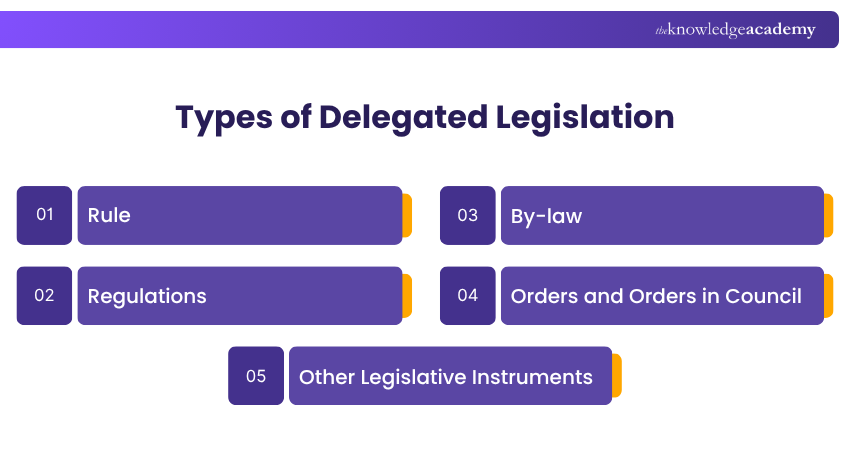
1) Rule
Rules are one form of delegated legislation, providing detailed requirements or procedures under powers granted by legislation. They operate within the scope of the parent Act and help implement legal and administrative requirements in practice.
2) Regulations
Regulations are a common form of delegated legislation used to establish detailed legal requirements under powers granted by an Act of Parliament. They can provide the practical detail required to implement a broader legislative framework.
3) By-law
By-laws are laws created by local authorities or public bodies under statutory powers. They address local issues such as public safety and behaviour, and are enforceable within specific areas, reflecting the unique needs and conditions of local communities effectively and appropriately.
4) Orders and Orders in Council
Orders are another form through which delegated powers may be exercised. Certain statutory Orders in Council are also a form of delegated legislation. Statutory Orders in Council are made through the Privy Council under powers delegated by Parliament and may be subject to parliamentary procedures such as the affirmative or negative procedure.
5) Other Legislative Instruments
Depending on the parent Act, delegated legislation may also take forms such as schemes, codes of practice and other Statutory Instruments. The name of an instrument does not by itself determine its parliamentary procedure; this is governed by the relevant enabling legislation.
Trainer's Insight
Do not confuse the form of delegated legislation with the way it is controlled. Regulations, rules and orders can be forms of delegated legislation; affirmative and negative procedures concern parliamentary scrutiny.
Develop essential leadership skills with the Leadership Skills Training - Join today!
What are Statutory Instruments?
Statutory Instruments (SIs) are the most common form of delegated legislation. They are created by Ministers or other authorised individuals or bodies who have been granted the power to do so, usually by an Act of Parliament.
A Statutory Instrument (SI) is the principal mechanism through which many delegated legislative powers are exercised. Depending on the enabling Act, SIs can take forms such as regulations, orders or rules and may be subject to different parliamentary procedures.
What is Parliament's Role in Delegated Legislation?
Delegated legislation can only be created using powers granted by an Act of Parliament (the ‘parent Act’). These powers outline who can make the delegated legislation, what it may or must do, the parliamentary scrutiny process it may undergo, and any other requirements for its creation.
Problems with the Process:
Concerns can arise both over the scope of the law-making powers delegated by Parliament and the level of scrutiny applied to the resulting Statutory Instruments. The large volume of delegated legislation and Parliament's generally limited ability to amend individual SIs can make detailed scrutiny challenging.
Stages of the Delegated Legislation system:
a) Delegation of Powers: Parliament passes Acts granting defined law-making powers to Ministers or other authorised bodies.
b) Exercise and Scrutiny: Those powers are used to make delegated legislation, often through Statutory Instruments. Where the parent Act requires it, Parliament scrutinises the resulting instruments through the applicable procedure.
Parliament’s Role:
a) First Stage: Parliament passes the Acts that delegate powers.
b) Second Stage: Parliament scrutinises SIs through the procedure set by the parent Act. Some instruments require active parliamentary approval, while others may come into force unless annulled.
Factors Responsible for the Rapid Growth of Delegated Legislation
Factors have contributed to the rapid growth of delegated legislation, reflecting the evolving needs and complexities of modern governance.
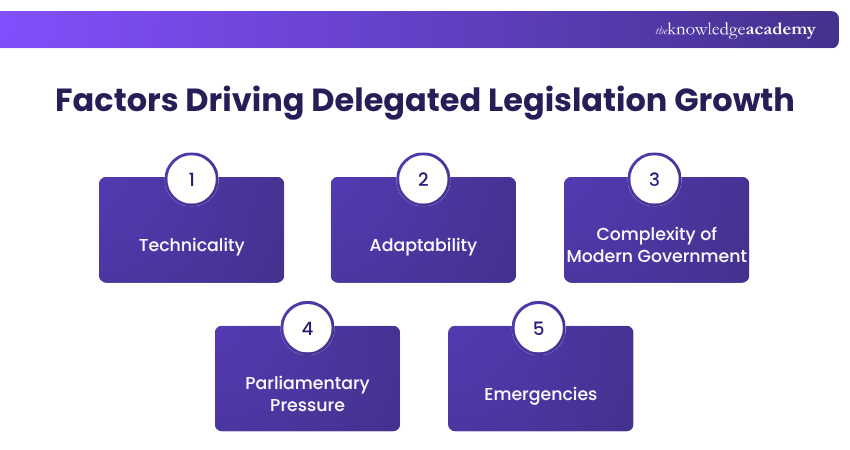
1) Technicality
Modern governance often requires precise and technical rules. Areas ranging from environmental regulation to digital privacy can require specialist knowledge that Parliament may choose to address through delegated powers.
Delegated legislation allows expert bodies or individuals to develop these detailed regulations under the authority of a broader legislative framework. This approach ensures that laws are not only comprehensive but also crafted with the precision necessary to effectively manage complex, technical issues in a rapidly evolving world.
2) Adaptability
Delegated legislation facilitates swift adjustments to evolving circumstances, including advancements in technology and shifts in societal norms. This agility ensures that the legal framework remains relevant and effective amidst rapid changes, allowing authorities to address emerging issues promptly.
Whether it's updating regulations to accommodate new innovations or responding to shifting public attitudes, delegated legislation offers a dynamic and responsive approach to governance. This adaptability is important for maintaining the effectiveness and legitimacy of the legal system in an ever-changing world.
3) Complexity of Modern Government
Modern government operates across highly specialised areas that can require extensive technical rules. Delegated legislation allows Parliament to establish the main legislative framework while authorised bodies deal with some of the detailed implementation requirements.
4) Parliamentary Pressure
Parliamentary pressure refers to the influence exerted by legislative bodies on the need for delegated legislation. As parliaments grapple with heavy workloads and intricate policy matters, they may delegate certain legislative functions to expedite the process. This pressure can arise from various factors, including time constraints, political priorities, and the need for specialised expertise.
Delegated legislation enables parliamentarians to focus on overarching policy issues while delegating the details to relevant authorities. Maintaining a balance between parliamentary oversight and administrative efficiency ensures legislative accountability and transparency in delegated legislation.
5) Emergencies
During times of crises or emergencies, including natural disasters or public health emergencies, swift action is imperative to safeguard the well-being of citizens. Delegated legislation provides a vital mechanism for governments to respond promptly and effectively.
By granting authorities the power to enact temporary measures or regulations, delegated legislation facilitates the rapid deployment of resources. It allows for the coordination of emergency response efforts and the implementation of necessary protocols or restrictions to mitigate the impact of the crisis.
Pro Tip
A useful way to remember why delegated legislation exists is TIME:
T: Technical detailI: Implementation of primary legislationM: Managing changing circumstancesE: Emergency response
Get a deep understanding of how to better manage your time with our Practical Thinking Course – Register now!
Advantages and Disadvantages of Delegated Legislation
Here are the advantages and disadvantages of delegated legislation:
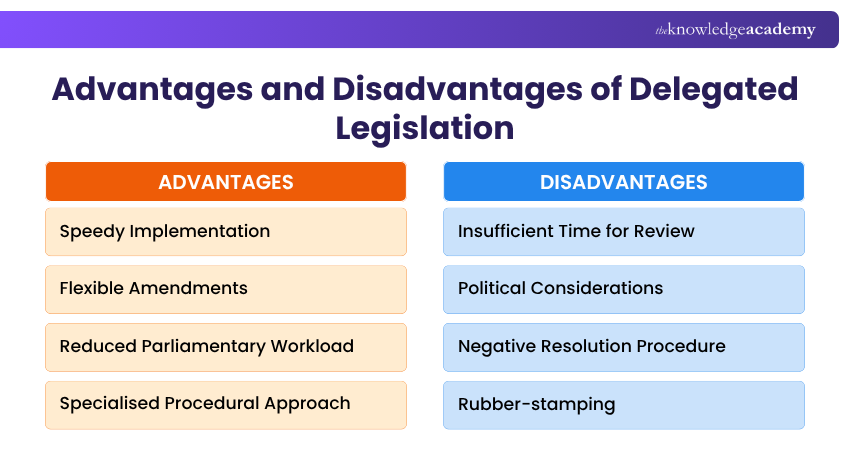
Advantages of Delegated Legislation
The following are the advantages of delegated legislation:
1) Speedy Implementation: Enables rapid legal changes and quick responses to urgent matters, allowing faster adaptation compared to traditional primary legislation.
2) Flexible Amendments: Allows detailed legal requirements to be updated more efficiently where the relevant statutory powers permit.
3) Reduced Parliamentary Workload: Allows Parliament to focus on broader policy issues by delegating detailed regulatory management to specialised bodies, improving overall legislative efficiency.
4) Specialised Procedural Approach: Facilitates sector-specific regulations that can address unique characteristics and demands of different industries with greater precision and technical expertise.
Disadvantages of Delegated Legislation
The following are the disadvantages of delegated legislation:
1) Insufficient Time for Review: The sheer volume of secondary legislation can overwhelm Parliament, making it difficult to thoroughly review each statutory instrument. This can result in potentially problematic rules being passed without adequate scrutiny.
2) Political Considerations: The political composition of Parliament can influence the level and outcome of scrutiny of delegated legislation.
3) Negative Resolution Procedure: Under the negative procedure, an SI generally remains in force unless either House annuls it within the applicable scrutiny period, usually 40 days. Critics argue that this procedure can provide less opportunity for active parliamentary scrutiny.
4) Rubber-stamping: A limited scope for amendment or discussion can create a “rubber-stamping” effect, where approval is given without comprehensive scrutiny.
Examples of Delegated Legislation in the UK
Delegated legislation plays a crucial role in shaping the UK’s legal framework across various sectors. Here are some prominent examples:
1) Health and Safety at Work Regulations
Delegated legislation is widely used to establish detailed workplace health and safety requirements under powers provided by primary legislation. This allows technical requirements to be specified and updated without putting every operational detail into an Act of Parliament.
2) Building Regulations
Building Regulations establish detailed requirements concerning areas such as building safety, construction, accessibility and energy efficiency.
Building regulations are a devolved matter, so the applicable regulatory framework differs across the UK. In England, Building Regulations are made under statutory powers and establish requirements that apply to building work. Scotland, Wales and Northern Ireland have their own arrangements.
3) Environmental Regulations
A range of environmental regulations, such as the Environmental Permitting Regulations and the Air Quality Regulations, set out standards and practices to manage pollution, safeguard natural resources, and, in some cases, address climate change.
4) Taxes and Financial Regulations
Delegated legislation can also be used in taxation and financial matters where Parliament has granted the relevant law-making powers. Some financial Statutory Instruments are considered only by the House of Commons rather than by both Houses.
Quick Checklist: Is it a Delegated Legislation?
Ask:
✓ Is the power to make the rule derived from legislation?✓ Who has been authorised to exercise that power?✓ What limits does the parent Act impose?✓ What form does the resulting instrument take?✓ Does the parent Act require a parliamentary procedure?
These questions help distinguish Delegated legislation from primary legislation and other exercises of governmental power.
How is Delegated Legislation Controlled?
It is controlled through parliamentary oversight and judicial review to ensure legal limits and accountability. Key control mechanisms include:
1) Parliamentary Control:
a) Enabling Act: Defines the scope and limits of delegated powers.
b) Affirmative Procedure: Requires active parliamentary approval. Some affirmative instruments require approval before being made, while made-affirmative instruments may take effect first and require subsequent approval.
c) Negative Procedure: Generally, remains in force unless annulled by Parliament within the applicable scrutiny period.
d) Scrutiny Committees: Examine Statutory Instruments and draw Parliament’s attention to technical, legal and other scrutiny concerns.
e) Super Affirmative Procedure: An enhanced scrutiny procedure used where the enabling legislation provides for it, involving additional parliamentary scrutiny and consultation.
2) Judicial Control (Judicial Review):
a) Ultra Vires: Invalid if powers are exceeded.
b) Procedural Ultra Vires: Invalid if required steps are not followed.
c) Substantive Ultra Vires: Invalid if content exceeds authority.
d) Other Grounds of Judicial Review: Depending on the circumstances, delegated legislation may also be challenged on other recognised public-law grounds, including irrationality.
Trainer's Insight
Think of the parent Act as defining the legal boundary. Delegated legislation operates inside that boundary. Parliamentary scrutiny examines instruments through the procedures Parliament has established, while judicial review can address whether delegated powers have been exercised lawfully.
What is Judicial Review in Delegated Legislation?
Judicial review is the process by which courts examine delegated legislation to ensure it stays within the limits of the parent Act and the law. It prevents misuse of delegated powers and maintains legal accountability.
The key principle is ultra vires, meaning "beyond powers". Where delegated legislation exceeds the statutory powers under which it was made, fails to comply with applicable legal requirements or is otherwise unlawful, a court may grant an appropriate judicial review remedy, which can include quashing the unlawful measure.
Delegated legislation allows authorised bodies to create detailed laws under powers granted by Parliament, offering flexibility, technical expertise and faster implementation while remaining subject to parliamentary scrutiny and judicial review.
Gain familiarity with the tasks, responsibilities, and empowerment of teams with the High Performing Teams Training – Join now!

Saurav Sharma is a Marketing Head with 9+ years of experience in performance marketing, SEO, paid advertising and growth strategy. His data-informed approach, project oversight and strategic leadership provide practical expertise across Business Skills, Project Management, and Leadership and Management.
View Detail

 If you wish to make any changes to your course, please


