




We may not have the course you’re looking for. If you enquire or give us a call on 01344203999 and speak to our training experts, we may still be able to help with your training requirements.
Data Independence in DBMS: An Overview
ByNilotpal SarmahLast updated on: 10 October 2026
This blog delves into the concept of data independence in DBMS, exploring its significance, types, benefits, and challenges. It provides a comprehensive understanding of how data independence helps maintain flexibility in database systems. This ensures that changes in the database do not disrupt applications or user interfaces.
Quick Snapshot
1. Data independence operates across different levels of database architecture.2. It is primarily classified into logical and physical data independence.3. Logical independence deals with changes to data structures and relationships.4. Physical independence concerns storage, indexing, and other physical changes.5. Both types help database systems evolve while limiting dependencies between schema levels.
Data independence is a critical concept in the field of Database Management Systems (DBMS). It refers to the capability of changing the schema at one level of the database system without requiring a change to the schema at the next higher level. This feature is crucial for the flexibility, scalability, and maintainability of database systems.
This also helps maintain operations as the underlying database structures change. Continue reading below to explore data independence, its types, and why it’s a fundamental concept in the design and management of database systems.
What is Data Independence in DBMS?
Data independence in DBMS refers to a database system's capacity to change the schema at one level without requiring changes at the next higher level. This concept is crucial for ensuring that the database can evolve without affecting the applications or User Interfaces (UI) that interact with it. Data independence allows for modifications in the database's physical or logical schema without disrupting the overall functionality.
In a database system, data is typically organised into three levels:
1) The physical level (how data is stored).
2) The logical level (how data is structured and related).
3) The view level (how data is presented to users).
Data independence ensures that changes at the lower levels do not necessitate changes at the higher levels, thereby preserving the database system's integrity and usability.

Types of Data Independence
In DBMS, data independence is categorised into two primary types: logical data independence and physical data independence. Each type plays an important role in maintaining the database system's flexibility and resilience.
1) Logical Data Independence
Logical data independence refers to changing the logical schema, how data is organised and structured, without altering the external schema or application programs that access the data. This means that tables, views, or other database structures can be changed without affecting how users interact with the data.
Examples of Changes Under Logical Data Independence
a) Adding or Removing Fields: New attributes can be added, or existing attributes can be removed, provided dependent external views and applications can continue to operate through appropriate schema mappings. For example, adding a new column that existing applications do not reference may require no changes to those applications.
b) Restructuring Tables: Tables may be merged, split, or otherwise reorganised at the logical level without requiring changes to external applications if appropriate views or schema mappings preserve the structures those applications expect.
c) Redefining Relationships: Changes to relationships between entities, such as restructuring tables during normalisation, may be hidden from external applications through suitable views or schema mappings, allowing applications to continue using their existing external representation.
2) Physical Data Independence
Physical data independence is the ability to change the physical schema, which defines how data is physically stored, without requiring changes to the logical schema. This includes changes in storage devices, indexing strategies, or data compression methods.
Examples of Changes Under Physical Data Independence
a) Changing Storage: Data can be reorganised or moved across physical storage without altering the logical structure of the database. This allows storage configurations to be changed or optimised without affecting how the data is logically organised.
b) Modifying Indexing Strategies: Indexes can be created, removed or modified to improve data retrieval without requiring changes to the logical schema or dependent application code. This allows the database to be optimised for different workloads while preserving its logical structure.
c) Optimising Data Storage: Data compression, partitioning or other physical storage optimisation techniques can be implemented without affecting the logical organisation of the data. This can support more efficient use of storage resources while maintaining data accessibility.
Quick Check
A database administrator changes the way records are indexed, but tables and application queries remain unchanged. Which type of data independence does this demonstrate?Answer: Physical data independence, because the change affects the storage or access level without requiring a change to the logical schema.
Learn about database approaches and database management systems with the Relational Databases & Data Modelling Training – Register now!
Difference Between Logical Data Independence & Physical Data Independence
While both logical and physical data independence contribute to the overall flexibility and resilience of a database system, they address different aspects of data management and have distinct implications:
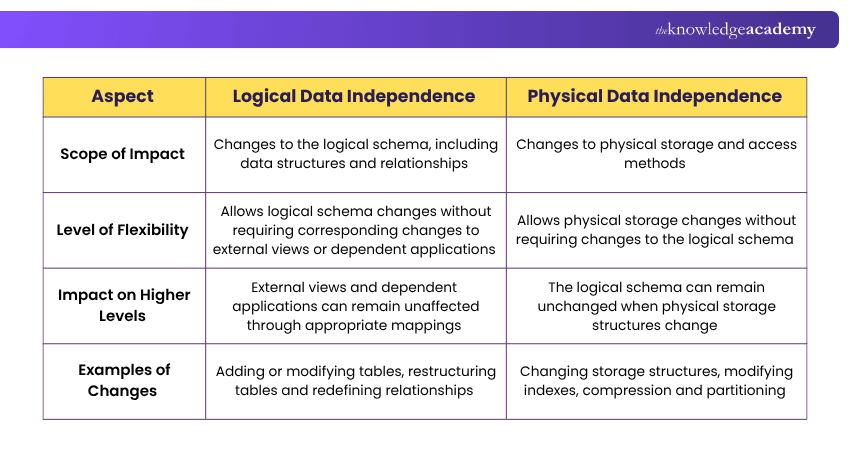
Understanding these differences is important for effectively managing and maintaining a robust and flexible database system.
Real-world Scenario
Imagine an online retailer with a growing customer database. The database administrator splits a customer table into two tables but retains a view that provides applications with the original structure. This demonstrates logical data independence.
Benefits of Data Independence
Data independence offers numerous benefits that contribute to the efficiency, flexibility, and longevity of a database system:
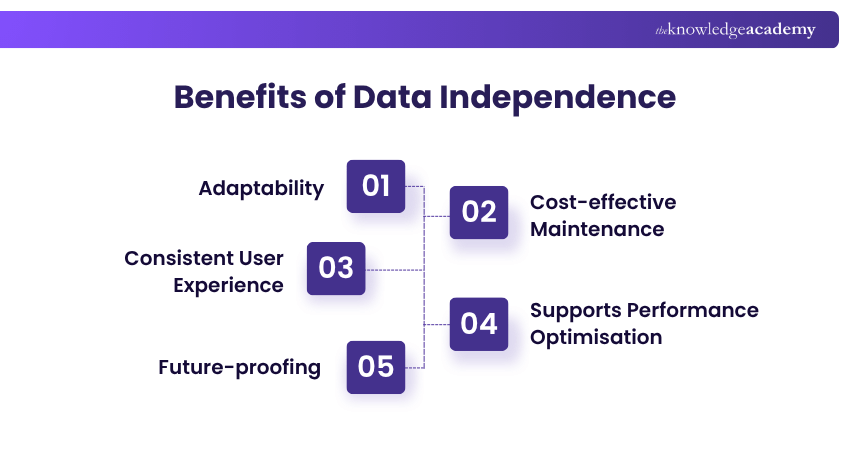
a) Adaptability: Databases can evolve as business needs change without requiring a complete system overhaul. This adaptability is crucial in dynamic business environments where data requirements frequently shift.
b) Cost-effective Maintenance: Data independence reduces the need for costly and time-consuming rewrites of applications when changes are made to the database. By isolating the impact of changes to specific levels of the database, data independence allows for more efficient and cost-effective maintenance.
c) Consistent User Experience: Data independence ensures that users continue interacting with the data seamlessly, even as underlying structures are modified. This consistency is vital in environments where users rely on steady access to data for their daily operations.
d) Supports Performance Optimisation: Physical data independence allows storage structures, indexes and access methods to be optimised without requiring corresponding changes to the logical schema.
e) Future-proofing: Data independence makes the database more resilient to future changes, ensuring it can adapt to new technologies and requirements. As new technologies and methodologies emerge, the ability to incorporate these changes without disrupting existing operations is critical for ensuring the longevity and relevance of the database system.
These benefits make data independence an essential feature in any modern DBMS, supporting current operations and future growth.
DBA’s Pro Tip
When planning schema changes, first identify which applications, views and queries depend on the affected structures. Maintaining clear dependency information makes it easier to determine whether a proposed change can remain isolated at the physical or logical level.
Drawbacks of Data Independence
While data independence provides many advantages, it is not without its challenges:
a) Complex Implementation: Achieving data independence requires a well-designed DBMS, which can be complex to develop and maintain. Separating logical and physical schemas requires careful planning and design to ensure the system operates efficiently.
b) Schema Management Complexity: Maintaining mappings, views and dependencies between different schema levels can add complexity, particularly when schemas evolve significantly or multiple applications depend on different representations of the same data.
c) Training and Expertise: Maintaining data independence requires skilled personnel who understand the database's technical and functional aspects. Effective schema management requires expertise in database design, management, and optimisation.
DBMS architecture organises data across different schema levels, while data independence helps reduce dependencies between them. Logical data independence deals with changes to the logical structure, whereas physical data independence focuses on changes to data storage. Schema mappings help isolate these changes and maintain compatibility across different levels.
Learn data security practices to protect sensitive information effectively with the Database Training – Join now!

Nilotpal Sarmah is a Senior Content Writer with 11+ years of overall experience spanning engineering, operations and content development. His technical knowledge and extensive writing experience enable him to simplify specialised topics across IT and Tech, Business Skills, Project Management, Health and Safety, and ISO and Compliance.
View Detail

 If you wish to make any changes to your course, please


