




We may not have the course you’re looking for. If you enquire or give us a call on +44 1344 203 999 and speak to our training experts, we may still be able to help with your training requirements.
10 Types of Cyber Security Incidents You Need to Know
ByJohn DaviesLast updated on: 09 September 2026
Cyber Security Incidents can affect data, systems, operations, and organisations in different ways. Understanding how these incidents occur and their types can help businesses and individuals recognise potential security threats and respond appropriately.
A suspicious email.
An unusual login.
A suddenly encrypted file.
Would you know which one signals a Cyber Security Incident?
The tricky part is that cyber threats do not always look dangerous at first. Some are obvious and cause immediate disruption, while others can go unnoticed until the damage has already been done.
Knowing the different Types of Cyber Security Incidents can make them easier to recognise and understand. In this blog, we explore 10 common types, how they occur, potential impacts, and ways to prevent them. Let's get started!
What is a Cyber Security Incident?
A Cyber Security Incident is an event that compromises or threatens the confidentiality, integrity, or availability of an organisation’s data, systems, or networks. It can involve unauthorised access, malicious activity, data exposure, system disruption, or attempts to exploit security weaknesses.
Not every incident leads to a confirmed breach, but each one can indicate that security has been threatened or disrupted. Recognising an incident early helps organisations assess what happened, limit its impact, and begin an appropriate response.
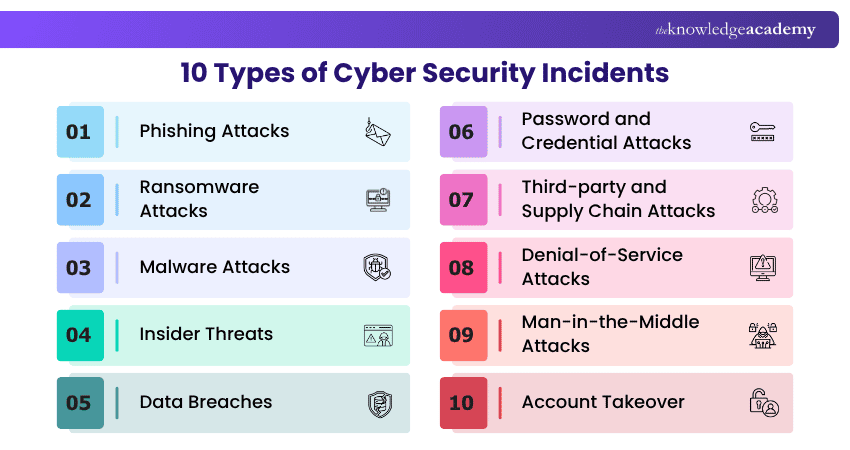
10 Types of Cyber Security Incidents
Cyber Security Incidents can take many forms, from deceptive attacks targeting individuals to large-scale disruptions affecting entire organisations. The following are the 10 common types:
1) Phishing Attacks
Phishing uses deceptive emails, messages, or websites to trick users into revealing sensitive information or clicking malicious links. It often targets login credentials, financial details, or personal data.
2) Ransomware Attacks
Ransomware encrypts files or locks systems and demands payment for restoration. In some cases, attackers also threaten to publish stolen data if the ransom is not paid.
3) Malware Attacks
Malware includes malicious software such as viruses, Trojans, and spyware. It can damage systems, steal data, monitor activity, or provide unauthorised access.
Build the expertise needed to identify malicious code with Malware Analysis Training – Register today!
4) Insider Threats
Insider threats involve employees, contractors, or trusted users who misuse their access intentionally or accidentally. These incidents can lead to data exposure, fraud, or operational disruption.
5) Data Breaches
A data breach happens when sensitive or protected information is accessed, exposed, changed, or taken without permission. It may result from cyber-attacks, inadequate security measures, or human mistakes.
6) Password and Credential Attacks
Attackers may use brute-force methods, credential stuffing, password spraying, or stolen login details to gain unauthorised access. Weak or reused passwords can increase the risk.
7) Third-party and Supply Chain Attacks
These incidents target vendors, suppliers, or service providers to reach a larger organisation indirectly. A compromised third party can expose data, software, or connected systems.
8) Denial-of-Service Attacks
Denial-of-Service (DoS) and Distributed Denial-of-Service (DDoS) attacks overwhelm systems or networks with traffic. This can make websites, applications, or online services unavailable.
9) Man-in-the-Middle Attacks
A Man-in-the-Middle (MITM) attack occurs when an attacker secretly intercepts communications between two parties. The attacker may monitor, alter, or steal information being exchanged.
10) Account Takeover
Account takeover happens when an attacker gains control of a legitimate user account. Once inside, they may steal data, make fraudulent transactions, or use the account to target others.
Did You Know?
💡38% of UK businesses experienced phishing attacks in the past 12 months, making phishing the most common identified cyber breach or attack.
What Causes Cyber Security Incidents?
Cyber Security Incidents rarely have a single cause. They can result from weaknesses in technology, human actions, security processes, or external suppliers, with attackers often combining several vulnerabilities during an attack. Here are some of the most common causes:
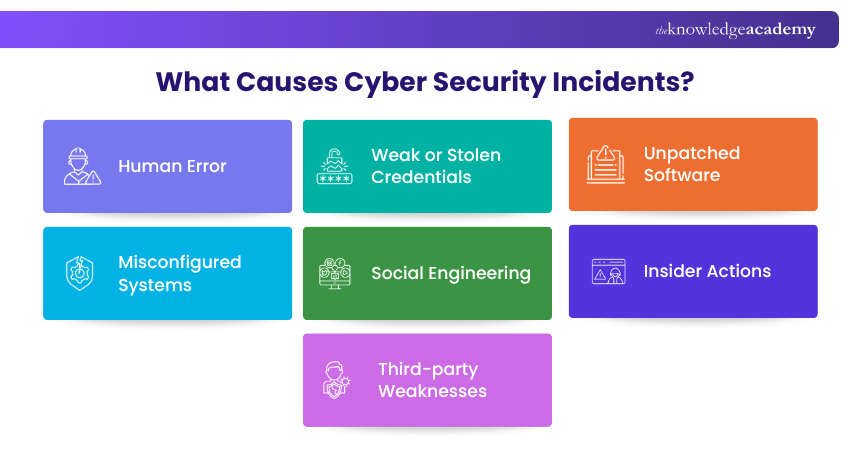
1) Human Error: Mistakes such as mishandling data or sending information to the wrong person, can create security risks.
2) Weak or Stolen Credentials: Weak, reused, or compromised credentials can give attackers unauthorised access to accounts and systems.
3) Unpatched Software: Outdated software may contain known vulnerabilities that attackers can exploit to enter or compromise systems.
4) Misconfigured Systems: Incorrect security settings in applications, networks, or cloud services can unintentionally expose information or systems.
5) Social Engineering: Attackers may manipulate employees into revealing credentials, sharing sensitive information, or performing unsafe actions.
6) Insider Actions: Employees, contractors, or other trusted users may cause incidents accidentally or deliberately through their authorised access.
7) Third-party Weaknesses: Vulnerabilities within suppliers and service providers can provide attackers with an indirect route into an organisation.
Trainer’s Pro Tip: Assess cyber incidents by business impact, not just technical severity. Consider how an incident could affect critical operations, sensitive data, customers, and recovery priorities when deciding how quickly to respond.
Build practical response skills with Incident Response Training and manage cyber incidents quickly and effectively.
What are the Impacts of Cyber Security Incidents?
Cyber Security Incidents can affect far more than IT systems alone. Depending on their scale and severity, they can disrupt operations, expose sensitive information, damage trust, and create significant financial and regulatory consequences. The main impacts include:
1) Increased recovery costs, lost revenue, legal expenses, and additional security spending.
2) Disruption to systems, websites, communications, production, and customer services.
3) Exposure, theft, alteration, or loss of sensitive and confidential information.
4) Reduced trust and confidence among customers, partners, and other stakeholders.
5) Regulatory investigations, reporting obligations, and potential enforcement action.
6) Loss or exposure of intellectual property, research, designs, and trade secrets.
7) Disruption to critical services, potentially affecting long-term business continuity.
How to Prevent Cyber Security Incidents?
Preventing Cyber Security Incidents requires a combination of secure technology, clear processes, and employee awareness. A structured approach helps organisations reduce vulnerabilities and respond to emerging risks more effectively. Follow these steps to strengthen prevention:
Step 1: Assess Cyber Security Risks
Identify critical systems, sensitive data, vulnerabilities, and potential threats to understand where protection is most needed.
Step 2: Strengthen Access Security
Use strong passwords, Multi-factor Authentication (MFA), and role-based access to limit unauthorised entry to systems and data.
Step 3: Keep Systems Updated
Apply security patches and software updates promptly to address known vulnerabilities.
Step 4: Train Employees Regularly
Help staff recognise phishing, social engineering, suspicious links, and other common warning signs.
Step 5: Protect Data and Systems
Use firewalls, endpoint protection, encryption, and secure backups to reduce the impact of potential attacks.
Step 6: Manage Third-party Risks
Review the security practices of suppliers, vendors, and service providers that access organisational systems or information.
Step 7: Monitor for Suspicious Activity
Use security monitoring tools and alerts to identify unusual behaviour and possible attacks early.
Step 8: Maintain an Incident Response Plan
Define responsibilities, communication routes, and response procedures so teams can act quickly when an incident occurs.
What to do After a Cyber Security Incident?
After a Cyber Security Incident, organisations should focus on limiting damage, understanding what happened, and restoring normal operations safely. A coordinated response can also help preserve evidence and prevent further disruption. Key actions to take include:
1) Identify and Assess: Determine what happened, which systems or data are affected, and the severity of the incident.
2) Contain the Threat: Isolate affected systems, devices, or accounts to prevent the incident from spreading further.
3) Preserve Evidence: Secure relevant logs, alerts, records, and other evidence needed for investigation or reporting.
4) Remove the Threat: Eliminate malicious software, compromised accounts, vulnerabilities, or other identified causes.
5) Recover Safely: Restore affected systems and data from trusted sources and verify their security before resuming operations.
6) Report and Communicate: Inform relevant stakeholders, regulators, authorities, or affected individuals where required.
7) Review and Improve: Examine what happened, document lessons learned and strengthen controls to reduce the risk of recurrence.
Easy to Miss!
During an investigation, document systems, accounts, and data that are confirmed as unaffected. This helps establish the incident boundary and shows whether existing security controls successfully contained the threat.
Cyber Security Incident Report
A Cyber Security Incident Report is a formal record of a security event, documenting what happened, when it occurred, what was affected, and how the organisation responded. It creates a clear record that teams can use for investigation, recovery, compliance, and future prevention.
Rather than treating it as just paperwork, think of the report as the story of the incident from detection to resolution. A useful report typically captures:
What happened → When it happened → What was affected → Actions taken → Impact → Root cause → Lessons learned → Preventive actions
Quick Tip: Record facts and evidence as soon as possible after an incident. Avoid assumptions or unverified conclusions, as accurate timelines and details can make later investigation much easier.
Strengthen your fraud investigation capabilities through the Fraud Analytics Training. Sign up today!

John Davies creates security-focused content that helps organisations understand digital risks and establish appropriate safeguards. His practical explanations connect regulatory expectations, governance principles and security controls with wider organisational priorities.
View Detail

 If you wish to make any changes to your course, please


