




We may not have the course you’re looking for. If you enquire or give us a call on 01344203999 and speak to our training experts, we may still be able to help with your training requirements.
Conventional Sources of Energy: Explained in Detail
ByThe Knowledge AcademyLast updated on: 19 September 2026
Energy powers everything we do, from daily activities to industrial processes. This blog explores conventional sources of energy like coal, oil, wood fuel, and natural gas, explaining their uses and impact.

Quick Preview
1. Conventional sources of energy are established energy resources that have been widely used over long periods.2. Coal, petroleum, natural gas, wood fuel and nuclear energy can feature in conventional energy classifications.3. Energy sources should be distinguished from energy carriers such as electricity and facilities such as thermal power plants.4. Conventional sources support electricity generation, transport, heating and industry but can also create environmental challenges.5. Conventional, renewable, non-renewable and low-carbon describe different characteristics and should not be treated as interchangeable terms.
Have you ever wondered how the lights in your home turn on or how your car gets you from place to place? It all comes down to energy! Energy is an important part of our lives, powering everything from small gadgets to massive industrial machines. In this blog, we discuss the conventional sources of energy, such as coal, oil, wood fuel, and natural gas. You'll learn how these sources continue to be important in our energy landscape today.

Classification of Energy Sources
Energy Sources are divided into two categories: Conventional and non-conventional sources of energy. This classification helps us understand the various types of energy we use:
a) Conventional Sources of Energy: These are the traditional forms of energy that have been in use for centuries. They are primarily non-renewable, meaning they are finite and will eventually be depleted. These sources have been the backbone of industrial development and are still widely used today. They are widely used for electricity generation, transportation, heating and industrial activities.
b) Non-Conventional Sources of Energy: These sources, also known as renewable energy sources, are those that are continuously replenished by natural processes. They are environmentally friendly compared to conventional sources. Common examples include solar, wind and geothermal energy. Their use can help reduce dependence on fossil fuels and support a transition towards lower-carbon energy systems.
Trainer Insight
Do not automatically treat conventional and non-renewable as identical terms. Conventional describes an established pattern of energy use, while renewable and non-renewable describe whether a resource is naturally replenished.
Conventional Sources of Energy
Here are some important conventional sources of energy:
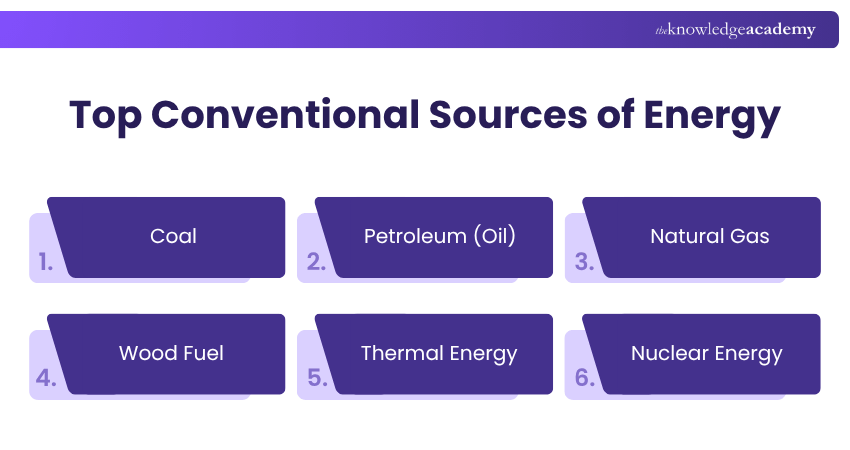
1) Coal
Coal is one of the oldest and most widely used sources of energy. It is a black or brownish-black sedimentary rock that's composed mainly of carbon, along with other Most Abundant Elements on Earth like hydrogen, sulphur, oxygen, and nitrogen.
Coal is used for electricity generation in coal-fired power plants. It is also used in industries like steel and cement production. Despite its widespread use, coal is a contributor to air pollution and greenhouse gas emissions, thus making it a less sustainable option.
2) Petroleum (Oil)
Petroleum, also known as oil, is a liquid fossil fuel taken from underground deposits. It is a complex mixture of hydrocarbons and is used in a variety of applications. It is refined into products such as diesel, gasoline, jet fuel, and lubricants. It is also used in the production of plastics, chemicals, and other materials. The transportation sector is heavily reliant on petroleum products, making it a crucial energy source.
3) Natural Gas
It is a gaseous fossil fuel composed mainly of methane. It is found in underground reservoirs, often alongside petroleum deposits. It is used for electricity generation and heating and as fuel for vehicles. It is also used as a raw material in the production of chemicals and fertilisers. Natural gas releases fewer emissions, making it a cleaner option.
4) Wood Fuel
Firewood is wood used as a source of energy, typically for cooking and heating. It is one of the oldest forms of energy used by humans. It is used for cooking and heating, particularly in rural and developing areas. While it is renewable, unsustainable harvesting can lead to deforestation and environmental degradation.
Pro Tip
Do not confuse low-carbon with renewable. They describe different characteristics of an energy source.
5) Thermal Energy
Thermal energy is associated with motion of particles within a substance and is commonly experienced as heat. It can be produced from sources such as natural gas, coal, oil, nuclear reactions and geothermal processes. In conventional energy systems, thermal energy is widely used for industrial processes, heating and electricity generation. In thermal power plants, heat is commonly used to generate steam, which can drive turbines connected to generators.
6) Nuclear Energy
It is a powerful source of energy generated through nuclear reactions, primarily fission. It is a non-renewable but low-carbon energy source. Nuclear energy is used for electricity generation in nuclear power plants. It is a reliable source of energy but poses challenges pertaining to radioactive waste disposal and safety concerns.
Learn how to use an energy-oriented business administration with our ISO 50001 Energy Management Systems Training – Join today!
Quick Check
Test your understanding:
1) Is electricity an energy source in the same way as coal?No. Electricity is an energy carrier or form that can be generated using several primary energy sources.2) Are petroleum and crude oil separate conventional sources?No. Crude oil is a form of petroleum and is refined for producing fuels and other products.3) Is every renewable energy source automatically sustainable?No. Sustainability also depends on how a resource is produced, harvested and managed.
Advantages of Conventional Sources of Energy
Here are the key benefits of conventional sources of energy:
1) Established Infrastructure: Many conventional energy sources have well-developed infrastructure for extraction, processing and distribution.
2) Reliable Energy Supply: Some conventional sources can provide energy when required without depending directly on weather conditions.
3) Wide Range of Uses: They support electricity generation, transportation, heating and various industrial activities.
4) Developed Supply Systems: Established technologies and distribution networks make many conventional sources widely accessible.
5) Industrial Importance: Conventional energy sources support manufacturing, transportation and other energy-intensive industries.
Disadvantages of Conventional Sources of Energy
Here are some drawbacks of conventional sources of energy that need to be considered:
1) Finite Resources: Many major conventional sources, particularly fossil fuels, are non-renewable and available in limited quantities.
2) Greenhouse Gas Emissions: Burning fossil fuels releases dangerous greenhouse gases that contribute to climate change.
3) Environmental Impact: Extraction, processing and transportation can affect ecosystems and natural resources.
4) Pollution and Waste: Some conventional energy systems produce air pollutants, waste or other environmental and safety challenges.
5) Long-term Resource Concerns: Continued dependence on finite resources can create energy security and sustainability challenges.

The Knowledge Academy develops accessible learning content across Project Management, IT, Cybersecurity, Data Science, Business Analysis, HR, Accounting and Finance, Leadership and Health and Safety. Its resources combine subject research with clear explanations to help professionals build practical knowledge across a wide range of disciplines.
View Detail

 If you wish to make any changes to your course, please


