




We may not have the course you’re looking for. If you enquire or give us a call on 01344203999 and speak to our training experts, we may still be able to help with your training requirements.
Cloudflare vs Google DNS: A Complete Breakdown
ByNilotpal SarmahLast updated on: 24 September 2026
Dive into the intricacies of Cloudflare vs Google DNS in this comprehensive blog. Discover the nuances in fundamental characteristics, privacy measures, velocity, and reliability, empowering you to make an informed decision. Unveil the strengths of Cloudflare's global network and security features versus Google DNS's simplicity, reliability and global infrastructure.
Choosing a DNS resolver isn't just a technical detail, it shapes how fast websites load and how much of your browsing activity gets logged along the way. Cloudflare and Google DNS are two of the most widely used options, each built around a different set of priorities: Cloudflare leans into privacy and security, while Google DNS leans into simplicity and reliability, backed by its global infrastructure.
This comparison looks at how the two actually differ in practice, from privacy policies to speed and dependability, so you can work out which one actually fits how you use the internet, without relying on marketing claims from either side.
What is Cloudflare?
Cloudflare is a prominent and versatile internet security and performance company that provides a suite of services designed to enhance the reliability, speed, and security of websites. Founded in 2009, Cloudflare has evolved into a global leader, offering a range of solutions that provide for the various needs of website owners, businesses, and online platforms.
Cloudflare operates a Content Delivery Network (CDN), strategically distributing website content across a vast network of servers worldwide. This not only accelerates the delivery of web pages but also mitigates the impact of DDoS attacks, ensuring consistent and secure access for users.
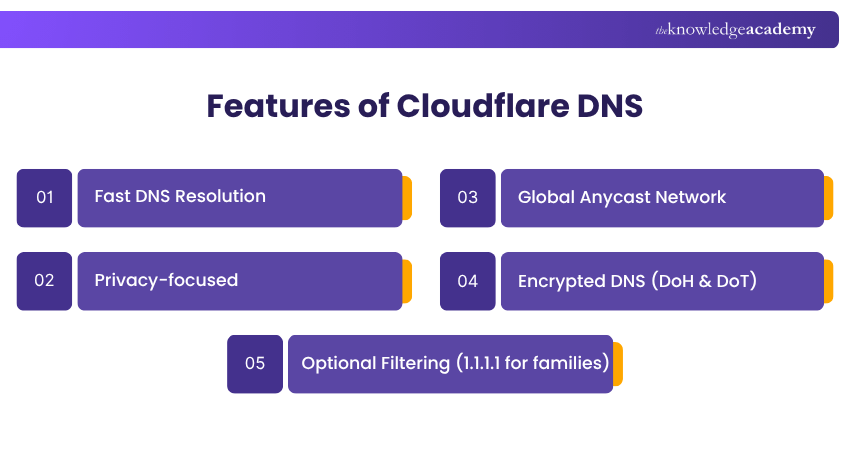
One of Cloudflare's standout features is its Domain Name System (DNS) service, including its 1.1.1.1 public DNS resolver, which acts as a crucial intermediary between users and the internet. By leveraging an expansive network of servers strategically positioned across the globe, Cloudflare's DNS service enhances the speed and reliability of domain name resolution.
Cloudflare's broader platform provides security services against threats such as DDoS attacks and malicious traffic. Its 1.1.1.1 public resolver focuses on fast and privacy-oriented DNS resolution, while 1.1.1.1 for Families provides optional malware and content filtering.
Furthermore, Cloudflare has extended its commitment to privacy through initiatives like DNS over HTTPS (DoH) and DNS over TLS (DoT), which encrypt DNS queries between the user's device and the resolver. In essence, Cloudflare plays a pivotal role in optimising the performance and security of the internet, while its 1.1.1.1 public resolver provides a fast, privacy-focused DNS resolution service.

What is Google DNS?
Google DNS, or Google Public DNS, is a free Domain Name System (DNS) resolution service offered by Google. Launched in 2009, Google DNS aims to improve users' internet experience by providing a fast, reliable, and secure way to translate domain names into IP addresses.
Google DNS operates on a global network of servers, strategically distributed to reduce latency and enhance the speed of DNS resolution. By leveraging Google's extensive infrastructure, the service aims to minimise the time it takes for users to access websites, ultimately optimising their online experience.
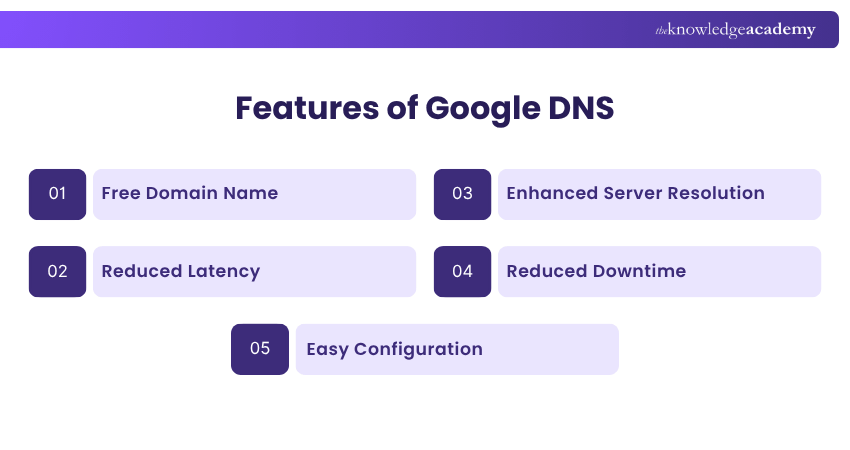
One of the key features of Google DNS is its simplicity. Users can easily configure their devices to use Google DNS, and the service boasts a user-friendly setup process. The service also emphasises security by supporting encryption protocols like DNS over HTTPS (DoH) and DNS over TLS (DoT), ensuring that the communication between users and the DNS server remains private and secure.
Google DNS has gained popularity for its speed, reliability and straightforward configuration. Backed by Google's global infrastructure, it provides a widely accessible public DNS resolution service for individuals and organisations seeking an alternative to their default DNS resolver.
Obtain hands-on experience with real-world cloud tools and platforms with our Google Cloud Certification – Register now!
Difference Between Cloudflare and Google DNS
Cloudflare and Google DNS are DNS resolution services with distinct approaches. Both use distributed infrastructure globally and support secure DNS resolution, while differing in areas such as privacy policies, configuration and network architecture.
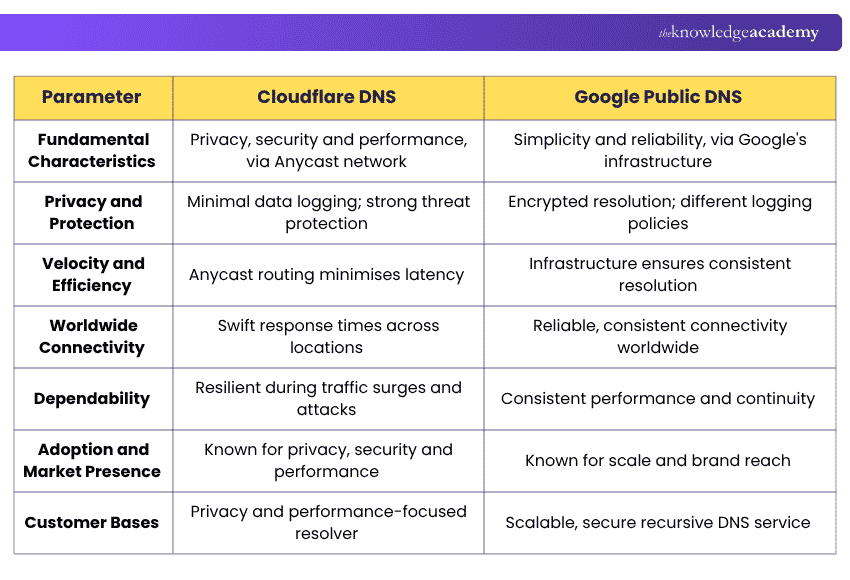
The table below provides an overview of the key differences between Cloudflare and Google DNS:
1) Fundamental Characteristics
Cloudflare DNS is built around privacy and security, supporting encrypted protocols such as DoH and DoT alongside its global Anycast network. Google DNS, by contrast, is built around simplicity and ease of use, backed by Google's global infrastructure and a straightforward setup process. Both support encrypted resolution, but Cloudflare positions privacy as its core selling point, while Google leans on brand reliability and accessibility.
2) Privacy and Protection
Cloudflare emphasises minimal data logging and positions privacy as a core feature of its 1.1.1.1 resolver. Google DNS also supports encrypted protocols, but its data-handling and logging policies differ from Cloudflare's. Since the two providers publish separate privacy documentation, users with specific privacy concerns should compare the current policies directly rather than assume either is more private by default.
Trainer’s Pro Tip
Encrypted DNS protects DNS queries between your device and the resolver, but it does not make all internet activity private. Consider DNS encryption as one part of a broader privacy and security approach.
3) Velocity and Efficiency
Cloudflare's Anycast routing directs a request to the nearest available server, which is designed to reduce the number of network hops and minimise latency.
Google DNS instead relies on the sheer scale of its infrastructure to keep resolution times low and consistent, rather than a dedicated routing method like Anycast. Both approaches can deliver fast resolution, but actual speed still depends on the user's location and network conditions.
4) Worldwide Connectivity and Response Time
Cloudflare's network spans data centres in a large number of countries, giving it a dense geographic footprint designed to keep most users close to a server. Google DNS operates across Google's own global data centre network, which is smaller in raw location count but backed by significant infrastructure investment at each site.
Neither provider publishes directly comparable server-count data, so geographic density alone doesn't guarantee a consistently better experience for every user.
Common Misconception
Myth: One public DNS resolver is always faster than another.
Reality: DNS performance varies with location, ISP, network routing and network conditions. Therefore, Cloudflare may perform better on one network while Google Public DNS may perform better on another.
5) Dependability and Operational Continuity
Cloudflare's dependability claims lean on its experience mitigating large-scale DDoS attacks, since its network was originally built to absorb exactly that kind of traffic surge. Google DNS's dependability instead comes from the broader reliability track record of Google's infrastructure, which supports many other Google services beyond DNS. Both are generally considered highly available, but the underlying reason for that reliability differs between the two.
6) Adoption and Market Presence
Cloudflare 1.1.1.1 is widely used, in part due to its early marketing around privacy and speed when it launched in 2018. Google Public DNS has been available since 2009, giving it a longer track record and wider historical adoption among developers and IT administrators.
However, neither company publishes precise, directly comparable market-share figures, so claims about which resolver is "more popular" should be treated with caution.
7) Customer Bases
Cloudflare's public messaging tends to target privacy-conscious individuals and organisations specifically looking for a security-focused alternative to their ISP's default resolver. Google Public DNS tends to attract users already embedded in Google's ecosystem, or those simply looking for a well-known, reliable alternative without a specific privacy focus. The right option ultimately depends on which priority, privacy or familiarity, matters more to the user.
Keep This in Mind
Choosing a DNS resolver is not just about advertised speed. Your location, ISP, network routing, privacy preferences and device configuration can influence the experience. A resolver that performs well on one network may perform differently on another.
Gain hands-on experience in solving real-world IT challenges with the IT Support and Solution Training – Sign up now!

Nilotpal Sarmah is a Senior Content Writer with 11+ years of overall experience spanning engineering, operations and content development. His technical knowledge and extensive writing experience enable him to simplify specialised topics across IT and Tech, Business Skills, Project Management, Health and Safety, and ISO and Compliance.
View Detail

 If you wish to make any changes to your course, please


