




We may not have the course you’re looking for. If you enquire or give us a call on 01344203999 and speak to our training experts, we may still be able to help with your training requirements.
Clojure Loop: Effortless Control Flow
ByVishnu SankarLast updated on: 23 September 2026
Dive into the world of Clojure's loop construct! Explore its seamless control flow for efficient and expressive iterative processes. Uncover how Clojure empowers developers with effortless looping, optimising performance in functional programming. Master the art of control flow with Clojure's loop. Elevate your coding prowess today
Are you tired of encountering Stack Overflow when running your codes? Is your code constantly running out of space and is unable to give the output you desire. Perhaps you need to find a new iterative process which can offer you everything traditional loops in other languages can’t. Meet Clojure Loop!
This blog will guide you through Clojure Loops, its syntax and examples to demonstrate its use cases. Keep Reading!
Introduction to Clojure Loop
Clojure's Loop is a powerful and versatile construct for creating iterative processes in a concise and expressive manner. Similar to traditional loops in other languages, Loop in Clojure provides a mechanism for repetitive execution of a block of code. What sets it apart is its functional approach and flexibility. It allows local bindings to be defined, and recursion within the loop, providing a rich toolset for creating complex algorithms.
Loop embodies Clojure's emphasis on immutability and functional programming principles, offering developers an elegant and efficient means of managing repetitive tasks in a functional paradigm.

Syntax of Clojure Loop
In Clojure, the Loop form provides a mechanism for iterative control flow. Unlike traditional loop constructs, Clojure emphasises recursion and functional programming paradigms. The syntax of a loop involves creating a named loop and defining bindings for local variables. Here's a breakdown of the syntax:
|
(loop [bindings] (if (condition) (recur updated-bindings) ; else, execute loop body (do ; loop body expressions (println "Iteration completed.") ; additional expressions ))) |
The following list will guide you through the important sections that make up a loop, we’ll refer to the elements present in the aforementioned example:
a) loop: Initiates the loop construct.
b) [bindings]: Specifies the local bindings, similar to destructuring in function arguments.
c) (if (condition) (recur updated-bindings) ...): Implements the conditional check for iteration termination. If the condition is met, recur is used to update bindings and restart the loop; otherwise, the loop body executes.
d) (do ...): Groups multiple expressions within the loop body. The do block can include various expressions, such as print statements or other computations.
e) The loop construct, coupled with recursion and recur, aligns with Clojure's emphasis on immutability and functional programming, providing a flexible and expressive means for handling iterative tasks in a functional paradigm.
Master the art of software design: Register for our Object-Oriented Programming (OOPs) Course and unleash your coding potential today!
Flowchart of Clojure Loop
Creating a flowchart for a loop in Clojure involves visualising the iterative control structure, typically implemented using constructs like loop and recur. Below is a simplified representation of a Clojure Loop in a flowchart:
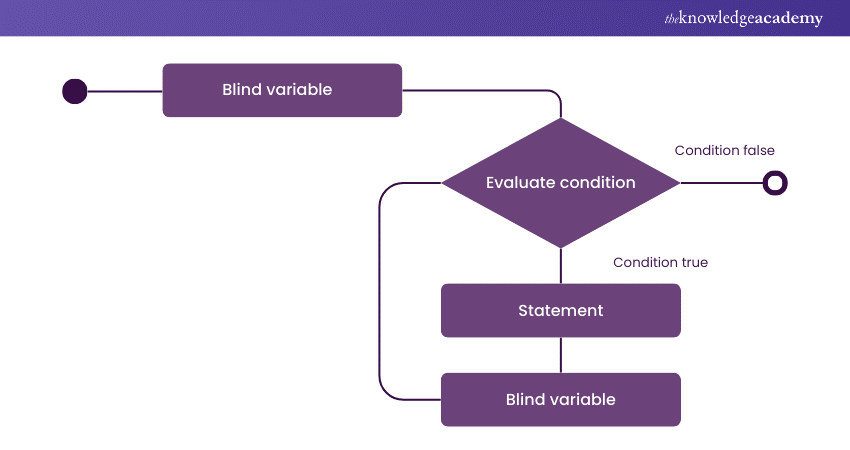
a) Start: The process begins with the start symbol.
b) Initialise variables: Initialise loop-related variables. In Clojure, this is often done using a loop and specifying initial values.
c) Condition Check: Evaluate the loop condition. If the condition is true, proceed to the next step; otherwise, exit the loop.
d) Loop body: Execute the loop body, which contains the statements to be repeated.
e) Update variables: Update loop-related variables within the loop body as needed.
f) Recur or exit: Use the recur function to repeat the loop with updated variables. If the loop condition is false, exit the loop.
g) End: The process concludes with the end symbol.
Clojure's Loop constructs, in combination with recur, provide a concise and functional way to implement iterative operations. The flowchart illustrates the cyclical nature of the loop, emphasising the repeated execution of the loop body until the exit condition is met, showcasing Clojure Data Types and their elegance in managing iterative processes.
Unlock the power of Clojure: Register now for comprehensive Clojure Programming Language Training and elevate your coding prowess!
Working of Clojure Loop
Clojure's Loop macro is a fundamental construct for creating iterative processes. It allows developers to implement looping and iteration in programming concisely and expressively. The basic structure of a loop involves defining bindings, conditions, and recursion.
Here is a simplified example:
|
(defn countdown [n] (loop [i n] (if (<= i 0) "Blastoff!" (do (println i) (recur (dec i)))))) (countdown 5) |
In this example, the loop is initiated with the binding i set to the initial value of n. The loop continues until the condition (<= i 0) is met. The current value of i is printed within the loop, and then the recur function is called with the decremented value of i. This creates a tail-recursive loop, optimising the iterative process.
The loop construct provides a powerful mechanism for handling repetitive tasks functionally and clearly. It allows for creating loops without resorting to mutable variables and provides an elegant solution for managing state within a functional paradigm. Using recur ensures the loop is tail-recursive, optimising performance and avoiding stack overflow issues. Overall, the loop macro in Clojure is an essential tool for building efficient and concise iterative processes in functional programming.
Master the key concepts with Clojure Interview Questions and Answers to boost your interview confidence!
Examples of Clojure Loop
Here are two extensive examples demonstrating the usage of the loop macro in Clojure:
Example 1: Fibonacci Sequence
|
(defn factorial [n] (loop [i 1 result 1] (if (<= i n) (recur (inc i) (* result i)) result))) (println (factorial 5)) |
In this example, the loop is used to generate the first n Fibonacci numbers. The loop maintains state with bindings a and b, while count keeps track of the remaining iterations. The result vector accumulates the Fibonacci sequence.
Example 2: Factorial Calculation
|
(defn custom-range [start end] (loop [current start result []] (if (< current end) (recur (inc current) (conj result current)) result))) (println (custom-range 1 5)) |
Here, the loop calculates the factorial of a number n. The loop maintains state with i representing the current number in the factorial calculation and result accumulating the factorial product. The loop continues until i exceeds n, returning the final factorial result.
Transform your coding journey: Join our Programming Training today and master the skills that propel you toward coding excellence!
Take the first step toward your new career by practicing Software developer interview questions and showing off your skills!

Vishnu Sankar is a Senior Content Writer with 5+ years of experience across content development, software development, web development and system administration. His technical background and professional training support his expertise in IT and Tech, while his extensive research and writing experience covers Project Management and Health and Safety.
View Detail

 If you wish to make any changes to your course, please


