


We may not have the course you’re looking for. If you enquire or give us a call on 01344203999 and speak to our training experts, we may still be able to help with your training requirements.
CAPM® vs PRINCE2®: A Detailed Comparison
ByDavid EvansLast updated on: 13 October 2026
Confused about choosing between CAPM and PRINCE2? Explore this detailed comparison of their eligibility requirements, exam formats, renewal processes, and career opportunities. Discover how CAPM builds foundational project management knowledge, while PRINCE2 offers a structured approach to managing projects.
Quick Look
1. CAPM and PRINCE2 offer different routes into project management.2. CAPM builds broad foundational knowledge, while PRINCE2 teaches a structured project method.3. The two differ in eligibility, exam format and renewal.4. Each suits different roles and career stages.5. The right choice depends on career goals, experience and employer requirements.
Imagine sitting across from two project management experts. One tells you to get CAPM, while the other insists PRINCE2 is the way to go. Both make convincing arguments, and somehow, you're more confused than when you started! That confusion is common, because CAPM and PRINCE2 are often compared as if they were direct rivals.
In fact, they are built for different purposes and suit different stages of a project management career. One builds broad foundational knowledge, while the other teaches a structured way of managing projects. To see where each one fits, it helps to start with what each certification actually covers.
What is CAPM®?
Certified Associate in Project Management (CAPM)® is an entry-level certification offered by the Project Management Institute (PMI). It validates foundational knowledge of project management principles, predictive methodologies, Agile practices and business analysis.
CAPM is suitable for aspiring Project Managers and professionals entering project-related roles. It does not require previous project management experience, making it an accessible starting point for developing professional credibility.

What is PRINCE2®?
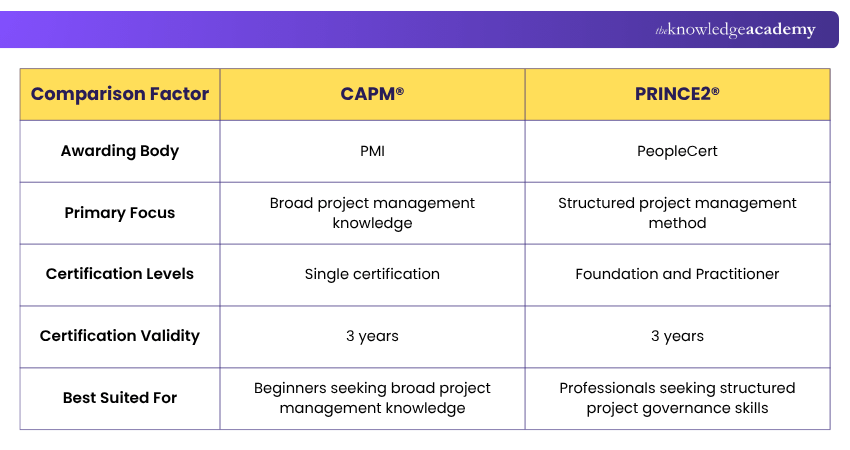
PRINCE2 (PRojects IN Controlled Environments) is a structured project management method that provides principles, practices, and processes for managing projects effectively. PRINCE2 certifications are awarded by PeopleCert. The current PRINCE2 (Version 7) offers two main certification levels:
a) PRINCE2 Foundation: Establishes an understanding of the method, terminology and core elements.
b) PRINCE2 Practitioner: Focuses on applying and tailoring the method to different project situations.

Key Differences Between CAPM® and PRINCE2®
Although both certifications support project management careers, they differ in eligibility, examination structure, knowledge coverage and professional applications. The following sections explain these differences.
1) Eligibility Requirements
CAPM and PRINCE2 have different entry requirements, particularly when comparing CAPM with PRINCE2 Practitioner.
CAPM Eligibility Requirements
According to PMI, candidates must fulfil the following requirements before taking the CAPM examination:
a) Hold a secondary degree, such as a high school diploma, GED or equivalent qualification.
b) Be at least 18 years old.
c) Complete at least 23 hours of project management education before the examination.
CAPM does not require previous professional project management experience.
PRINCE2 Eligibility Requirements
PeopleCert establishes separate requirements for each PRINCE2 certification level.
a) PRINCE2 Foundation: No formal prerequisites are required, allowing beginners to pursue the qualification directly.
b) PRINCE2 Practitioner: Candidates must hold an accepted prior qualification, such as PRINCE2 Foundation, CAPM, PMP or another certification recognised by PeopleCert.
2) Project Management Approach and Exam Content
The primary difference between CAPM and PRINCE2 lies in their approach to project management.
CAPM Approach
CAPM develops an understanding of different project management approaches rather than focusing on one specific method.
According to PMI, its examination covers four domains:
a) Project management fundamentals and core concepts: 36%
b) Predictive, plan-based methodologies: 17%
c) Agile frameworks and methodologies: 20%
d) Business analysis frameworks: 27%
This combination helps professionals understand how different approaches support project planning, delivery and stakeholder requirements.
PRINCE2 Approach
PRINCE2 provides a defined method for managing projects through structured governance and clearly assigned responsibilities.
Its core elements include:
a) Seven Principles: Guide project management decisions and activities.
b) Seven Practices: Address essential management areas, including risk, quality, planning and business justification.
c) Seven Processes: Describe the activities involved in managing projects from initiation to closure.
PRINCE2 Version 7 also places greater emphasis on people, sustainability, digital considerations and tailoring the method to project circumstances.
3) Exam Format and Difficulty
CAPM and PRINCE2 examinations differ in their question formats, duration, assessment methods and passing requirements.
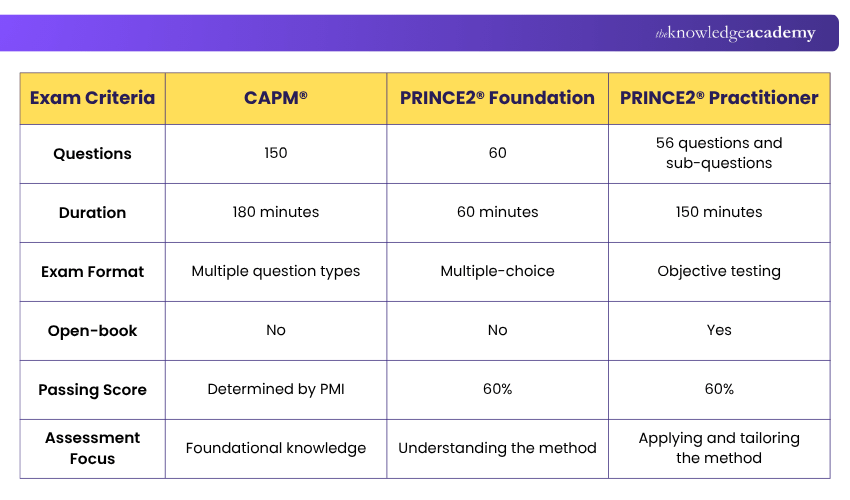
The following table summarises their official examination structures:
CAPM Examination
The CAPM examination contains 150 questions, including 135 scored questions and 15 unscored pretest questions. Candidates have 180 minutes to complete the examination.
PMI determines the passing standard through its examination development and scoring processes rather than publishing a fixed passing percentage.
PRINCE2 Examinations
PRINCE2 Foundation contains 60 multiple-choice questions and lasts 60 minutes. Candidates must achieve at least 60% to pass.
PRINCE2 Practitioner includes 56 questions and sub-questions worth 70 marks. It is an open-book examination lasting 150 minutes, with a minimum passing score of 60%.
Which Examination is More Difficult?
Difficulty depends on preparation and familiarity with project management concepts. CAPM covers several methodologies, requiring candidates to understand a broader range of topics.
PRINCE2 Foundation focuses on learning a defined method, while Practitioner requires candidates to apply their understanding to project scenarios. The Practitioner examination is more application-oriented than Foundation, although the open-book format allows candidates to consult permitted reference materials.
4) Certification Validity and Renewal
Both CAPM and PRINCE2 operate on three-year renewal cycles. However, their professional development requirements differ.
CAPM Certification Renewal
PMI requires CAPM certification holders to earn 15 Professional Development Units (PDUs) during each three-year certification cycle.
These requirements include:
a) Earning at least nine Education PDUs.
b) Claiming a maximum of six Giving Back PDUs.
c) Completing at least two Education PDUs in each PMI Talent Triangle area: Ways of Working, Power Skills and Business Acumen.
Certification holders must record their PDUs through PMI's Continuing Certification Requirements System and pay the applicable renewal fee.
PRINCE2 Certification Renewal
PeopleCert offers three routes for maintaining PRINCE2 certification:
a) Retake the Examination: Pass the same certification examination again.
b) Earn Another Certification: Pass another examination within the same PeopleCert product suite before the renewal deadline.
c) Complete CPD Activities: Maintain PeopleCert Plus membership and record 20 Continuous Professional Development (CPD) points annually for three consecutive years.
5) Career Opportunities and Industry Recognition
Both certifications support professional development, but their relevance depends on employer expectations and the responsibilities associated with particular roles.
Career Opportunities With CAPM
CAPM is particularly suitable for professionals beginning careers in project management or supporting project delivery.
Potential roles include:
a) Project Coordinator
b) Project Administrator
c) Project Analyst
d) Assistant Project Manager
Career Opportunities With PRINCE2
PRINCE2 is particularly relevant to organisations that use structured project governance, formal documentation and clearly defined responsibilities.
Potential roles include:
a) Project Support Officer
b) Project Manager
c) PMO Analyst
d) Project Delivery Manager
PRINCE2 Foundation commonly supports entry and support roles, while Practitioner supports professionals who manage and deliver projects, applying and adapting the method to organisational requirements.
Industry Recognition
CAPM is recognised internationally across industries that use predictive, agile and hybrid approaches. Because it covers several methodologies, it is often seen as a general starting credential for people entering project roles.
PRINCE2 is also recognised internationally and is especially established in the UK, Europe and Australia, particularly in the public sector and other organisations that use formal project management frameworks.
However, certification alone does not decide career progression. Practical experience, organisational needs and individual capabilities matter as well, and many professionals add further certifications as their careers develop.

David Evans creates accessible resources that help professionals understand different approaches to planning and delivering projects. His content addresses changing requirements, collaborative working and the practical demands of contemporary project environments.
View Detail

 If you wish to make any changes to your course, please


