


We may not have the course you’re looking for. If you enquire or give us a call on 01344203999 and speak to our training experts, we may still be able to help with your training requirements.
Business Management Case Study: A Complete Breakdown
ByNilotpal SarmahLast updated on: 08 October 2026
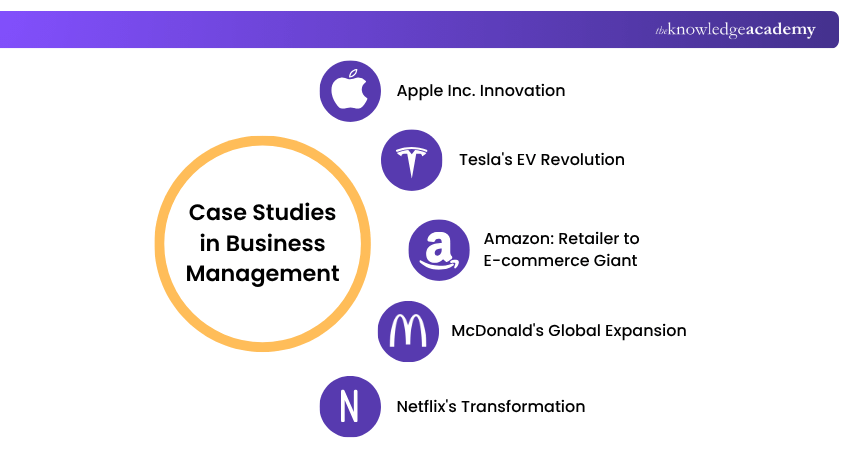
This blog examines five business management case studies featuring Apple, Tesla, Amazon, McDonald’s, and Netflix. It explores their approaches to innovation, expansion, competition and transformation, highlighting key strategies, outcomes, and management lessons from each example.
Some business decisions look brilliant in hindsight. Others probably caused a few sleepless nights, difficult conversations, and plenty of second-guessing before they finally paid off. What seems like an obvious move today may once have been a risky choice made with limited information and no guarantee of success.
That is exactly why case studies are worth exploring. They take you beyond textbook concepts and into the messy, fascinating reality of how organisations make choices when the stakes are high. By looking at real situations, you can better understand the thinking, trade-offs, and pressures behind important decisions, along with the lessons that emerge from their outcomes.
Five Business Management Case Studies
These five case studies examine business management decisions, the challenges behind them, and the outcomes and lessons they offer.
1) Apple: The 1997 Turnaround
a) Background: By 1997, Apple was close to collapse. It had lost about $1 billion in fiscal 1997, its market share was shrinking, and its product line was confusing, with many overlapping Macintosh models. Steve Jobs, who had left in 1985, returned after Apple bought his company NeXT.
b) Management Challenge: Apple needed to survive financially while rebuilding a clear identity. It faced a bloated product range, weak operating systems, low morale, and significant financial pressure.
c) Strategic Approach: Jobs applied radical focus. He reorganised the product strategy around four categories in a simple grid (consumer and professional, desktop and portable), ended Mac clone licensing, and strengthened the focus on design. He also made a pragmatic deal with Microsoft, which invested $150 million and committed to continue developing Office for the Mac.
d) Implementation: Many projects were cancelled, including further development of Newton OS and Newton-based products in February 1998. Engineering and design were concentrated on the iMac (1998), and marketing was rebuilt around the "Think Different" campaign. Later, the iPod (2001), iTunes Store (2003), and iPhone (2007) extended the strategy of integrating hardware, software, and services.
e) Outcomes and Lessons: Apple returned to profitability in fiscal 1998 and grew into one of the world's most valuable companies.
1) Focus and the discipline to say no matter more than breadth.
2) Competitors can become strategic partners when collaboration creates mutual benefits.
3) Design and brand are strategic assets, not just cosmetics.

2) Tesla: The Model 3 "Production Hell"
a) Background: Tesla began with the low-volume Roadster and the Model S and X, following Musk's "Master Plan" of moving from premium to mass-market cars. The Model 3, unveiled in 2016, with deliveries beginning in July 2017, was meant to be a more affordable car for a wider market, and it attracted hundreds of thousands of reservations.
b) Management Challenge: Tesla had to move from making thousands of cars to making hundreds of thousands, while burning cash and under intense public and investor scrutiny. Tesla aimed to reach 5,000 Model 3 vehicles per week, initially targeting late 2017, but production difficulties repeatedly delayed this goal.
c) Strategic Approach: Tesla chose a highly automated "alien dreadnought" factory in Fremont, aiming to make manufacturing itself a competitive advantage by designing the product and the factory together.
d) Implementation: Complex automated systems, including the battery module line, proved unreliable and created bottlenecks. Musk described the period as "production hell" and slept at the factory. Tesla replaced some automation with manual work and built an additional assembly line in a tent in 2018. Musk later said excessive automation was a mistake.
e) Outcomes and Lessons: Tesla produced 5,031 Model 3 vehicles in the final seven days of Q2 2018 and reported GAAP net income of $312 million in Q3. However, it still recorded a full-year net loss attributable to common shareholders of approximately $976 million.
1) Ambitious timelines need realistic validation of new processes.
2) Automation is not automatically better, and humans are sometimes more flexible.
3) Visionary leadership can mobilise teams, but it also creates risk when targets are set publicly.
3) Amazon: Long-Term Thinking and the Creation of AWS
a) Background: Founded in 1994 as an online bookstore, Amazon grew rapidly but reported thin profits or losses for years. Bezos's 1997 shareholder letter set out the philosophy of putting long-term market leadership ahead of short-term profit.
b) Management Challenge: Amazon had to scale without losing speed, while investors pressed for profits. Internally, its teams struggled to get computing infrastructure quickly, which showed that technology infrastructure was both a bottleneck and a possible opportunity.
c) Strategic Approach: Amazon reinvested its cash flow into growth, logistics, and technology, and organised around customer obsession and a "Day 1" culture. It decided to build externally available cloud infrastructure services, drawing on its experience of developing and operating technology at scale
d) Implementation: Amazon Web Services launched in 2006 with storage (S3) and computing (EC2) services. Small "two-pizza" teams owned services and shipped quickly. Amazon also made failed bets, such as the Fire Phone in 2014, and treated them as the cost of experimentation.
e) Outcomes and Lessons: When Amazon began reporting AWS separately in 2015, it showed a highly profitable business that helped fund the retail operation. AWS became a market leader in cloud computing.
1) Patient capital and a long-term view can create entirely new businesses.
2) Internal capabilities can become external products.
3) A culture that tolerates failure supports innovation, though scale also brings regulatory and antitrust scrutiny.
Pro Tip
Look for Trade-offs: Management decisions often involve choosing between speed, cost, control, flexibility, or scale rather than finding a perfect solution.
4) McDonald's: The "Plan to Win" Turnaround (2003)
a) Background: McDonald's expanded aggressively in the 1990s, opening many restaurants quickly. In the fourth quarter of 2002 it reported its first quarterly loss as a public company, and it suffered from inconsistent service, tired restaurants, and a menu that no longer matched customer tastes.
b) Management Challenge: The company had to reverse declining sales and customer satisfaction. It also faced growing public concern about health and nutrition, while managing a global franchise system with thousands of independent operators.
c) Strategic Approach: Jim Cantalupo returned as CEO in 2003 and launched the "Plan to Win," built on the principle of "better, not just bigger." The focus shifted from adding restaurants to improving the performance of existing ones, in areas such as people, products, place, price, and promotion.
d) Implementation: McDonald's slowed new openings remodelled restaurants, improved service and consistency, and expanded the menu with premium salads and chicken options. It introduced healthier choices such as apple slices and expanded the Happy Meal options. The "I'm lovin' it" campaign launched in 2003. After Cantalupo's death in 2004, leadership passed to Jim Skinner in November 2004, who continued the plan.
e) Outcomes and Lessons: Sales performance and profitability improved as the Plan to Win strategy took hold, helping McDonald's restore momentum during the following years.
1) Growth in quality can beat growth in quantity.
2) Listening to customer trends, such as health concerns and café-style options, can reopen markets.
3) A franchise system needs alignment between corporate and operators to execute a turnaround.
Develop practical skills for global growth with our Global Business Strategy Course – Join now!
5) Netflix: The Streaming Pivot and the Qwikster Mistake
a) Background: Netflix began in 1997 as a DVD-by-mail rental service and disrupted Blockbuster with a subscription model and no late fees. By the mid-2000s, broadband growth made streaming a viable future.
b) Management Challenge: Netflix had to shift from a profitable DVD business to streaming before others did, even though that would cannibalise its existing model. It also had to deal with rising content costs and the risk of losing subscribers during the transition.
c) Strategic Approach: Netflix launched streaming in 2007, then invested heavily in content licensing and later in original content, in order to reduce reliance on studios that could withdraw their catalogues.
d) Implementation: In 2011, Netflix raised prices sharply and announced it would split DVDs into a separate service called Qwikster. Customers reacted angrily, and Netflix reversed the Qwikster decision within weeks, after losing subscribers and seeing its share price fall sharply. It then pressed ahead with original content, starting with Lilyhammer premiering on Netflix in 2012 and House of Cards in 2013, and expanded globally.
e) Outcomes and Lessons: Netflix recovered and became a global streaming leader with hundreds of millions of subscribers.
1) Disrupting your own business is painful but may be necessary.
2) Poor communication and ignoring customer experience can damage even a strong strategy.
3) Owning content and data creates a lasting competitive advantage.
Key Learnings
1. Stay Responsive: Timely shifts help organisations remain relevant when industries and expectations change.2. Think Beyond Products: Lasting value often comes from connected capabilities rather than standalone offerings.3. Read the Market: Strong decisions begin with recognising changing behaviour, demand, and competitive pressure.4. Balance Scale and Flexibility: Expansion works best when consistency is combined with room for regional differences.5. Invest with Purpose: Resources create greater impact when tied to clear long-term priorities.6. Turn Plans into Action: Clear execution, coordination, and follow-through to determine whether ideas deliver results.

Nilotpal Sarmah is a Senior Content Writer with 11+ years of overall experience spanning engineering, operations and content development. His technical knowledge and extensive writing experience enable him to simplify specialised topics across IT and Tech, Business Skills, Project Management, Health and Safety, and ISO and Compliance.
View Detail

 If you wish to make any changes to your course, please


