




We may not have the course you’re looking for. If you enquire or give us a call on 01344203999 and speak to our training experts, we may still be able to help with your training requirements.
Artificial Intelligence in Finance: Uses and Benefits
ByJyoti TuraLast updated on: 07 October 2026
AI in Finance is reshaping the industry by automating tasks and enhancing customer experiences. This blog explores how artificial intelligence in finance is applied in fraud detection, credit assessment, and personalised banking, showcasing real-world examples. It will also highlight AI's transformative impact on financial services.
At a Glance
1. AI is becoming a core capability in modern finance rather than standalone technology.2. Its value depends heavily on data quality, governance, security, and human oversight.3. Financial institutions are increasingly combining AI with existing digital systems instead of using it in isolation.4. The strongest AI use cases are those that improve decisions without removing accountability.5. As adoption grows, organisations must balance innovation with transparency, resilience, and regulatory responsibility.
What happens when financial expertise meets systems that can analyse vast amounts of information in seconds? The result is a faster, more responsive industry where technology increasingly supports how institutions understand customers, manage uncertainty, and make decisions.
Artificial Intelligence is now influencing finance at both operational and strategic levels, making it an important part of how modern financial services are evolving.
What is AI in Finance?
Artificial intelligence in finance leverages advanced algorithms and machine learning to automate tasks, analyse data, and improve decision-making. It can improve efficiency and speed across data analytics, forecasting, investment and risk management, fraud detection, and customer service while supporting more consistent data-driven decisions. AI-powered models can support automated trading, market analysis, and investment decision-making based on predefined strategies and risk controls.
AI strengthens risk management, aiding fraud prevention, AML, KYC, and compliance initiatives. AI also personalises customer interactions by predicting behaviour and refining credit scoring. Overall, AI is transforming financial services, enabling data-driven decision-making, improving security, and enhancing customer experience while driving innovation across the industry.

Applications of AI in Financial Services
AI is transforming financial services by solving complex challenges across various applications. From improving customer experiences to enhancing fraud detection, AI-driven solutions are revolutionising the industry's operations. Here are some instances of how AI can solve real challenges in Financial Services:
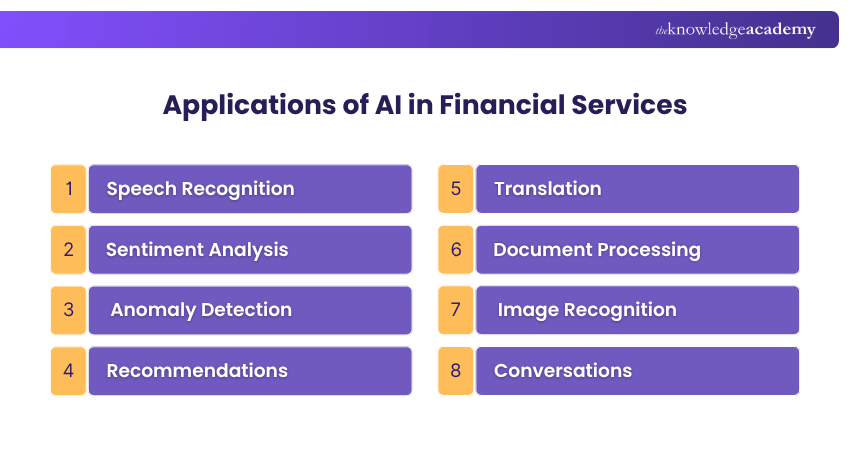
1) Speech Recognition
AI-powered speech recognition systems can automate customer service interactions by understanding and transcribing spoken language. Speech and voice technologies can support identity verification and fraud monitoring where appropriate, alongside other security controls.
2) Sentiment Analysis
Sentiment analysis uses Natural Language Processing (NLP) to gauge customer sentiment from various communications, including social media, emails, and chat interactions. Financial institutions can use this to monitor customer satisfaction, detect emerging trends, and predict market movements based on public sentiment.
3) Anomaly Detection
AI-based anomaly detection can flag irregularities in financial transactions and help identify potentially fraudulent or suspicious activity. Machine Learning algorithms can learn "normal" behaviour and trigger alerts for deviations that may signify financial crimes or cyber security threats.
4) Recommendations
AI can provide personalised financial product recommendations by analysing customers' past behaviour, preferences, and financial goals. This is particularly effective in wealth management and personal banking, helping users personalise product suggestions, savings options, or investment information based on customer data and configured eligibility criteria.
5) Translation
Financial institutions with global operations benefit from AI-driven language translation tools. These systems allow seamless communication with clients across different languages and regions, making services more accessible and efficient for a wider audience.
6) Document Processing
AI streamlines document-heavy processes such as loan applications, mortgage approvals, and compliance by automating data extraction, classification, and analysis. This reduces manual workload, speeds up processes, and supports more consistent data extraction and classification.
7) Image Recognition
In banking and financial services, image recognition, combined with Fraud Analytics, can be applied in areas like document verification. AI models can scan and verify documents such as ID proofs, signatures, and checks, enhancing the onboarding process while strengthening fraud detection mechanisms.
8) Conversations
AI-driven chatbots and virtual assistants provide real-time customer support, handling common queries and freeing up human agents for more complex cases. Conversational AI systems can be deployed across multiple communication channels, offering 24/7 support for balance enquiries, account management, product information, and routine service requests.
9) Data Science and Analytics
AI is important in analysing large datasets for trends, patterns, and insights. This helps in risk management, fraud detection, market analysis, and investment strategy development in finance. Machine learning models can analyse historical data to identify patterns and estimate possible future outcomes.
10) Predictive Modeling
AI-based predictive modelling can forecast market trends, assess credit risks, and model financial scenarios. It is used in various applications, such as portfolio management, stock price prediction, and risk assessment, enabling institutions to make more informed decisions.
11) Cyber Security
AI strengthens Cyber Security by identifying unusual patterns of activity that may signal a potential attack. Machine Learning models can detect and mitigate threats in real time, ensuring financial institutions remain secure from data breaches, phishing attacks, and fraud.
12) Generative AI
Generative AI can create synthetic financial data to train Machine Learning models, simulate trading scenarios, or generate market forecasts. In customer service, generative models can craft personalised responses in communication tools, adding a human-like touch to automated interactions.
Unlock the power of data with our comprehensive Machine Learning Course – Join today!
Benefits of AI in Finance
AI is revolutionising the financial industry by offering numerous benefits that enhance productivity, accuracy, and innovation. AI drives significant improvements across financial operations and customer experiences, from automating routine tasks to enabling real-time decision-making.
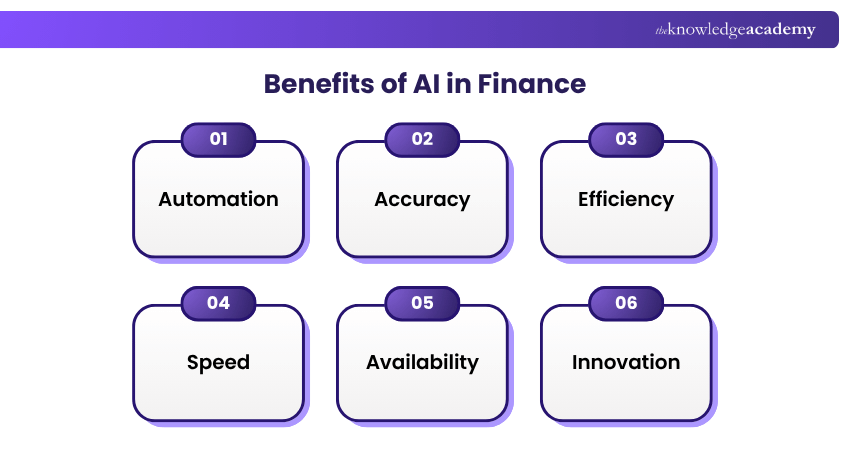
1) Automation
AI can automate suitable workflows and support decision-making and service delivery through configured rules, models, and human oversight. For instance, AI can support a payments provider by automating Cyber Security through continuous network traffic monitoring and analysis. It can also improve a bank’s client-centric approach by offering more personalised, flexible digital banking experiences that meet customer needs faster and with greater security.
2) Accuracy
AI can reduce certain manual processing errors and improve consistency in structured tasks when models are trained, tested, and monitored appropriately. Human review and data quality controls remain important.
3) Efficiency
When AI handles repetitive tasks, it frees people to focus on more strategic work. AI can automate document verification, call transcription, or answer common customer queries like “What time do you close?” AI bots are commonly used to manage routine, low-touch tasks, reducing the need for human intervention in these areas.
4) Speed
AI process vast amounts of information far quicker than humans, identifying patterns and relationships in data that might otherwise go unnoticed. This leads to faster insights that drive decision-making, enhance trading strategies, improve risk modelling, streamline compliance management, and more.
5) Availability
AI enables customers to manage their finances, achieve goals, and complete financial tasks anytime. When deployed in the cloud, both AI and machine learning can continuously operate, efficiently handling assigned tasks, and delivering real-time solutions.
6) Innovation
AI can support the development of new financial products and services by analysing customer needs, market behaviour, and operational data. For example, predictive analytics can help insurers personalise customer interactions and improve service delivery.
Master cutting-edge techniques in AI with our Deep Learning Course – join now and elevate your expertise.
Trainer’s Insight
AI delivers the most value in finance when it supports human judgement rather than replacing accountability. Strong data quality, clear governance, and regular monitoring are essential when AI influences customer, risk, or financial decisions.
Examples of Companies Using AI in Finance
Let us take you through some real-world examples of organisations integrating artificial intelligence into their business processes and information architectures.
1) JPMorgan Chase
JPMorgan utilises a proprietary algorithm to detect fraud patterns. The bank's data centres process credit card transaction details, conducting thorough assessments to identify potential fraudulent activity efficiently. This AI-driven approach enhances the security and reliability of its financial services.
2) Bank of America
Bank of America uses AI across customer service and employee support through tools such as Erica and EricaAssist. In 2026, Bank of America expanded EricaAssist with generative AI capabilities that provide customer service representatives with real-time contextual guidance while keeping employees responsible for client interactions.
3) Capital One
Capital One, a financial institution specialising in banking, credit cards, and auto loans, is renowned as a technology-driven bank. It launched Eno, designed for natural language interaction. Eno provides insights, predicts customer needs, and alerts users to potential fraud, enhancing customer service and security through AI-driven solutions.
4) Visa
Visa uses artificial intelligence across payments, fraud prevention, and financial insights. In 2026, it introduced an AI Financial Assistant designed to help financial institutions provide cardholders with personalised spending insights and conversational financial guidance within existing banking apps. Visa also uses AI to support fraud detection and real-time payment risk assessment across its global network.
5) Gynger
Gynger leverages AI to streamline its tech financing platform, providing solutions for both buyers and vendors. The company claims buyers can quickly and easily create an account, with approval granted by the next day, enabling them to access flexible payment options for hardware and software purchases.
6) Enova
Enova uses AI and ML in its lending platform to offer advanced financial analytics and credit assessments. The company focuses on serving non-prime consumers and small businesses, addressing challenges like emergency expenses and small business loans, while ensuring both lenders and borrowers avoid unmanageable financial risks.
7) Workiva
Workiva uses AI across financial reporting, risk, compliance, and sustainability workflows. Its AI capabilities support tasks such as drafting content, analysing documents, extracting insights, and assisting with reporting and compliance processes.
Turn everyday tasks into AI-powered workflows with the AI Productivity Foundation and Practitioner (The Users) Training – Join now!
8) Kensho Technologies
Kensho, an S&P Global company, developed Machine Learning and data analytics software capable of analysing vast datasets and documents. By integrating Machine Learning, Cloud Computing, and Natural Language Processing, Kensho’s platform delivers clear answers to complex financial questions and rapidly extracts insights from tables and documents.
9) Trumid
Trumid is a fintech platform specialising in fixed-income trading. It uses machine learning in its Fair Value Model Price™ (FVMP™) solution to provide real-time predictive pricing across more than 30,000 U.S. corporate bonds. The system combines proprietary trading data with external market data to support price discovery and trading decisions.
10) Tegus
Tegus, an investment research platform powered by AI and Machine Learning algorithms, helps clients efficiently explore investment opportunities. By offering AI-generated summaries of expert interviews, Tegus enables investors to make informed decisions faster and more accurately.
11) SoFi
SoFi provides online banking services to consumers and small businesses, offering checking and savings accounts, small business loans, student loan refinancing, and credit score insights. SoFi uses digital tools and AI-supported services across areas such as customer support, financial insights, and account management.
12) Stripe
Stripe uses AI through its Radar platform to detect and prevent payment fraud. Radar analyses signals across Stripe’s global payments network to assess transaction and account risk, helping businesses identify suspicious activity, reduce fraud, and protect legitimate payments in real time.
13) American Express
American Express uses AI across fraud prevention, credit assessment, customer service, and commercial operations. In 2026, the company reported using AI to analyse unstructured data for credit insights and to help classify fraud claims, support faster risk assessment, and improve customer and merchant experiences.
14) Jumio
Jumio’s KYX platform helps businesses build trust with online customers by verifying identities using facial recognition and ensuring compliance with financial regulations. It continuously assesses risk while analysing customer identities through biometric authentication and transaction monitoring. Widely adopted in industries like education, healthcare, retail, and gaming, Jumio’s platform enhances security and regulatory adherence.
15) Visa A2A Protect
Visa also uses advanced AI in its A2A Protect solution to help financial institutions identify account-to-account payment fraud. The system provides real-time risk insights and uses AI and transfer learning to help banks detect suspicious transactions before funds leave customer accounts.
The Future of AI in Financial Services
The future of artificial intelligence is poised to drive growth in financial services as more organisations embrace digital transformation, enhancing their ability to sell, boost efficiency, and leverage data. To scale relationship-based customer engagement, AI will be crucial in delivering personalised responses, offering safer, accountable product recommendations, and expanding concierge services when customers need them most.
Additionally, financial institutions must create permission-based digital customer profiles, though necessary data often needs to be siloed. By integrating AI to break down these barriers and seamlessly incorporating human engagement, institutions can enhance their digital customer service, delivering tailored experiences that meet customer needs while scaling effectively.
Explore practical AI concepts and applications with our Artificial Intelligence Courses– Start learning today!
Quick Check
Which AI application is commonly used to identify unusual transaction patterns in financial services?
A. Sentiment AnalysisB. Anomaly DetectionC. TranslationD. Image RecognitionCorrect Answer: B

Jyoti Tura is a Senior Web & UX/UI Manager with 7+ years of experience in front-end development, web development and user-focused interface design. Her technical expertise and managerial responsibilities support her knowledge across IT and Tech, Leadership and Management.
View Detail

 If you wish to make any changes to your course, please


