




We may not have the course you’re looking for. If you enquire or give us a call on 01344203999 and speak to our training experts, we may still be able to help with your training requirements.
What is Agentic AI and How It Works
ByThe Knowledge AcademyLast updated on: 05 October 2026
Agentic AI refers to autonomous systems that work towards defined goals, plan actions, and execute multi-step tasks with limited human oversight. These systems can adapt their actions based on changing conditions, feedback, and available information while interacting with tools and connected systems.
Quick Overview
1. Agentic AI can plan and execute multi-step tasks towards defined goals.2. Its core operating cycle involves perception, reasoning, action and reflection.3. Agentic systems can interact with applications, APIs, databases and other AI agents.4. Use cases span customer support, IT operations, supply chains, finance and software development.5. Effective implementation requires clear goals, security, monitoring and appropriate human oversight.
Let’s face the truth: generative AI is cool, but it’s a prompt addict. Type something clever, get something clever back. What if your AI didn’t wait for instructions, it just knew what to do? Welcome to the rise of Agentic AI; the next evolution in artificial intelligence where bots don’t just think, they act. These digital agents don’t just react, they plan, execute, and learn.
It’s like hiring a digital intern that doesn’t need sleep, breaks, or constant babysitting. In this blog, you will explore how these agents are transforming industries, managing workflows, and even running Crypto plays while you’re bingeing Netflix. This isn’t just a smarter tool, but a digital partner with a drive.
What is Agentic AI?
Agentic AI refers to artificial intelligence systems that operate as agents. That means they don’t just process data, but perceive their environment, reason about what’s happening, act to achieve a goal, and learn from the outcomes. The term Agentic comes from "agency" which is the capacity to act independently and make choices.
These systems copy human-like decision-making and can work independently or in collaboration with other agents. They are smart assistants that not only take orders but know what to do when no one’s watching.

How Does Agentic AI Work?
Agentic AI systems function through a cognitive loop that enables autonomy and adaptability. A typical agentic workflow can be explained through four key stages:
1) Perception
Perception is the first stage of an agentic AI system, where the AI gathers information from documents, applications, databases, APIs, sensors, and other connected systems. It analyses this data to understand the current context before making decisions.
2) Reasoning and Planning
After collecting information, the AI evaluates available options and develops a plan to achieve its objective. It develops a suitable sequence of actions, selects available tools, and can adjust the plan based on task requirements and new information.
3) Taking Action
The AI executes its planned tasks by interacting with applications, APIs, automation tools, or other AI agents. These actions may include updating records, retrieving information, generating content, initiating workflows, or coordinating processes across multiple systems.
4) Reflecting and Learning
Once an action is completed, the system can evaluate the outcome and use feedback or stored context to refine subsequent actions. Depending on its design, memory and evaluation mechanisms can help it maintain continuity and adapt future decisions.
Agentic AI in Action
Consider an AI agent supporting IT incident management.
Perceive: It detects an application issue and gathers relevant logs.Reason: It analyses the available information and identifies a possible cause.Act: It performs an authorised corrective action or escalates the issue.Reflect: It checks whether the service has recovered and records the outcome.
Types of AI Agents in Agentic AI Systems
AI agents can be categorised in different ways depending on their architecture and behaviour. The following are some commonly discussed categories:
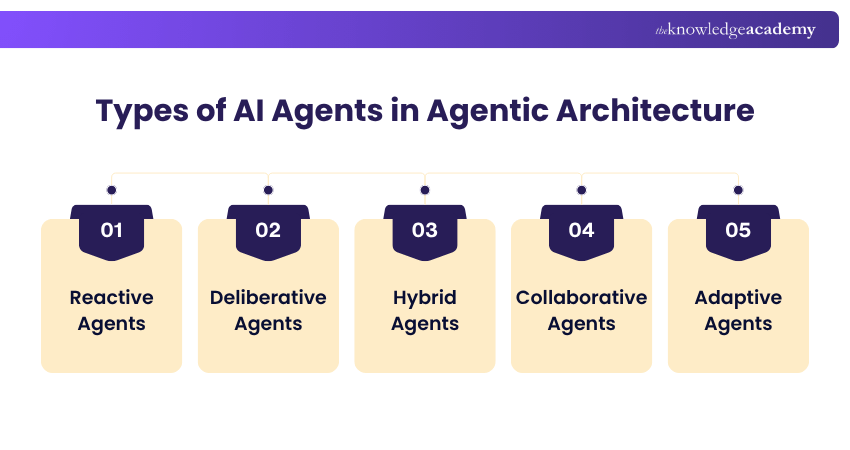
1) Reactive Agents: These respond to specific inputs without internal memory. They’re fast but not adaptable.
2) Deliberative Agents: They think before they act. These agents plan, predict outcomes, and decide accordingly.
3) Hybrid Agents: Combine reactive behaviour with planning and reasoning capabilities.
4) Collaborative Agents: These work with other agents or humans to achieve shared goals.
5) Adaptive Agents: They learn and evolve based on new data or feedback from their actions.
Trainer’s Insight
Autonomy does not necessarily mean operating without human involvement. Agentic systems can work within defined permissions and approval points while independently handling suitable parts of a workflow.
Make algorithms your most reliable business allies. Sign up for the Artificial Intelligence (AI) For Business Analysts Training!
Use Cases of Agentic AI
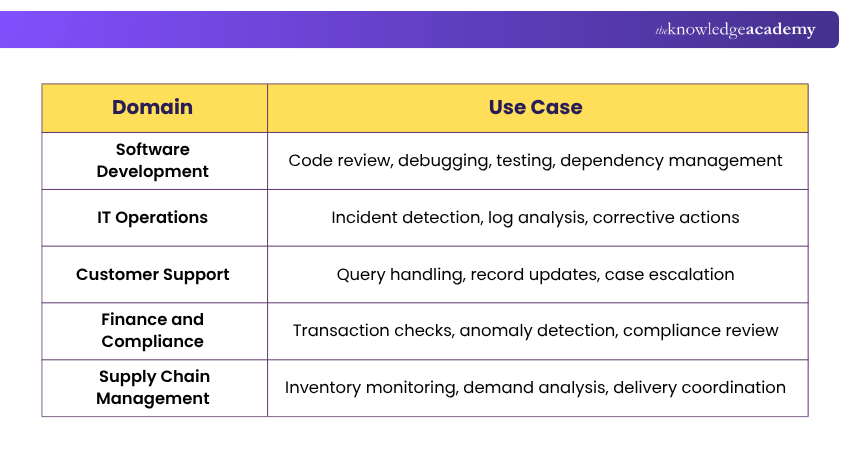
Agentic AI is transforming industries by taking on tasks that require autonomy, context-awareness, and continuous learning. These systems are ideal for situations where simple automation falls short, and human-like reasoning is needed. Here are the use cases of the same:
1) Software Development
Agentic AI can support developers by reviewing code, identifying potential issues, suggesting improvements, and coordinating development tasks. It can also interact with development tools to assist with testing, debugging, and dependency management.
For Example: An AI agent can identify an outdated software dependency, suggest an updated version, and prepare a pull request for developer review.
2) IT Operations
AI agents can assist IT teams by monitoring systems, analysing logs, identifying possible causes of incidents, and recommending or carrying out authorised actions. They can also escalate issues when human intervention is required.
For Example: An agent can detect an application issue, collect relevant logs, suggest a corrective action, and verify whether the service has recovered.
3) Customer Support
Agentic AI can handle suitable customer enquiries by retrieving information, generating responses, updating records, and escalating complex cases. This can help streamline support workflows while keeping human agents involved where necessary.
For Example: An AI agent can review a customer request, retrieve account information, provide a relevant response, and escalate the case if further assistance is needed.
4) Finance and Compliance
Agentic AI can assist with tasks such as invoice processing, transaction validation, anomaly detection, and compliance checks. It can compare information against configured policies and flag cases that require further review.
For Example: An agent can review transaction data, identify unusual activity, and send the case to a finance professional for investigation.
5) Supply Chain Management
Agentic AI can support inventory monitoring, demand analysis, supplier coordination, and delivery planning. It can respond to changing conditions by adjusting recommendations or workflows based on updated information.
For Example: An agent can detect low inventory levels, review demand data, and recommend changes to replenishment or delivery schedules.
Trainer’s Insight
Autonomy itself is not the goal. The value comes from outcomes such as reduced manual coordination, faster execution and more consistent handling of suitable workflows.
Develop predictive models using essential machine learning techniques by joining the Machine Learning Course today!
Benefits and Challenges of Agentic AI
Agentic AI brings a powerful shift from passive automation to intelligent and goal-driven systems. They can think, act, and learn on their own. But it’s not without some challenges. Here's a quick glance at the pros and cons:
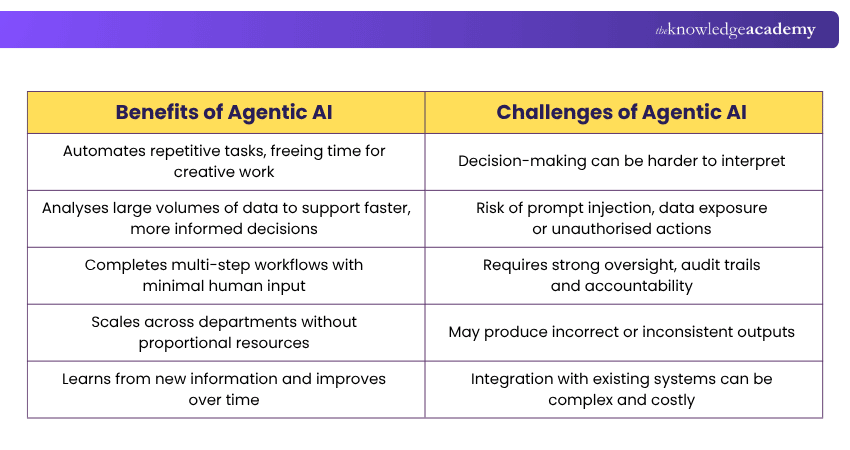
Now let’s explore its benefits and challenges in detail:
1) Benefits of Agentic AI
1) Improved Productivity: Agentic AI automates repetitive and multi-step tasks. This allows employees to focus on higher-value activities such as strategy, innovation, and customer engagement.
2) Better Decision-making: By analysing large volumes of data in real time, Agentic AI provides insights that support faster, more informed, and data-driven decisions.
3) Greater Operational Efficiency: Unlike traditional automation, Agentic AI can plan, execute, and adapt workflows with minimal human input, improving speed, accuracy, and consistency.
4) Scalability: Agentic AI can manage growing workloads across multiple departments without requiring a proportional increase in resources, making it suitable for expanding organisations.
5) Continuous Learning and Adaptation: Through feedback and changing data, Agentic AI continuously refines its performance, enabling it to improve outcomes and respond effectively to evolving business needs.
Don’t follow the future; just shape it with our Cognitive Computing Training. Register Today!
2) Challenges of Agentic AI
1) Limited Transparency: The reasoning behind AI-generated decisions can be difficult to interpret, making it harder to explain outcomes or identify the cause of errors.
2) Security and Privacy Risks: Because Agentic AI interacts with data and business systems, organisations must implement stern security measures to protect sensitive information and prevent unauthorised actions.
3) Governance and Compliance: Organisations need clear policies, human oversight, and accountability to ensure Agentic AI operates ethically and complies with regulatory requirements.
4) Accuracy and Reliability: Agentic AI may occasionally produce incorrect or inconsistent outputs, particularly when handling unfamiliar scenarios or poor-quality data. Regular monitoring and validation remain essential.
5) Implementation Complexity: Deploying Agentic AI often requires integrating multiple systems, preparing high-quality data, and redesigning workflows, which can demand significant time, expertise, and investment.
Agentic AI Risk Checklist
Before giving an AI agent greater autonomy, check:
□ What systems and data can it access?□ Which actions is it authorised to perform?□ Which decisions require human approval?□ Can its actions be logged and reviewed?□ How will incorrect outputs be identified?□ Can problematic actions be stopped or reversed?□ Are security and privacy requirements addressed?□ Is someone accountable for monitoring the system?
Examples of Agentic AI Automation
Agentic AI can autonomously plan, make decisions and complete multi-step tasks with minimal human intervention. Unlike traditional automation, it adapts to changing conditions, uses external tools, and coordinates actions to achieve a defined goal across business workflows.
1) Customer Support Automation
Agentic AI can handle suitable customer enquiries by retrieving relevant information, generating responses, updating records, and escalating cases that require human assistance. This reduces response times while improving service quality.
2) IT Operations and Incident Management
AI agents can detect system issues, analyse logs, identify root causes, recommend solutions, and even execute corrective actions. They continuously monitor IT environments to minimise downtime and improve operational efficiency.
3) Supply Chain Optimisation
Agentic AI monitors inventory, predicts demand, coordinates suppliers, adjusts delivery schedules, and responds to disruptions in real time. This helps organisations improve inventory management and maintain resilient supply chains.
4) Financial Process Automation
AI agents can process invoices, validate transactions, detect anomalies, prepare financial reports, and support compliance checks with minimal manual intervention. This improves accuracy while reducing repetitive administrative work.
5) Software Development Assistance
Agentic AI can assist developers by generating code, debugging applications, running tests, analysing results, and suggesting improvements. It supports the entire development lifecycle while enabling faster and more efficient software delivery.
Master the technology behind smarter decisions, automation and innovation with our range of Artificial Intelligence Courses - Sign up now!
Best Practices for Implementing Agentic AI
Implementing Agentic AI means building smart systems that can think and act on their own. However, they still need good design and clear rules. Here are some simple best practices to follow:
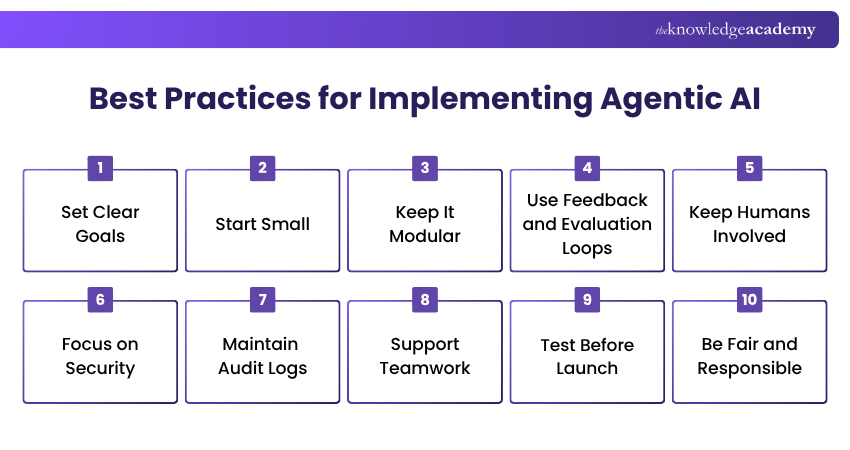
1) Set Clear Goals: Make sure each agent knows what it’s supposed to do and what success looks like.
2) Start Small: Begin with one agent doing a simple task, then add more as needed.
3) Keep It Modular: Build agents like building blocks which can be easy to reuse, change, or upgrade.
4) Use Feedback and Evaluation Loops: Review outcomes and use validated feedback to improve prompts, policies, workflows, memory, or agent behaviour where appropriate.
5) Keep Humans Involved: Even smart agents need human checks, especially for big or risky decisions.
6) Focus on Security: Give agents dedicated identities and only the minimum permissions required to complete authorised tasks.
7) Maintain Audit Logs: Record relevant agent actions, tool calls, approvals, and outcomes so activity can be reviewed, investigated, and audited.
8) Support Teamwork: In multi-agent setups, make sure agents can talk to each other and work together smoothly.
9) Test Before Launch: Try your agents in safe, test environments before using them in the real world.
10) Be Fair and Responsible: Watch out for bias or unfair behaviour, when agents learn on their own.
Implementation Checklist
Before deploying Agentic AI:
□ Define a clear goal□ Select a bounded initial use case□ Establish permissions and limits□ Define human approval points□ Protect connected systems and data□ Establish logging and monitoring□ Test actions in a controlled environment□ Create escalation procedures□ Define accountability□ Review the system regularly
Agentic AI vs Generative AI
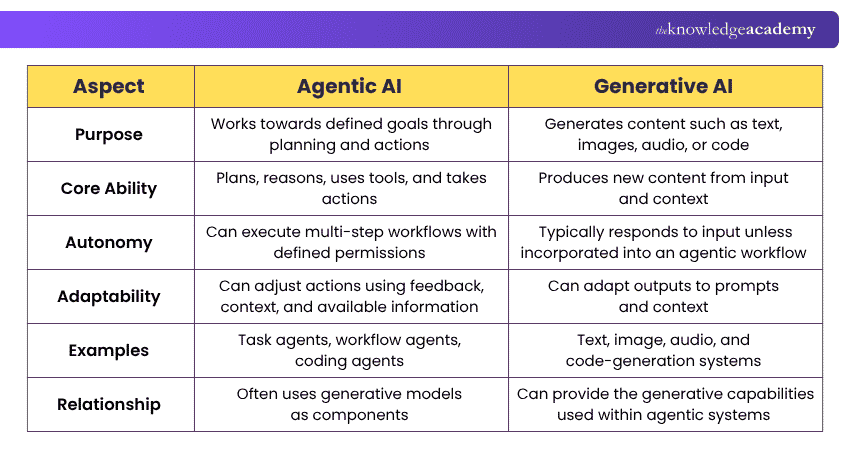
Both Agentic AI and Generative AI are forms of advanced artificial intelligence; they serve very different purposes. Generative AI focuses on creating content like text, images, or code based on prompts. In contrast, Agentic AI is goal oriented as it can perceive situations, make decisions, take actions, and learn from outcomes. In fact, Agentic AI can even use generative models as tools to achieve its goals, making it more autonomous and interactive.

The Knowledge Academy develops accessible learning content across Project Management, IT, Cybersecurity, Data Science, Business Analysis, HR, Accounting and Finance, Leadership and Health and Safety. Its resources combine subject research with clear explanations to help professionals build practical knowledge across a wide range of disciplines.
View Detail

 If you wish to make any changes to your course, please


