




We may not have the course you’re looking for. If you enquire or give us a call on + 1-866 272 8822 and speak to our training experts, we may still be able to help with your training requirements.
Advantages and Disadvantages of UML: An In-Depth Analysis
ByThe Knowledge AcademyLast updated on: 09 September 2026
Interested in learning all about the Advantages and Disadvantages of UML? Unified Modelling Language (UML) is a flexible instrument for illustrating system designs, yet it has pros and cons. This blog dives into the Advantages and Disadvantages of UML in software development, offering perspectives on its real-world uses.

Unified Modelling Language (UML) is a tool that software developers use to design and understand complex systems. While some companies consider UML essential for developing precise software models, others question its significance. In this blog, we will discuss the Advantages and Disadvantages of UML and provide a UML guide. Whether you are new to development or an experienced professional, this balanced perspective will help determine if UML suits your projects.
Advantages of Unified Modelling Language (UML)
Unified Modelling Language (UML) helps Software Developers to strategise intricate systems by illustrating how components interact.

1) Visualisation
UML diagrams showcase system elements, connections, and operations. This visual picture helps in understanding and creating intricate systems.

2) Analysis and Design
UML aids in both the analysis and design phases of software development. It helps represent system needs and turn them into a design that can be implemented.
3) Communication
UML diagrams effectively communicate complex concepts to various stakeholders, such as Developers, Designers, Testers, and Business Users.
4) Standardisation
UML offers a standardised way of depicting system models. This guarantees that developers and stakeholders can effectively communicate with each other using a shared visual representation.
5) Clarity and Adaptability
UML offers standard diagrams that are clear and easy to understand. These diagrams can be modified to meet different project requirements, improving communication and comprehension.
6) Simplified Debugging Process
UML diagrams simplify the process of identifying and resolving issues. They visually illustrate system parts and relationships, making troubleshooting and issue resolution easier.
Transform your Designing skills with our Software Design and Architecture Training - Sign up now!
Disadvantages of Unified Modelling Language (UML)
Apart from some pros, UML comes with some drawbacks. Let’s explore some of the key disadvantages of UML
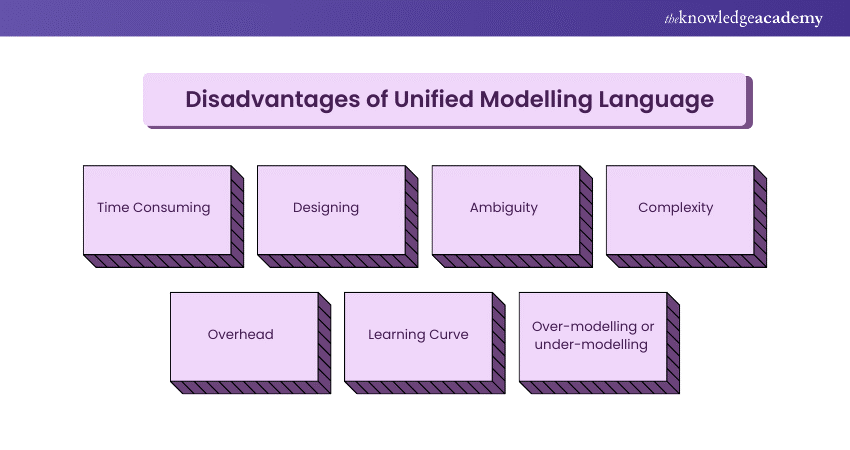
1) Time Consuming
Developing and managing large UML diagrams can be time-consuming, particularly on extensive projects. This may delay the development schedule and raise the project budget.
2) Designing
Creating diagrams with UML can be complex, necessitating scrutiny to guarantee accurate and efficient designs.
3) Ambiguity
Understanding UML diagrams can vary from person to person, possibly leading to confusion within the team.
Learn and master your projects with our Analysis and Design using UML Course – Register now!
4) Complexity
UML's wide range of capabilities may seem daunting, especially for newbies, causing difficulty in becoming proficient.
5) Overhead
Developing and keeping up with UML diagrams can require extra effort, especially for smaller projects that don't require extensive documentation.
6) Learning Curve
Learning UML can be challenging because of its many features and types of diagrams, requiring practical training and practice.
7) Over-modelling or under-modelling
Over-modelling or under-modelling refers to the problem of creating machine learning (ML) models that are too complex or simplistic, leading to poor performance on unseen data.

The Knowledge Academy develops accessible learning content across Project Management, IT, Cybersecurity, Data Science, Business Analysis, HR, Accounting and Finance, Leadership and Health and Safety. Its resources combine subject research with clear explanations to help professionals build practical knowledge across a wide range of disciplines.
View Detail

 If you wish to make any changes to your course, please


