




We may not have the course you’re looking for. If you enquire or give us a call on 01344203999 and speak to our training experts, we may still be able to help with your training requirements.
ACID Properties in DBMS: A Complete Guide
ByThe Knowledge AcademyLast updated on: 02 October 2026
Curious about ACID properties in DBMS? ACID stands for Atomicity, Consistency, Isolation, and Durability, ensuring reliable database transactions. This blog explains each property in detail and its importance in maintaining data integrity. Learn how ACID properties safeguards your database and why they are necessity in modern databases!
What's Inside This Blog
1. How ACID properties keep database transactions reliable2. What Atomicity, Consistency, Isolation, and Durability mean3. How ACID works in a practical money-transfer example4. The key benefits of ACID transactions5. The performance, concurrency, and scalability trade-offs to consider
Have you ever wondered what happens when a database operation fails halfway through or multiple transactions occur at the same time? Without proper transaction controls, these situations can lead to incomplete updates, conflicting changes or unreliable results.
ACID properties provide a structured approach to handling such challenges. In this blog, we’ll explore how they work, see them in action through a practical example and examine their key benefits and trade-offs. Let's dive in!
What are ACID Properties in DBMS?
ACID properties encompass four fundamental principles: Atomicity, Consistency, Isolation, and Durability. These principles provide transactional guarantees that help maintain data integrity and reliability. Let’s explore them in detail:
1) Atomicity
Atomicity requires that transactions be treated as a single “unit of work.” The entire sequence of operations within a transaction must either succeed or fail as one entity, with no partial success or failure. For example, transferring money between bank accounts involves debiting one account and crediting another.
If either operation fails, the entire transaction is rolled back, preventing partial or incomplete transactions and maintaining data consistency.

2) Consistency
Consistency ensures that a transaction moves the database from one valid state to another while preserving defined integrity constraints and rules. Constraints such as primary keys, foreign keys, unique constraints and checks can help enforce consistency. Application logic or database mechanisms such as triggers may enforce additional business rules.
For instance, a transaction that violates a defined account balance constraint can be rejected, helping maintain data integrity.
3) Isolation
Isolation controls how concurrent transactions interact, helping prevent one transaction from improperly interfering with another. Database systems may use locking, Multi-Version Concurrency Control (MVCC), snapshots or other concurrency-control mechanisms to provide isolation. The level of protection depends on the configured transaction isolation level.
For example, one transaction may update a row while another transaction sees an earlier committed version rather than the uncommitted change.
Trainer’s Insight
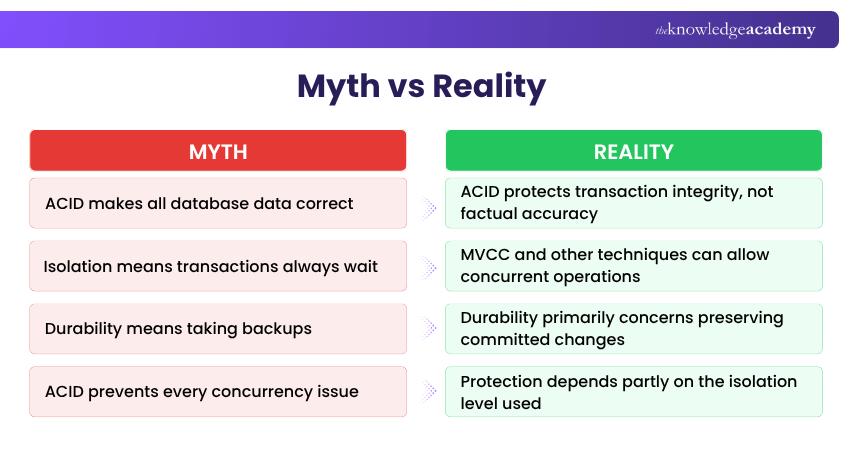
Isolation does not always mean transactions run one after another. Modern databases can use techniques such as MVCC and different isolation levels to balance data consistency with concurrency and performance.
4) Durability
Durability ensures that once a transaction has been successfully committed, its changes persist even after a system crash or restart. Database systems commonly achieve this through mechanisms such as write-ahead or redo logging and persistent storage.
For example, if a committed transaction updates a customer’s address, durability helps ensure that the change can be recovered after an unexpected system failure.
These ACID properties are essential for maintaining the reliability, integrity, and consistency of databases, making them crucial for any robust Database Management System (DBMS).
Example of ACID Properties in DBMS
Atomicity ensures both balance updates succeed or fail together. Consistency ensures defined database constraints remain valid. Isolation controls how concurrent transfers interact, while durability ensures that committed balance changes persist after a failure. To better understand how ACID properties function in real-world scenarios, let’s consider a practical example.
Example: Imagine you’re developing a function to transfer money between two bank accounts, each represented as a separate record. If money is debited from the source account but not credited to the destination account, the transaction becomes incomplete and could leave the account balances inconsistent.
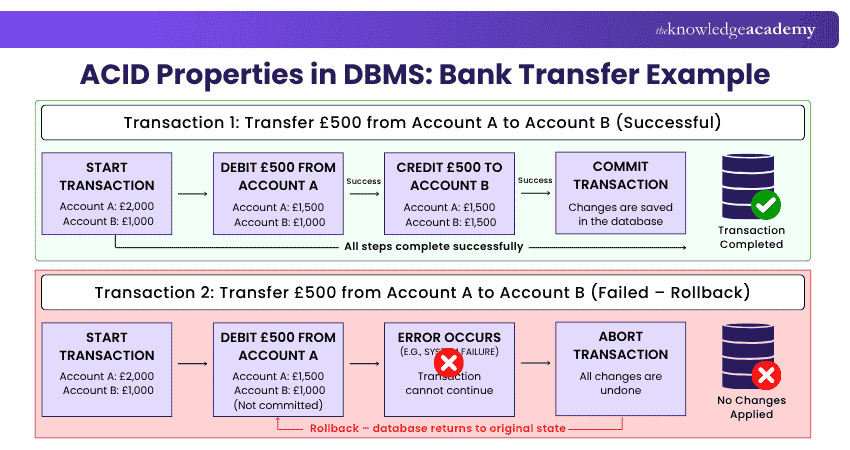
If either operation fails, the transaction is rolled back (i.e., undone), preventing partial changes from being committed to the database. The following MongoDB Node.js example demonstrates a multi-document transaction:
‘await session.withTransaction(async () => {const subtractMoneyResults = await accountsCollection.updateOne({ _id: account1 },{ $inc: { balance: amount * -1 } },{ session });if (subtractMoneyResults.modifiedCount !== 1) { await session.abortTransaction(); return;}const addMoneyResults = await accountsCollection.updateOne({ _id: account2 },{ $inc: { balance: amount } },{ session });if (addMoneyResults.modifiedCount !== 1) {await session.abortTransaction();return;}});’
Gain essential skills in database and build smart solutions with our Introduction to Database Training – Register now!
Advantages of ACID Properties
ACID properties provide transactional reliability during failures and concurrent database operations. Their key benefits include:
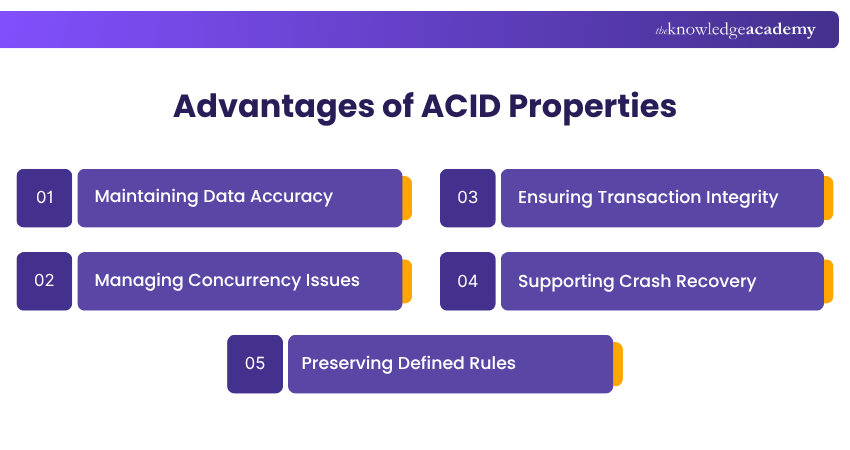
a) Maintaining Data Accuracy: Ensuring that all data entered into the database adheres to predefined rules and constraints, such as primary keys, foreign keys, unique constraints and check constraints, is essential to maintaining data accuracy and reliability.
b) Managing Concurrency Issues: Transaction isolation helps control concurrency anomalies such as dirty reads, non-repeatable reads and phantom reads. The anomalies prevented depend on the database system and the configured isolation level.
c) Ensuring Transaction Integrity: Using transaction management techniques to ensure that all operations within a transaction are completed successfully before committing the changes. This helps maintain the database’s integrity and consistency, while higher isolation levels, such as serialisable isolation, can provide stronger guarantees for concurrent transaction outcomes.
d) Supporting Crash Recovery: Transaction logs and recovery mechanisms can help restore committed database changes after crashes or unexpected failures, supporting durability and reducing the risk of losing committed transactions.
e) Preserving Defined Rules: ACID transactions work with database constraints and application logic to help preserve defined rules during transactions. For example, a foreign key constraint can prevent an order from referencing a non-existent product.
Myth vs Reality
Disadvantages of ACID Properties in DBMS
While ACID properties provide numerous benefits for maintaining database integrity and reliability, they also come with certain drawbacks. Let's explore them in detail:
a) Performance Overhead: Maintaining ACID guarantees can impact system performance due to additional processing and resource utilisation.
b) Complexity: It adds complexity to database systems, increasing design and maintenance challenges.
c) Scalability Trade-offs: Providing strong transactional guarantees across distributed systems can require additional coordination, which may increase latency and make horizontal scaling more complex.
d) Potential for Deadlocks: Lock-based transaction management can create deadlocks when transactions wait for resources held by one another. Database systems typically detect and resolve these situations by rolling back one of the transactions.
e) Concurrency Trade-offs: Stronger isolation levels or extensive locking can reduce concurrency in some workloads, potentially affecting transaction throughput.
f) Distributed-system Trade-offs: In distributed databases, maintaining strong consistency and transactional guarantees across nodes may require coordination that can increase latency or affect availability during network failures.
Quick Checklist
Before implementing transactions, check:
1. Are multiple related operations required to succeed together?2. Which database constraints must remain valid?3. What level of transaction isolation does the workload require?4. Could concurrent transactions conflict?5. How are committed transactions protected during failures?6. What performance trade-offs are acceptable?
Master data security practices to protect sensitive information effectively with our Database Training – Join now!

The Knowledge Academy develops accessible learning content across Project Management, IT, Cybersecurity, Data Science, Business Analysis, HR, Accounting and Finance, Leadership and Health and Safety. Its resources combine subject research with clear explanations to help professionals build practical knowledge across a wide range of disciplines.
View Detail

 If you wish to make any changes to your course, please


