




We may not have the course you’re looking for. If you enquire or give us a call on 01344203999 and speak to our training experts, we may still be able to help with your training requirements.
Accounting Principles: Definition, Role, and Types Explained
ByNaveena VenkatesanLast updated on: 02 October 2026
Accounting principles are guidelines ensuring consistency, reliability, and comparability in financial reporting. These principles uphold the integrity of financial statements. They help stakeholders make better decisions and ensure transparency and trust in reporting practices. Keep reading to learn more!

What’s in This Blog?
1. What accounting principles are and how they guide financial reporting.2. How accounting principles influence the recognition, measurement, presentation and disclosure of financial information.3. The key types of accounting principles, from accrual and consistency to materiality and going concern.4. The main features, benefits and limitations of accounting principles.
Every financial transaction tells part of a business's story, but that story needs a common framework to remain meaningful. Accounting principles provide this foundation by guiding how organisations record and report their financial activities.
From recognising revenue to valuing assets and matching expenses with income, these principles influence many aspects of accounting. Dive into this blog to uncover what accounting principles are and why they are essential for strong business practices. Let’s get started!
What are Accounting Principles?
Accounting principles are foundational rules and guidelines designed to ensure that financial reporting is consistent, accurate, and reliable. These principles help standardise how financial statements are prepared and presented, making it simpler to compare financial data across different organisations. Following these principles enhances transparency and trust, enabling stakeholders to make well-informed decisions based on clear and comparable financial information.

Role of Accounting Principles
Accounting principles play an important role in guiding how financial transactions and events are recognised, measured, presented and disclosed. They provide a framework for preparing financial statements and help Accountants apply relevant accounting standards consistently.
These principles also support professional judgement when determining the appropriate accounting treatment for different transactions.
Trainer’s Insight
Applying accounting principles effectively requires professional judgement. Accountants must consider the nature of each transaction and follow the relevant accounting standards when deciding how financial information should be recognised, measured, and reported.
Types of Accounting Principles
Accounting principles provide a framework for financial reporting, make sure that financial statements are correct and reliable. They guide how transactions and events are recognised, measured, presented, and disclosed, supporting consistency and transparency in financial reporting. Here are the key principles:
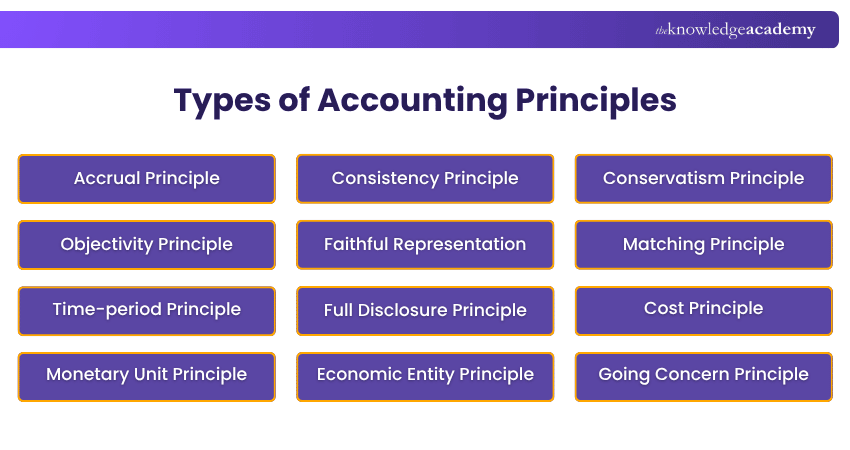
1) Accrual Principle
Records the effects of transactions and other events in the periods in which they happen, rather than simply when cash is received or paid, in accordance with applicable accounting requirements.
2) Consistency Principle
Requires organisations to apply accounting policies consistently to similar transactions and across periods unless a change is required or permitted under applicable accounting standards.
3) Conservatism Principle
It encourages prudence when making judgements under conditions of uncertainty, without deliberately overstating liabilities or expenses or understating assets or income.
4) Objectivity Principle
Ensures that financial statements are based on objective evidence and verifiable data rather than personal opinions.
5) Faithful Representation
Financial information should faithfully represent the economic phenomena it describes and should be complete, neutral, and free from error to the extent possible.
6) Matching Principle
Related income and expenses are often recognised in the same period when this results from applying the relevant recognition requirements, helping present financial performance appropriately.
7) Time-period Principle
Requires financial reporting to be done for defined reporting periods, such as quarterly or annually, depending on applicable requirements and reporting needs.
8) Full Disclosure Principle
Requires material information necessary for users to understand the financial statements to be appropriately presented or disclosed in accordance with applicable reporting requirements.
9) Cost Principle
Assets should be recorded at their acquisition cost, although subsequent measurement may differ depending on the asset and applicable accounting standards.
10) Monetary Unit Principle
Assumes that transactions and events included in financial statements can be measured and expressed in monetary terms.
11) Economic Entity Principle
Requires that a business's financial activities be kept separate from those of its owners or other businesses.
12) Going Concern Principle
Assumes that a business will continue operating for the expected future unless management intends to liquidate or cease operations or has no alternatve.
13) Revenue Recognition Principle
Revenue should be recognised when the applicable recognition criteria are satisfied, rather than simply when cash is received.
14) Materiality Principle
Information is considered material if excluding, misstating, or obscuring it could reasonably be expected to influence decisions made by users of the financial statements.
Bonus Tip
Instead of memorising each accounting principle by its definition, connect it to the problem it addresses. For example, the consistency principle supports comparison across periods, while the economic entity principle helps keep business and personal financial activities separate.
Features of Accounting Principles
Accounting principles support useful and consistent financial reporting. Modern financial reporting frameworks identify several characteristics that make financial information useful. These include:
a) Usefulness: Accounting principles are designed to be relevant and valuable to their users. They ensure that Accountants and stakeholders receive the essential information needed for accurate financial analysis and decision-making.
b) Feasibility: Accounting principles are intended to provide a practical framework for recording and reporting financial information. Their application must remain consistent with the relevant accounting standards rather than allowing adjustments simply because market conditions change.
c) Objectivity: Accounting principles support neutral and evidence-based financial reporting. Where estimates or professional judgement are required, they should be based on reasonable assumptions and appropriate supporting information.
Strengthen your financial expertise and unlock new opportunities with the Accounting Courses now!
Key Benefits of Accounting Principles
These are the benefits of accounting principles:
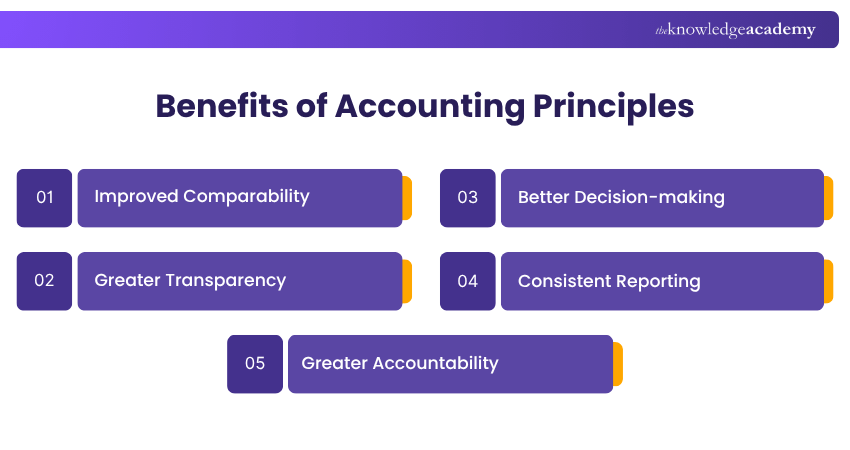
1) Improved Comparability
Consistent accounting practices make it easy to compare financial information across reporting periods and organisations.
2) Greater Transparency
Clear reporting principles help users understand how financial information has been prepared and presented.
3) Better Decision-making
Reliable and relevant financial information supports informed decisions by investors, lenders, management and other stakeholders.
4) Consistent Reporting
Applying accounting principles alongside relevant standards helps organisations maintain a consistent approach to recording and presenting transactions.
5) Greater Accountability
Structured financial reporting makes it easier to evaluate financial performance and identify significant changes or discrepancies.
Drawbacks of Accounting Principles
While accounting principles support consistency and reliability in financial reporting, they are not without limitations. Here are some drawbacks:
1) Inflexibility
Accounting requirements may not always capture every unique or rapidly changing business situation perfectly, and their application can require professional judgement.
2) Complexity
Adhering to various accounting principles can make financial reporting complex and difficult to understand, particularly for small businesses with limited resources.
3) Judgment and Bias
Despite the aim of objectivity, some accounting principles involve subjective judgment, which can introduce biases or inconsistencies in financial statements.
4) Cost of Compliance
Implementing and maintaining compliance with accounting principles can be costly and resource-intensive, particularly for businesses with limited budgets.
5) Lag in Information
Financial statements are prepared for defined reporting periods and may not fully reflect conditions or events arising after the reporting date. However, applicable accounting standards may require adjustments or disclosures for certain events occurring before the financial statements are authorised for issue.
The limitations of accounting principles do not make them ineffective. Financial reporting often involves estimates, professional judgement, and different measurement requirements. The key is to apply the relevant principles consistently alongside applicable accounting standards.
Learn the basic principles of project accounting with the Project Accounting Course - Join now!

Naveena Venkatesan is a Content Editor with 2+ years of experience in content writing, editing and linguistic quality assurance. Her research, fact-checking and editorial experience enable her to develop accurate, accessible resources across Business Skills, Human Resources, and Accounting and Finance.
View Detail

 If you wish to make any changes to your course, please


