


 Top Rated Course

We may not have the course you’re looking for. If you enquire or give us a call on 01344203999 and speak to our training experts, we may still be able to help with your training requirements.
PMP Certification Benefits: Boost Your Career and Earning Potential
Grace Mitchell 05 September 2026This blog explores the key PMP Certification Benefits, from career growth and skills development to professional recognition, along with who benefits most and how to get the most value from it.
Home
 Resources
Project Management
PMP Certification Benefits: Boost Your Career and Earning Potential
Resources
Project Management
PMP Certification Benefits: Boost Your Career and Earning Potential
Resources
Project Management
PMP Certification Benefits: Boost Your Career and Earning Potential

Training Outcomes Within Your Budget!
We ensure quality, budget-alignment, and timely delivery by our expert instructors.
Table of Contents
Key Takeaways
1. PMP Certification provides globally recognised validation of Project Management experience and capabilities.2. It can strengthen professional credibility and support progression into project leadership roles.3. PMP preparation develops knowledge across people, processes, and business-focused Project Management.4. PMP holders may gain access to broader professional and networking opportunities.5. Organisations can benefit from employees who apply structured Project Management practices consistently.
Before PMP: You may have Project Management experience but demonstrating it consistently to employers can be challenging.
After PMP: You hold a globally recognised credential that validates your project leadership experience and capabilities.
That distinction is one reason professionals pursue PMP Certification, but the value doesn't stop at recognition. From how PMP is perceived by employers to what it can mean for salary negotiations and long-term career direction, the certification tends to shift far more than just a line on a CV.
What is PMP Certification?
PMP Certification is a globally recognised certification across organisations in Project Management. Earning the PMP® demonstrates that you have met PMI's experience and training requirements and successfully demonstrated your Project Management knowledge through the certification.
This certification validates your training and experience in the field of Project Management. The purpose of the PMP Certification is to prove the candidate's ability and the experience gained to take responsibility for high-end projects.
Benefits of PMP Certification for Individuals
PMP Certification can offer benefits beyond professional recognition, from strengthening Project Management capabilities to supporting career progression and earning potential. Here are the key benefits:
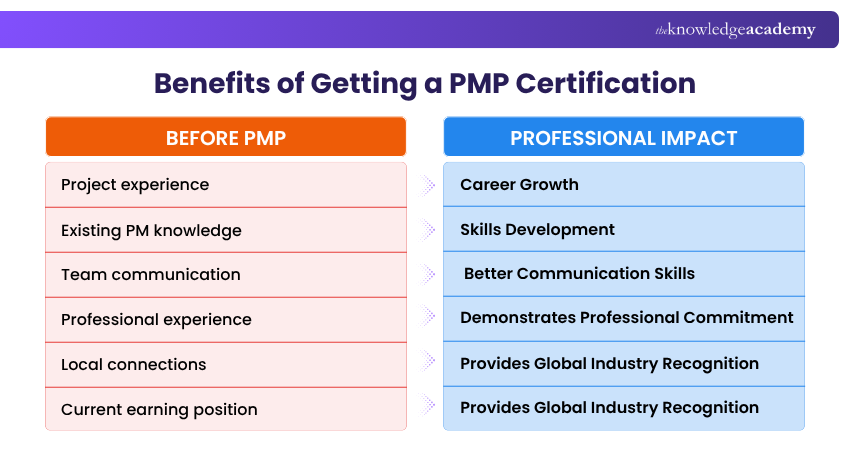
1) Career Growth
PMP Certification can strengthen your professional profile by demonstrating recognised Project Management experience and capabilities. This can be valuable when pursuing roles that involve greater responsibility for projects, teams, budgets, and business outcomes.
Because PMP is applicable across industries, it may also support professionals looking to move between sectors or pursue Project Management opportunities in different markets.
2) Skills Development
Preparing for PMP Certification helps professionals strengthen their understanding of key Project Management areas, including stakeholder engagement, team leadership, risk, planning and project delivery.
It also covers predictive, agile, and hybrid approaches, helping professionals understand how different practices can be applied depending on the project environment.
3) Better Communication Skills
PMP preparation reinforces the importance of effective communication with stakeholders, project teams, and other decision-makers. Professionals develop a stronger understanding of stakeholder engagement, collaboration, and team leadership within project environments.
These capabilities can help Project Managers communicate expectations more clearly and maintain alignment throughout the project lifecycle.
4) Demonstrates Professional Commitment
Earning PMP Certification requires professionals to meet eligibility requirements and complete a structured certification process. Achieving the credential can therefore demonstrate a commitment to professional development and recognised Project Management practices.
Maintaining the certification also requires ongoing professional development, encouraging PMP holders to continue developing their Project Management knowledge.
5) Provides Global Industry Recognition
PMP is recognised across industries and geographical markets, making it valuable for professionals working in diverse project environments. Its broad applicability means the credential is not limited to a single sector or Project Management approach.
This recognition can help professionals communicate their Project Management capabilities through a credential based on established standards.
Take the next step towards PMP Certification with our PMP® Exam Prep Boot Camp Training – Register now!
6) Expands Professional Networking Opportunities
PMP holders can connect with a wider Project Management community through PMI chapters, professional events, and industry networks. These connections can support knowledge sharing, professional development, and awareness of career opportunities.
Engaging with other project professionals can also expose PMP holders to different industries, practices, and Project Management perspectives.
7) Improves Earning Potential
PMP Certification can be associated with stronger earning potential for experienced project professionals. Salary outcomes, however, vary according to factors such as location, industry, role, experience, and employer.
Rather than guaranteeing a salary increase, PMP can strengthen a professional profile when pursuing senior Project Management opportunities or negotiating career progression.
Salary Survey
PMI's latest Salary Survey reports that PMP-certified respondents had 17% higher median salaries on average across 21 countries compared with non-certified respondents.
Benefits of PMP Certification for Organisations
A PMP Certification not only benefits early-career professionals but also helps organisations and employers perform better in a competitive business environment. Therefore, implementing Project Management strategies is essential. Let's look in detail at some of the benefits that PMP Certification provides:
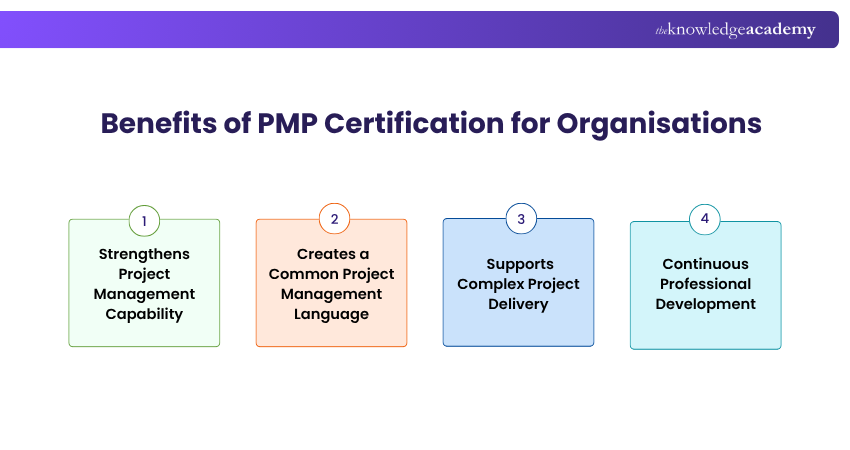
1) Strengthens Project Management Capability
PMP-certified professionals bring knowledge of structured Project Management approaches that can support consistent project delivery. This can be particularly valuable for organisations managing multiple projects at once, since a shared methodology reduces the variation in how different teams approach planning, risk and delivery. Over time, this consistency can make project outcomes easier to predict and compare across the organisation.
2) Creates a Common Project Management Language
Shared terminology and practices can make collaboration across project teams and stakeholders more consistent. This becomes especially useful when teams span different departments or regions, where inconsistent terminology can otherwise lead to misunderstandings about scope, status or responsibility. A common language also makes it easier to bring new team members up to speed quickly.
3) Supports Complex Project Delivery
PMP knowledge can help professionals approach project risks, stakeholders, teams and delivery challenges more systematically. This structured approach can be especially valuable for large-scale or multi-phase projects, where informal or ad hoc methods are more likely to miss dependencies or emerging risks. It also gives organisations more confidence when assigning certified professionals to higher-stakes initiatives.
4) Continuous Professional Development
PMP holders must maintain their certification through professional development, encouraging continued learning. This ongoing requirement means organisations benefit from staff who stay current with evolving Project Management practices rather than relying on knowledge that becomes outdated over time. It can also support a broader culture of learning within project teams.
Who Can Benefit Most from PMP Certification?
PMP Certification can be particularly valuable for professionals who want to strengthen their Project Management capabilities and progress into greater responsibilities. It can benefit:
1) Project Managers: Professionals responsible for planning, managing, and delivering projects.
2) Aspiring Project Managers: Those looking to move into formal Project Management roles.
3) Team Leaders: Professionals managing teams, resources, priorities, and project activities.
4) Project Coordinators: Those seeking to progress towards more senior Project Management responsibilities.
5) Programme Managers: Professionals overseeing multiple related projects and strategic objectives.
6) Business Analysts: Those working closely with project teams, stakeholders, requirements, and business objectives.
7) Experienced Professionals: Individuals seeking a globally recognised credential to validate their Project Management knowledge and experience.
Pro Tip
Before pursuing PMP Certification, compare your current project responsibilities and experience with the certification requirements. This can help you determine whether PMP aligns with your career stage and identify areas where you may need additional Project Management experience.
Conclusion
The PMP Certification Benefits add credentials to your CV. It can validate Project Management capabilities, strengthen professional credibility, support skill development, and create opportunities for career progression and professional networking. However, its value depends on how well the certification aligns with your experience and career goals.
Prepare to advance your Project Management capabilities with our PMP® Bridge Training – Join now!
Frequently Asked Questions
Can I Pass PMP in 3 Months?

Yes, passing the PMP® exam within three months is achievable with a consistent study plan. This can involve 2 to 3 hours of focused preparation each day, alongside completing the required 35 hours of Project Management education or training.
Will PMP be Replaced by AI?
No, the Project Management Professional (PMP)® Certification and Project Manager roles are not expected to be replaced by Artificial Intelligence (AI). Instead, AI can automate routine tasks, allowing project professionals to focus more on leadership, stakeholder engagement, strategic decision-making, and other human-centred responsibilities.
Is Pursuing PMP Certification Worth It in the Current Market?
Yes, pursuing the Project Management Professional (PMP)® Certification can be worthwhile in today’s job market. As a globally recognised credential, it can strengthen your professional profile, demonstrate validated Project Management capabilities, and support progression into leadership roles across industries such as IT, construction, finance, and healthcare.

Grace Mitchell


Senior Project Management Consultant and Author
Grace Mitchell is a highly experienced project management professional with over 15 years of expertise in leading large-scale projects across industries, including construction, IT, and finance. With qualifications in PRINCE2®, PMP®, AgilePM®, and MSP®, Grace specialises in delivering complex programmes with precision and clarity. Her writing is grounded in real-world application and focuses on helping learners build confidence in project delivery and stakeholder management.
View Detail

 If you wish to make any changes to your course, please


