


We may not have the course you’re looking for. If you enquire or give us a call on 01344203999 and speak to our training experts, we may still be able to help with your training requirements.
Top Benefits of Reverse Engineering
ByThe Knowledge AcademyLast updated on: 10 November 2026
Discover the key benefits of Reverse engineering and how this approach is used across engineering, manufacturing and technology to analyse existing products and systems.

The Rundown
1. Reverse engineering helps professionals understand existing products, components and systems.2. It supports the restoration and modernisation of obsolete products when original design information is unavailable.3. It helps identify design weaknesses, security vulnerabilities and potential causes of product failures.4. It can reduce development costs and time by using existing designs as references.5. It supports innovation, CAD modelling, product compatibility and the analysis of existing technologies.
A product exists. Its original design files are missing. Its internal structure is not fully understood. The challenge? Work backwards to uncover how it functions.
This is where reverse engineering comes into play. By systematically examining an existing product, engineers can reconstruct an understanding of its design and operation. But why is this approach used across so many industries? Let's look at what makes reverse engineering valuable across different industries.
What are the Benefits of Reverse Engineering?
Reverse engineering involves analysing an existing product, component or system to understand its design, structure and functionality. It helps engineers and organisations recover design information, investigate problems and identify opportunities for improvement.
Here are key benefits of reverse engineering:
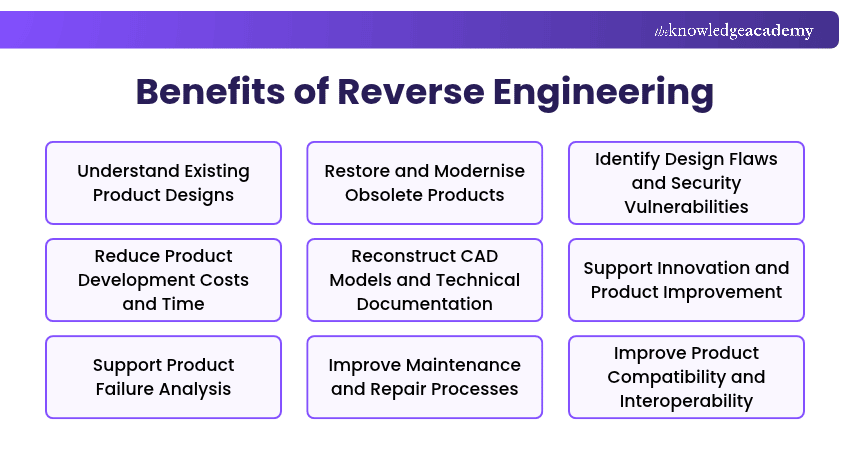
1) Understand Existing Product Designs
Reverse engineering helps professionals understand how an existing product or system is designed and how its components function together. By examining its structure, materials and operating mechanisms, engineers can gain valuable insights into its performance.
This understanding is particularly useful when technical documentation is incomplete or unavailable. It allows organisations to evaluate existing designs, detect areas for improvement and make informed decisions about future modifications.

2) Restore and Modernise Obsolete Products
Some products become obsolete when manufacturers discontinue production or stop supplying replacement parts. Reverse engineering helps organisations recreate components or recover design specifications needed to maintain older equipment.
By analysing the original product, engineers can reconstruct design information and develop replacement components that are subsequently checked against relevant material, dimensional and performance requirements. They can also explore improvements using modern materials or manufacturing techniques.
Pro Tip
Before recreating an obsolete component, verify its dimensions, materials and operating conditions. An accurate-looking replacement may still fail if its mechanical properties or tolerances do not match the original requirements.
3) Identify Design Flaws and Security Vulnerabilities
Reverse engineering enables professionals to examine products and systems for potential design weaknesses and security vulnerabilities. By studying their internal structure, functionality and interactions, they can identify possible issues that may not be apparent during normal operation.
In physical products, this may involve examining structural weaknesses or inefficient components. In software and electronic systems, authorised reverse engineering can help analysts investigate potential vulnerabilities or unexpected behaviours. Further testing may be needed to confirm findings before corrective actions are implemented.
4) Reduce Product Development Costs and Time
Developing a product entirely from scratch can require considerable time, resources and investment. Reverse engineering can reduce some of this effort by providing useful information about existing designs, components and manufacturing methods.
This can reduce unnecessary design work, support more efficient development and help organisations allocate resources effectively. However, the actual savings depend on the product's complexity, available information and the testing required to validate the revised design.
5) Reconstruct CAD Models and Technical Documentation
Reverse engineering allows engineers to reconstruct digital representations of physical components using measurement techniques such as 3D scanning and Coordinate Measuring Machines (CMMs). These measurements can be used to reconstruct Computer-Aided Design (CAD) models for further development.
The resulting models help professionals examine product geometry, modify designs and prepare technical documentation. They can also support manufacturing, simulation and collaboration between engineering teams. However, reconstructed models must be checked for accuracy before being used for critical applications.
Reverse Engineering Preparation Checklist
Before creating a CAD model through reverse engineering, ensure that you:□ Confirm the objective and intended use of the reconstructed model.□ Check whether original drawings or specifications are available.□ Identify critical dimensions, tolerances and material requirements.□ Select suitable measurement and modelling methods.□ Plan how the reconstructed model will be validated.□ Review applicable intellectual property rights, contractual restrictions and permissions.
6) Support Innovation and Product Improvement
Reverse engineering provides opportunities to learn from existing products and use those insights to develop improved solutions. By examining how different designs achieve their intended functions, engineers can identify approaches worth exploring in their own development projects.
For example, studying an older mechanical system may reveal a reliable operating mechanism that can be adapted using modern materials or manufacturing techniques. This approach can encourage creative problem-solving and support improvements in functionality, usability and performance.
7) Support Product Failure Analysis
When a product malfunctions or breaks down, understanding the cause is essential to preventing similar problems. Reverse engineering helps engineers examine damaged components, internal mechanisms and system interactions to investigate potential failure causes.
By analysing the product's design and comparing damaged components with their intended function and operating conditions, professionals can investigate failure mechanisms and identify possible root causes. These findings can support maintenance decisions, product redesign and improved reliability.
Trainer's Insight
When investigating product failures, avoid assuming that the most visibly damaged component caused the problem. Examine how the components interact and consider operating conditions and maintenance history to identify the underlying cause.
8) Improve Maintenance and Repair Processes
Reverse engineering helps maintenance teams understand the structure and operating mechanisms of equipment when technical documentation is limited. This information can support the identification of suitable repair methods and replacement requirements.
For example, engineers can examine a worn mechanical component to estimate its original dimensions, assess its condition and identify relevant repair requirements. This can help organisations maintain equipment more effectively and reduce avoidable downtime.
9) Improve Product Compatibility and Interoperability
Reverse engineering can help organisations develop components or systems that work with existing products, particularly when technical specifications are unavailable or incomplete. By examining physical dimensions, communication interfaces and operating requirements, engineers can understand how different components interact.
This information can support the development of compatible replacement parts, software integrations and system upgrades. Improved interoperability can be particularly valuable when maintaining legacy equipment or connecting older technologies with newer systems.
Gain hands-on industry-relevant skills and the confidence to tackle complex projects with the Engineering Skills Training – Sign up now!
When Should You Use Reverse Engineering?
Use the following table to identify situations where reverse engineering may be useful and the approaches that could help address different engineering challenges:
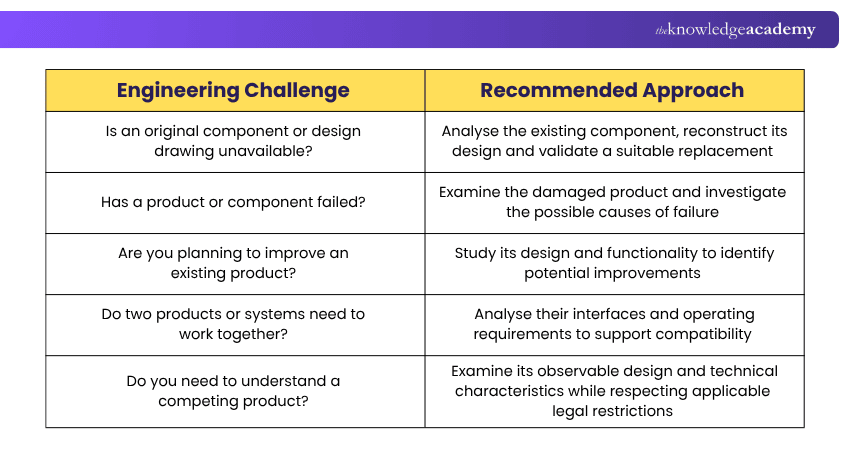
With accurate analysis, appropriate validation and consideration of legal requirements, reverse engineering can support practical improvements across engineering, manufacturing and technology.

The Knowledge Academy develops accessible learning content across Project Management, IT, Cybersecurity, Data Science, Business Analysis, HR, Accounting and Finance, Leadership and Health and Safety. Its resources combine subject research with clear explanations to help professionals build practical knowledge across a wide range of disciplines.
View Detail

 If you wish to make any changes to your course, please


