


We may not have the course you’re looking for. If you enquire or give us a call on 01344203999 and speak to our training experts, we may still be able to help with your training requirements.
Top Benefits of Portfolio Management
ByThe Knowledge AcademyLast updated on: 14 November 2026
Discover the top benefits of portfolio management, from strategic alignment and resource allocation to improved risk oversight and decision-making. Learn how managing projects helps organisations focus on priorities and achieve greater value.

Quick Look
1. Portfolio management evaluates projects and programmes together so that they support strategic goals.2. Selection decides which initiatives enter the portfolio; prioritisation decides which get funding and attention first.3. Reviewing resources and risks across the portfolio shows conflicts and shared dependencies that individual project reviews may miss.4. Consolidated visibility and benefits oversight support informed decisions, a balanced portfolio and quicker adaptation to change.5. Clear governance defines decision-making authority and accountability for portfolio oversight.
An organisation has several promising projects but limited budgets, competing priorities and shared resources. Which initiatives should receive funding, and which should be delayed? Portfolio management helps organisations make these decisions by evaluating projects and programmes against strategic objectives.
The benefits of portfolio management go beyond choosing projects. It gives organisations a structured way to keep investments focused and adapt as priorities change. The benefits below show how this works in practice.
Top Benefits of Portfolio Management
Portfolio management helps organisations evaluate initiatives collectively rather than treating every project or programme independently. Here are the important benefits that support strategic planning, resource efficiency and organisational performance:
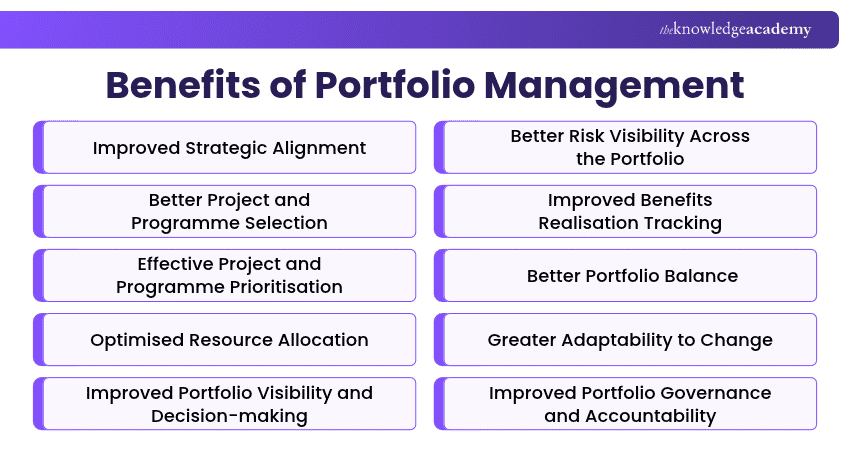
1) Improved Strategic Alignment
One of the primary benefits of portfolio management is ensuring that projects contribute to organisational objectives. It provides a structured approach for evaluating whether proposed and ongoing initiatives support strategic priorities.
By reviewing initiatives against business goals, organisations can identify activities that no longer fit their strategy and redirect attention towards more relevant investments. This helps maintain a stronger connection between strategy and execution.

2) Better Project and Programme Selection
Portfolio management helps organisations select projects based on their expected value, strategic relevance, feasibility and potential risks. Instead of approving every proposal, decision-makers can evaluate which initiatives are suitable for inclusion in the portfolio.
This approach reduces the likelihood of investing in initiatives that offer limited strategic value. It also helps organisations concentrate on work that has a stronger potential to contribute to their objectives.
3) Effective Project and Programme Prioritisation
Portfolio management emphasises the importance of prioritising projects and initiatives based on their strategic value and potential benefits. This prioritisation process involves evaluating initiatives against criteria such as strategic alignment, risk, resource availability, dependencies and expected outcomes.
It helps organisations determine which initiatives should receive greater attention, earlier funding or priority for delivery. Clear priorities also support more consistent decisions when several initiatives compete for limited resources.
Example: Selecting vs Prioritising Projects
A company evaluates three proposed initiatives: a cybersecurity upgrade, a customer service platform and an office refurbishment.All three may qualify for inclusion in the portfolio. However, if the cybersecurity upgrade addresses an urgent and significant risk, it may receive higher priority for funding and resources. Selection determines which initiatives belong in the portfolio. Prioritisation determines their relative importance.
4) Optimised Resource Allocation
Effective portfolio management helps organisations allocate financial, human and technical resources according to strategic priorities and available capacity. By reviewing resource requirements across projects, decision-makers can identify competing demands and adjust allocations where necessary.
This helps reduce overcommitment and supports more realistic investment planning. For example, if two high-priority projects need funding from the same budget cycle, portfolio-level planning can help determine how limited funds should be phased or shared.
5) Improved Portfolio Visibility and Decision-making
Portfolio management promotes a holistic view of projects, allowing organisations to assess their collective performance, risks, costs and expected benefits.
Consolidated reporting helps decision-makers identify delays, resource constraints and dependencies that may be difficult to recognise when initiatives are reviewed separately. This wider visibility supports informed decisions.
Build a strong foundation for smarter portfolio decisions by signing up with the Management of Portfolios (MoP®) Foundation Training today!
6) Better Risk Visibility Across the Portfolio
Portfolio management helps organisations evaluate risks across the entire portfolio. This includes identifying shared dependencies, resource constraints, concentrated risk exposure and potential conflicts between initiatives.
By considering these risks collectively, organisations can evaluate how one initiative may affect others. Portfolio-level risk oversight also supports decisions about adjusting investments or balancing initiatives within the organisation's risk appetite and tolerance.
Trainer's Insight: Look Beyond Individual Project Risks
7) Improved Benefits Realisation Tracking
Portfolio management helps organisations monitor whether projects and programmes are expected to deliver benefits that support strategic objectives. It enables decision-makers to review anticipated financial and non-financial benefits, compare them with current expectations and identify initiatives requiring further attention.
For example, an organisation may assess whether a digital transformation programme is contributing to targeted improvements in efficiency or customer service. Portfolio management supports this oversight, although actual benefits realisation depends on effective delivery and operational adoption.
8) Better Portfolio Balance
Portfolio management helps organisations maintain an appropriate combination of initiatives across different levels of risk, expected value, investment size and delivery timescales. A balanced portfolio may include short-term improvements alongside longer-term strategic investments.
It can also combine relatively predictable initiatives with higher-risk opportunities that offer potential future value. This approach helps organisations avoid concentrating too heavily on one type of initiative while considering overall strategic priorities and resource constraints.
9) Greater Adaptability to Change
Organisational priorities can change because of market conditions, customer expectations, new regulations or emerging business opportunities. Portfolio management supports regular reviews to determine whether existing initiatives remain relevant.
When circumstances change, organisations can reconsider priorities, reallocate resources or recommend that certain initiatives be paused. This flexibility helps organisations respond to changing conditions without continuing investments solely because they were previously approved.
10) Improved Portfolio Governance and Accountability
Portfolio management supports clear governance arrangements for evaluating, approving, monitoring and reviewing projects and programmes. It helps organisations define decision-making authority, establish consistent assessment criteria and assign accountability for portfolio oversight.
This encourages transparency in investment decisions and provides a structured approach to reviewing performance. Effective governance also helps ensure that important portfolio decisions are documented, communicated and aligned with organisational policies and strategic objectives.
Go beyond managing projects and develop effective portfolio strategies with the Portfolio Management Professional PfMP® Certification Training - Join now!

The Knowledge Academy develops accessible learning content across Project Management, IT, Cybersecurity, Data Science, Business Analysis, HR, Accounting and Finance, Leadership and Health and Safety. Its resources combine subject research with clear explanations to help professionals build practical knowledge across a wide range of disciplines.
View Detail

 If you wish to make any changes to your course, please


