


We may not have the course you’re looking for. If you enquire or give us a call on 01344203999 and speak to our training experts, we may still be able to help with your training requirements.
Top Benefits of Drupal for Website Development
ByThe Knowledge AcademyLast updated on: 12 November 2026
Drupal is a powerful open-source Content Management System (CMS) that supports flexible, secure and scalable website development. Explore the top benefits of Drupal, from multilingual capabilities and customisation to SEO, accessibility and mobile-friendly design.

At a Glance
Here's a quick look at what makes Drupal valuable for website development:1. Open-source Platform: Provides flexibility to use and customise the software without licensing fees.2. Scalability: Supports websites with different content structures and changing requirements.3. Multilingual Capabilities: Helps organisations manage content across multiple languages.4. Advanced Customisation: Enables developers to create tailored functionality and integrate external systems.5. Security Support: Provides security advisories and updates for supported releases.
Your website looks great, runs smoothly and does everything you need. But will it still keep up when your business grows?
What happens when you need more features, multiple languages or a completely different website experience? Suddenly, the platform that once seemed perfect might start holding you back.
That's where Drupal comes in. Built to support changing website requirements, Drupal gives organisations the flexibility to expand and adapt without starting from scratch every time. But what makes it such a compelling choice for website development? Let's explore the key benefits that set it apart.
Essential Benefits of Drupal
Drupal offers several advantages, from its flexible architecture and multilingual support to advanced customisation and security features. Here are the top benefits of Drupal:
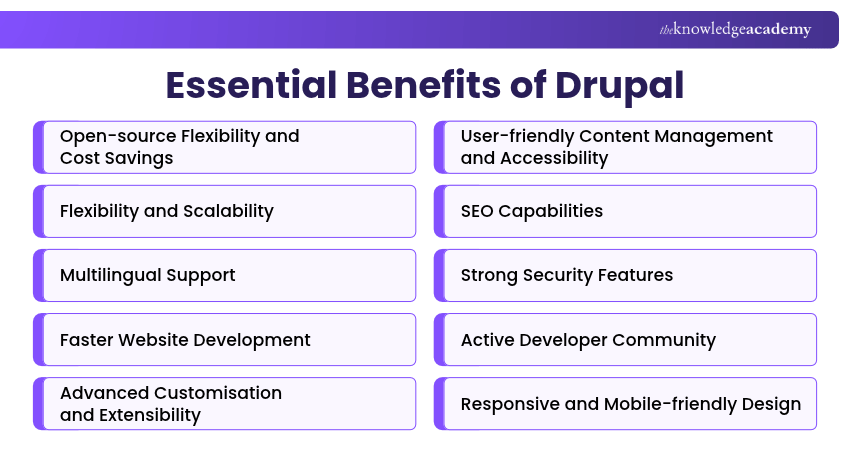
1) Open-source Flexibility and Cost Savings
Drupal's open-source nature is one of its greatest advantages. Anyone can download, use and modify the software without paying licensing fees.
This approach encourages innovation and collaboration while giving developers and organisations the freedom to customise websites according to their requirements. However, hosting, development and maintenance may still involve costs.

2) Flexibility and Scalability
The adaptability and versatility of Drupal make it beneficial for a wide range of web development needs. Its flexible architecture supports everything from personal blogs to complex enterprise websites. With suitable infrastructure, caching and configuration, Drupal can also support growing content volumes, higher traffic and changing operational requirements.
3) Multilingual Support
Drupal's multilingual capabilities help businesses and organisations connect with audiences across different regions. Its built-in language and translation modules support multilingual content, interfaces and website configuration.
With appropriate configuration and translated content, Drupal websites can offer experiences in multiple languages, helping organisations reach and serve international audiences.
4) Faster Website Development
Drupal's modular approach can help accelerate web development by reducing the need to build every feature from scratch. Reusable modules, themes and preconfigured components allow developers to assemble and customise website functionality more efficiently. This can save development time, particularly when suitable components are available.
5) Advanced Customisation and Extensibility
Drupal provides developers with tools for creating sophisticated website functionality. From building custom content types and managing structured data to integrating external systems through APIs, it supports complex web development requirements. Its extensible architecture allows organisations to develop tailored digital experiences without being restricted to standard website layouts.
6) User-friendly Content Management and Accessibility
Drupal supports content creation and management through configurable editing tools and workflows. Built on Drupal core, Drupal CMS offers a more visual editing experience through Drupal Canvas, allowing content teams to create and arrange pages using reusable components.
Drupal also provides accessibility-focused features and themes that can help developers build inclusive websites.
Trainer Insight
Drupal core provides a flexible foundation for building customised websites, while Drupal CMS offers additional ready-to-use tools for site building and content editing. For example, Drupal Canvas enables more visual page creation, which can reduce reliance on developers for routine content layout changes.
7) SEO Capabilities
Drupal supports Search Engine Optimisation (SEO) through customisable URL structures and additional modules. Contributed modules such as Metatag and Simple XML sitemap help website owners manage page metadata and generate XML sitemaps. These capabilities can support search engine visibility when combined with quality content and sound technical SEO practices.
8) Strong Security Features
Drupal places significant emphasis on website security through its dedicated security team, advisories and security updates for supported Drupal core releases and eligible contributed projects. These measures help developers identify and address vulnerabilities.
However, maintaining security also requires timely updates, reliable contributed modules, appropriate permissions and secure website configuration.
Pro Tip
Before installing contributed Drupal modules, check their compatibility, maintenance status and security advisory coverage. Regularly update supported Drupal core, modules and themes to reduce avoidable vulnerabilities and maintain a more secure website.
9) Active Developer Community
One of Drupal's greatest strengths is its large and active developer community. Developers and website owners can access shared knowledge, documentation, contributed modules and community discussions to support their projects.
This collaborative environment encourages innovation, helps address development challenges and contributes to the platform's ongoing improvement.
10) Responsive and Mobile-friendly Design
Drupal supports responsive website development, allowing developers to build layouts that fit different screen sizes. With suitable responsive themes and mobile-friendly design practices, Drupal websites can offer consistent experiences across desktops, tablets and smartphones.
This flexibility helps organisations meet the needs of users accessing websites through different devices.
Keep This in Mind
Drupal offers flexibility, multilingual support and customisation for websites with different needs. Its modules, content management tools and active community make it a versatile platform for website development. Choosing suitable features, maintaining updates and following good development practices can help organisations build reliable digital experiences.
Learn to turn your code into meaningful digital experiences by joining the Web Development Training today!

The Knowledge Academy develops accessible learning content across Project Management, IT, Cybersecurity, Data Science, Business Analysis, HR, Accounting and Finance, Leadership and Health and Safety. Its resources combine subject research with clear explanations to help professionals build practical knowledge across a wide range of disciplines.
View Detail

 If you wish to make any changes to your course, please


