


We may not have the course you’re looking for. If you enquire or give us a call on +44 1344 203 999 and speak to our training experts, we may still be able to help with your training requirements.
Benefits of Diversity and Inclusion in the Workplace
ByThe Knowledge AcademyLast updated on: 03 November 2026
Understand the benefits of diversity and inclusion in the workplace and explore how they support employee wellbeing, creativity, collaboration and organisational success.
Diversity and Inclusion at a Glance
1. Workplace diversity brings together people with different backgrounds, experiences, skills and perspectives.2. Inclusion ensures employees have opportunities to participate, contribute and feel respected at work.3. Diverse and inclusive practices can support creativity, problem-solving, collaboration and better-informed decisions.4. Fair recruitment, development and workplace practices can help organisations attract, engage and retain employees.5. Organisations can assess progress through employee feedback, recruitment outcomes, career progression, retention and accessibility measures.
Different backgrounds.
Different experiences.
Different ways of thinking.
What happens when all these differences come together in one workplace?
New ideas emerge, perspectives broaden and teams gain opportunities to approach challenges differently. But diversity alone isn't enough. Employees also need to feel respected, included and comfortable contributing their ideas.
That's where diversity and inclusion become important. Let's explore the benefits of diversity and inclusion in the workplace and how they can strengthen workplace relationships and contribute to organisational success.
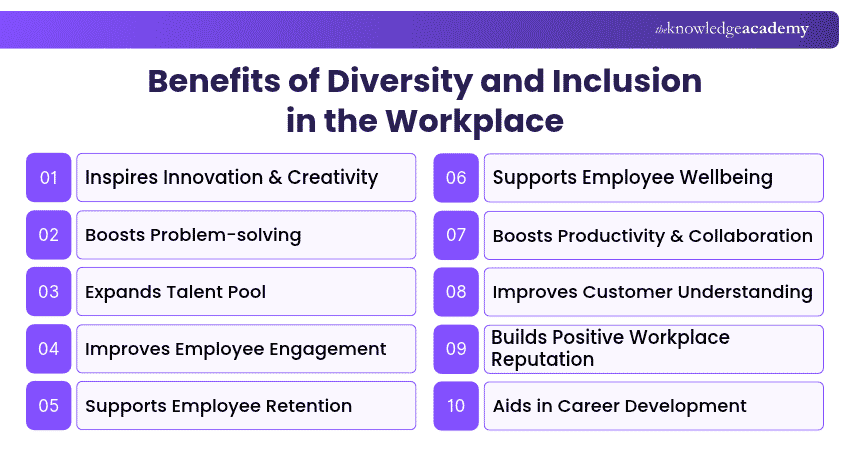
Key Benefits of Diversity and Inclusion in the Workplace
Diversity and inclusion can contribute to better employee experiences and organisational outcomes when supported by effective leadership and fair workplace practices. Let's explore the benefits in detail:
1) Encourages Innovation and Creativity
Diverse workplaces bring together employees with different knowledge, experiences and ways of thinking. However, these perspectives are more likely to contribute to innovation when employees have equal opportunities to participate, feel comfortable challenging assumptions and can discuss ideas constructively. Inclusive working practices encourage employees to share suggestions and challenge existing approaches constructively.
This can support improvements in products, services and internal processes. For example, a product development team involving employees with different technical and customer-facing experiences may identify features or usability concerns that a less varied team could overlook.

2) Improves Problem-solving and Decision-making
Teams can benefit from considering different viewpoints when solving complex problems. Employees may identify risks, alternative solutions or important information that others have missed.
Inclusive decision-making allows teams to examine alternative solutions, question assumptions and consider potential risks before reaching a conclusion. This can make the decision-making process more thorough, particularly when individuals bring relevant knowledge and expertise to the discussion.
Pro Tip: Collect Ideas Before Group Discussions
Before an important decision-making meeting, invite employees to share suggestions individually. Review these contributions during the discussion so that useful ideas are considered even when some participants are less comfortable speaking publicly.
3) Expands the Talent Pool
Inclusive recruitment practices can help organisations reach a broader range of qualified candidates. Removing unnecessary barriers from job advertisements, application processes and interviews can improve access to employment opportunities.
For example, organisations can use clear job requirements, accessible application formats and consistent assessment criteria to evaluate candidates fairly.
Workplace Example: Inclusive Recruitment
Consider an organisation struggling to attract candidates for a technical role. After reviewing its recruitment process, it discovers that the job advertisement includes unnecessary degree requirements and unclear expectations.The organisation updates the advertisement to focus on essential skills, offers accessible application options and introduces structured interviews.These changes can make the recruitment process more accessible while maintaining the required standards for the role.
4) Improves Employee Engagement
Employee engagement reflects employees' connection, motivation and commitment towards their work and organisation. Inclusive workplaces can support engagement by creating opportunities for meaningful involvement, recognising contributions and ensuring employees feel their concerns are taken seriously.
When individuals feel that their opinions are respected and their concerns are taken seriously, they may feel more involved in their work. For example, managers can improve employee participation by encouraging feedback, involving team members in relevant decisions and communicating openly about workplace changes.
5) Supports Employee Retention
Inclusive workplaces can help organisations create conditions that encourage employees to remain with the organisation. Fair treatment, supportive management and access to development opportunities can influence how employees experience their working environment.
For example, an organisation that provides transparent promotion criteria, appropriate workplace support and fair access to training may be better positioned to retain employees who might otherwise encounter barriers to progression. Retention depends on several factors, including pay, workload, career opportunities and management practices.
6) Strengthens Employee Belonging and Wellbeing
A sense of belonging develops when employees feel accepted, respected and able to participate in the workplace without unnecessary pressure to hide aspects of themselves. Inclusive practices can also support psychological safety by encouraging employees to ask questions, raise concerns and express different opinions without fear of humiliation or unfair treatment.
For example, an organisation that addresses inappropriate behaviour, respects employees' circumstances and provides suitable workplace support can help create a more supportive environment. However, inclusion alone does not guarantee employee wellbeing. Working conditions, workload, management support and organisational culture also play important roles.
7) Enhances Productivity and Collaboration
Diverse teams may bring complementary skills, experiences and approaches to their work. When employees are included in discussions and have fair access to the information and resources they need, teams can coordinate more effectively and make better use of individual expertise.
For example, a cross-functional project team may include employees with technical, operational and customer-facing experience. Encouraging contributions from each area can help identify dependencies earlier, reduce avoidable rework and improve coordination. However, productivity also depends on workload, leadership, resources and how effectively the team operates.
8) Improves Customer Understanding
A workforce with varied experiences and perspectives can help organisations consider a wider range of customer needs. Employees may identify overlooked customer expectations, accessibility requirements or communication preferences that influence how products and services are designed.
For example, a customer service team may recommend improving the accessibility of online support materials after recognising that existing instructions are difficult for some customers to use. However, organisations should combine employee perspectives with direct customer research rather than assuming that employees automatically represent particular customer groups.
Inclusive Workplace Checklist
Use this checklist to review the essential elements of an inclusive workplace.□ Recruitment and promotion decisions follow fair, transparent criteria.□ Employees have accessible ways to provide feedback.□ Workplace policies address discrimination and inappropriate behaviour.□ Managers encourage respectful communication and participation.□ Employees have fair access to training and development.□ Workplace accessibility needs are considered and addressed.□ Progress is reviewed using appropriate employee and workforce information.
9) Builds a Positive Workplace Reputation
Organisations that demonstrate fair treatment, transparent policies and respectful workplace practices can strengthen trust among employees, job applicants and other stakeholders. A positive workplace reputation depends on consistent actions rather than public statements alone.
For example, organisations that communicate their employment practices clearly, address discrimination concerns and provide accessible recruitment opportunities may develop greater credibility with potential employees. Diversity and inclusion initiatives should therefore be supported by genuine organisational commitment rather than treated primarily as reputation-building activities.
10) Supports Fair Career Development Opportunities
Inclusive organisations aim to ensure that employees can access professional development and career opportunities without unfair barriers. This may involve reviewing how training places, mentoring arrangements, high-visibility assignments and promotions are allocated.
For example, an organisation might discover that employees working remotely have fewer opportunities to participate in leadership development activities. By reviewing its selection practices and making development opportunities more accessible, the organisation can support fairer career progression.
Develop strategies to increase employee participation with Employee Engagement Training – Register today!
Diversity vs Inclusion: What's the Difference?
Although diversity and inclusion are closely connected, they serve different purposes.
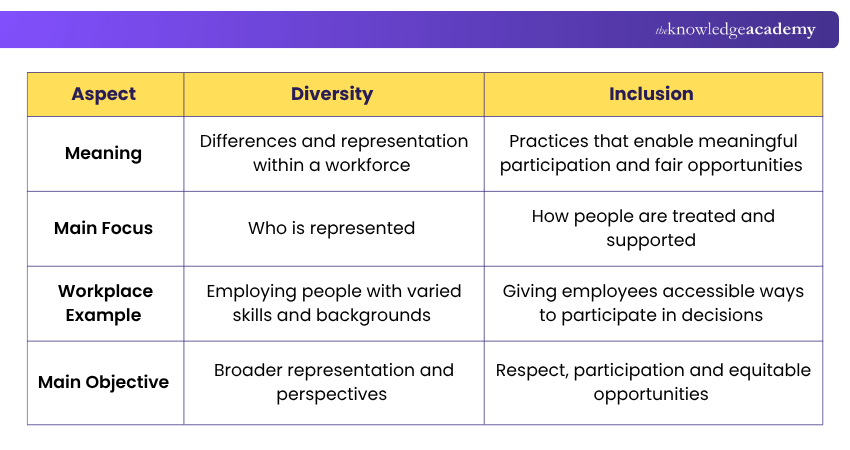
However, a workplace may have a diverse workforce without being inclusive. For example, employees may come from different backgrounds but still experience barriers to career progression or participation in important discussions.
Types of Diversity in the Workplace
Workplace diversity extends beyond visible differences. Understanding its various dimensions can help organisations recognise the experiences and perspectives employees bring to their roles. The following are four commonly used categories of diversity that provide a practical framework for understanding workplace differences, rather than a fixed or exhaustive classification:
1) Internal Diversity
Internal diversity refers to personal characteristics that are often closely connected to an individual's identity, such as age, ethnicity and aspects of personal background. Some characteristics may be protected under equality legislation, depending on the jurisdiction. Understanding these differences helps organisations recognise the importance of fair treatment and avoiding assumptions about employees.
2) External Diversity
External diversity includes differences influenced by personal circumstances and life experiences, such as educational background, socioeconomic circumstances, family responsibilities and geographic location. These experiences can influence the knowledge, perspectives and opportunities individuals bring to the workplace.
3) Organisational Diversity
Organisational diversity refers to differences within an organisation, including job roles, departments, professional experience, seniority and employment arrangements. For example, collaboration between employees from finance, marketing and operations can bring different professional perspectives to a business challenge.
4) Worldview Diversity
Worldview diversity involves differences in beliefs, values, opinions and ways of interpreting information. These perspectives may be influenced by cultural experiences, education and personal circumstances.
Recognising different viewpoints can support constructive discussions and help organisations examine issues from several perspectives. These categories are useful for understanding diversity, but they can overlap. An individual's experiences and characteristics should not be reduced to a single category.
How to Measure Diversity and Inclusion Progress?
Useful measures may include:□ Recruitment Outcomes: Reviewing whether recruitment processes create unnecessary barriers.□ Employee Feedback: Understanding perceptions of respect, belonging and fair treatment.□ Career Progression: Comparing access to training and promotion opportunities.□ Retention Patterns: Identifying whether certain employee groups experience higher turnover.□ Accessibility Feedback: Assessing whether workplace adjustments and support arrangements are effective.
Build a workplace where every individual feels empowered to contribute. Sign up for Diversity Training now!

The Knowledge Academy develops accessible learning content across Project Management, IT, Cybersecurity, Data Science, Business Analysis, HR, Accounting and Finance, Leadership and Health and Safety. Its resources combine subject research with clear explanations to help professionals build practical knowledge across a wide range of disciplines.
View Detail

 If you wish to make any changes to your course, please


