




We may not have the course you’re looking for. If you enquire or give us a call on 01344203999 and speak to our training experts, we may still be able to help with your training requirements.
Top Benefits of ACCA
ByThe Knowledge AcademyLast updated on: 26 November 2026
Discover the top ACCA benefits, including global recognition, career opportunities, flexible learning, and professional development. Learn how the qualification builds financial expertise, strengthens career prospects, and supports professional growth across industries.

Quick Preview
1. Global Recognition: ACCA supports international career opportunities across industries.2. Career Opportunities: Explore careers in accounting, auditing, taxation, finance and advisory services.3. Flexible Learning: Choose study options that fit your schedule and commitments.4. Professional Expertise: Develop financial, analytical, ethical and strategic skills.5. Long-term Development: ACCA membership provides networking, learning resources and professional development support.
Think ACCA is just about numbers? Think again.
Expectation: Study accounting, earn qualifications, and become an Accountant.
Reality: Develop financial expertise, strengthen business decision-making skills, explore international career opportunities, and build professional connections.
And that's only the beginning.
The ACCA benefits extend far beyond accounting fundamentals. Whether you're starting your career or looking to progress professionally, the qualification can help you develop valuable skills, explore new opportunities, and strengthen your career prospects.
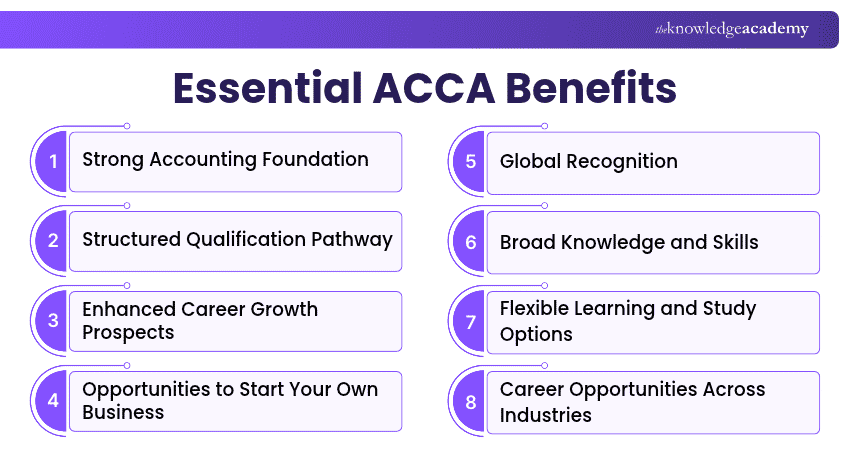
Essential ACCA Benefits
ACCA offers several advantages for individuals looking to develop their accounting expertise and progress professionally. From global recognition to career flexibility, the following are the key benefits of ACCA:
1) Strong Accounting Foundation
ACCA offers pathways for individuals from different educational and professional backgrounds. Those meeting the academic entry requirements can begin the ACCA qualification directly, while individuals without the required qualifications can start through the Foundations in Accountancy route.
The qualification builds core accounting knowledge and develops an understanding of financial management, business operations, and professional ethics. This foundation helps individuals interpret financial information and apply accounting principles in professional situations.

2) Structured Qualification Pathway
The ACCA qualification follows a structured approach to developing accounting and financial expertise. Its current syllabus progresses through applied knowledge, applied skills and strategic professional levels, covering foundational concepts and more advanced financial, managerial, analytical and strategic subjects.
The qualification combines technical learning with ethical and professional development, helping candidates understand how accounting principles apply in business. ACCA also updates its syllabus to reflect changing professional requirements and industry practices.
Important Note
From July 2027, ACCA will begin introducing its redesigned qualification, with knowledge, expertise and strategic professional levels supported by Essential Employability Modules. Foundations and knowledge examinations will begin in July 2027, followed by the first session-based expertise and strategic professional examinations in September 2027.
3) Enhanced Career Growth Prospects
ACCA is recognised for its professional accounting standards and comprehensive coverage of finance and business subjects. It helps individuals develop technical and professional capabilities relevant to career advancement.
Completing the ACCA qualification and gaining membership can strengthen your professional profile and support progression. With suitable experience, professionals may progress into specialised or senior roles in financial management, business analysis, strategic planning, and organisational leadership.
4) Opportunities to Start Your Own Business
ACCA provides knowledge of business and financial management that can support individuals interested in entrepreneurship. Understanding accounting, budgeting, financial reporting, and business planning helps aspiring business owners make informed financial decisions.
Qualified ACCA members may also pursue opportunities to establish independent accounting, advisory, or consultancy practices. However, certain professional services may require appropriate practising certificates, regulatory approvals, or additional qualifications, depending on the jurisdiction.
5) Global Recognition
One of the most valuable benefits of ACCA is its international recognition. The qualification is recognised by employers across different countries and can support opportunities within multinational corporations, financial institutions, and professional services firms.
Its international focus helps professionals develop accounting and financial knowledge relevant to organisations operating across borders. However, professional recognition and permission to undertake regulated activities, particularly statutory audits, vary by country.
6) Broad Knowledge and Skills
The ACCA qualification covers a wide range of accounting, finance, and business subjects. Its current syllabus includes financial reporting, management accounting, taxation, corporate and business law, auditing, financial management, strategic planning and professional ethics.
These subjects develop analytical, technical, and problem-solving capabilities. They also help candidates evaluate financial performance, interpret business information, and contribute to informed financial decisions.
Go beyond the numbers and turn financial insights into smarter decisions with the Management Accounting (FMA) Training – Join now!
7) Flexible Learning and Study Options
ACCA offers different learning options, including online, classroom-based, full-time and part-time study. This flexibility allows candidates to choose an approach that suits their learning preferences, work schedules and personal commitments.
Candidates can also compare tuition providers and study arrangements to manage their expenses. However, overall costs depend on registration fees, annual subscriptions, examinations, exemptions, and the learning provider selected.
Pro Tip
Look beyond tuition fees when planning your ACCA journey. Consider registration charges, annual subscriptions, examination fees, and possible exemptions to understand the overall cost and choose a suitable study approach.
8) Career Opportunities Across Industries
Accounting and financial expertise are relevant to organisations across nearly every industry. ACCA can support career opportunities in sectors such as banking, financial services, manufacturing, technology, healthcare, retail and professional consulting.
Professionals may work in financial reporting, management accounting, internal audit, taxation, risk management and financial planning. This cross-industry relevance provides flexibility when exploring opportunities or moving between business sectors.
9) Lifelong Support and Networking
ACCA membership provides access to a global professional community and resources designed to support continuous learning and career development.
Members can benefit from technical updates, professional publications, networking opportunities and Continuing Professional Development (CPD) resources. These help Accountants stay informed about changes in accounting standards, regulations and business practices.
10) Higher Earning Potential
An ACCA qualification can support higher earning potential by helping individuals develop specialised accounting and financial expertise. As professionals gain relevant experience, they may qualify for positions involving greater responsibility and more complex financial decisions.
Employers may value ACCA qualifications when recruiting for financial reporting, audit, taxation, financial management and senior accounting positions. However, earning potential varies according to experience, location, employer, industry, and job responsibilities.
Trainer Insight
ACCA can strengthen your professional credentials, but career advancement also depends on practical experience and demonstrated capability. Focus on applying your knowledge to real financial challenges and developing skills relevant to your intended role.
11) Strong Professional Ethics and Values
Professional ethics and accountability are fundamental to the accounting profession. ACCA places significant emphasis on ethical behaviour, integrity, professional judgement, and responsible decision-making.
The current qualification includes the Ethics and Professional Skills Module (EPSM), helping candidates recognise ethical challenges and evaluate appropriate responses. ACCA members must also maintain professional standards and meet applicable CPD obligations.
12) Practical Experience and Career Readiness
ACCA combines academic learning with practical experience to develop workplace skills. Under the current qualification, candidates must complete 36 months of relevant experience and nine performance objectives: five essential and four technical.
Practical experience helps candidates apply accounting knowledge, develop professional judgement and strengthen workplace capabilities. Alongside the required examinations and EPSM module, it forms an essential part of the pathway to ACCA membership.
Learn how to turn financial figures into clear reports and confident decisions by joining the Financial Reporting (FR) Training today!

The Knowledge Academy develops accessible learning content across Project Management, IT, Cybersecurity, Data Science, Business Analysis, HR, Accounting and Finance, Leadership and Health and Safety. Its resources combine subject research with clear explanations to help professionals build practical knowledge across a wide range of disciplines.
View Detail

 If you wish to make any changes to your course, please


