


 Top Rated Course

We may not have the course you’re looking for. If you enquire or give us a call on +61 272026926 and speak to our training experts, we may still be able to help with your training requirements.
PMP vs Scrum: Choose the Best Method for Your Project
Grace Mitchell 13 July 2026PMP emphasises structured planning, scope, and budget control, while Scrum focuses on Agile teamwork, short sprints, and rapid adaptation to change. As a result, PMP suits projects with fixed requirements and long timelines, whereas Scrum works best for evolving products driven by speed, feedback, and continuous improvement.

Training Outcomes Within Your Budget!
We ensure quality, budget-alignment, and timely delivery by our expert instructors.
Table of Contents
The debate around PMP vs Scrum has long captured the attention of Project Management professionals. Both certifications are built on different Project Management philosophies, which is why comparisons between PMP and Scrum continue to spark discussion across industries. Although both roles involve leading projects, they are not the same.
A Project Manager leads projects across industries, while a Scrum Master works specifically with Scrum teams. With over 1.6+ million PMP-certified professionals worldwide and an average £62K Scrum Master salary in the UK, both paths offer strong career value. This blog explains the key differences in roles, scope, and career prospects in PMP vs Scrum to help you choose the right certification.
Table of Contents
1) What is PMP?
2) What is Scrum?
3) Key Differences Between PMP and Scrum
4) PMP vs Scrum: Which One to Choose?
5) Benefits of Having the PMP Certification
6) Benefits of Obtaining a Scrum Master Certification
7) Conclusion
What is PMP?
Project Management Professional (PMP) is a globally recognised certification for Project Managers, awarded by the Project Management Institute (PMI), a U.S.-based professional association. It validates a professional’s ability to manage projects successfully across different industries and business environments.
The PMP Certification demonstrates expertise in leading teams, managing processes, and using predictive, Agile, and hybrid approaches. To earn it, candidates must meet education requirements, have solid Project Management experience, and pass a rigorous exam, making PMP a trusted mark of professional competence.
What is Scrum?
Scrum is a lightweight framework within the Agile methodology that helps teams deliver work in small, manageable cycles called sprints. Each sprint normally lasts between one and four weeks and ends with a usable product increment that provides value to stakeholders. This method allows teams to deliver results quickly and adapt to change easily.
Unlike traditional Project Management, Scrum shares responsibility across three key roles: the Product Owner, Scrum Master, and Development Team. In contrast, a Project Management Professional uses a centralised leadership approach led by the Project Manager. Scrum focuses on sprint cycles, self-organising teams, regular ceremonies, and continuous delivery of working outcomes.
Key Differences Between PMP and Scrum
In Project Management, there has always been some ambiguity regarding the differences between the PMP and Scrum Master qualifications. Many new Project Management credentials have developed over the past few decades, making it difficult for aspiring Project Management professionals to decide which one is appropriate for their professional goals.
It is not easy to give a single answer to this question, as each certification offers its own value by addressing different professional needs. The choice ultimately depends on an individual’s career goals and work environment. Both credentials are highly regarded, which is why PMP vs Scrum often becomes a key consideration for professionals. The following information will help you decide which certification to pursue.
a) PMP vs Scrum: Pre-requisites
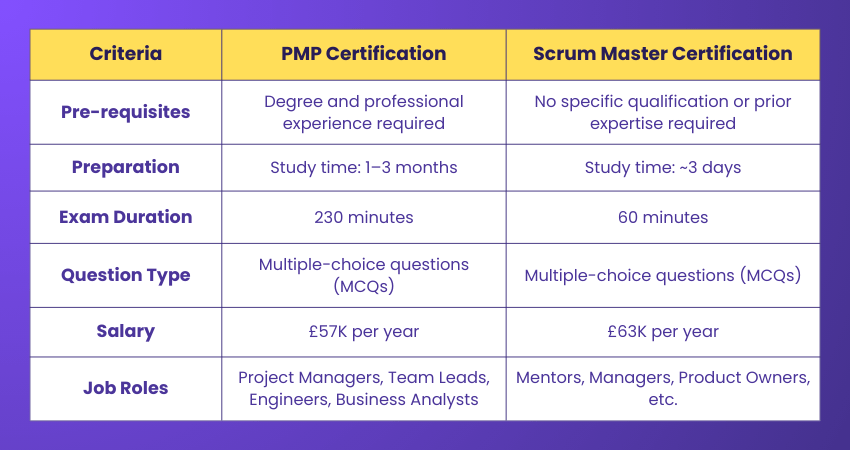
You must have previous experience in managing and leading projects, whether with a four-year degree or just a high school diploma.
PMP: You must have Project Management experience. You will need 36 months of project-leading experience if you have a four-year degree and 60 months of experience if you have a high school diploma or an Associate degree.
Scrum Master: No prerequisite.
b) PMP vs Scrum: Preparation
People are reluctant to spend much money on preparation time or exam fees if they don't benefit from it. Therefore, you should pursue the certification that will yield the highest return for the time and money you invest in it.
PMP: If a candidate’s degree meets PMI requirements, the required Project Management experience may be reduced to 24 months (2 years). In all cases, candidates must also complete 35 hours of Project Management education or hold a CAPM® Certification to qualify.
Scrum: The Scrum Master Certification can usually be completed within three days. While prior knowledge of Agile Principles and basic Project Management concepts is helpful, the course is suitable for professionals such as software engineers, Project Managers, product owners, QA specialists, and aspiring Scrum Masters.
Certification requires completing structured training, typically two days of instructor-led learning or around 16 hours of self-paced study, followed by a multiple-choice exam. The exam is time-bound and candidates must achieve the required passing score, which generally falls between 60% and 74%, depending on the certification provider.
c) PMP vs Scrum: Salary and Earning Power
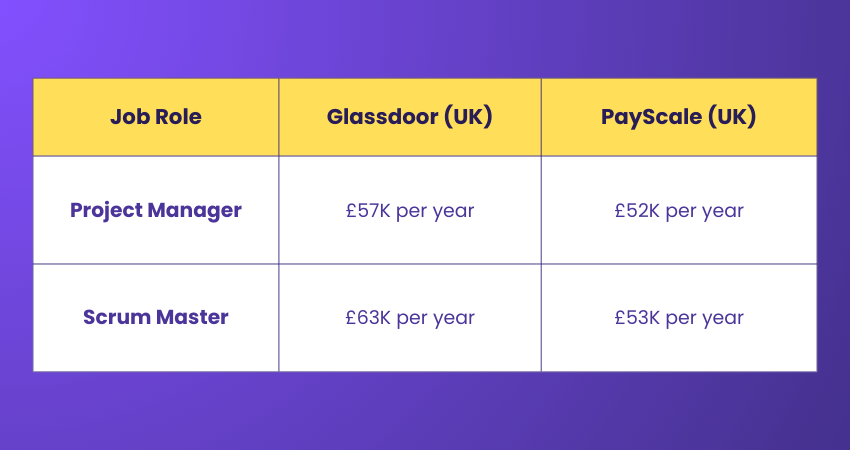
Based on data from multiple salary aggregation platforms, the average salaries for Project Managers and Scrum Masters in the UK are outlined below. The figures reflect the most recently available data and provide a general market comparison.
To sum it up
1) The PMP and Scrum Certification both seem to have a direct effect on earning potential.
2) On Scrum Teams, Project Managers are frequently chosen to serve as Scrum Masters. However, specialists who serve only as Scrum Masters typically earn more money. This might be because Scrum is a specialised area of Project Management that calls for specific skill sets.
Become proficient in the subject and enhance your job prospects through the PMI-ACP® Certification – Register today!
d) PMP vs Scrum: Job Roles
The PMP and Scrum Master credentials will open doors for increased employment opportunities. These certifications demonstrate a person's dedication to continuing their education and staying current with Scrum and Project Management developments.
Frequently, Scrum Masters Become:
a) Coaches
b) Mentors
c) Product Owners
d) Managers
e) Continue as Scrum Masters in more challenging scenarios
After obtaining your PMP Certification, some of the PMP job profiles you can apply for are:
a) Project Managers
b) Associate/Asst. Manager – Projects
c) Team Leads/Managers
d) Project Executives/Engineers
e) Software Developers
f) Technical Project Managers
g) Project Delivery Manager
h) Business Analyst
Below is a quick overview of what we’ve discussed:
PMP vs Scrum: Which One to Choose?
Both PMP and Scrum Master Certifications will help you in building your knowledge in Project Management practice and executing the projects. You could frequently ponder whether PMP or Scrum is the better option, but everything relies on the goals you desire to accomplish.
1) The Project Management credential with the highest recognition is the PMP. It evaluates applicants' knowledge of Project Management terminology, methodologies, and techniques.
2) A Project Manager focuses on projects and manages the accompanying timelines, whereas a Scrum Master directs and coaches their team. A Scrum Master Certification proves your proficiency with activities, artefacts, and roles and responsibilities. Project Managers with a focus on Agile Project Management are called Scrum Masters.
Choose the option that will have the most significant positive effect on your career and future, if you have to pick between the two. The Scrum Master Certification will undoubtedly be helpful if you already work in Agile Project Management. On the other hand, Getting a PMP Certification is an excellent approach to launching your Project Management career. Thus, to get the Top certification for you, thoroughly investigate all your viable options.
Benefits of Having the PMP Certification
The advantages of obtaining a certification like PMP, which include both concrete and intangible benefits, are as follows for both individuals and organisations.
1) Industry Recognition
The PMP Handbook highlights that PMP Certification is widely recognised and accessible anywhere, making it applicable to any setting or business. So, regardless of your industry or professional background, adding this certification to your resume can be highly beneficial.
2) Facilitates Essential Project Management Skills
Requirements for PMP Certification are very stringent. It is incredibly challenging to pass this exam without a lot of studying. You also need to understand how to use the information in practice. Many hard and soft skills must be acquired to earn the PMP Certification. It improves comprehension of crucial Project Management procedures, equipment, and techniques.
Also, check out here to find the best PMP Tools in the market!
3) Contributes to Higher Paycheques
One of the key benefits of PMP Certification is a stronger earning potential. PMP-certified Project Managers are often rewarded more favourably than non-certified professionals, as employers recognise their proven skills, experience, and ability to deliver complex projects. This makes PMP a valuable credential for long-term career and financial growth.
4) Demonstrates Your Commitment to the Profession
An employee who makes educational investments is valuable to the company. Your PMP Certification demonstrates your dedication to developing your professional abilities, knowledge, and competence. It also helps you gain the respect of your co-workers and supervisors.
Learn Agile frameworks to lead projects with confidence and clarity with our Scrum Master Certification – Join now!
Benefits of Obtaining a Scrum Master Certification
The following are the benefits you can get from earning a Scrum Certification:
1) Enhances Your Mindset
Possessing the Scrum Master Certification shows that you have an open mind to learning and are knowledgeable about recent Scrum advances. The certification trains people to stay up to date and to have a learning attitude, that is willing to learn new things and understand more about Scrum's objectives and principles.
2) Makes you an Asset at the Workplace
When a business implements a new technique, it affects its management, people, clients, and processes. When all these elements function well together, and the company switches to an Agile environment, the Scrum Master training equips students with the practical knowledge they need.
3) Improves Teamwork and Collaboration
The Scrum Master Certification teaches individuals about team management and aids with their understanding of team-building principles, improving teamwork and collaboration. Candidates receive training on cooperation to build successful products. They are aware of their obligations as a Scrum Master and the various approaches and strategies for collaborating with a Scrum team.
Read this blog on Agile Coach vs Project Manager: A Complete Comparison to gain insights into their unique skills approaches and impact on Agile teams
Conclusion
Choosing between PMP vs Scrum ultimately depends on your career goals, working style, and the types of projects you manage. Both certifications offer strong career value, global recognition, and long-term growth opportunities. Understanding their differences in roles, approach, and scope will help you make a confident, smart decision that aligns with your professional ambitions.
Learn backlog management, stakeholder communication, and Scrum roles from experts. Join our Scrum Product Owner Certification today!
Frequently Asked Questions
What is the Rule of 7 in PMP?

The Rule of 7 in PMP is a Quality Management guideline. It highlights a potential process issue when seven consecutive data points fall on one side of a control chart’s average. This helps Project Managers spot patterns early and take corrective action before problems grow.
Is Scrum Master Being Replaced by AI?
No, Scrum Masters are not being replaced by AI. While AI can handle routine tasks, the role relies on human skills like coaching, facilitation, and conflict resolution. AI supports Scrum Masters rather than replacing them.

Grace Mitchell


Senior Project Management Consultant and Author
Grace Mitchell is a highly experienced project management professional with over 15 years of expertise in leading large-scale projects across industries, including construction, IT, and finance. With qualifications in PRINCE2®, PMP®, AgilePM®, and MSP®, Grace specialises in delivering complex programmes with precision and clarity. Her writing is grounded in real-world application and focuses on helping learners build confidence in project delivery and stakeholder management.
View Detail

 If you wish to make any changes to your course, please


