


 Top Rated Course

We may not have the course you’re looking for. If you enquire or give us a call on +61 272026926 and speak to our training experts, we may still be able to help with your training requirements.
How to Run a Design Thinking Workshop: Complete Guide
Elizabeth Clark 24 March 2026Run a successful Design Thinking Workshop with a clear, user-focused agenda across Empathise, Define, Ideate, Prototype, and Test through practical activities. Encourage collaboration, creative problem solving, and rapid idea generation among participants. Turn insights into actionable solutions that address real user needs.

Training Outcomes Within Your Budget!
We ensure quality, budget-alignment, and timely delivery by our expert instructors.
Table of Contents

Have you ever been in a meeting where great ideas are shared but nothing truly innovative comes out of it? Many teams struggle to turn Creative Thinking into solutions that actually solve real user problems. This is where a Design Thinking Workshop becomes powerful, helping teams collaborate, explore ideas, and focus on user needs.
Understanding How to Run a Design Thinking Workshop helps teams turn ideas into structured problem-solving. With the right approach, organisations can unlock creativity and build practical solutions that truly matter. Let's begin!
Table of Contents
1) What is a Design Thinking Workshop?
2) How to Run a Design Thinking Workshop?
3) What Kinds of Challenges are Addressed with a Design Thinking Workshop?
4) Who Should Run a Design Thinking Workshop?
5) Remote Design Thinking Workshop Best Practices
6) How do You Measure the Success of a Workshop?
7) What Happens After the Workshop?
8) Conclusion
What is a Design Thinking Workshop?
A Design Thinking Workshop is a collaborative, hands-on session where teams work together to understand user problems and develop creative solutions using the Design Thinking approach. It brings participants from different roles together to explore challenges, share ideas, and generate innovative solutions in a structured and engaging environment for effective problem solving.
These workshops typically focus on key Design Thinking phases such as empathy, ideation, prototyping, and testing. Participants work to understand user needs, generate solution ideas, and create simple prototypes for quick testing. Design Thinking Workshops promote collaboration, creativity, and practical problem-solving across teams in areas like product, marketing, sales, and leadership.
How to Run a Design Thinking Workshop?
These steps will help you to understand How to Run a Design Thinking Workshop.
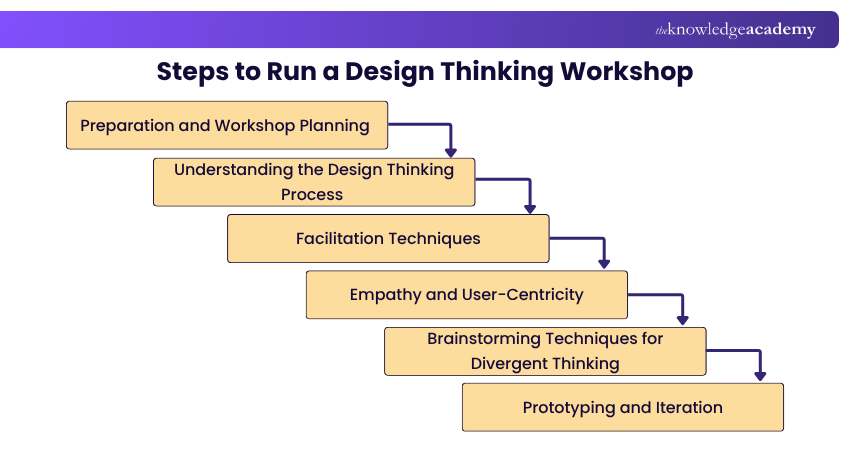
Step 1: Preparation and Workshop Planning
The success of a Design Thinking workshop begins with careful preparation. This stage sets the foundation for a productive session by defining goals, organising resources, and planning activities that encourage collaboration and innovation. The following elements help create an effective workshop plan:
a) Define Workshop Objectives:
Start by identifying the purpose of the workshop. Determine the problem or opportunity you want to address, such as improving customer experience, generating new product ideas, or solving a business challenge.
b) Choose the Right Venue and Resources:
Select a comfortable and open space that encourages creativity and collaboration. Ensure the venue has the necessary tools and materials required for brainstorming, discussion, and prototyping activities.
c) Create a Clear Workshop Agenda:
Develop a structured agenda based on the Design Thinking stages such as empathise, define, ideate, prototype, and test. Allocate sufficient time for each phase while keeping the schedule flexible for discussions and activities.
d) Prepare Materials and Visual Aids:
Design worksheets, templates, and visual aids that guide participants through the workshop activities. Clear materials help participants understand tasks and maintain engagement.
e) Set a Realistic Timeline:
Plan a balanced timeline that allows enough time for brainstorming, prototyping, and testing ideas. While maintaining the schedule, remain flexible to adjust the pace based on group progress.
f) Include a Diverse Participant Group:
Invite participants from different roles, departments, and backgrounds. A diverse group brings varied perspectives and encourages more creative and innovative solutions.
g) Prepare Facilitators and Resources:
Ensure facilitators understand the Design Thinking process and can guide discussions effectively. Gather all necessary resources such as sticky notes, markers, and prototyping materials to support workshop activities.
Understand employee engagement, sign up for our Leadership Training now!
Step 2: Understanding the Design Thinking Process
The Design Thinking process focuses on empathy, creativity, and collaboration to solve problems. It helps teams understand user needs, generate ideas, and develop solutions through iterative stages. The following phases show how the process works:
a) Understand the User:
The process begins with empathy, where teams focus on understanding user’s needs, emotions, and challenges. Methods such as interviews, observations, and empathy maps help participants gain insights into the user’s perspective.
b) Clarify the Problem:
In this stage, teams analyse the insights gathered and define the core problem from the user’s point of view. A clear problem statement helps set direction for the next steps.
c) Generate Ideas:
During ideation, participants brainstorm a wide range of ideas and potential solutions. Creative techniques such as brainstorming and mind mapping encourage innovative thinking without limitations.
d) Prototype and Test:
Ideas are then turned into simple prototypes such as sketches, mock-ups, or models. These prototypes are tested with users to gather feedback, identify improvements, and refine solutions.
e) Embrace Iteration and Wider Application:
Design Thinking is an iterative process, meaning teams often revisit earlier stages to improve their solutions. While commonly used for product design, it can also be applied to services, business processes, and organisational challenges.
Understand how Design Thinking solves business problems, sign up for our Design Thinking For R&D Engineers Training now!
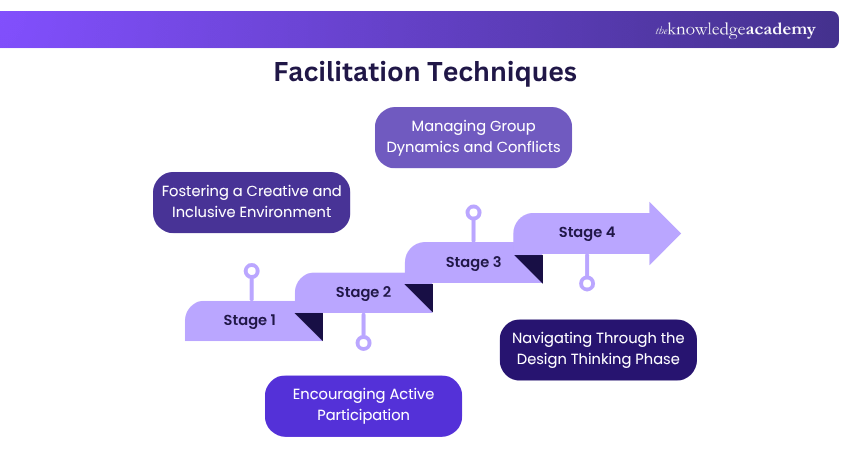
Step 3: Facilitation Techniques
Effective facilitation ensures participants collaborate, share ideas, and progress smoothly through each stage. The following techniques help guide the workshop effectively:
a) Encourage Active Participation:
Facilitators should involve all participants and encourage everyone to contribute ideas. Techniques such as round-robin discussions help ensure every voice is heard and prevent a few individuals from dominating conversations.
b) Manage Group Dynamics and Conflicts:
Workshops often include participants with different viewpoints. Facilitators should manage disagreements constructively and promote respectful discussions so that diverse perspectives lead to better solutions.
c) Guide the Design Thinking Phases:
Facilitators should clearly explain each stage of the Design Thinking process and guide participants through activities. Smooth transitions between phases help maintain momentum and clarity.
d) Manage Time and Pace:
Good Time Management ensures that every phase receives proper attention. Facilitators should monitor progress, keep discussions focused, and adjust the pace when necessary.
e) Maintain Energy and Engagement:
Facilitators should maintain enthusiasm and a positive atmosphere throughout the workshop. High energy and encouragement help participants stay engaged and collaborate more effectively.
Learn the role of an instructional designer in an organisation, sign up for our Instructional Design Training now!
Step 4: Empathy and User-Centricity
Empathy is a key element of the Design Thinking process, helping teams understand users’ needs, experiences, and emotions. By focusing on the user’s perspective, teams can develop solutions that are meaningful, practical, and closely aligned with real-world challenges.
a) Understanding User Needs:
Teams focus on learning about users’ behaviours, expectations, and pain points. This deeper understanding helps ensure that solutions address real problems.
b) Adopting a Human-Centred Approach:
Empathy encourages teams to prioritise user needs rather than only technical or organisational constraints, leading to more relevant solutions.
c) Exploring User Experiences and Emotions:
By analysing how users feel and interact with products or services, teams gain insights that guide better design decisions.
d) Building an Empathy-Driven Mindset:
Encouraging teams to view challenges from the user’s perspective helps create innovative solutions that truly resonate with real-world needs.
Step 5: Brainstorming Techniques for Divergent Thinking
Divergent thinking techniques help teams generate creative ideas during a Design Thinking workshop. Methods such as Crazy 8s, mind mapping, and SCAMPER encourage unconventional thinking. Ideas are then organised and prioritised. The following methods help refine them further:
a) Organising and Clustering Ideas:
After brainstorming, facilitators help participants group similar ideas into clusters based on common themes. This helps bring clarity and prepares the team for deeper exploration.
b) Collaborative Idea Selection:
Teams use methods such as dot voting or prioritisation matrices to evaluate and select the most promising ideas. This collaborative approach ensures that different perspectives are considered.
c) Encouraging Open Discussions:
Participants are encouraged to share ideas freely without immediate judgement. An open environment allows diverse viewpoints and creative suggestions to emerge.
d) Promoting Playful and Risk-Taking Thinking:
Facilitators encourage participants to experiment and think creatively. A playful mindset helps teams explore bold ideas that can lead to innovative solutions.
Step 6: Prototyping and Iteration
The prototyping and iteration phase turns ideas into tangible solutions through quick testing and refinement. Prototypes help teams visualise concepts and gather feedback for improvement. The following steps support this process:
a) Creating Rapid Prototypes:
Teams develop simple prototypes such as sketches, mock-ups, or basic models to represent their ideas and explore possible solutions.
b) Balancing Simplicity and Resources:
Prototypes should remain simple while using available materials and tools effectively. This allows teams to test ideas quickly without investing excessive time or resources.
c) Testing With Users:
User testing helps teams understand how people interact with the prototype. Feedback from users highlights strengths, weaknesses, and areas for improvement.
d) Iterating and Improving Solutions:
Based on feedback, teams refine and adjust their prototypes. This iterative process helps develop solutions that better address user needs and solve the defined problem effectively.
What Kinds of Challenges are Addressed with a Design Thinking Workshop?
Design Thinking workshops are designed to address complex challenges that require creative problem-solving and user-centred solutions. They are commonly used to improve product design, enhance customer experiences, and streamline internal processes. These workshops are especially useful when problems are unclear, team goals are misaligned, or organisations struggle to generate innovative ideas.
They can also help organisations respond to broader business or societal challenges, such as adapting to changing user needs, creating inclusive services, or developing sustainable solutions. By focusing on empathy, collaboration, and iterative testing, Design Thinking workshops help teams explore ideas, refine solutions, and address challenges in a structured yet flexible way.
Who Should Run a Design Thinking Workshop?
A Design Thinking Workshop is led by a facilitator who plans the session, guides activities, and ensures the team follows the Design Thinking process while encouraging collaboration and idea generation.
Typically, the following professionals can run a Design Thinking Workshop:
1) Design Thinking Facilitator: Leads the workshop, manages activities, and ensures the process runs smoothly.
2) UX or Product Designers: Guide teams in understanding user needs and developing creative solutions.
3) Innovation or Strategy Leaders: Use workshops to drive new ideas and business improvements.
4) Project Managers or Team Leaders: Facilitate collaboration and help teams solve complex challenges.
5) External Consultants or Trainers: Bring specialised expertise and guide organisations in applying Design Thinking effectively.
Remote Design Thinking Workshop Best Practices
To ensure the smooth execution of your remote Design Thinking Workshop, consider the following best practices:
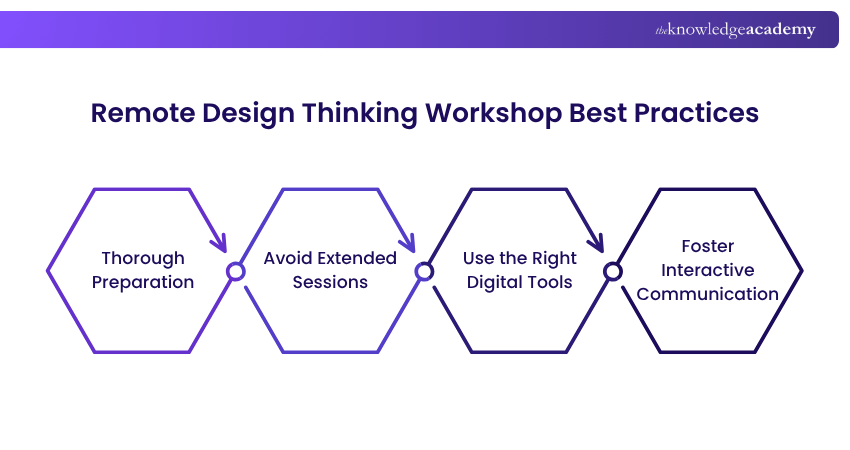
Thorough Preparation
Develop a comprehensive agenda that outlines the workshop's flow and objectives. Prior to the workshop day, conduct a practice run-through to ensure seamless coordination and fine-tune timings. Given the unique challenges of virtual settings, allocate extra time to address any unforeseen issues.
Avoid Extended Sessions
Acknowledging the natural distinctions between in-person and remote workshops, especially in participant engagement, it's a good idea to steer clear of lengthy sessions. This helps maintain ongoing engagement and ensures everyone participates optimally.
Unlike in-person workshops that naturally incorporate breaks, it can be challenging to maintain energy levels throughout an entire day. Opt for shorter digital workshops, and if needed, spread the session over two days. This approach ensures sustained engagement, effectiveness, and optimal participation from all involved.
Use the Right Digital Tools
Choosing the right digital tools is crucial for a smooth remote workshop. Platforms that offer features like breakout rooms, real-time collaboration on whiteboards, and easy file sharing are essential. Ensure participants are familiar with these tools ahead of time and provide clear instructions for using them during the workshop. Reliable technology and well-chosen tools can greatly enhance collaboration and the overall workshop experience.
Foster Interactive Communication
Remote settings can sometimes lead to reduced engagement, so it's important to foster interactive communication. Encourage active participation using methods like polls, chat discussions, and quick ice-breaker activities. Additionally, keep the communication channels open throughout the workshop, allowing participants to freely share ideas and ask questions, ensuring everyone feels included and heard.
How do You Measure the Success of a Workshop?
Workshop success is measured by how well participants understand the topic, apply new ideas, and benefit from the session. This is typically assessed through feedback, knowledge checks, and alignment with the workshop’s learning objectives.
Common ways to measure workshop success include:
1) Participant Satisfaction: Surveys or feedback forms to understand how useful and engaging the workshop was.
2) Knowledge Acquisition: Quizzes or assessments to evaluate what participants learned during the session.
3) Behavioural Changes: Follow-up reviews to see whether participants apply the skills or ideas in their work.
4) Key Metrics: Indicators such as Net Promoter Score (NPS), skill improvement scores, or completion of action plans.
5) Alignment with Objectives: Comparing outcomes with the workshop’s predefined goals, such as improved productivity, innovation, or return on investment.
What Happens After the Workshop?
After a workshop, the focus shifts from idea generation to turning insights into practical actions. Teams review the outcomes of the session, identify the most valuable ideas, and convert them into clear action plans that can be implemented in the organisation.
Key post-workshop steps include summarising key decisions, assigning ownership of tasks, and setting deadlines for action items. Teams may also collect participant feedback through surveys, develop implementation plans or prototypes such as a Minimum Viable Product (MVP), and schedule follow-up meetings to track progress and maintain momentum.
Conclusion
Understanding How to Run a Design Thinking Workshop enables teams to approach challenges with creativity and a strong focus on user needs. With clear planning, collaboration, and structured activities, organisations can transform ideas into practical solutions, encourage innovation, and build a culture that supports continuous improvement and effective problem solving.
Frequently Asked Questions
What Skills or Mindsets do Participants Develop in a Design Thinking Workshop?

Participants enhance skills like creative problem-solving, empathy, collaboration, and adaptability while developing a user-centric mindset. They also cultivate a proactive approach to innovation, learning how to quickly iterate and refine ideas based on real-world feedback.
Are There Specific Tools Used in Design Thinking Workshops to Boost Collaboration and Idea Generation?
Yes, tools like brainstorming, mind mapping, sticky notes, and empathy maps are key for fostering collaboration and creative thinking. Digital platforms like virtual whiteboards also enhance team interaction in both remote and in-person workshops.
What are the Other Resources and Offers Provided by The Knowledge Academy?
The Knowledge Academy takes global learning to new heights, offering over 3,000+ online courses across 490+ locations in 190+ countries. This expansive reach ensures accessibility and convenience for learners worldwide.
Alongside our diverse Online Course Catalogue, encompassing 17 major categories, we go the extra mile by providing a plethora of free educational Online Resources like Blogs, eBooks, Interview Questions and Videos. Tailoring learning experiences further, professionals can unlock greater value through a wide range of special discounts, seasonal deals, and Exclusive Offers.
What is The Knowledge Pass, and How Does it Work?
The Knowledge Academy’s Knowledge Pass, a prepaid voucher, adds another layer of flexibility, allowing course bookings over a 12-month period. Join us on a journey where education knows no bounds.
What are the Related Courses and Blogs Provided by The Knowledge Academy?
The Knowledge Academy offers various Leadership Courses, including the Design Thinking Course, High Performing Teams Training, and the Technical Team Leading Training. These courses cater to different skill levels, providing comprehensive insights into How to Set Goals and Achieve Them.
Our Business Skills Blogs cover a range of topics related to Design Thinking Workshop, offering valuable resources, best practices, and industry insights. Whether you are a beginner or looking to advance your Business skills, The Knowledge Academy's diverse courses and informative blogs have got you covered.

Elizabeth Clark


Senior Leadership Trainer and Business Strategist
Elizabeth Clark is a senior trainer and strategist with a strong background in leadership, business management, and operational improvement. With more than 15 years of experience, she has worked with leaders across industries to enhance their influence, communication, and strategic planning skills. Her writing is known for being insightful and focused on real-world leadership challenges.
View Detail
Upcoming Business Skills Resources Batches & Dates
Date
 Successful People Management and Team Leadership
Successful People Management and Team Leadership
Fri 3rd Jul 2026
Successful People Management and Team Leadership
Fri 6th Nov 2026

 If you wish to make any changes to your course, please


