


We may not have the course you’re looking for. If you enquire or give us a call on 01344203999 and speak to our training experts, we may still be able to help with your training requirements.
Top 10 Hadoop Tools and Their Key Features
ByThe Knowledge AcademyLast updated on: 13 November 2026
Discover 10 essential Hadoop tools and their key features, from HDFS, MapReduce and YARN to Hive, Spark, Tez and Ozone. Learn how these technologies support distributed storage, data processing, resource management, integration and security.

Quick Preview
1. Hadoop tools support large-scale data storage, processing, integration, analysis and security across distributed environments.2. HDFS, MapReduce and YARN are core Hadoop components, while Hive, HBase, Spark and other ecosystem technologies provide additional capabilities.3. The ecosystem includes specialised technologies for SQL analytics, distributed processing, data integration and access control.4. Choosing the right tool depends on data volume, processing requirements, system compatibility and security needs.
Handling large amounts of data can be challenging, especially when traditional systems struggle to store and process information efficiently. This is where Hadoop and its ecosystem of tools come into play, helping organisations manage large datasets across distributed environments.
With several Hadoop tools available, choosing the right one can be challenging. How do you know which best suits your requirements? This blog explores 10 Hadoop tools, their key features and practical applications to help you understand what each offers.
Top 10 Hadoop Tools
Hadoop tools and related ecosystem technologies support distributed storage, processing, resource management, analytics, integration and security. Understanding their key features and practical applications can help you choose the right solution.
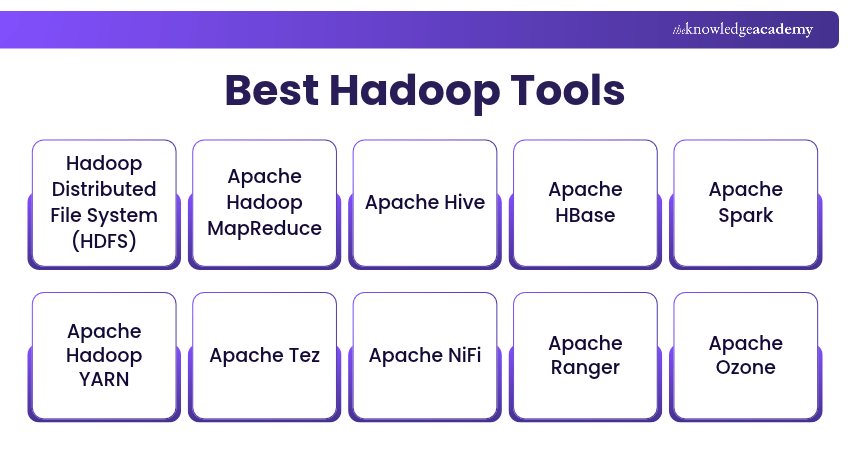
1) Hadoop Distributed File System (HDFS)
Hadoop Distributed File System (HDFS) is one of the main components of Hadoop that provides distributed storage for large datasets. It divides files into blocks and stores them across multiple machines in a cluster, allowing data to be accessed and processed efficiently.
It is designed to handle large files and provide high-throughput data access. Its distributed architecture also helps maintain data availability when individual machines experience failures.
Key Features:
a) Distributed Storage: Stores data blocks across multiple nodes to support large-scale storage.
b) Fault Tolerance: Uses data replication to help protect against hardware failures.
c) Scalability: Allows storage capacity to expand by adding more machines to the cluster.
d) High-throughput Access: Supports efficient reading and writing of large datasets.
Best Used For: Storing and managing large datasets in distributed Hadoop environments, particularly for batch-processing workloads.

2) Apache Hadoop MapReduce
Apache Hadoop MapReduce is a distributed processing framework and programming model used to analyse large datasets across clusters. It divides processing tasks into smaller operations that run in parallel, allowing large workloads to be completed across multiple machines.
MapReduce uses Map and Reduce functions. Map tasks generate intermediate key-value pairs, which the framework shuffles and sorts before Reduce tasks process them to produce the output.
Key Features:
a) Parallel Processing: Distributes data processing tasks across multiple cluster nodes.
b) Scalability: Supports large workloads by using distributed computing resources.
c) Fault Tolerance: Can recover from task failures by rerunning affected tasks.
d) Batch Processing: Handles large-scale data transformation and analysis tasks.
Best Used For: Processing large datasets in batch-oriented Hadoop environments, especially where MapReduce is already part of the infrastructure.
3) Apache Hive
Apache Hive is a data warehouse system that permits users to query and analyse large datasets using SQL. It simplifies data analysis by allowing professionals familiar with SQL to work with distributed data without writing complex processing programs.
Hive is commonly used for data warehousing, reporting and analytics. It supports structured and semi-structured datasets and can work with different storage formats and processing engines.
Key Features:
a) SQL-based Queries: Uses Hive Query Language (HiveQL) to analyse data.
b) Data Warehousing: Supports large-scale analytical queries and reporting.
c) Multiple File Formats: Works with formats such as Parquet, ORC and Avro.
d) Data Integration: Supports data stored in Hadoop-compatible storage systems.
Best Used For: Data warehousing, SQL-based analytics and reporting on large datasets.
4) Apache HBase
Apache HBase is a distributed, scalable NoSQL database designed to provide random, real-time read and write access to large datasets. It is built to work with Hadoop's HDFS and uses a column-family data model to organise information.
Unlike systems primarily designed for batch analytics, HBase supports applications that require frequent updates and quick access to individual records.
Key Features:
a) NoSQL Storage: Supports flexible data structures using a column-family model.
b) Real-time Data Access: Enables random reads and writes across large datasets.
c) Horizontal Scalability: Distributes data across multiple servers as workloads grow.
d) Hadoop Integration: Works with HDFS and other Hadoop ecosystem components.
Best Used For: Applications requiring fast access to large volumes of data, such as time-series records and operational data systems.
5) Apache Spark
Apache Spark is a distributed data processing engine designed to handle large-scale analytics and computational workloads. It supports batch processing, stream processing, machine learning and SQL-based analysis through a unified platform.
Spark uses optimised execution and can retain intermediate data in memory, making it particularly useful for workloads involving repeated computations.
Key Features:
a) Distributed Processing: Executes large-scale data processing tasks across multiple machines.
b) In-memory Computing: Can reuse data in memory to improve performance for suitable workloads.
c) Structured Streaming: Supports processing data from continuous streams.
d) Advanced Analytics: Provides libraries for SQL, machine learning and graph processing.
Best Used For: Large-scale data transformation, analytics, machine learning and stream processing.
Master techniques for optimising Spark applications to ensure faster data processing with our Apache Spark Training – Sign up now!
6) Apache Hadoop YARN
Apache Hadoop YARN (Yet Another Resource Negotiator) is a core Hadoop component responsible for resource management and application scheduling. It helps multiple processing applications share computing resources across a distributed cluster.
YARN uses a ResourceManager to allocate resources, NodeManagers to manage individual nodes and ApplicationMasters to coordinate application execution. This allows different workloads to run within a shared Hadoop environment.
Key Features:
a) Resource Management: Allocates computing resources across applications running in a Hadoop cluster.
b) Job Scheduling: Allocates cluster resources to applications based on availability and configured scheduling policies.
c) Scalability: Supports distributed workloads across multiple nodes in a cluster.
d) Application Monitoring: Tracks application execution and resource usage through its management components.
Best Used For: Managing cluster resources, scheduling distributed applications and coordinating workloads in Hadoop environments.
7) Apache Tez
Apache Tez is a distributed data-processing framework built on Apache Hadoop YARN. It supports complex processing workflows using Directed Acyclic Graphs (DAGs), allowing tasks and their dependencies to be executed efficiently.
Tez can execute workflows that would otherwise require multiple MapReduce jobs. It is particularly relevant to Apache Hive, where it can serve as a query execution engine.
Key Features:
a) DAG-based Processing: Organises processing tasks and dependencies into directed acyclic graphs.
b) YARN Integration: Runs distributed processing applications using Hadoop YARN resources.
c) Optimised Execution: Supports efficient execution of interconnected processing stages.
d) Hive Integration: Provides an execution framework for supported Apache Hive workloads.
Best Used For: Running complex distributed processing workflows, particularly SQL analytics executed through Apache Hive.
8) Apache NiFi
Apache NiFi automates data movement and transformation between systems. Its visual interface helps users design and monitor data flows, making it useful for ingestion, routing and integration workflows. It can also connect Hadoop-compatible data sources and destinations through supported processors.
Key Features:
a) Visual Data Flow Design: Provides a graphical interface for creating and managing workflows.
b) Data Routing and Transformation: Moves and modifies data between connected systems.
c) Data Provenance: Tracks the movement and processing history of data.
d) Flow Management: Supports back pressure, prioritisation and error handling.
Best Used For: Automating data ingestion, routing and movement across multiple systems.
Pro Tip
Identify whether your workload needs data movement, resource management or processing. NiFi helps move and route data, YARN manages cluster resources, and processing frameworks such as MapReduce and Tez execute distributed workloads.
Master real-time data ingestion, routing, transformation, and error handling with our Apache NiFi Training – Join now!
9) Apache Ranger
Apache Ranger is a security framework designed to manage and monitor data access across supported data platforms. It provides centralised security administration, helping organisations define access policies and maintain visibility over user activities.
Ranger is particularly useful in environments where multiple users and applications require controlled access to sensitive information.
Key Features:
a) Centralised Policy Management: Helps administrators define and manage security policies.
b) Fine-grained Access Control: Supports detailed permissions for supported resources.
c) Security Auditing: Records access activities to support monitoring and compliance.
d) Hadoop Ecosystem Integration: Provides security capabilities for supported services, including Hive and HBase.
Best Used For: Managing data access permissions, security policies and auditing across supported Hadoop ecosystem components.
10) Apache Ozone
Apache Ozone is a distributed object storage system designed for large-scale data environments. It provides scalable storage for Hadoop-compatible workloads and supports common Amazon S3 API operations through its S3 Gateway.
Ozone supports replication and erasure coding for data resilience. It also provides Hadoop-compatible file system interfaces, allowing analytics tools to work with stored data through supported integrations.
Key Features:
Scalable Object Storage: Stores large volumes of data across distributed storage nodes.
a) Data Resilience: Supports replication and erasure coding to protect stored data.
b) S3-compatible Access: Provides object access through an S3-compatible Gateway.
c) Hadoop Integration: Supports Hadoop-compatible file system interfaces for data-processing workloads.
Best Used For: Building large-scale object storage environments and supporting Hadoop-compatible analytics and data lake workloads.
How to Choose the Right Hadoop Tool
Choosing the right Hadoop tool depends on your data requirements, processing needs and existing infrastructure. Here are five factors to consider:
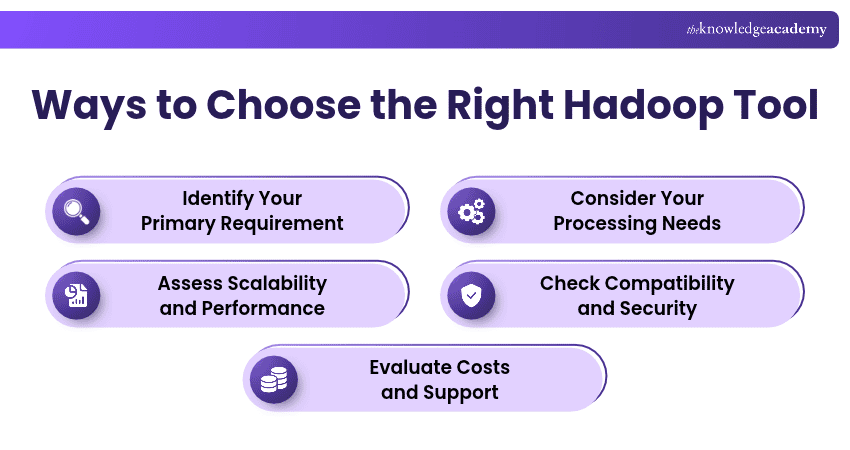
1) Identify Your Primary Requirement: Determine whether you need data storage, processing, analytics, integration or security capabilities.
2) Consider Your Processing Needs: Identify whether your workloads involve batch processing, streaming or real-time data access.
3) Assess Scalability and Performance: Consider data volume, processing speed, fault tolerance and future growth requirements.
4) Check Compatibility and Security: Ensure the tool integrates with your existing infrastructure and meets your data access and security requirements.
5) Evaluate Costs and Support: Review implementation costs, maintenance needs, technical expertise, documentation and ongoing project support.
Hadoop tools support different aspects of distributed data management, from HDFS storage and YARN resource management to Hive analytics and Ranger security. Understanding their capabilities helps you select technologies that match your processing needs, infrastructure and long-term data requirements.
Learn to design scalable data solutions with the Big Data and Hadoop Solutions Architect Training – Sign up now!

The Knowledge Academy develops accessible learning content across Project Management, IT, Cybersecurity, Data Science, Business Analysis, HR, Accounting and Finance, Leadership and Health and Safety. Its resources combine subject research with clear explanations to help professionals build practical knowledge across a wide range of disciplines.
View Detail

 If you wish to make any changes to your course, please


