


 Top Rated Course

We may not have the course you’re looking for. If you enquire or give us a call on +61 272026926 and speak to our training experts, we may still be able to help with your training requirements.
Lean Six Sigma vs Agile
James Smith 16 May 2026Learn Program Life Cycle Management, its key phases, benefits, and how it helps organisations plan, execute, and control programs effectively. Discover how each phase improves planning, resource use, and risk control. Learn how organisations achieve successful outcomes and align programs with strategic goals.

Training Outcomes Within Your Budget!
We ensure quality, budget-alignment, and timely delivery by our expert instructors.
Table of Contents
Related Courses
In today’s fast-paced business environment, organisations strive to improve their processes, enhance efficiency, and deliver high-quality products and services. Two popular methodologies that have gained significant traction have sparked a debate in the market. These are Lean Six Sigma vs Agile.
While both approaches focus on process improvement and driving success, they have distinct characteristics and applications. While Lean Six Sigma focuses on process efficiency, Agile focuses on developing project efficiency.
Since both methodologies strive to improve business operations, it is obvious for businesses to be at crossroads. But you can eliminate this confusion. Read this blog to explore the key differences between Lean Six Sigma vs Agile methodologies. Also, learn which approach best aligns with your needs.
Table of Contents
1) Lean Six Sigma – An overview
2) Understanding the Agile methodology
3) Key differences between Lean Six Sigma and Agile
4) Can Lean Six Sigma and Agile complement each other?
5) Choosing the right methodology
6) Conclusion
Lean Six Sigma – An Overview
Lean Six Sigma is a methodology that combines Lean manufacturing and Six Sigma principles. It aims to minimise waste, reduce variation, and improve process efficiency and quality. Lean focuses on eliminating non-value-added activities using tools like SMED (Single-Minute Exchange of Dies) to reduce setup times while Six Sigma aims to reduce process variation and defects. Lean focuses on eliminating non-value-added activities, while Six Sigma aims to reduce process variation and defects.
By integrating these approaches, Lean Six Sigma provides a comprehensive framework for process improvement. At its core, this methodology follows certain key principles that are as follows:
a) Identifying and understanding customer requirements.
b) Measuring and analysing data to make informed decisions.
c) Continuously refining processes to achieve optimal results.
Understanding the Agile Methodology
Agile is an iterative and incremental Project Management and software development approach. It originated in the software development industry but has since been adopted across various domains. This methodology promotes collaboration, adaptive planning, and rapid delivery of high-quality products.
Further, it values individuals and interactions, working solutions, customer interaction, and responding to change over following rigid processes and documentation. Agile is also guided by a set of principles known as the Agile Manifesto. These principles include the following:
1) Prioritising customer satisfaction through early and continuous delivery of valuable software.
2) Welcoming changing requirements even in later stages of development.
3) Delivering working software frequently.
4) Fostering face-to-face communication.
5) Enabling self-organising teams.
Key Differences Between Lean Six Sigma and Agile
While both Lean Six Sigma and Agile methodologies aim to improve processes and deliver successful outcomes, they differ significantly in their focus, approach, project management methodology, team structure, and flexibility.
Therefore, understanding these key differences is essential for organisations seeking to adopt the most suitable methodology for their needs. So, let’s explore the distinctions between Lean Six Sigma and Agile in more detail:
Focus and Approach
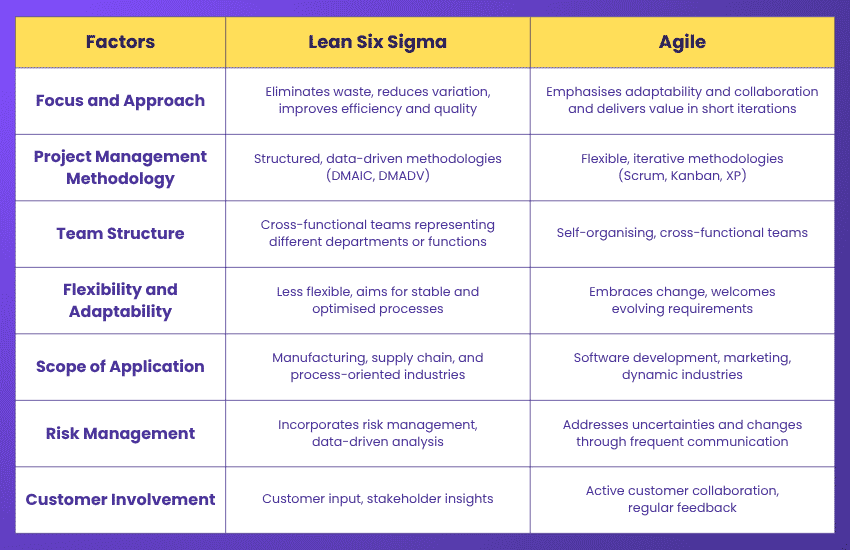
Lean Six Sigma primarily focuses on eliminating waste, reducing variation, and improving efficiency and quality. It also employs a structured and data-driven approach to identify and solve problems, aiming for incremental and continuous improvement.
Agile, on the other hand, emphasises adaptability, collaboration, and delivering value in short iterations. Further, it embraces change and encourages teams to be responsive to customer feedback.
Project Management Methodology
Lean Six Sigma follows a project-based approach using methodologies such as DMAIC and DMADV. It utilises tools and techniques like process mapping, statistical analysis, and root cause analysis to drive improvements.
Agile, in contrast, adopts a flexible and iterative Project Management methodology. It employs frameworks like Scrum, Kanban, or Extreme Programming (XP) to manage work in short cycles or sprints. This allows teams to adapt to changing requirements.
Team Structure
Lean Six Sigma essentially involves cross-functional teams, with members representing different departments or functions. These teams work together to analyse and improve processes using Lean Six Sigma tools.
Agile teams, on the other hand, are self-organising and cross-functional. They collaborate closely, share knowledge, and collectively work towards delivering value. Agile promotes a flatter hierarchy and encourages frequent communication among team members.
Flexibility and Adaptability
Lean Six Sigma provides a structured and systematic approach, which may be less flexible when accommodating changes in requirements. It aims to establish stable and optimised processes.
Agile, however, embraces change and welcomes evolving requirements. It enables teams to adapt quickly and reprioritise work based on customer feedback and changing market conditions.
Scope of Application
Lean Six Sigma originated in manufacturing industries but has since expanded to various sectors, including healthcare, finance, and services. It is well-suited for organisations seeking to optimise processes and improve overall operational performance.
On the other hand, Agile initially emerged in the software development domain. However, its principles and practices have been successfully applied beyond software, including marketing, Project Management, and product development.
Risk Management
Lean Six Sigma incorporates risk management as an integral part of its methodology. It identifies and mitigates risks through statistical analysis and process improvement efforts.
Agile, on the other hand, considering the risks, primarily addresses uncertainties and changes. It promotes regular communication, collaboration, and the ability to adapt quickly. Therefore, the methodology thrives in dynamic environments where responding to risks and changes is essential.
Customer Involvement
Lean Six Sigma methodologies involve customer input but may not prioritise direct customer involvement in decision-making processes. Here, customer requirements are often determined through data analysis and stakeholder insights.
In contrast, Agile methodologies actively encourage customer collaboration and involvement throughout the development cycle. Regular customer feedback and close collaboration ensure that the end product aligns closely with customer needs and expectations.
Can Lean Six Sigma and Agile Complement Each Other?
While Lean Six Sigma and Agile have distinct approaches, they can complement each other in certain cases. Organisations can leverage Lean Six Sigma principles to establish a foundation of process efficiency and quality. Simultaneously, they can adopt Agile practices to ensure adaptability, responsiveness, and quick feedback loops.
This hybrid approach can be effective when projects require both stability and agility. By combining the strengths of Lean Six Sigma and Agile, organisations can achieve optimal results, balancing efficiency, quality, and the ability to respond quickly to changing requirements.
Embrace agility and enhance your project management skills with Agile Training.
Choosing the Right Methodology
Lean Six Sigma is well-suited for processes that require optimisation, reduction of waste, and stability. It works effectively in manufacturing, supply chain management, and process-oriented industries.
Agile, on the other hand, is ideal for projects that demand flexibility, frequent feedback loops, and rapid adaptation. It excels in software development, digital marketing, and industries with rapidly changing market dynamics.
But the question remains intact, which methodology is ideal? To answer this question, organisations should consider the following factors before implementing any methodology for their business operations:
a) Nature of the project
b) The organisation's goals
c) The industry context
By keeping these factors in mind, organisations can decide which methodology aligns best with their objectives and drives the desired results.
Conclusion
Lean Six Sigma vs Agile – Which is perfect for your business? This has become a prolonged battle that every organisation is tackling. By considering their specific project needs, industry context, and desired outcomes, they can select the methodology that aligns best with the organisation’s goals and project requirements.
Learn the fundamentals of Lean Six Sigma principles and methodology. Join our Lean Six Sigma Certification Training now!
Frequently Asked Questions
Which is Better for Process Improvement, Lean Six Sigma or Agile?

Lean Six Sigma is better for process improvement as it focuses on reducing waste, minimising variation, and improving quality through data-driven methods. Agile is more suitable for flexibility and rapid delivery, rather than deep process optimisation.
Is Agile Faster Than Lean Six Sigma?
Yes, Agile is generally faster because it works in short iterations and delivers results quickly. Lean Six Sigma takes more time as it follows a structured, data-driven approach to ensure long-term process improvement and quality.
What are the Other Resources and Offers Provided by The Knowledge Academy?
The Knowledge Academy takes global learning to new heights, offering over 3,000+ online courses across 490+ locations in 190+ countries. This expansive reach ensures accessibility and convenience for learners worldwide.
Alongside our diverse Online Course Catalogue, encompassing 17 major categories, we go the extra mile by providing a plethora of free educational Online Resources like Blogs, eBooks, Interview Questions and Videos. Tailoring learning experiences further, professionals can unlock greater value through a wide range of special discounts, seasonal deals, and Exclusive Offers.
What is The Knowledge Pass, and How Does it Work?
The Knowledge Academy’s Knowledge Pass, a prepaid voucher, adds another layer of flexibility, allowing course bookings over a 12-month period. Join us on a journey where education knows no bounds.
What are the Related Courses and Blogs Provided by The Knowledge Academy?
The Knowledge Academy offers various Lean Six Sigma Certification Courses, including the Lean Six Sigma Green Belt Course, Lean Six Sigma Yellow Belt and the Lean Six Sigma Black Belt Course. These courses cater to different skill levels, providing comprehensive insights into Lean Manufacturing.
Our Business Improvement Blogs cover a range of topics related to Lean Six Sigma, offering valuable resources, best practices, and industry insights. Whether you are a beginner or looking to advance your Lean Six Sigma skills, The Knowledge Academy's diverse courses and informative blogs have got you covered.

James Smith


Digital Marketing Manager and Trainer
James Smith is a digital marketing professional with over a decade of experience in SEO, content strategy, paid media and analytics. He has supported both SMEs and global brands in transforming their digital presence. James’s writing and training are rooted in results-driven tactics and the latest marketing trends.
View Detail
Upcoming Business Improvement Resources Batches & Dates
Date
 Lean Six Sigma Green Belt
Lean Six Sigma Green Belt
Mon 29th Jun 2026
Lean Six Sigma Green Belt
Mon 31st Aug 2026
Lean Six Sigma Green Belt
Mon 19th Oct 2026
Lean Six Sigma Green Belt
Mon 7th Dec 2026

 If you wish to make any changes to your course, please


