


 Top Rated Course

We may not have the course you’re looking for. If you enquire or give us a call on +61 272026926 and speak to our training experts, we may still be able to help with your training requirements.
What is the ArchiMate® 3 Modelling Language, and What are its Purpose and Features?
James Smith 03 June 2026Have you ever wondered what is the ArchiMate® 3 Modelling Language and what its purpose is? This blog will take you through the purpose of this modelling language while also explaining its common features like its layered structure extensive language elements, explaining its relationship types, its ability to give visual notations and diagrams and its tool support.
Home
 Resources
Business Improvement
What is the ArchiMate® 3 Modelling Language, and What are its Purpose and Features?
Resources
Business Improvement
What is the ArchiMate® 3 Modelling Language, and What are its Purpose and Features?
Resources
Business Improvement
What is the ArchiMate® 3 Modelling Language, and What are its Purpose and Features?

Training Outcomes Within Your Budget!
We ensure quality, budget-alignment, and timely delivery by our expert instructors.
Table of Contents
Enterprise architecture plays a vital role in aligning business goals with IT strategies in the modern business landscape. It enables organisations to plan, design, and implement IT infrastructures effectively while ensuring seamless integration with business processes. A standardised modelling language is essential to support this alignment, and that is where the ArchiMate® 3 Modelling Language comes into play. This blog explores its purpose, key concepts, and features.
Table of Contents
1) What is the ArchiMate® 3 Modelling Language?
2) What is the Purpose of the ArchiMate® 3 Modelling Language?
3) What are the Features of the ArchiMate® 3 Modelling Language?
4) What are the Key Concepts of the ArchiMate® 3 Modelling Language?
5) Conclusion
What is the ArchiMate® 3 Modelling Language?
The ArchiMate® 3 Modelling Language is a widely adopted enterprise architecture modelling language that provides a standardised and visual approach for describing and analysing complex architectures. With its layered structure, language elements, relationship types, and visual notation, the language enables effective communication, informed decision-making, and alignment between IT and business. It clearly represents an organisation's systems, processes, and technologies, facilitating better understanding and stakeholder collaboration.

What is the Purpose of the ArchiMate® 3 Modelling Language?
The primary purpose of the ArchiMate® 3 Modelling Language is to provide organisations with a standardised and effective means of describing, analysing, and communicating their enterprise architectures. By using the ArchiMate® Modelling Language, organisations can achieve several important objectives.
Firstly, the ArchiMate® 3 Modelling Language helps organisations improve their understanding of their enterprise architecture. It enables stakeholders to capture and represent the architecture's various components, relationships, and dependencies. This deeper understanding allows organisations to identify potential bottlenecks, inefficiencies, and areas for improvement. It also helps stakeholders gain insights into how different elements of the architecture interact and impact each other.
Secondly, the language enhances communication and collaboration among stakeholders. The language provides a common vocabulary and an easily understandable visual representation by business and IT professionals. This facilitates effective communication between different departments and teams, ensuring that everyone has a shared understanding of the architecture. It also helps stakeholders discuss, evaluate, and make decisions based on a clear and consistent understanding of the enterprise architecture.
Furthermore, it supports informed decision-making. By accurately modelling the enterprise architecture, organisations can simulate and evaluate different scenarios, understand the consequences of potential changes, and make data-driven decisions. This reduces the risk of costly mistakes and helps organisations align their business strategies with their IT systems more effectively.
The ArchiMate® 3 Modelling Language also promotes better alignment between business and IT. By representing the architecture clearly and structured, it enables stakeholders from both domains to collaborate and ensure that IT capabilities support business objectives. This alignment helps organisations optimise their processes, systems, and technologies to meet business needs, improving efficiency and effectiveness.
Unlock the power of the ArchiMate® Modelling Language with our ArchiMate® 3 Training Course: Level 1 – sign up now!
What are the Features of the ArchiMate® 3 Modelling Language?
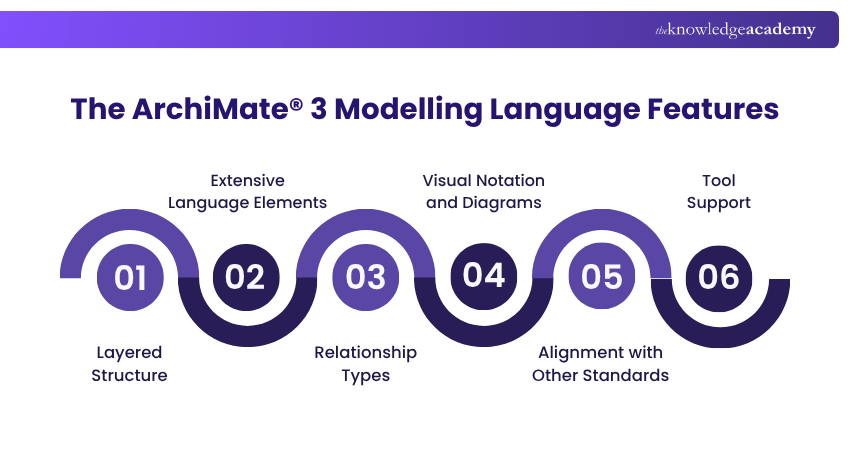
The ArchiMate® 3 Modelling Language encompasses several robust features that empower organisations to represent and analyse their enterprise architectures comprehensively. These features enable stakeholders to capture, communicate, and understand the complexities of their systems, processes, and technologies. The following are its key features:
a) Layered Structure: The ArchiMate® 3 Modelling Language adopts a layered structure, dividing the enterprise architecture into three primary layers: Business, Application, and Technology. This structure provides a systematic approach to organising and representing different aspects of the architecture. Each layer focuses on elements and relationships relevant to its perspective, facilitating a clear understanding of the architecture's components and their interactions.
b) Extensive Language Elements: The language offers a comprehensive range of language elements covering enterprise architecture's diverse aspects. These language elements include Business Objects, Processes, Functions, Applications, Infrastructure, and more. By leveraging this comprehensive set of elements, organisations can create detailed and accurate representations of their architecture, ensuring that no crucial aspect is overlooked.
c) Relationship Types: The language defines various relationship types that depict the dependencies and interactions between different elements within the architecture. These relationship types allow stakeholders to capture the dynamic aspects of the architecture, such as flows, triggers, access, and associations. The relationships enable a deeper understanding of how various elements collaborate and impact each other, supporting informed decision-making and analysis.
d) Visual Notation and Diagrams: The ArchiMate® 3 Modelling Language provides a visual notation and a standardised set of symbols to represent the enterprise architecture. This visual representation makes it easier for stakeholders to grasp complex concepts and relationships. The language supports the creation of diagrams that capture different views of the architecture, such as the Application Landscape, Business Process Flow, or Technology Infrastructure. These diagrams offer a clear and intuitive way to communicate architectural concepts and facilitate effective collaboration.
e) Alignment with Other Standards: It is compatible with different widely adopted standards in the field of enterprise architecture, like the TOGAF® Standard. This compatibility allows organisations to integrate the language into their existing architectural practices and frameworks, fostering consistency and interoperability.
f) Tool Support: The language is supported by various modelling tools that provide dedicated features and functionalities to facilitate creating, analysing, and managing enterprise architecture models. These tools offer capabilities such as automated diagram generation, relationship validation, and report generation, enhancing the efficiency and accuracy of architectural work.
By leveraging these powerful features, the ArchiMate® 3 Modelling Language empowers organisations to model, communicate, and analyse their enterprise architectures effectively. It promotes a comprehensive understanding of the architecture's components, relationships, and dependencies, enabling stakeholders to make informed decisions, align business and IT strategies, and drive successful architectural transformations.
Take your enterprise architecture skills to the next level with our the ArchiMate® 3 Training Course: Level 2 – sign up today!
What are the Key Concepts of the ArchiMate® 3 Modelling Language?
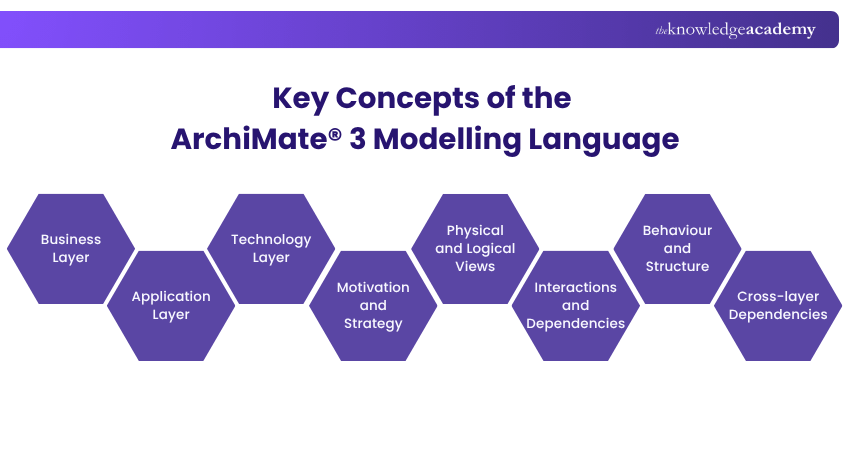
The ArchiMate® 3 Modelling Language encompasses a range of key concepts forming the building blocks of the enterprise architecture modelling language. These concepts provide a comprehensive framework for representing and understanding the components, relationships, behaviours, and motivations within an organisation's architecture. Here are its key concepts:
a) Business Layer: It focuses on capturing the business aspects of an organisation, including its structure, processes, capabilities, and goals. It comprises elements such as Business Process, Business Function, Business Role, and Business Object. These elements help depict the business domain's activities, responsibilities, and resources.
b) Application Layer: It represents the software applications and systems that support and automate the organisation's business processes. It includes elements such as Application Service, Application Component, Application Interface, and Data Object. These elements represent application functionality, data exchange, and integration points.
c) Technology Layer: It encompasses the hardware, software, and infrastructure components underpinning the organisation's IT capabilities. It comprises Devices, System Software, Networks, and Infrastructure Services. These elements represent the technology infrastructure and its connectivity, ensuring the effective delivery and operation of applications and services.
d) Motivation and Strategy: The language captures the motivations, goals, principles, and strategies that drive the enterprise architecture. It includes elements such as Driver, Goal, Principle, and Requirement. These elements help stakeholders align the architecture with the organisation's objectives, guiding the decision-making process and ensuring strategic coherence.
e) Physical and Logical Views: The language enables stakeholders to view the architecture from physical and logical perspectives. The Physical View focuses on the tangible assets, infrastructure components, and their spatial distribution. The Logical View represents the abstract concepts, structures, and relationships between architectural elements, emphasising their functional and conceptual aspects.
f) Interactions and Dependencies: The ArchiMate® 3 Modelling Language provides relationship types that allow the modelling of interactions and dependencies between architectural elements. Relationship types include Composition, Aggregation, Association, Flow, Triggering, Access, and Influence. These relationships enable stakeholders to capture how elements collaborate, exchange information, influence, and rely on one another within the architecture.
g) Behaviour and Structure: The language distinguishes between the behaviour and structure of architectural elements. Behaviour elements include Process, Event, and Service, representing the dynamic aspects of the architecture. Structure elements, such as Components, Objects, and Nodes, represent the architecture's static aspects and composition. This differentiation allows stakeholders to analyse the architecture's functionality and composition.
h) Cross-layer Dependencies: The ArchiMate® 3 Modelling Language recognises that architectural elements often span multiple layers. It allows stakeholders to capture cross-layer dependencies and relationships, enabling the representation of how changes in one layer may impact elements in another layer. This promotes a holistic understanding of the architecture and supports decision-making considering the interdependencies between different layers.
Conclusion
The ArchiMate® 3 Modelling Language serves as a robust and standardised modelling language for enterprise architecture. Its purpose lies in providing a shared language that facilitates organisational communication, alignment, and decision-making. With its comprehensive representation, support for cross-domain modelling, and powerful features such as viewpoints, the language empowers architects to design and optimise architectures that align with business objectives and drive digital transformation.
Learn the ArchiMate® Modelling Language, metamodels, and stakeholder concerns & relationships with the ArchiMate® 3 Training Course- Sign in now!
Frequently Asked Questions
Who Should Learn the ArchiMate® 3 Modelling Language?

The ArchiMate® 3 Modelling Language is ideal for enterprise architects, solution architects, business analysts, and IT professionals involved in system design and organisational transformation. It helps them create structured models, align business and IT, and communicate complex architectures clearly.
How is the ArchiMate® Modelling Language Different from UML or BPMN?
the ArchiMate® Modelling Language focuses on enterprise architecture by connecting business, application, and technology layers in one model. Unlike UML (software design) or BPMN (process modelling), ArchiMate® provides a holistic view of how systems and strategies align across an organisation.
What are the Other Resources and Offers Provided by The Knowledge Academy?
The Knowledge Academy takes global learning to new heights, offering over 3,000+ online courses across 490+ locations in 190+ countries. This expansive reach ensures accessibility and convenience for learners worldwide.
Alongside our diverse Online Course Catalogue, encompassing 17 major categories, we go the extra mile by providing a plethora of free educational Online Resources like Blogs, eBooks, Interview Questions and Videos. Tailoring learning experiences further, professionals can unlock greater value through a wide range of special discounts, seasonal deals, and Exclusive Offers.
What is The Knowledge Pass, and How Does it Work?
The Knowledge Academy’s Knowledge Pass, a prepaid voucher, adds another layer of flexibility, allowing course bookings over a 12-month period. Join us on a journey where education knows no bounds.
What are the Related Courses and Blogs Provided by The Knowledge Academy?
The Knowledge Academy offers the ArchiMate® Training on various courses including the ArchiMate® 3 Training, the ArchiMate® 3 Training Course: Level 1, and the ArchiMate® 3 Training Course: Level 2. These courses cater to different skill levels, providing comprehensive insights into the ArchiMate® Viewpoints.
Our Business Improvement Blogs cover a range of topics related to the ArchiMate® 3 Modelling Language, offering valuable resources, best practices, and industry insights. Whether you are a beginner or looking to advance your Business Improvement skills, The Knowledge Academy's diverse courses and informative blogs have got you covered.

James Smith


Digital Marketing Manager and Trainer
James Smith is a digital marketing professional with over a decade of experience in SEO, content strategy, paid media and analytics. He has supported both SMEs and global brands in transforming their digital presence. James’s writing and training are rooted in results-driven tactics and the latest marketing trends.
View Detail
Upcoming Business Improvement Resources Batches & Dates
Date
 ArchiMate® 3 Training Course
ArchiMate® 3 Training Course
Thu 3rd Sep 2026
ArchiMate® 3 Training Course
Thu 26th Nov 2026

 If you wish to make any changes to your course, please


