


 Top Rated Course

We may not have the course you’re looking for. If you enquire or give us a call on +1 7204454674 and speak to our training experts, we may still be able to help with your training requirements.
Receptionist Job Description: Key Duties And Responsibilities
Charlotte Wilson 15 July 2026A receptionist manages the front desk, welcomes visitors, answers calls, and handles administrative tasks to ensure smooth and efficient office operations. They also manage appointments, maintain records, and support staff with day-to-day tasks. Their role is key to creating a welcoming, organised, and professional environment.

Training Outcomes Within Your Budget!
We ensure quality, budget-alignment, and timely delivery by our expert instructors.
Table of Contents
Receptionists play a vital role in maintaining a professional and welcoming front office. They are often the first point of contact for visitors and callers. Their responsibilities include managing appointments, handling enquiries, and supporting daily administrative tasks. A well-organised receptionist helps ensure smooth office operations.
Table of Contents
1) Receptionist Duties and Responsibilities
2) What does a Receptionist do?
3) Requirements for a Receptionist
4) Typical working hours for a Receptionist
5) Receptionist Job Description Template
6) Conclusion
Receptionist Duties and Responsibilities
Receptionists are essential to creating a positive first impression and ensuring smooth communication within an organisation. Their role combines customer service with administrative support.
Duties of a Receptionist
- Greet and welcome visitors in a professional manner
- Answer and direct phone calls efficiently
- Manage appointments and maintain schedules
- Handle incoming and outgoing mail and deliveries
- Maintain the reception area and ensure it is tidy
- Monitor building security and issue visitor passes
- Provide refreshments to guests when appropriate
- Use office software like Microsoft Word and Excel for administrative tasks
Responsibilities of a Receptionist
The key responsibilities of a Receptionist include:

1) Welcoming visitors: Receptionists are responsible for creating a positive first impression by warmly greeting and welcoming visitors to the organisation. They should be friendly, approachable, and able to provide basic information about the company.
2) Answering and managing calls: Receptionists handle incoming telephone calls, acting as the first point of contact for external callers. They are responsible for efficiently and professionally directing calls to the appropriate individuals within the organisation. They also take messages and provide basic information to callers.
3) Managing front desk: The front desk is the hub of the organisation, and Receptionists are responsible for maintaining its cleanliness, organisation, and professional appearance. This includes keeping the area clutter-free and ensuring that any materials or information available are up-to-date.
4) Administrative support: Receptionists often provide general administrative support to the organisation. This may include tasks such as handling mail, managing appointments and schedules, and assisting with basic office tasks. They may also be responsible for maintaining office supplies and ensuring that office equipment is in working order.
What does a Receptionist do?
Receptionists act as the first point of contact for an organisation, handling key responsibilities that ensure smooth daily operations. They answer phone calls, greet visitors, manage appointments, and coordinate mail and packages, all while creating a positive and professional impression. These skills are essential for anyone aspiring to begin a career as a receptionist.
In addition to front desk duties, receptionists provide vital administrative support such as data entry, document preparation, and maintaining filing systems. They also ensure the reception area remains clean and welcoming. As highlighted in the Receptionist Careers Guide, their role is central to effective communication and overall business efficiency.

Requirements for a Receptionist
To become a successful receptionist, candidates must meet certain educational, experiential, and skill-based criteria. The following sections outline the key requirements employers typically look for in this role.
Receptionist Experience Requirements
Most employers give preference to an employee who has previous experience in front-of-house, customer care, or administration work. It is good to be conversant with IT systems such as booking or calendar programs. Although experience related to the industry may be a plus, it is not necessarily a necessity. It might take several years to have relevant experience in the position of senior receptionist.
Receptionist Education and Training Requirements
Receptionist roles typically do not require extensive formal education. Employers often look for GCSEs along with basic literacy, numeracy, and IT skills. Practical experience in customer service or similar roles is usually valued more than formal qualifications. In some sectors, on-the-job training or certifications like NVQs may be provided to support role-specific skills.
Skills Required to be a Receptionist
- Excellent verbal and written communication skills
- Strong organisational and time management abilities
- Proficiency in office software like Microsoft Word and Excel
- Ability to multitask and handle a busy front desk
- Friendly and professional demeanour
- Attention to detail and accuracy
- Customer service experience and interpersonal skills
- Problem-solving and adaptability in fast-paced environments
Gain essential skills with expert-led Administrative Assistant Training – Join now!
Typical Working Hours for a Receptionist
The typical working hours for a Receptionist can vary depending on the industry, organisation, and specific job requirements. However, here are some general patterns:
1) Standard business hours: Receptionists often follow a typical work schedule, usually from 9 in the morning to 5 in the evening, spanning Monday to Friday.
2) Part-time shifts: Some organisations, particularly those with extended business hours or in industries like healthcare or hospitality, may require Receptionists to work part-time shifts that include evenings and weekends.
3) Rotating shifts: In certain settings, Receptionists might work rotating shifts to ensure coverage during peak business hours. This could involve shifts during mornings, afternoons, evenings, or weekends.
4) Flexible schedules: Some organisations offer flexible work schedules for Receptionists, allowing them to adjust their hours within a certain range or work compressed workweeks.
5) Seasonal variances: Depending on the nature of the business, there may be seasonal variations in working hours. For example, in the tourism industry, Receptionists may work longer hours during peak seasons.
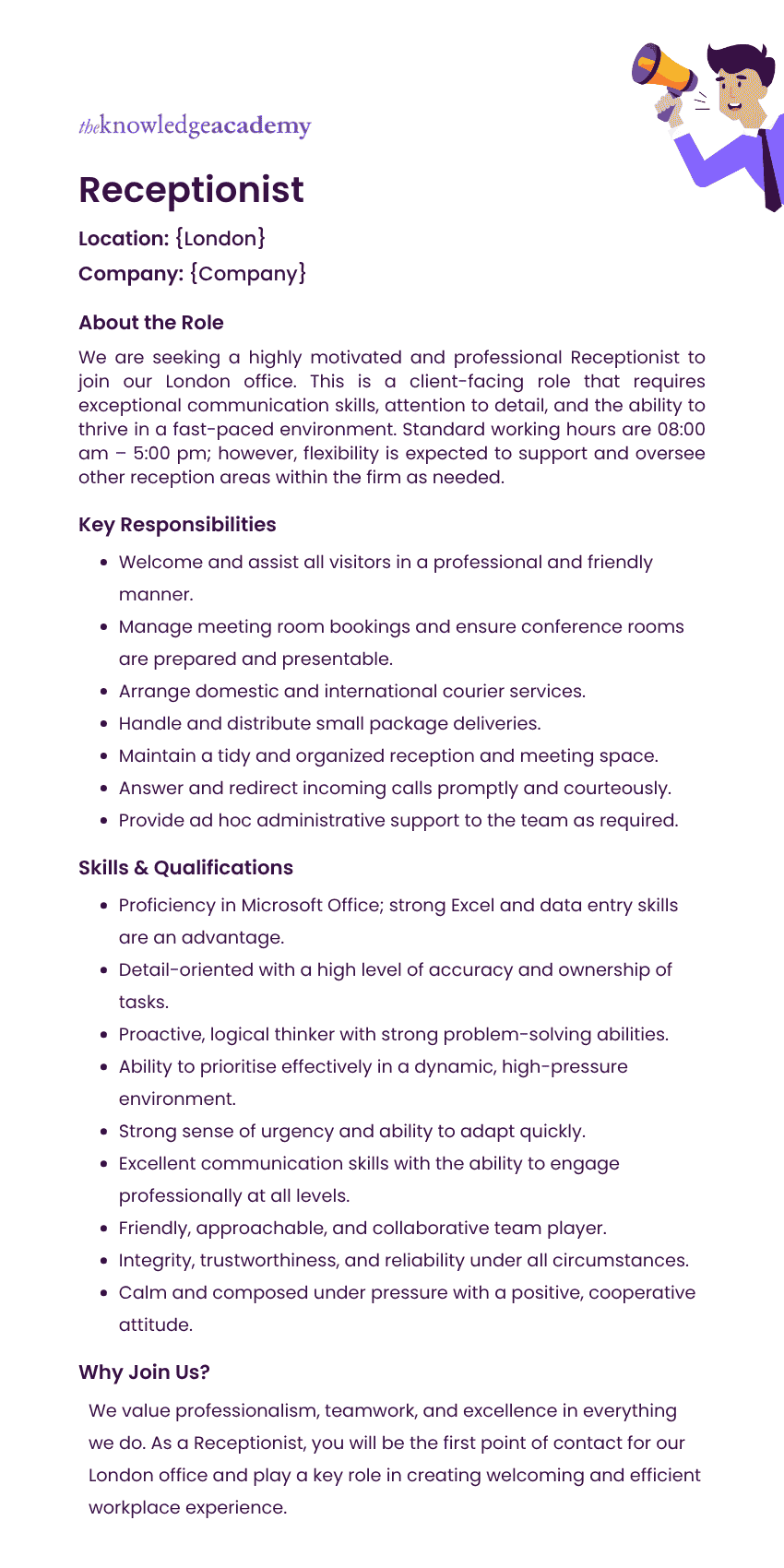
Receptionist Job Description Template
Advance your career with expert-led Secretarial Course – Join now!
Conclusion
Receptionists play a key role in maintaining smooth office operations and delivering excellent customer service. Their responsibilities range from managing communication to providing administrative support. With the right training and skills, they can thrive in various professional environments. The Receptionist Job Description highlights the importance of this role across industries.
Start your journey with expert-led PA and Secretarial Courses – Join now!
Frequently Asked Questions
What is the Difference Between a Receptionist and an Administrative Assistant?

A Receptionist primarily manages front desk duties, greeting visitors, answering calls, and handling basic enquiries. An Administrative Assistant takes on broader responsibilities, including scheduling, document preparation, and supporting senior staff with more complex tasks.
What Qualities Does a Successful Receptionist Candidate Have?
A successful Receptionist is friendly, organised, and confident, with strong communication and IT skills. They show initiative, maintain professionalism, and create a welcoming environment. Their ability to multitask and handle enquiries efficiently is key to delivering excellent front-of-house service.

Charlotte Wilson


Soft Skills and Business Training Manager
Charlotte Wilson is an expert in soft skills development, with over 14 years of experience helping individuals and teams improve communication, productivity and emotional intelligence in the workplace. Her training content is focused on enhancing interpersonal effectiveness and fostering positive, collaborative environments across all levels of an organisation.
View Detail

 If you wish to make any changes to your course, please


