




We may not have the course you’re looking for. If you enquire or give us a call on +1 6474932992 and speak to our training experts, we may still be able to help with your training requirements.
What Is ITIL Project Management?
ByThe Knowledge AcademyLast updated on: 05 October 2026
ITIL project management combines Project Management activities with relevant ITIL service management concepts to connect project delivery with ongoing service value.

Overview
1. ITIL provides guidance for digital product and service management rather than acting as a standalone project management methodology.2. Project management focuses on planning and delivering temporary initiatives with defined objectives.3. ITIL concepts can help connect project outputs with ongoing service management and improvement.4. Project Managers can apply relevant ITIL concepts across initiation, planning, execution, monitoring and closure.5. ITIL can complement established project management approaches rather than replacing them.
Project management involves using specific processes, skills, and knowledge to meet project goals within defined constraints. ITIL provides guidance for managing digital products and services and can complement project management when a project creates, changes, or improves something that will continue into operation.
The ITIL framework brings together guiding principles, management practices, the ITIL Value System, the Four Dimensions, and the Product and Service Lifecycle to support value creation and continual improvement. Explore this blog to understand how relevant ITIL concepts can support project management and help Project Managers connect project delivery with ongoing product and service management.
What is ITIL® Project Management?
ITIL project management refers to applying relevant ITIL concepts alongside established project management approaches. ITIL itself is not a standalone project management methodology; instead, its guidance can help Project Managers connect project outputs with wider product and service management, value creation, operational readiness, and continual improvement.
This becomes particularly useful when a project introduces a new digital product or service, significantly changes an existing one, or delivers technology that must continue to be managed after the project ends.
Change is constant in the business world, which highlights the importance of flexibility and continual improvement when responding to evolving needs. Through projects, organisations can introduce new products or services, improve existing ones, or implement technical solutions that support business and customer outcomes.
Relevant ITIL guidance can help teams consider what happens beyond delivery, including operational readiness, support, value creation, experience, and ongoing improvement once the project output enters use.
Mini Scenario: Successful Project, Difficult Launch
Imagine a team delivers a new customer portal on time and within budget.Technically, the project is complete.But after launch:1. Support teams do not know how to handle incidents.2. Monitoring arrangements are unclear.3. Users do not know where to request support.4. Operational responsibilities have not been assigned.The project met its delivery targets, but the resulting service was not fully prepared for operation.

How Do ITIL and Project Management Work Together?
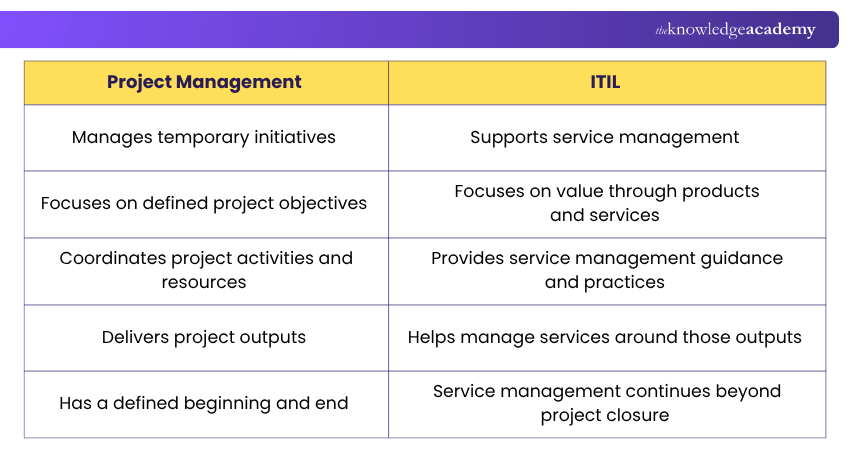
Project management and ITIL approach organisational change from different but connected perspectives. Project management concentrates on delivering a defined outcome within project constraints. ITIL considers how products and services can be managed to support value creation and ongoing service delivery. Their connection becomes particularly useful when a project introduces a new IT service, significantly modifies an existing service or implements technology that will later require operational support.
For example, a Project Manager may oversee the delivery of a new customer portal. Project management helps control its scope, resources, risks and delivery activities. Relevant ITIL concepts can help the team consider how the portal will be supported, monitored and improved once it becomes operational.
Here are the key aspects of ITIL and project management:
Key ITIL Concepts Relevant to Project Management
Several ITIL concepts can be particularly useful when managing IT-enabled projects. They help Project Managers look beyond immediate delivery and consider how project outputs will create value, fit into the wider organisation, and continue to be managed after launch.
ITIL Foundation (Version 5) covers the ITIL Guiding Principles, Four Dimensions, ITIL Value System, Product and Service Lifecycle, and continual improvement as core concepts.
1) Focus on Value
Project activities should contribute to outcomes that matter to customers, users and the organisation. Rather than focusing only on completing tasks, Project Managers can consider how each major decision contributes to the intended value of the resulting product or service.
This helps teams connect project outputs with wider business objectives and user needs. It also encourages decisions that consider outcomes, costs, risks, experience and sustainability rather than viewing successful delivery as the only measure of value.
2) Collaborate and Promote Visibility
Projects involve multiple stakeholders, including users, customers, delivery teams, technical specialists and operational teams. Collaboration and visibility help these groups understand requirements, identify potential issues and coordinate decisions throughout the project.
Making relevant information visible can also reduce misunderstandings and support quicker problem-solving. This becomes particularly valuable when project teams and operational teams need to work together before a new or changed product or service moves into ongoing use.
3) Think and Work Holistically
Projects rarely operate independently of the wider organisation. Project Managers should consider how people, technology, suppliers, processes and organisational structures interact when planning and delivering change.
Thinking holistically helps teams understand how a decision made in one part of a project can affect another area. This wider perspective can support better coordination and reduce the risk of improving one area while unintentionally creating problems elsewhere.
4) Four Dimensions of Product and Service Management
The Four Dimensions provide a balanced way to consider the different factors involved in managing digital products and services. They are Organisations and People, Information and Technology, Partners and Suppliers, and Value Streams and Processes.
For Project Managers, these dimensions can help identify important considerations beyond scope, time and cost. For example, a new system may require trained employees, suitable technology, supplier support and clearly defined processes before it can operate effectively after project delivery.
5) ITIL Value System
The ITIL Value System explains how different organisational components work together to support value creation. It brings together guiding principles, governance, value chain activities, management practices and continual improvement.
For Project Managers, this provides a wider view of how project outputs connect with ongoing organisational activities. Instead of viewing project delivery as an isolated event, teams can consider how the resulting product or service will interact with governance, operational practices and improvement activities once it enters use.
6) Product and Service Lifecycle
The Product and Service Lifecycle helps organisations consider digital products and services across their full journey, from discovery and design through delivery, operation and support. ITIL (Version 5) places greater emphasis on this end-to-end lifecycle perspective.
This is particularly useful in project management because a project may deliver only one part of that wider lifecycle. Project Managers can therefore plan for handover, support, monitoring and future improvement rather than treating project closure as the end of responsibility for the resulting product or service.
7) Continual Improvement
Continual improvement encourages teams to regularly review performance, feedback and outcomes to identify opportunities for improvement. It is embedded within ITIL rather than treated as an activity that only happens after major problems occur.
Project Managers can apply this thinking throughout delivery by reviewing lessons, stakeholder feedback and performance information as the project progresses. This can help teams make timely adjustments and provide useful improvement information to the teams that will manage the product or service after project closure.
Pro Tip
Use ITIL concepts where they add value. A Project Manager does not need to force every service management practice into every project.
How Does ITIL Help a Project Manager?
ITIL can complement project management by helping Project Managers consider what happens to a product, service, or technical solution beyond project delivery. While project management focuses on delivering defined objectives within agreed constraints, ITIL can add a wider view of value, experience, service readiness, support, and continual improvement.
For example, ITIL concepts can encourage earlier collaboration with operational teams, clearer consideration of support requirements, and greater visibility of how project decisions affect users and other stakeholders. The Four Dimensions can also help teams consider people, information and technology, partners and suppliers, and value streams and processes together rather than treating them separately.
ITIL can also help Project Managers connect delivery decisions with ongoing product and service management. This is especially useful when the project introduces or changes something that will require monitoring, support, incident resolution, continual improvement, or further development after launch.
Project management and ITIL therefore serve different purposes but can complement one another. Project management provides the structure for delivering temporary initiatives, while ITIL provides guidance that can help the resulting products and services continue to create value after project closure.
Trainer’s Insight
Project closure should not create an operational cliff. Make sure ownership, support information and service expectations are clear before the project team disengages.
Go for sustainable business and IT transformation with the ITIL® 5 Transformation Certification Training – Sign up now!
How Can ITIL® Certification Benefit Project Managers?
ITIL® Certification can help Project Managers broaden their understanding of how digital products and services are managed beyond project delivery. This can be particularly useful for professionals working on technology-enabled projects or collaborating closely with service, product, support, and operational teams.
ITIL knowledge does not automatically qualify someone for roles such as Service Delivery Manager or Transition Manager. However, it can strengthen understanding of areas such as value creation, product and service management, continual improvement, change enablement, incident resolution, and cross-functional collaboration.
ITIL (Version 5) also introduces a stronger focus on digital products and services across their lifecycle. The current Foundation covers the Product and Service Lifecycle, ITIL Value System, Four Dimensions, Guiding Principles, management practices, and continual improvement.
For Project Managers, this knowledge can provide a wider perspective when planning handovers, engaging operational teams, assessing how project outputs will be supported, and considering how products and services can continue to deliver value after project closure.
Here's how ITIL project management can make a difference:
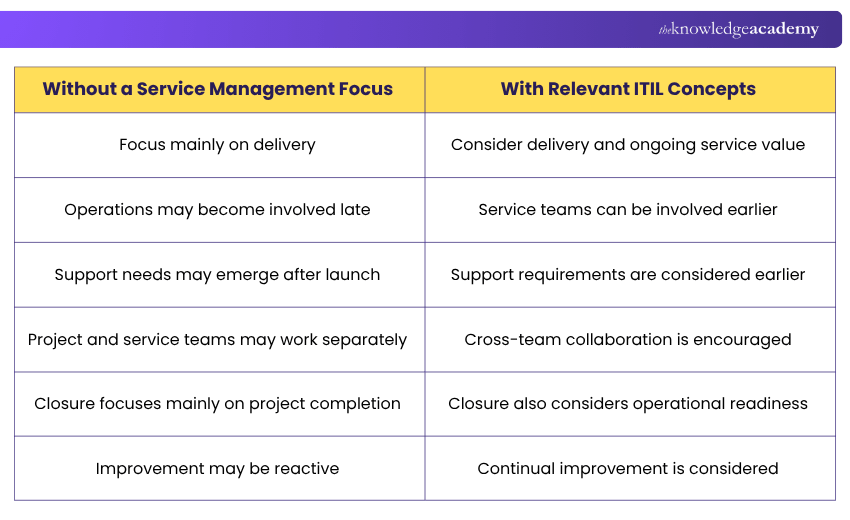
How to Use ITIL Concepts Across Different Project Management Phases
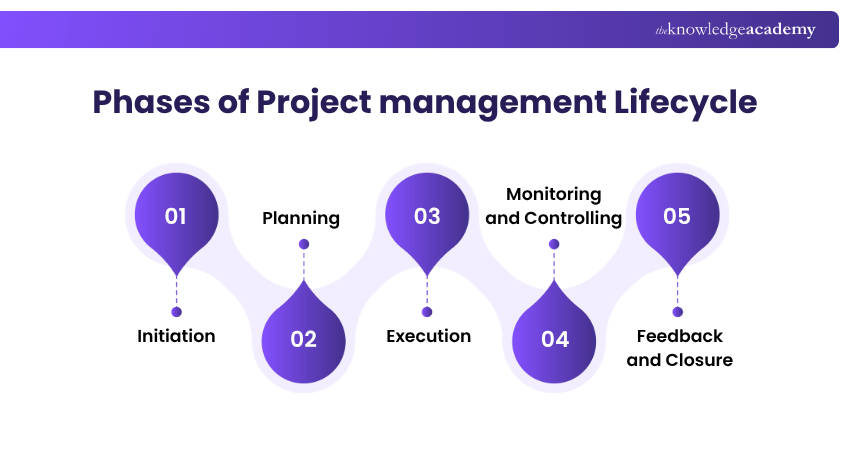
This section explores how relevant ITIL concepts can be applied across different phases of the project management lifecycle.
1) Initiation
In project management, the initiation phase refers to the early stages of a project, when its purpose, objectives, stakeholders, constraints, risks, and expected outcomes begin to take shape. Relevant ITIL concepts can add a wider perspective by helping the team consider the value expected from the resulting product or service and the people, technology, partners, and value streams that may be affected.
2) Planning
The project planning phase establishes the scope, requirements, schedule, resources, risks, and activities needed to deliver the project. ITIL Guiding Principles can support decision-making during this phase by encouraging teams to focus on value, collaborate, consider the wider system, and keep solutions practical.
Relevant ITIL concepts can also help Project Managers consider operational requirements early, such as support arrangements, technology dependencies, suppliers, service expectations, and how the resulting product or service will continue to create value after delivery.
3) Execution
The project execution stage is where planned project activities are carried out and the required outputs are developed or delivered. Relevant ITIL management practices can support areas such as change enablement, supplier coordination, incident and problem considerations, knowledge sharing, and continual improvement where these are relevant to the project.
Project Managers should apply ITIL guidance selectively rather than forcing every practice into every project. The focus should remain on the practices and principles that help the project and its resulting product or service create value.
4) Monitoring and Controlling
This phase requires detailed monitoring and controlling of project aspects such as scope, cost, risk, quality, and required changes. Relevant ITIL concepts can support visibility into how changes affect products, services, users, and operational teams while encouraging continual improvement throughout delivery.
Project Managers can also use this phase to check service-readiness considerations, monitor dependencies, coordinate stakeholders, and address issues that could affect a smooth transition into ongoing use.
5) Feedback and Closure
In the final phase of a project, it's important to collect feedback from clients, users, and collaborators. This feedback can help review project performance and identify lessons for future improvement. The team should also confirm that operational ownership, support arrangements, knowledge transfer, monitoring, and other readiness requirements are in place before closure.
Relevant ITIL concepts can help ensure that the resulting product or service is ready to move into ongoing operation without creating a sudden gap between project delivery and day-to-day management.
Project-to-Service Readiness Checklist
Before closing an IT-enabled project, check:
□ Are operational responsibilities clearly assigned?□ Are support teams prepared for the new or changed service?□ Has relevant knowledge been transferred?□ Are monitoring requirements understood?□ Are known risks and issues documented?□ Are users aware of available support channels?□ Is there a process for collecting feedback?□ Can the resulting service be supported after the project team steps away?
Lead the future of digital product management with the ITIL® 5 Product Certification Training – Sign up now!

The Knowledge Academy develops accessible learning content across Project Management, IT, Cybersecurity, Data Science, Business Analysis, HR, Accounting and Finance, Leadership and Health and Safety. Its resources combine subject research with clear explanations to help professionals build practical knowledge across a wide range of disciplines.
View Detail

 If you wish to make any changes to your course, please


