




We may not have the course you’re looking for. If you enquire or give us a call on 01344203999 and speak to our training experts, we may still be able to help with your training requirements.
Process Synchronisation in Operating System (OS): An Overview
ByJyoti TuraLast updated on: 02 October 2026
This comprehensive blog delves into the intricacies of process synchronisation in Operating Systems (OS), a critical aspect of concurrent process execution. We start by defining process synchronisation and its operational dynamics within OS environments.

In a Nutshell
Process synchronisation coordinates concurrent processes or threads so they can safely share data and resources. Mechanisms such as mutexes, semaphores, monitors, condition variables and spinlocks help prevent race conditions, maintain data integrity and control access to critical sections. Classic problems such as the Bounded-buffer and Readers-Writers problems show why careful synchronisation is essential in operating systems.
Akin to the blend of various instruments in an orchestra to produce harmonious melodies, process synchronisation orchestrates concurrent processes in an operating system to create a coherent and orderly performance. This becomes especially important when multiple processes interact with shared data and resources.
Process synchronisation pivots on the concept of harmonised interactions among processes, preventing conflicts and data dissonance. It helps ensure that shared resources are used responsibly, maintaining data integrity and supporting controlled resource access.
What is Process Synchronisation in Operating System?
Process synchronisation is a fundamental concept in the field of operating systems, crucial for managing multiple concurrent processes or threads effectively. It is basically the coordination and control of these processes to ensure they execute in a harmonious and orderly manner, avoiding conflicts and undesirable race conditions.
Now, the primary goal of process synchronisation is to maintain data integrity, manage shared resources, and help manage concurrency-related issues such as data corruption, race conditions, resource contention, and deadlock risks.

How Does Process Synchronisation Work in OS?
Process synchronisation is a critical aspect of operating systems that coordinates concurrent processes or threads. It helps prevent conflicts and race conditions when they access shared resources or critical sections of code.
Operating systems provide synchronisation mechanisms that may involve user-space operations, atomic hardware instructions or operating system services. Examples include spinlocks, compare-and-swap operations and blocking system calls.
Mechanisms such as mutexes, semaphores and condition variables control access to critical sections or coordinate execution. A process or thread may wait until a resource or condition becomes available before proceeding. This helps protect shared data and maintain the required execution order.
Process Synchronisation Mechanisms in OS
Process synchronisation mechanisms are techniques used to coordinate concurrent processes or threads when they access shared resources or depend on one another. They help prevent race conditions, protect shared data and control the required order of execution. Common mechanisms include:
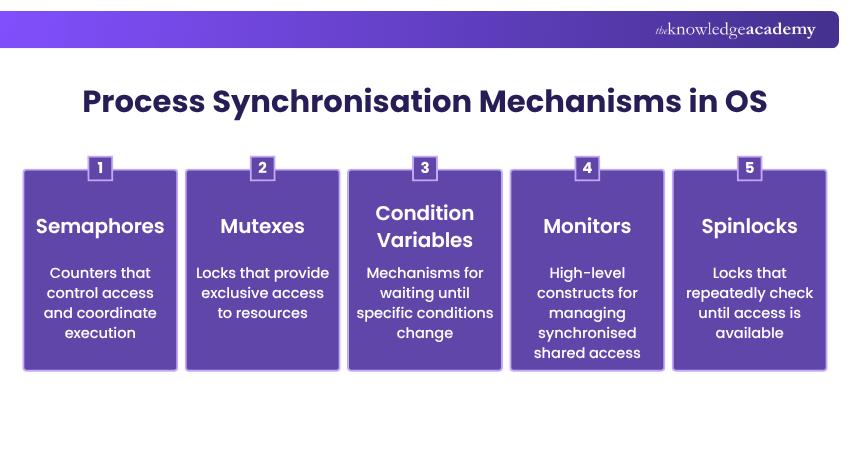
1) Semaphores: Semaphores are synchronisation variables that use counters to control access to shared resources and coordinate processes or threads. They can be used for signalling or controlling access based on the number of available resource instances. A binary semaphore can also restrict access to a shared resource.
2) Mutexes: Mutexes are locking mechanisms that allow only one process or thread at a time to access a protected resource or critical section. Other processes or threads attempting to acquire the same mutex must wait until it is released.
3) Condition Variables: Condition variables are typically used with mutexes. They allow processes or threads to wait until a particular condition may have changed. The condition is checked while holding the associated mutex and rechecked after waking.
4) Monitors: Monitors are high-level synchronisation constructs that combine shared data, procedures and mutual exclusion, providing controlled access to protected shared state.
5) Spinlocks: Spinlocks repeatedly check whether a lock is available until they acquire it. They are useful when the expected waiting time is very short and are often used in low-level operating system code.
Types of Process Synchronisation in OS
Processes involved in synchronisation are commonly classified as independent processes and cooperating processes. These process types differ in whether they interact with or affect other processes.
Whether a process is independent or cooperating depends on whether it shares data, communicates with or can affect other processes during execution.
Here are the two process categories explained in further detail:
1) Cooperative Processes
Cooperating processes can affect or be affected by other processes, often by sharing data or resources. Because of this interaction, they may require synchronisation to prevent race conditions and maintain data consistency.
2) Independent Processes
Independent processes do not share data or affect the execution of other processes. Because they operate separately, they generally do not require synchronisation with one another.
Learn to program in the top used languages by signing up for our Programming Training now!
Quick Insight
Cooperating processes can share data or influence one another, so synchronisation may be required. Independent processes operate separately and generally do not need synchronisation with each other.
Example of Process Synchronisation
There are two key examples of process synchronisation in operating systems, which are described as follows:
Bounded-buffer Problem
It is a classic example of process synchronisation and concurrent programming. It represents a scenario where multiple processes or threads are involved in the production and consumption of data in a shared, fixed-size buffer or queue.
Moreover, this problem is a fundamental illustration of how to ensure that producers and consumers can work concurrently without issues such as overflows or underflows.
The key characteristics of the bounded-buffer problem include:
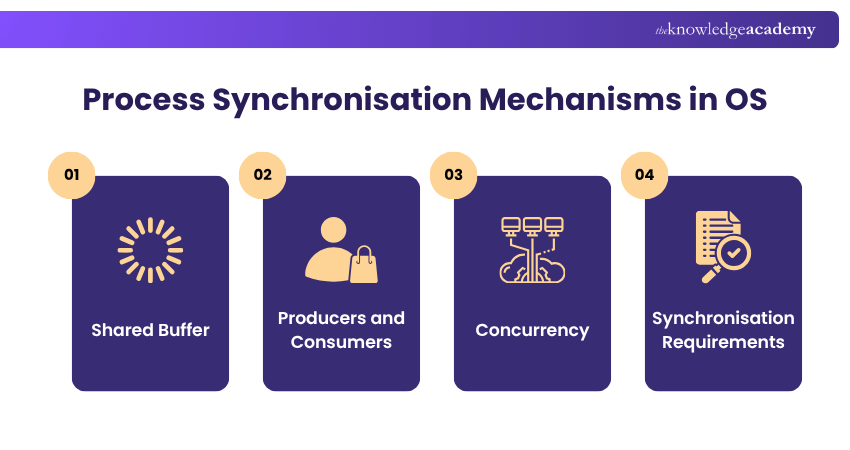
a) Shared Buffer: There is a shared, fixed-size buffer with a limited capacity. This buffer can store a predefined number of items, which is typically referred to as the buffer size.
b) Producers and Consumers: Two types of processes or threads are involved in this problem, namely producers and consumers. Producers generate data items and attempt to place them in the buffer, while consumers retrieve and process items from the buffer.
c) Concurrency: Both producers and consumers run concurrently, which means they may attempt to access the shared buffer at the same time. This concurrent access requires synchronisation mechanisms to ensure that producers do not add items when the buffer is full and consumers do not remove items when the buffer is empty.
d) Synchronisation Requirements: The primary challenge in the bounded-buffer problem is to coordinate the actions of producers and consumers so that they do not violate the buffer's size constraints. Producers should be blocked when the buffer is full, and consumers should be blocked when the buffer is empty.
Readers-writers Problem
The Readers-Writers problem is a classic example in the field of process synchronisation that illustrates the challenges of managing concurrent access to shared data. It involves two types of processes, namely readers and writers, both of which want to access a shared resource, typically a data structure.
This problem highlights the importance of maintaining data integrity and ensuring that readers and writers can operate concurrently while preventing potential data inconsistencies or conflicts.
The key characteristics of the Readers-Writers problem include:
a) Readers: Readers only want to read the shared resource, and their operations are generally non-destructive. Multiple readers can safely access the resource simultaneously without causing issues.
b) Writers: Writers, on the other hand, want to modify or update the shared resource. Because their operations change the shared data, writers typically require exclusive access to maintain data consistency.
c) Concurrency: The problem involves concurrent readers and writers that require coordinated access to the same shared resource. Multiple readers may be allowed to access the resource simultaneously, while writers typically require exclusive access.
d) Synchronisation Requirements: The primary challenge in the Readers-Writers problem is to coordinate and synchronise the actions of readers and writers to ensure that data consistency is maintained while allowing for concurrent access. It is essential to balance the need for data integrity with the goal of maximising resource utilisation.
Learn cutting-edge technologies for versatile web solutions with our App & Web Development Training – Join now!
Importance of Synchronisation in Operating Systems
Synchronisation is crucial in an operating system for various reasons, and its importance can be summarised as follows:
a) Data Integrity: Synchronisation ensures that shared data structures remain consistent, preventing data corruption due to concurrent access.
b) Resource Allocation: It coordinates access to shared resources among competing processes, helping reduce resource conflicts.
c) Orderly Execution: Synchronisation mechanisms establish a sequence of execution for processes, maintaining order and predictability.
d) Deadlock Management: Proper synchronisation and resource-allocation strategies can help reduce and manage deadlock risks.
e) Concurrency Control: Synchronisation allows multiple processes or threads to work together without causing conflicts, ensuring that they do not interfere with each other's tasks.
f) Real-time Systems: In real-time environments, synchronisation helps coordinate tasks so timing requirements can be met.
g) Efficient Resource Utilisation: It helps optimise resource utilisation by coordinating how multiple processes access shared resources.
h) Preventing Race Conditions: Proper synchronisation helps prevent race conditions by controlling concurrent access to shared data and resources.
What is Critical Section Problem?
The critical section problem is a foundational concept in concurrent computing and process synchronisation. It refers to the challenge of coordinating access to a critical section, where shared data or resources are accessed or modified.
The problem revolves around ensuring that concurrent processes or threads can safely execute critical sections without causing data corruption or undesirable outcomes. A correct classical solution should satisfy three key requirements: mutual exclusion, progress and bounded waiting.
Moreover, to solve the Critical Section Problem, synchronisation mechanisms like semaphores, mutexes or other forms of locks are employed to coordinate access to protected critical sections and enforce the required mutual exclusion, thereby maintaining data integrity and system reliability.
Solutions for Critical Section Problem
Various solutions have been developed to tackle the critical section problem, using mechanisms that provide mutual exclusion, coordinate concurrent execution or manage access to shared data:
a) Locks and Mutexes: Locks, including mutexes, allow processes or threads to acquire exclusive access before entering a protected critical section, thereby enforcing mutual exclusion.
b) Semaphores: Semaphores use atomic wait and signal operations to coordinate access to shared resources and critical sections.
c) Monitors: Monitors encapsulate data and procedures into a single unit, simplifying synchronisation by offering built-in mechanisms for access control.
d) Spinlocks: Spinlocks repeatedly check for lock availability, offering a lightweight synchronisation solution but potentially leading to high CPU usage.
e) Condition Variables: Used alongside locks, condition variables enable processes or threads to wait until specific conditions may have become true, after which the condition is rechecked while holding the associated lock. This supports efficient coordination without continuously busy-waiting.
Remember
Good synchronisation is about coordination, not simply blocking processes. The goal is to protect shared data while allowing concurrent tasks to progress safely and efficiently.
Get acquainted with the foundations of programming by signing up for our Object Oriented Programming (OOPs) Course now!

Jyoti Tura is a Senior Web & UX/UI Manager with 7+ years of experience in front-end development, web development and user-focused interface design. Her technical expertise and managerial responsibilities support her knowledge across IT and Tech, Leadership and Management.
View Detail

 If you wish to make any changes to your course, please


