


 Top Rated Course

We may not have the course you’re looking for. If you enquire or give us a call on +44 1344 203999 and speak to our training experts, we may still be able to help with your training requirements.
What is Enterprise Architecture | Frameworks
Sophia Ellis 16 July 2026Enterprise Architecture is a strategic framework that aligns IT infrastructure with business goals to improve efficiency, agility, and decision-making. It connects people, processes, data, and tech to align operations and support long-term growth. It enables quick change and drives confident, innovative decision-making.

Training Outcomes Within Your Budget!
We ensure quality, budget-alignment, and timely delivery by our expert instructors.
Table of Contents

Ever used a smart home system where the lights, thermostat, and doorbell don’t sync and you end up freezing in the dark while your phone keeps ringing? That’s what running a business feels like without Enterprise Architecture. It’s the blueprint that links all your systems and strategies, so everything runs smart, smooth, and in sync.
This blog will guide you through What is Enterprise Architecture using easy-to-understand explanations and relatable examples. We’ll cover what EA is, why it matters, and its four key areas. Also, the EA process, benefits, best practices, top frameworks like TOGAF and Zachman and real-world uses.
Table of Contents
1) What is Enterprise Architecture (EA)?
2) The Purpose Behind Enterprise Architecture
3) The Four Key Domains of Enterprise Architecture
4) Enterprise Architecture Process
5) Key Benefits of Enterprise Architecture
6) Best Practices for Effective Enterprise Architecture
7) Frameworks and Methodologies of Enterprise Architecture
8) Common Use Cases for Enterprise Architecture
9) Conclusion
What is Enterprise Architecture (EA)?
Enterprise Architecture (EA) is a way to plan and organise everything in a company. It connects business goals with technology. This alignment ensures that IT investments directly support what the business is trying to achieve. It helps eliminate unnecessary systems and improves how resources are used.
It gives a full picture of how the business runs, including:
1) What does the company do?
2) What tools and systems does it use?
3) How does data move around?
4) What technology supports the business?
The Purpose Behind Enterprise Architecture
The main goal of EA is to make sure that business and IT work well together. Here’s what EA helps with:
1) Aligning IT with business goals
2) Reducing waste and duplicate work
3) Making it easier to change systems or processes
4) Supporting growth and innovation
5) Improving decision-making with clear data
EA makes the company smarter, faster, and more flexible.
Learn about business, data, and Software Architecture with our Enterprise Architecture Green Belt Training– Join now!
The Four Key Domains of Enterprise Architecture
Enterprise Architecture (EA) has four main parts. Each part focuses on a different area of the business.
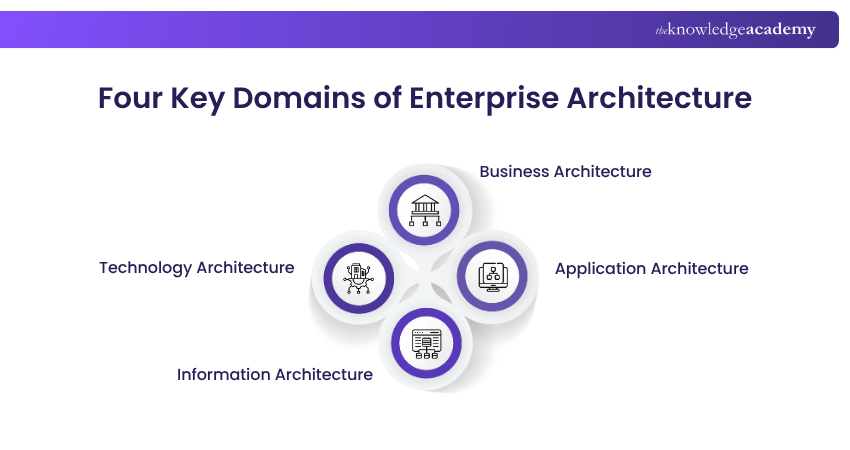
1) Business Architecture
This shows what the company does, its goals, people, departments, and processes.
Example: A supermarket’s business architecture would include buying products, managing stores, hiring staff, and serving customers.
2) Application Architecture
This covers all the software and apps the company uses.
Example: The supermarket might use software for online shopping, billing, stock checking, and customer support.
3) Information Architecture
This is about how data is collected, stored, shared, and protected.
Example: Customer names, purchase history, stock levels, all this information needs to be stored and used safely.
4) Technology Architecture
This includes all the hardware and networks, the actual machines and systems.
Example: Computers, servers, internet connections, and security systems that help everything run smoothly.
Understand the processes and controls for effective management and governance. Join our Enterprise Integration Advanced Course now!
Enterprise Architecture Process
Here are the basic steps companies follow to build and use Enterprise Architecture:
1) Establish Clear Goals and Objectives
The company must first decide what it wants to achieve. For example: reduce IT costs, improve customer experience, or grow into new markets. Clear goals help guide every step of the Enterprise Architecture journey.
2) Identify Key Stakeholders
These are the people involved in planning and using EA, like Business Leaders, IT Managers, and Department Heads. Getting their input early ensures support and better decision-making.
3) Choose a Modern Enterprise Architecture Tool
EA tools help create visual maps and documents. They show how everything connects and make planning easier. A good tool makes the architecture more understandable and easier to update.
4) Evaluate the Current IT Infrastructure and Systems
This step checks what the company already has, apps, systems, servers, and so on. It helps identify what is working well and what needs improvement.
5) Design the Target Future-State Architecture
Here, the company plans how things should look in the future. What changes are needed? What tools should be replaced or added? This vision guides all upgrades and digital transformation efforts.
6) Develop an Implementation Roadmap
This is the action plan. It shows what steps to take, when to take them, and who is responsible. It breaks down the transformation into manageable phases.
7) Track Progress and Refine the EA Framework
After making the changes, the company must keep checking the progress. Things may need to be adjusted along the way. Continuous tracking ensures the EA stays aligned with business needs.
Key Benefits of Enterprise Architecture
Enterprise Architecture (EA) helps businesses in many ways:
1) Better Planning: EA gives a clear picture of the company’s systems and goals.
2) Faster Decisions: With better data and visibility, choices are quicker and smarter.
3) Lower Costs: EA helps remove duplicate tools and reduce waste.
4) Smooth Changes: EA makes changes such as new software or branches easier to manage.
5) Improved Communication: EA helps IT and business teams understand each other.
6) Stronger Security: EA makes it easier to protect systems and data.
Best Practices for Effective Enterprise Architecture
To make EA successful, companies should follow these smart tips:

1) Start with an Initiation Document
Write down what you want EA to achieve, what areas it will cover, and how it will help. This gives you a clear and strong starting point. A well-written charter keeps the team focused and aligned from day one.
2) Define the Desired Future State
Think about what success should look like. Knowing this helps you plan the right steps to get there. It sets a clear direction and helps measure progress over time.
3) Ensure Comprehensive Infrastructure Visibility
Make a list of all tools, systems, and data your company uses now. This gives you a full picture of your current setup. Without this, it's hard to spot gaps or areas for improvement.
4) Use Metrics and KPIs That Matter
Track useful numbers like system performance, IT costs, or customer happiness. These numbers help you see what’s working. Relevant KPIs also help justify EA efforts to stakeholders.
5) Stay Updated on EA Trends
Technology changes all the time. Keep learning about new ideas and tools so your EA stays current. This keeps your business competitive and ready for the future.
6) Treat EA as an Ongoing Initiative
EA is not something you do once and forget. You need to update it often to match new business needs. Regular updates help the architecture grow with the business.
7) Keep EA Flexible and Scalable
Make sure your EA can change and grow as the company changes. It should work for both small updates and big expansions. This ensures long-term value and adaptability.
8) Clearly Communicate EA Value
Show others how EA helps the business. Use real examples and numbers to prove its value. This builds trust and gets more support from teams and leaders. Clear communication encourages wider adoption across departments.
9) Leverage the Right Tools
Use helpful EA software to make maps, track updates, and understand systems better. Good tools make EA easier to manage. The right tools save time, reduce errors, and improve collaboration.
Learn techniques for analysing Integration Requirements and solutions. Join our Enterprise Integration Practitioner Course now!
Frameworks and Methodologies of Enterprise Architecture
Many organisations have created simple ways to plan and manage IT systems. These became today’s popular Enterprise Architecture (EA) frameworks. Here are some top ones:
1) ArchiMate
ArchiMate is a simple way to draw and understand how different parts of a business connect. It uses standard symbols and shapes to help people see how systems, processes, and teams work together.
2) The Zachman Framework
The Zachman Framework is like a table that helps you look at your business from different points of view. It has six rows showing who is involved (like planners or builders) and six columns showing what they need to know (like goals, processes, tools, and functions).
3) The Open Group Architectural Framework (TOGAF)
TOGAF is a step-by-step guide to building and improving your company’s systems. It helps you design, plan, and manage everything in a clear and structured way. It has been used and improved for over 25 years.
4) Federal Enterprise Architecture Framework (FEAF)
FEAF was first made for the U.S. Government, but now many businesses use it. It helps big organisations work together better by planning and managing systems in a shared way.
5) Gartner's Enterprise Architecture Framework
Gartner is a well-known company that gives advice on IT. Over time, it has created its own way of doing Enterprise Architecture. This method focuses more on real business results than just technical details.
Common Use Cases for Enterprise Architecture
Enterprise Architecture can help with many business goals. Here are a few real-world examples:

1) Application Portfolio Assessment: This means checking all the software your company uses. You see what each one does and if it helps the business.
2) Application Rationalisation: This means finding apps that are old, repeated, or not used much. You then decide which ones to keep, fix, or remove to save money.
3) Obsolescence Risk Management: This helps you spot old tech that might stop working or is unsafe. You replace them before they cause problems.
4) Application Modernisation: This means improving old software or changing it to newer, faster, and safer versions that work better today.
5) ERP Transformation: This is about changing your company’s main system (called ERP) to a better one. It could mean updating it or moving it to the cloud to help the business run smoothly.
Conclusion
Understanding What is Enterprise Architecture (EA) helps businesses align people, processes, data, and technology more effectively. It brings structure, reduces confusion, and supports long-term goals. With the right framework and Enterprise Architecture Governance in place, organisations can, organisations can make smarter decisions, adapt quickly to change and improve overall performance. Also, making Enterprise Architecture a powerful tool for running modern, efficient and scalable operations.
Learn to gather integration requirements and analyse system landscapes. Join our Integration Architect Training now!
Frequently Asked Questions
What are the Four Pillars of Enterprise?

The four main pillars (or domains) of Enterprise Architecture are:
1) Business Architecture
2) Application Architecture
3) Information Architecture
4) Technology Architecture
What is the NIST Enterprise Architecture Model?
The NIST model was made by the U.S. National Institute of Standards and Technology. It shows a layered way to build Enterprise Architecture. It helps with:
1) Better security
2) Clear roles and responsibilities
3) Standardised systems
It’s especially useful in government and regulated industries.

 If you wish to make any changes to your course, please


