


 Top Rated Course

We may not have the course you’re looking for. If you enquire or give us a call on +44 1344 203999 and speak to our training experts, we may still be able to help with your training requirements.
Difference Between ISO 9001 and ISO 13485: A Complete Guide
The Knowledge Academy 15 July 2026One of the main Differences Between ISO 9001 and ISO 13485 is that ISO 13485 is specifically for medical devices, whereas ISO 9001 applies to all industries. Understanding these core differences will help you decide which standard is ideal for your organisation and aligns best with your mission for business excellence.

Training Outcomes Within Your Budget!
We ensure quality, budget-alignment, and timely delivery by our expert instructors.
Table of Contents
Quality is the ultimate destination, and multiple paths lead you to it. But do you know what assures a safe journey to that destination for businesses? The ISO standards, and two of the most prominent ones, are ISO 9001 and ISO 13485. While both focus on excellence, they serve very different worlds. ISO 9001 is built for businesses of all kinds, while the other is meant for the high-stakes world of medical devices. So, which road should your organisation take?
This blog unveils the key Differences Between ISO 9001 and ISO 13485. Whether you're navigating compliance or choosing the right certification, understanding the nuances between these two standards is useful. Read on and make the pick that perfectly align with your industry, goals and regulatory requirements!
Table of Contents
1) ISO 9001 vs ISO 13485
2) Difference Between ISO 9001 and 13485 for Medical Devices
a) QMS
b) Management Responsibility
c) Resource Management
d) Measurement, Analysis and Improvement
e) Product Realisation
3) How do I Determine Which Standard is Right for Me?
4) Conclusion
ISO 9001 vs ISO 13485
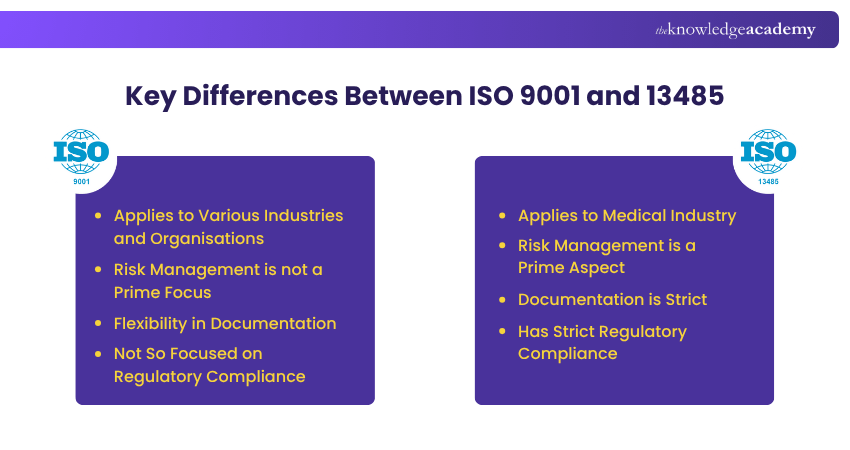
ISO 9001 is a general quality standard applicable to all industries, whereas ISO 13485 is specifically designed for medical devices. It focuses more on meeting health regulations and managing risks. Both help maintain quality, but ISO 13485 has stricter rules to ensure safety in the healthcare industry.
What is ISO 9001?
a) The International Organization for Standardization (ISO) offers various Quality Management standards.
b) ISO 9001 is the most widely recognised and used standard across industries.
c) It helps organisations build and maintain an effective Quality Management System (QMS).
d) The main goal is to improve performance and increase customer satisfaction.
e) ISO 9001 emphasises key principles such as customer focus, strong leadership, team involvement, and process efficiency.
f) It also promotes evidence-based decision-making and strong Relationship Management.
g) The standard helps organisations meet customer needs and keep improving their processes over time.
What is ISO 13485?
a) ISO 13485 is a global standard specifically for organisations in the medical device industry.
b) It outlines the requirements for a Quality Management System (QMS) to ensure the safety and effectiveness of devices.
c) The standard covers every stage of design, development, production, and servicing of medical devices.
d) It focuses on meeting both customer needs and regulatory requirements.
e) Key areas include Risk Management, traceability, and thorough documentation.
f) ISO 13485 Certification shows a company’s commitment to safety, quality, and compliance.
g) It ensures medical devices are consistently safe, high-quality, and reliable.
h) The goal is to help organisations follow strict regulations and deliver effective healthcare products.
Difference Between ISO 9001 and 13485 for Medical Devices
Even though both ISO 9001 and ISO 134845 work towards the same goal of creating a gold standard for products and services, they differ on several parameters due to their industry applications. Here are some notable Difference Between ISO 9001 and ISO 13485:
Quality Management System (QMS)
ISO 13485 builds on ISO 9001 by placing more responsibility on the manufacturer to maintain the effectiveness of the QMS. It includes stricter controls for documentation and record-keeping compared to ISO 9001 as covered in these points:
a) Regulatory documents must be included as part of the system documentation.
b) The QMS must have a file that lists product specification documents.
c) A Device Master Record must define the QMS requirements in detail.
d) Any changes to QMS documents must be reviewed and approved by the original approver or another individual with the necessary expertise.
e) Someone should conduct approvals with sufficient subject matter knowledge if the original approver is unavailable.
f) Manufacturers must establish data retention rules based on the product's lifespan and relevant regulatory requirements.
Turn quality from a goal to a standard! Sign up for our comprehensive ISO 9001 Foundation Course now!
Management Responsibility
ISO 9001 allows flexibility in assigning quality roles without requiring a clear definition. ISO 13485 requires a specific Manager to be assigned responsibility for each part of the QMS. The following points will make it clear:
a) Management must actively commit to regulatory compliance as outlined in ISO 13485.
b) Managers are also expected to review any new or updated cGMP regulations that may affect the organisation.
c) The management team must establish a quality policy and provide a structure for reviewing the QMS.
d) QMS goals and compliance levels must be measured and verified by management.
e) Each employee should have clearly defined responsibilities for managing, performing, and verifying QMS activities.
f) Management must ensure QMS standards are maintained by assigning and overseeing responsibilities.
g) Regular management reviews should include updates on relevant regulations.
Resource Management
Both ISO 13485:2016 and ISO 9001:2015 emphasise Resource Management, including equipment, facilities, and IT systems. ISO 13485 has added a focus on environmental controls and the prevention of contamination to ensure product safety as exemplified in these points:
a) Maintenance activities must be documented.
b) Keep records of all maintenance tasks that have been performed.
c) Set and document requirements for employee hygiene, clothing, and cleanliness.
d) If needed, establish procedures to monitor the work environment.
e) Create formal systems to manage and contain contaminated products, if applicable.
f) Develop and document active Risk Management procedures.
g) Keep detailed records related to Risk Management activities.
h) Establish clear communication policies for sending advisory notices to customers when required.
Measurement, Analysis and Improvement
ISO 9001 promotes continual improvement through a process-based approach. ISO 13485 goes further by defining specific improvement steps for medical device safety and effectiveness. The ISO 13485 requirements are as follows:
a) Establish a feedback system to detect early signs of nonconformances.
b) Review all feedback-related nonconformances as part of Quality Management.
c) Continuously monitor and measure product quality during production.
d) Confirm that all quality requirements are met before releasing or delivering the product.
e) Keep records of any rework done and ensure non-conforming products are only released if they meet regulatory standards.
f) Set up formal procedures for collecting, analysing, and storing quality data.
g) Record and track the implementation of advisory notices.
h) Provide clear justification for customer complaints that do not lead to Corrective and Preventive Actions (CAPA).
i) Document the process for reporting adverse events to relevant regulatory authorities.
Start Strong with Quality and build your ISO expertise with our ISO 9001 Internal Auditor Training - Register now!
Product Realisation
ISO 9001 views product quality as the outcome of robust policies and procedures. ISO 13485 goes further by adding detailed safety and regulatory controls for medical devices. It includes process, equipment, cleanliness, and Risk Management validations across the product lifecycle. Here are the key ISO 13485 requirements:
a) Document, define, and retain purchasing records for full traceability.
b) Ensure workstations have access to procedures, SOPs, requirements, and reference materials.
c) Develop and apply Standard Operating Procedures (SOPs) for product labelling and packaging.
d) Maintain unique batch records for every manufactured and approved device lot.
e) Review and approve each batch record before device release.
f) Document cleanliness standards, especially for devices that are or must be sterilised.
g) Define installation and verification processes, including instructions for third-party installers.
h) Keep complete records of installation and verification activities.
i) Document all servicing steps and keep maintenance records.
j) Set procedures for managing returned products.
k) Maintain traceability systems to track product status throughout its lifecycle.
l) Record and maintain all SOPs that ensure product conformity.
m) Document procedures to confirm product shelf life has not expired, where relevant.
Lead audits in the Medical Device Industry with confidence! Sign up for our ISO 13485 Lead Auditor Course now!
How do I Determine Which Standard is Right for Me?
Choosing between ISO 13485 and ISO 9001 depends on what your organisation does. ISO 9001 is a general quality standard that suits any type of business. ISO 13485 is made for companies that design, make, or sell medical devices. If you work with medical devices, ISO 13485 is the right choice. If not, ISO 9001 is likely a better option.
Conclusion
ISO 13485 focuses more on Regulatory Compliance, Risk Management, and documentation than ISO 9001, which applies broadly across industries. Despite the Differences Between ISO 9001 and ISO 13485, both promote process improvement, customer focus, and management responsibility. Choosing the right standard depends on your industry needs and regulatory requirements for business success.
Build the bedrock of medical quality with our ISO 13485 Foundation Training - Register now!
Frequently Asked Questions
Is ISO 9001 Equivalent to GMP?

No, ISO 9001 and Good Manufacturing Practice (GMP) are different. ISO 9001 is for Quality Management in many industries. GMP is for medicine and medical devices, ensuring products are safe. While both focus on quality, GMP has stricter rules for health-related products.
Who Should Use ISO 13485?
ISO 13485 is for medical device companies. This includes the manufacturers, suppliers and service providers for medical equipment, implants, and healthcare products. It helps meet safety and regulatory rules. Any company involved in making or selling medical devices should use it.

The Knowledge Academy


Global Training Provider
The Knowledge Academy is a world-leading provider of professional training courses, offering globally recognised qualifications across a wide range of subjects. With expert trainers, up-to-date course material, and flexible learning options, we aim to empower professionals and organisations to achieve their goals through continuous learning.

Upcoming Health & Safety Resources Batches & Dates
Date
 ISO 13485 Foundation
ISO 13485 Foundation
Mon 17th Aug 2026
ISO 13485 Foundation
Mon 16th Nov 2026
ISO 13485 Foundation
Mon 7th Dec 2026

 If you wish to make any changes to your course, please


