Who should attend this Certified Lean IT Training Course?
The Lean IT Certification is designed to provide delegates with the skills and knowledge necessary to implement Lean principles within Information Technology (IT) operations and Service Management. The Lean IT Courses are especially beneficial for these professionals:
- IT Managers
- IT Service Managers
- IT Process Improvement Specialists
- IT Project Managers
- IT Consultants
- Change Managers
- Quality Assurance Professionals
Prerequisites of the Certified Lean IT Training Course
There are no formal prerequisites for this Lean IT Courses. However, a basic understanding of Information Technology, Lean Principles, and their fundamental concepts would be beneficial for the delegates.
Certified Lean IT Training Course Overview
The Lean IT Courses offers a comprehensive understanding of Lean principles tailored specifically for the IT sector. In today's rapidly evolving digital landscape, Lean based IT principles become increasingly relevant as it aims to enhance the efficiency and effectiveness of IT services, aligning them more closely with customer needs. This approach is pivotal in streamlining processes, reducing waste, and ensuring optimal resource utilisation in IT operations.
Professionals in the IT sector, project managers, and individuals involved in IT service management should consider mastering Lean in IT. It is particularly important for those looking to improve process efficiencies, implement cost-saving strategies, and foster a culture of continuous improvement within their organisations. Lean based IT Training equips these professionals with the skills to drive significant operational improvements and deliver greater value to their customers.
This 1-Day Lean IT Courses by The Knowledge Academy is meticulously designed to provide delegates with practical skills and knowledge in Lean based IT principles. Delegates will learn how to apply Lean principles in IT settings effectively, leading to improved service delivery and enhanced customer satisfaction. The course covers key concepts and methodologies, preparing individuals for the Lean based IT Certification, which validates their expertise in this field.
Course Objectives
- To impart a thorough understanding of Lean principles in an IT context
- To demonstrate effective techniques for waste reduction in IT processes
- To equip delegates with skills for enhancing IT service efficiency
- To prepare individuals for the Lean IT Certification examination
- To provide insights into continuous improvement strategies in IT services
Upon completion of the course, delegates will possess a deep understanding of how to apply Lean methodologies in IT. They will be equipped with practical tools and techniques to initiate and lead Lean-based improvements within their IT environments, ensuring their organisations can deliver high-quality, efficient IT services that align with business objectives and customer expectations.
Core Concept Covered in Lean IT Training
Lean IT Training equips learners to improve IT service efficiency, eliminate waste, and optimise processes using Lean principles. Professionals can gain an understanding of how Lean methods apply to IT Service Management (ITSM).
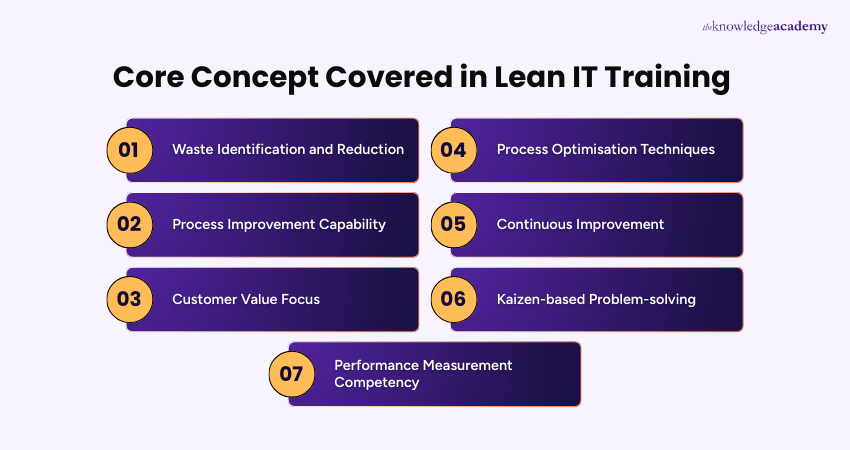
Key topics covered in this training include:
- Waste Identification and Reduction: Learn how to spot the seven types of waste in IT and apply Lean techniques to eliminate them for better performance.
- Process Improvement Capability: Analyse IT processes, spot inefficiencies, and streamline workflows using structured Lean techniques to improve service delivery.
- Customer Value Focus: Assess customer needs, define value from the user’s perspective, and align IT services to deliver higher-quality outcomes.
- Process Optimisation Techniques: Apply Lean methods to streamline IT workflows, remove inefficiencies, and improve the speed and reliability of service delivery.
- Continuous Improvement: Adopt iterative improvement cycles and foster a collaborative culture to implement ongoing enhancements through Gemba walks.
- Kaizen-based Problem-solving: Implement Lean IT tools such as the five Whys, fishbone diagram, and Define, Measure, Analyse, Improve and Control (DMAIC) to identify root causes and drive improvements.
- Performance Measurement Competency: Use Lean IT metrics such as process efficiency, value stream metrics, and performance data to monitor progress and support decisions.




 If you miss out, enquire to get
yourself
on the waiting list for the next day!
If you miss out, enquire to get
yourself
on the waiting list for the next day!













 If you wish to make any changes to your course, please


