


 Top Rated Course

We may not have the course you’re looking for. If you enquire or give us a call on +1 6474932992 and speak to our training experts, we may still be able to help with your training requirements.
What is IPv6: A Complete Guide
John Davies 20 July 2026IPv6 is the latest Internet Protocol (IP) standard, enabling more IP addresses, improved routing efficiency and secure, scalable network communication. Devices like computers and smartphones use it to communicate with each other. IPv6 supports stateless address autoconfiguration, allowing devices to configure themselves in a network.

Training Outcomes Within Your Budget!
We ensure quality, budget-alignment, and timely delivery by our expert instructors.
Table of Contents
The internet is nothing short of a bustling digital version of a city, and every device needs its own unique address to find its way home. IPv4, the old addressing system, is running out of space, much like a crowded street with no parking spots left. This is where IPv6 comes in as the much-needed upgrade.
This is the next-generation protocol designed to expand the digital neighbourhood, offering speed, security and scalability. In this blog, we’ll unravel What is IPv6, why it matters, and how it’s shaping the future of connectivity. So read on and understand the backbone behind every smooth video call, smart device and modern Cloud connection!
Table of Contents
1) What is IPv6?
2) IPv6 Address Types
3) Advantages of IPv6
4) Disadvantages of IPv6
5) Key Features of IPv6
6) How Does IPv6 Work?
7) Conclusion
What is IPv6?
The latest internet protocol is IPv6, which was created to allow endpoint systems to be identified and online traffic to be routed effectively by the Internet Engineering Task Force (IETF). It stands for Internet Protocol version 6. It deals with the problem of IPv4 address depletion due to high proliferation of internet enabled devices in the world.
As a network layer protocol, IPv6 allows effective communication with an option to give devices distinct IP Addresses. It was designed to overcome limits with the IPv4 protocols in the 1990s in the digital boom, and IPv6 was designated an IETF draft standard in 1998 and approved as an Internet Standard in 2017.
Representation of IPv6
Understanding what is IPv6 address is important to get the full picture. An IPv6 address is made up of eight groups of four hexadecimal characters, separated by dots. Each hexadecimal digit represents four bits, giving IPv6 a total address length of 128 bits. The general format is: gggg.gggg.gggg.ssss.xxxx.xxxx.xxxx.xxxx
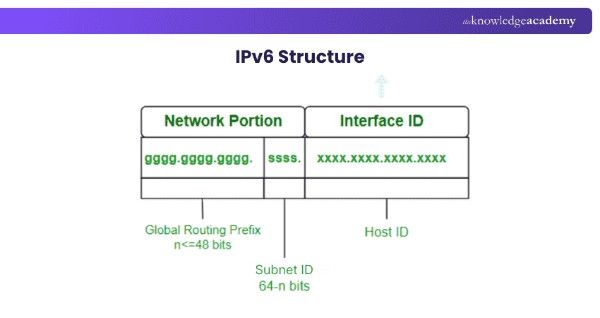
Here are the points to remember:
1) The first 48 bits form the global routing prefix, followed by 16 bits that can be used for subnet identification.
2) The remaining 64 bits identify the host.
3) Overall, the first 64 bits define the network portion, while the final 64 bits represent the interface identifier.

IPv6 Address Types
Now that we’ve got a sense of what is Internet Protocol version 6 (IPv6), let’s explore the various IPv6 address types:
1) Unicast Addresses: It denotes a singular node within a network, typically signifying either a lone sender or receiver. This address type is widely used for standard internet activities such as web browsing, email communication, and server access. It ensures precise and direct data delivery.
2) Multicast Addresses: These signifies a group of IP devices and can solely serve as the designated destination for a datagram. This approach reduces network congestion and bandwidth usage. This makes multicast especially effective for applications such as video streaming, online conferencing and network routing updates
3) Anycast Addresses: These are allocated to a group of interfaces, typically associated with distinct nodes. When data is sent to an anycast address, it is routed to the nearest or most efficient interface based on routing metrics. Anycast is commonly used for services like DNS, content delivery networks and load-balanced network services.
Future-Ready Meetings begin with our comprehensive Cisco Video Infrastructure Training - Sign up now and collaborate the smart way!
Advantages of IPv6
IPv6 introduces many advantages, positioning it as a crucial upgrade in the networking domain. The following are the benefits of IPv6:
1) Expanded Address Availability: IPv6 addresses the global shortage of IP addresses caused by increasing demand.
2) Improved Speed: It offers reliability and faster speeds allowing for a much more expansive internet experience.
3) Efficient Multicast Support: It supports multicast addresses for efficient delivery of bandwidth-intensive packet flows (such as media streams) to multiple destinations.
4) Enhanced Built-In Security: IPv6 enforces stronger network security with built-in IPSecurity. This ensures data privacy and integrity, while increasing routing efficiency.
5) Flexible Address Configuration: It supports both stateless and stateful address configuration, functioning effectively with or without a DHCP server.
6) Better Scalability and Packet Handling: The larger address space of IPv6 allows for more efficient packet handling and improved scalability.

Disadvantages of IPv6
While IPv6 brings many improvements, it has its challenges, such as the following:
1) Lack of Backward Compatibility: IPv6 is not backwards compatible with IPv4. This makes communication between networks and devices using different protocols challenging.
2) Continued Dominance of IPv4: Despite its limitations, IPv4 remains more widely used than IPv6 due to familiarity and existing infrastructure.
3) Complex Transition Process: Transitioning fully to IPv6 is a lengthy process because of protocol incompatibilities.
4) High Infrastructure Upgrade Costs: Upgrading infrastructure to support IPv6 involves significant expenses, hindering widespread adoption.
Key Features of IPv6
IPv6 was designed to overcome IPv4 limitations, offering improved scalability, performance and security. Below are its most important features:
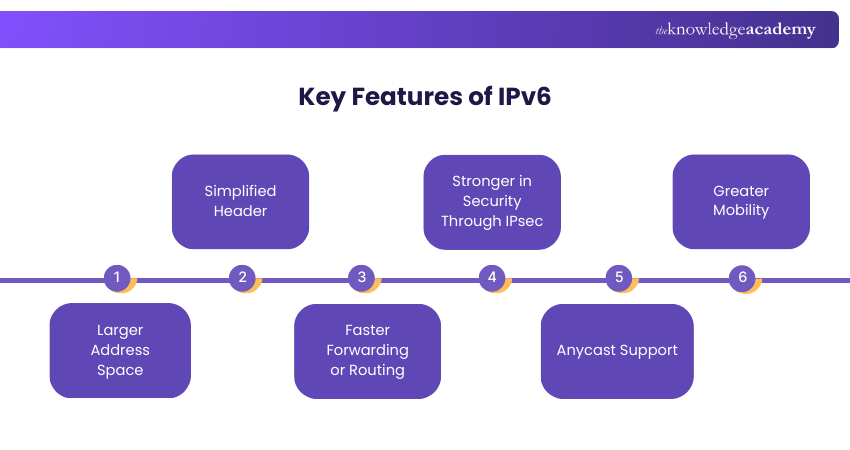
1) Larger Address Space: IPv6 uses 128-bit addressing, supporting approximately 3.4 × 10³⁸ unique addresses. This vast space enables seamless growth for IoT, cloud services and large-scale networks.
2) Simplified Header: IPv6 features a streamlined header design, with optional information moved to extension headers. This reduces processing overhead and improves efficiency in packet handling across modern networks.
3) Faster Forwarding or Routing: A smaller, simplified header allows routers to process packets more quickly which improves forwarding speed. This results in lower latency and better performance, especially in high-traffic environments.
4) Stronger in Security Through IPsec: IPv6 was designed with Internet Protocol Security (IPsec) support as a core feature, offering native encryption and authentication. This strengthens data confidentiality and integrity during network communication.
5) Anycast Support: Anycast routing enables packets to be delivered to the nearest available server within a group. This improves response times, load balancing, and overall service reliability.
Greater Mobility: IPv6 allows mobile devices to maintain consistent IP addresses as they move across networks. This enables uninterrupted connectivity and smoother handovers which improves performance for mobile and roaming applications.
Advance your networking career with industry-recognised CCNP Training and gain hands-on skills in Cisco technologies.
How Does IPv6 Work?
The working of IPv6 relies on several key concepts such as IPv6 addresses, network and node addresses, IPv6 address types and scope, and IPv6 loopback. It uses 128-bit addresses, enabling vastly more unique IPs and supporting ongoing internet growth.
IPv6 supports autoconfiguration, allowing devices to generate their own addresses using router information without manual setup. Instead of broadcasts, it uses multicast and anycast methods to deliver traffic to intended recipients or nearest nodes efficiently. This optimises routing and network traffic.
Conclusion
IPv6 emerged as the next step in internet evolution and the ideal solution to meet the demands of a connected world. Understanding What is IPv6 is essential for any IT professional, as it's paving the way for future innovations with expansive address space, increased security, and efficient performance. Opting for IPv6 is being ready for a smarter, faster digital future.
Explore our expert-led Cisco Training courses for advanced networking skills. Sign up now!
Frequently Asked Questions
Does IPv6 Make My Internet Faster?

While IPv6 does not automatically increase internet speed, it can improve efficiency. Its simplified header, better routing and removal of Network Address Translation (NAT) can reduce latency and connection delays, resulting in a more reliable performance in well-configured networks.
Is IPv6 Better Than IPv4?
Yes, IPv6 is an improvement over IPv4. It offers a much larger address space, built-in security support, better mobility and more efficient routing. These advantages make IPv6 better suited for modern networks.

John Davies


Cyber Security Governance & Assurance Specialist
John Davies is a cybersecurity expert specialising in governance, risk management, and compliance. With over 15 years in the field, he has led enterprise-wide security programmes across finance, healthcare and public sector organisations. His content provides practical guidance on building secure environments, managing risk and aligning with regulatory frameworks.


 If you wish to make any changes to your course, please


