


 Top Rated Course

We may not have the course you’re looking for. If you enquire or give us a call on +1 6474932992 and speak to our training experts, we may still be able to help with your training requirements.
ISO 26000 Core Subjects: A Comprehensive Guide
Michael Jones 25 August 2025ISO 26000 helps organisations act responsibly by focusing on social and environmental practices, such as human rights. This blog explores the ISO 26000 Core Subjects in depth, detailing their various advantages and challenges in modern life. Let's embark on a journey beyond certifications and empower a meaningful society.

Training Outcomes Within Your Budget!
We ensure quality, budget-alignment, and timely delivery by our expert instructors.
Table of Contents

ISO 26000 is your pathway to ethical excellence, showcasing the power of social and environmental responsibility. This standard delves into seven core subjects that cover every facet of social responsibility, ensuring your organisation leaves a long-lasting mark. Continue diving into this blog to explore these ISO 26000 Core Subjects in depth. Discover the benefits and challenges they bring in today’s dynamic world and see how they can revolutionise your approach to social responsibility.
Table of Contents
1) Understanding ISO 26000
2) The Seven Core Subjects of ISO 26000
3) Advantages of ISO 26000
4) Challenges of ISO 26000
5) Conclusion
Understanding ISO 26000
ISO 26000 is an international standard that provides guidelines on social responsibility, offering businesses a comprehensive framework to enhance their social and environmental impact. Understanding What is ISO 26000 is crucial for organisations aiming to operate responsibly and sustainably. Unlike other ISO standards, ISO 26000 is not meant for certification but serves as a guide to integrating social responsibility into an organisation’s core values and practices. It covers key areas such as organisational governance, human rights, labour practices, the environment, fair operating practices, consumer issues, and community involvement, making it essential for organisations aiming to operate responsibly and sustainably.
By implementing ISO 26000, organisations can recognise their societal responsibilities and act ethically and transparently, which can enhance their reputation, increase customer trust, and improve stakeholder relationships. This standard helps businesses align their operations with global standards, fostering a culture of continuous improvement and accountability. Ultimately, embracing ISO 26000 allows organisations to make meaningful contributions to society while also achieving long-term economic success.
The Seven Core Subjects of ISO 26000
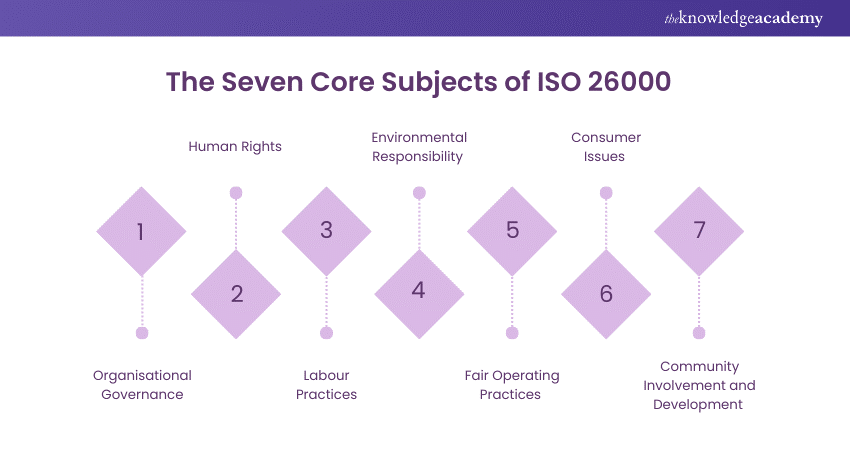
ISO 26000 provides a comprehensive framework for addressing social responsibility. These social responsibilities are paramount to preserving society beyond financial interests. It incorporates seven core subjects, which are described as follows:
1) Organisational Governance
This subject covers the ethical principles and practices for the decision-making process in an organisation. It is directly related to responsible management practices that align with the principles of social responsibility.
2) Human Rights
Human rights are a crucial subject of ISO 26000 that encourages the organisational employees and stakeholders to respect and promote human rights. This includes non-discrimination, fair treatment, and protection for vulnerable groups.
3) Labour Practices
Child and forced labour are some of the practices harming the organisation's reputation. The subject of labour practice teaches about integrating decent working conditions and the well-being of employees. These include ensuring fair wages, providing health and safety measures, promoting work-life balance, respecting the rights to collective bargaining, and offering opportunities for training and development.
Build your foundation in social responsibility with ISO 26000 Foundation Training- register today!
4) Environmental Responsibility
Environmental responsibilities are an urgent necessity. This applies equally to organisations and corporations as well. The ISO 26000 Core Subject, 'Environmental Responsibility' guides organisations in adopting sustainable practices to mitigate climate change in their operations.
5) Fair Operating Practices
The organisations require strict anti-corruption measures to deal with unethical behaviours in business operations. The "Fair Operating Practice" ISO 26000 Core Subject subject teaches about ethical business dealings to ensure fair competition and social responsibilities throughout the supply chain.
6) Consumer Issues
Consumer rights ensure product safety and provide reliable and accurate product information. The Consumer Issue subject covers responsible marketing practices, transparent communication, and fair consumer treatment.
7) Community Involvement and Development
Social and economic progress is among the crucial pillars of societal development. The subject of community involvement and development focuses on active participation in the community. It highlights the vitality of collaboration with local stakeholders and supports education, health, and employment opportunities.
Build your foundation in social responsibility with ISO 26000 Foundation Training>- register today!
Advantages of ISO 26000
ISO 26000 helps businesses align their strategies with global Corporate Social Responsibility Elements and standards, fostering ethical practices, sustainability, and community engagement. Here are five key advantages of adopting ISO 26000:
a) Enhanced Reputation and Trust: By adhering to ISO 26000, organisations can demonstrate their commitment to ethical practices, building trust among stakeholders, customers, and the community. This enhanced reputation can further lead to increased customer loyalty and brand value.
b) Improved Stakeholder Relationships: The standard encourages transparent communication and fair treatment, fostering stronger relationships with employees, customers, suppliers, and the broader community. This positive engagement can result in long-term partnerships and collaborative success.
c) Sustainable Business Practices: ISO 26000 promotes environmentally responsible practices, guiding organisations to minimise their ecological footprint as part of their commitment to business sustainability. This not only helps in conserving resources but also positions the business as a leader in sustainability, attracting eco-conscious consumers.
d) Compliance with Legal and Ethical Standards: Implementing ISO 26000 helps organisations stay ahead of legal requirements and industry norms, reducing the risk of legal issues. It establishes that businesses operate within the boundaries of ethical and legal standards.
e) Increased Competitiveness: Adopting ISO 26000 can differentiate a business from its competitors by showcasing its commitment to social responsibility. This competitive edge can open new markets and opportunities, particularly in regions where social and environmental responsibility are highly valued.
Gain knowledge on implementing social responsibility with our ISO 26000 Social Responsibility Training – Join today!
Challenges of ISO 26000
While ISO 26000 offers numerous benefits, organisations may encounter challenges when implementing the standard. These challenges often stem from the complexity of aligning social responsibility with business operations and the need for ongoing commitment. Here are five critical challenges associated with ISO 26000:
a) Lack of Clear Certification: Unlike other ISO standards, ISO 26000 does not offer certification, making it difficult for organisations to showcase compliance. This can lead to challenges in demonstrating the value of social responsibility initiatives to stakeholders.
b) Resource Intensive: Implementing ISO 26000 requires significant time, effort, and financial resources. Smaller organisations, in particular, may struggle with the costs associated with adopting and integrating the guidelines into their operations.
c) Complexity of Integration: Aligning ISO 26000 with existing business practices can be complex, especially for organisations with established procedures. It requires a comprehensive review of policies and practices, which can be challenging to execute effectively.
d) Cultural and Geographical Differences: Organisations operating in multiple regions may need help in standardising social responsibility practices due to varying cultural norms and legal requirements. Adapting ISO 26000 to local contexts can be a complex and time-consuming process.
e) Ongoing Commitment and Monitoring: Maintaining the principles of ISO 26000 requires continuous monitoring and commitment from all levels of the organisation. This can be challenging, particularly in ensuring that all employees and stakeholders are consistently aligned with the standard’s objectives.
Conclusion
We hope you have thoroughly understood the “ISO 26000 Core Subjects” and their significance in promoting social responsibility. In today’s rapidly evolving business environment, embracing the principles of ISO 26000 is vital for organisations that are committed to positively impacting society. By integrating these core subjects into your operations, you can enhance your organisation’s ethical standing, build great relationships with stakeholders, and contribute to a more sustainable future.
Join ISO 26000 Training to lead CSR efforts effectively! Build expertise in social responsibility for a positive workplace. Sign up now!
Frequently Asked Questions
What is the Latest Version of ISO 26000?

As of 2024, the 2010 version has been the current version of ISO 26000. It was confirmed and reviewed by ISO in 2021.
What are the 7 Principles of ISO 26000?
The seven principles of ISO 26000 are accountability, transparency, ethical behaviour, respect for stakeholder interests, respect for the rule of law, respect for international norms of behaviour, and respect for human rights.
What are the Other Resources and Offers Provided by The Knowledge Academy?
The Knowledge Academy takes global learning to new heights, offering over 3,000 online courses across 490+ locations in 190+ countries. This expansive reach ensures accessibility and convenience for learners worldwide.
Alongside our diverse Online Course Catalogue, encompassing 19 major categories, we go the extra mile by providing a plethora of free educational Online Resources like News updates, Blogs, videos, webinars, and interview questions. Tailoring learning experiences further, professionals can maximise value with customisable Course Bundles of TKA.
What is The Knowledge Pass, and How Does it Work?
The Knowledge Academy’s Knowledge Pass, a prepaid voucher, adds another layer of flexibility, allowing course bookings over a 12-month period. Join us on a journey where education knows no bounds.
What are the Related Courses and Blogs Provided by The Knowledge Academy?
The Knowledge Academy offers various ISO 26000 Training, including the ISO 26000 Social Responsibility Training and ISO 26000 Foundation Training. These courses cater to different skill levels, providing comprehensive insights into Social Worker Job Description: Responsibilities, Skills, & Salary.
Our Health & Safety Blogs cover a range of topics related to ISO 26000 Management, offering valuable resources, best practices, and industry insights. Whether you are a beginner or looking to advance your social responsibility management skills, The Knowledge Academy's diverse courses and informative blogs have got you covered.

Michael Jones


Health and Safety Consultant and Compliance Trainer
Michael Jones is a seasoned health and safety expert with more than 15 years of experience in workplace safety, risk management, and compliance training. He has worked across construction, manufacturing, and corporate sectors, helping organisations meet legal requirements and create safer working environments. Michael’s training and writing are known for being practical, clear, and aligned with UK regulations.

Upcoming Health & Safety Resources Batches & Dates
Date
 ISO 26000 Social Responsibility Training
ISO 26000 Social Responsibility Training
Mon 23rd Mar 2026
ISO 26000 Social Responsibility Training
Mon 1st Jun 2026
ISO 26000 Social Responsibility Training
Fri 5th Jun 2026, Sat 6th Jun 2026
ISO 26000 Social Responsibility Training
Fri 14th Aug 2026, Sat 15th Aug 2026
ISO 26000 Social Responsibility Training
Mon 14th Sep 2026
ISO 26000 Social Responsibility Training
Fri 23rd Oct 2026, Sat 24th Oct 2026
ISO 26000 Social Responsibility Training
Fri 11th Dec 2026, Sat 12th Dec 2026

 If you wish to make any changes to your course, please


