




We may not have the course you’re looking for. If you enquire or give us a call on +27 800 780004 and speak to our training experts, we may still be able to help with your training requirements.
Top 50+ Google Cloud Platform Interview Questions
By Vishnu SankarLast updated on: 17 September 2026
Cloud Computing jobs involve roles related to developing, implementing and maintaining Cloud-based systems spanning areas like Cloud architecture and Cloud security. Going through the most asked Google Cloud Interview Questions is a great way to master key concepts and boost the chances of landing a role in this field.

Considering Google Cloud Platform (GCP) is growing increasingly popular as an AI-powered digital playground for Developers and businesses, a career in this field is an excellent path to take. If you are a seasoned Cloud Specialist or even GCP newbie, this blog is your key to cracking the toughest Google Cloud Interview Questions and landing the dream job you've been planning for.
This blog brings you a curated list of more than 50 essential interview questions covering everything from Cloud Computing basics to advanced topics like Google Cloud IAM and Google Cloud Vertex AI. So read on, brush up on your Google Cloud expertise and become interview-ready in no time!
Most Asked Google Cloud Interview Questions
In this section, we will explore the more than 50 GCP Interview Questions with answers. By practising these questions, you can maximise your chances of cracking the interview and landing your dream job.
What is Computing?

Computing is an all-encompassing field that leverages technology to store and analyse vast range and amounts of data. Through computers, servers and software, computing enables the creation of complex algorithms and data structures that can efficiently process and organise information.
The applications of computing are vast and varied, ranging from developing new technologies to analysing and interpreting scientific data. It is a field that requires a deep understanding of mathematical concepts and programming languages and encompasses numerous sub-fields, such as Artificial Intelligence (AI), Machine Learning (ML), and Data Science.
What is Cloud Computing?
Cloud Computing is the delivery of computing services such as storage, servers, databases, networking and software, over the internet. It allows on-demand access and management of resources, reduces infrastructure costs and improves scalability. Cloud Computing delivers three main service models:
a) Infrastructure as a Service (IaaS)
b) Platform as a Service (PaaS)
c) Software as a Service (SaaS)
What is Google Cloud Platform (GCP)?
Google Cloud Platform (GCP) is a suite of services Google for Cloud Computing developed. It provides various infrastructure and platform services to help organisations and individuals build, deploy and manage apps on Google's highly scalable and reliable infrastructure.
What is Google Kubernetes Engine (GKE)?
Google Kubernetes Engine is a managed Kubernetes service that simplifies containerised applications' deployment, management, and scaling. It allows users to run applications in containers efficiently and ensures automatic updates and scaling.
How does Google Cloud ensure security for its services?
Google Cloud follows a multi-layered security approach, including hardware infrastructure security, data encryption at rest and in transit, Identity and Access Management (IAM), Distributed Denial of Service (DDoS) protection, and more. Compliance certifications from various standards organisations also add to its security credentials.
What is the significance of Virtual Private Cloud (VPC) in GCP?
VPC allows users to create their isolated network within GCP, providing control over IP address ranges, subnets, and firewall rules. It enables secure communication between resources and the ability to create VPNs for on-premises connections.
What is BigQuery, and how does it process large datasets?
BigQuery is a fully managed, serverless data warehouse that enables super-fast SQL queries on large datasets. It uses a distributed architecture and automatically scales resources to handle massive volumes of data.
What is Google Cloud Storage?
Google Cloud Storage is a scalable, secure, and durable Cloud-based storage solution that allows users to store and retrieve data from anywhere. It supports various storage classes, integrates with Google Cloud services, and offers high availability, automatic backups, and strong security features for businesses and Developers.
Explain the benefits of using Cloud Pub/Sub
Cloud Pub/Sub is a messaging service that lets application components be decoupled. It helps build scalable, event-driven systems, supports real-time analytics and enables reliable data ingestion from various sources.
What is the role of Cloud IAM and its key features?
Cloud Identity and Access Management (Cloud IAM) controls user access to Cloud resources, thus ensuring security and compliance. Key features include:
a) Role-based access control (RBAC)
b) Granular permissions
c) Multi-factor authentication
d) Audit logging
e) Integration with identity providers for centralised Access Management across Cloud environments
What is Google Cloud's Approach to Data Analytics?
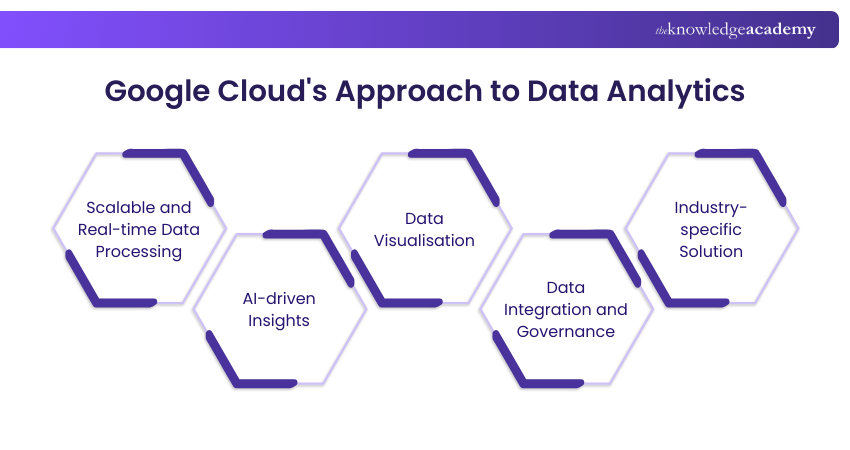
Google Cloud offers powerful data analytics tools to help businesses process and analyse data efficiently. These tools provide real-time insights, automate data handling, and integrate with AI, making it easier to make smart decisions. Google Cloud’s approach to Data Analytics involve the following:
a) Scalable Data Processing through BigQuery and Dataflow.
b) AI-powered insights through AI and ML tools like AutoML.
c) Data visualisation through Google Data Studio that offer interactive dashboards for better decision-making.
d) Data integration & security through tools like Cloud Data Fusion.
e) Tailored analytics solutions, such as Healthcare API and Retail AI, address sector-specific needs.
What is the pricing model in the GCP cloud?
With Google Cloud Platform's unique pay-as-you-go pricing model, you will only be charged for the exact resources you use, making it a truly cost-effective solution for businesses of any industry or size. GCP offers an industry-leading solution that allows you to get started without any upfront costs or long-term commitments. On top of that, you can easily set up a budget to track and manage your expenses, ensuring that you are getting the most out of your investment in GCP.
What is autoscaling in GCP?
Autoscaling is a useful feature of Managed Instance Groups (MIGs) in Google Cloud Platform (GCP). It allows you to automatically add or delete VM instances from a MIG based on increases or decreases in load. Autoscaling helps your applications handle the increase in traffic and reduce costs when the demand is lower.
What is Google Cloud SDK?
Google Cloud SDK is an ensemble of command-line tools that enable users to interact with Google Cloud Platform (GCP) services. It allows Developers to manage Cloud resources, deploy applications, and automate tasks through scripts. It includes tools like gcloud, gsutil, and bq for seamless Cloud operations.
What are Projects on Google Cloud?
Projects on Google Cloud serve as fundamental units for managing Cloud resources. Each project includes users, APIs, billing configurations, authentication, and monitoring settings. It provides isolation for different workloads, ensuring secure access control, efficient resource allocation, and streamlined management within the Google Cloud ecosystem.
What is the role of Google Cloud IAM?
Google Cloud IAM helps control access to Cloud resources by assigning roles to groups, users and service accounts. It ensures that permissions are granted only to those who need them, following the principle of least privilege. IAM simplifies resource management by providing predefined roles and allowing custom role creation for specific needs, ensuring secure and efficient access control.
What are Cloud Computing System Integrators?
Cloud Computing System Integrators are experts or firms that assist businesses in adopting and managing Cloud solutions. They design, deploy, and optimise Cloud infrastructure, ensuring seamless integration with existing systems. Their services include the following to enhance Cloud efficiency and scalability:
a) Migration
b) Security
c) Compliance
d) Performance monitoring
What is the function of a Bucket in Google Cloud Storage?
A bucket is a container for storing data in Google Cloud Storage, which can hold files and folders. You can organise and manage your data using buckets while controlling its accessibility. Unlike directories and folders, buckets cannot be nested. It is important to note that there is no limit to the number of buckets created within a project or location.
Explain what Google Cloud Machine images are.
Google Cloud Machine images offer engineers a convenient and efficient solution to store and manage various virtual machine instance data. With machine images, you can store not only the configuration and metadata of your VMs but also the associated permissions and multiple disk data.
This means you can easily create new VMs with the same configuration and settings as the original instance, saving you time and effort. Additionally, machine images provide a scalable and flexible way to manage your VM data, allowing you to quickly backup, restore, and share images across projects and teams.
What are the different models for deployment in Cloud Computing?
Cloud Computing offers four main deployment models:
a) Public Cloud: The services are hosted by third-party providers and shared across multiple users. Examples include AWS, Google Cloud, and Azure.
b) Private Cloud: A dedicated Cloud environment used exclusively by one organisation, offering enhanced security and control.
c) Hybrid Cloud: A combination of public and private Clouds. It allows data and applications to move between them for flexibility.
d) Community Cloud: A shared Cloud infrastructure used by multiple organisations with similar security and compliance requirements, such as government agencies or financial institutions.
Gain insight into the power of Google's fully scalable relational database in our Google Cloud Spanner Training - Register now!
Is it hard to get hired at Google Cloud?
Yes, getting hired at Google Cloud can be challenging due to its high standards and competitive selection process. Candidates need strong technical skills, industry experience, and problem-solving abilities. The hiring process includes multiple interviews, technical assessments, and cultural fit evaluations to ensure top-tier talent.
How long does it take to get hired at Google Cloud?
The hiring process at Google Cloud typically takes several weeks to a few months. It involves multiple interview rounds, including phone screenings, technical assessments, and onsite interviews. Factors like role complexity, candidate availability, and background checks can affect the overall timeline.
Intermediate Google Cloud Platform Interview Questions
This section focuses on intermediate-level GCP interview questions, exploring more complex concepts and tools to help you demonstrate advanced knowledge in Google Cloud services.
What are the core components of GCP?
The core components of GCP include:
a) Compute Engine
b) App Engine
c) Kubernetes Engine
d) Cloud Storage
e) Cloud SQL
f) BigQuery
Each component serves specific purposes, caters to diverse business needs, and provides a comprehensive Cloud ecosystem.
How does Google Cloud differ from other Cloud service providers?
Google Cloud offers numerous advantages, including
a) Global network infrastructure
b) Advanced Data Analytics capabilities
c) Machine Learning services
d) Industry-specific solutions
These unique features make GCP stand out among other Cloud providers.
Explain the key features of Google Cloud Storage
Google Cloud Storage provides highly durable and scalable object storage. It offers the following storage classes for different data access needs:
a) Multi-regional storage
b) Regional storage
c) Nearline storage
d) Coldline storage
Additionally, it provides Lifecycle Management for automated data archiving.
How can you transfer data from on-premises to the Google Cloud Platform?
Data can be transferred using methods like Cloud Storage Transfer Services, Transfer Appliances, and Cloud Data Transfer Services. These tools ensure seamless and secure data migration.
How does Google Cloud AutoML facilitate Machine Learning?
AutoML allows users to build Machine Learning models without extensive Data Science knowledge. It automates the training and deployment process, making integrating ML into various applications easier.
What are Google Cloud Functions and their use cases?
Google Cloud Functions are serverless, event-driven compute services that execute code in response to Cloud events. They automatically scale, eliminating the need for infrastructure management.
Here are some use Cases:
a) Real-time Data Processing: Process and transform streaming data from Cloud Storage or Pub/Sub.
b) API Integration: Connect Cloud services and external APIs effortlessly.
c) Automated Workflows: Trigger actions based on events, like resizing images or sending notifications.
d) IoT and Event-driven Applications: Respond to IoT device signals and Cloud events dynamically.
e) Microservices Development: Build lightweight, scalable applications efficiently.
Accelerate your career in the Cloud with our Developing Applications With Google Cloud Platform Training – Sign up now!
How does Google Cloud support Internet of Things (IoT) projects?
Google Cloud supports IoT the following ways:
a) Google Cloud IoT Core provides a secure and scalable platform for managing, processing and analysing IoT data.
b) It integrates with BigQuery, Pub/Sub, and AI tools for real-time insights and automation.
c) This helps businesses optimise operations, strengthen security and drive innovation.
Explain the importance of Google Cloud Marketplace
Google Cloud Marketplace is a one-stop platform that allows businesses to discover, deploy, and manage third-party software, datasets, and development tools on Google Cloud. Here’s why Google Cloud Marketplace is important:
a) Quick Deployment: Enables businesses to install pre-configured applications instantly.
b) Wide Range of Solutions: Offers SaaS, VM-based software, APIs, and datasets from verified vendors.
c) Simplified Billing: Consolidates payments for Cloud services and third-party tools in one invoice.
d) Scalability & Security: Ensures secure and scalable solutions that integrate with existing Cloud infrastructure.
e) Enterprise-Ready: Helps organisations streamline procurement and manage cloud-based tools efficiently.
How can users optimise costs while using Google Cloud services?
Optimising costs while using Google Cloud services is essential for ensuring efficient resource utilisation and maximising the value of your Cloud investment. Here are some strategies to help users optimise costs on Google Cloud:
a) Right-size Resources: Regularly adjust Cloud resources based on actual usage to optimise performance and reduce costs.
b) Use Sustained Discounts: Save costs by leveraging Google Cloud’s discounts for long-running virtual machine instances.
c) Committed Use Contracts: Commit to services for 1-3 years to receive significant cost reductions.
d) Monitor Usage: Use Google Cloud Monitoring and Billing reports to track and optimise resource consumption.
e) Optimise Storage: Apply lifecycle policies to shift infrequently accessed data to lower-cost storage classes.
What is the role of Cloud CDN in improving application performance?
Here's how Cloud CDN enhances application performance:
a) Caching & Content Delivery: Cloud CDN caches content at global edge locations, reducing data travel distance and load times.
b) Lower Latency: Serves content from nearby edge locations, ensuring faster load times and greater user experience.
c) Scalability & Availability: Handles high traffic and offloads origin servers, ensuring seamless performance during demand spikes.
d) DDoS Protection: Mitigates DDoS attacks by absorbing malicious traffic, safeguarding the origin server.
e) Global Reach: Delivers content from worldwide edge locations, ensuring optimal performance across all regions.
f) Cost Efficiency: Reduces bandwidth usage and infrastructure costs by caching content closer to users.
g) SSL Termination: Handles SSL/TLS connections at the edge, improving security and reducing server load.
h) Easy Integration: Simple setup with seamless integration into Google Cloud services, requiring minimal configuration.
How does Google Cloud comply with data regulations?
Google Cloud follows strict data protection regulations, including GDPR, HIPAA, and ISO 27001, ensuring high security and compliance standards. It offers encryption, access controls, and compliance certifications to safeguard data. Additionally, Google Cloud provides audit logs, compliance reports, and tools to help customers efficientlymeet regulatory obligations.
Explain the concept of Google Cloud Load Balancing
Google Cloud Load Balancing distributes incoming traffic across multiple servers to ensure high availability, reliability, and performance. It supports global and regional load balancing, automatically scales resources, and integrates with Google Cloud’s security features to handle traffic spikes and prevent downtime efficiently.
What are the benefits of using Google Cloud Deployment Manager?
Using Google Cloud Deployment Manager offers several benefits for managing and automating Cloud resources. Here are some key advantages:
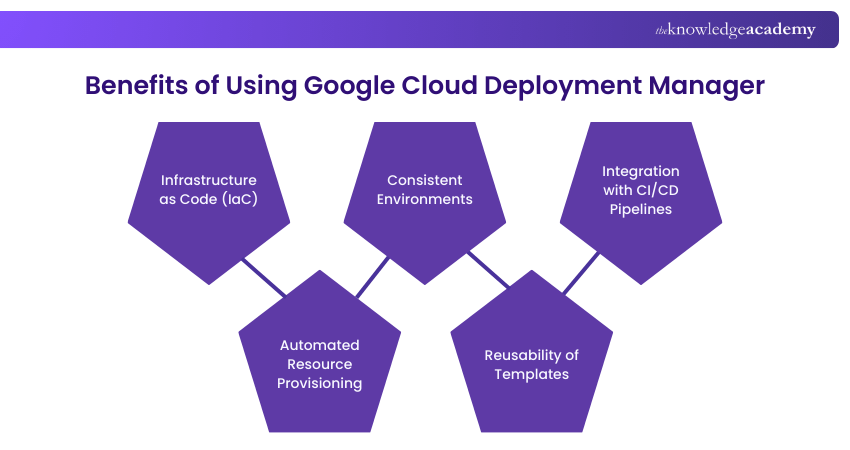
a) Infrastructure as Code (IaC): Define Cloud infrastructure using code, enabling version control and reproducibility.
b) Automated Resource Provisioning: Streamline creation and configuration of Cloud resources, saving time and reducing errors.
c) Consistent Environments: Ensure stable and predictable deployments across different environments.
d) Reusability of Templates: Use YAML or Python templates to replicate resource configurations efficiently.
e) Integration with CI/CD Pipelines: Seamlessly integrate with CI/CD workflows for automated deployments and updates.
Master Cloud Computing services to become a successful Cloud Digital Leader in our Google Cloud Digital Leader Training - Sign up now!
How does Google Cloud facilitate real-time data processing?
Google Cloud enables real-time data processing through BigQuery, Dataflow, and Pub/Sub, allowing businesses to ingest, process, and analyse streaming data instantly. These serverless tools provide auto-scaling, low-latency processing, and AI integration, ensuring seamless data insights, automation, and decision-making for applications requiring real-time analytics and event-driven architectures.
How can users achieve seamless automation with Google Cloud?
Users can achieve seamless automation with Google Cloud by leveraging various tools and services. Google Cloud offers solutions like Cloud Functions, Deployment Manager, and Cloud Scheduler that enable automated processes, resource provisioning, and task scheduling. Let’s explore how users can automate tasks, deployments, and scaling:
a) Defining infrastructure as code
b) Utilising event-driven functions
c) Integrating with CI/CD pipelines
Google Cloud's managed services also handle operational aspects, freeing users from managing the underlying infrastructure. This results in efficient, scalable, and cost-effective automation for their applications and workloads.
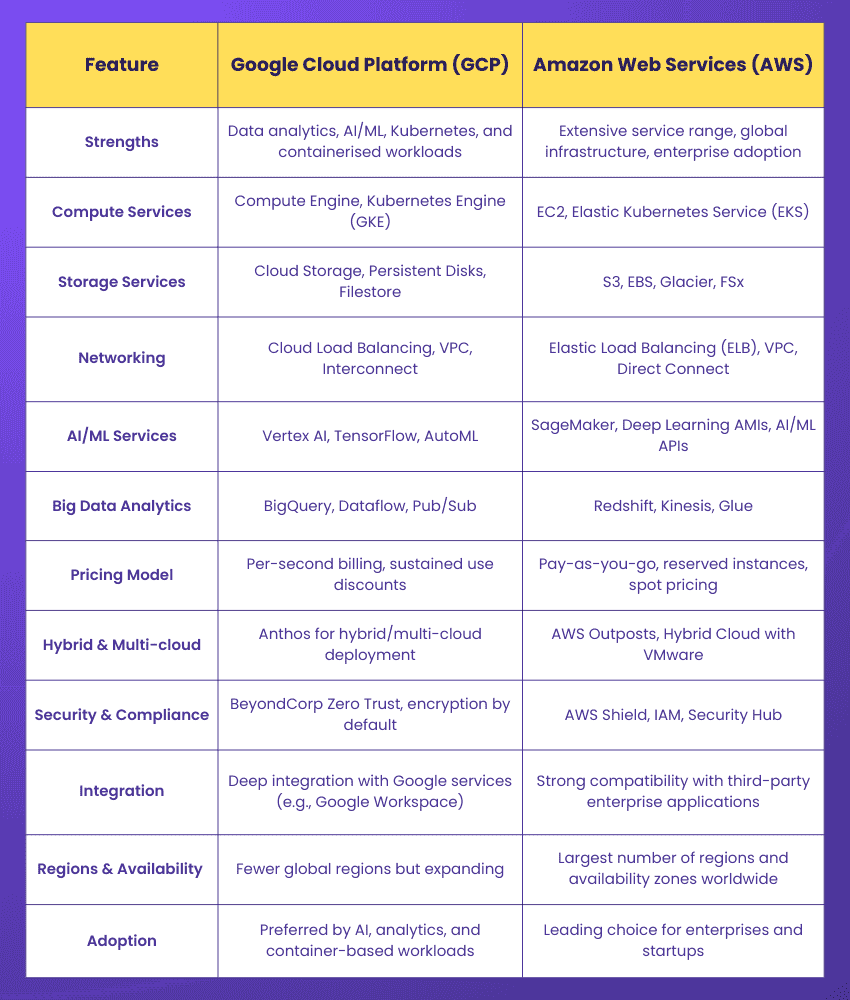
What is the difference between GCP and AWS?
Here are the key differences between GCP and AWS:
What are the libraries and tools for cloud storage on GCP?
Google Cloud Platform offers several ways to interact with Cloud storage. At the core level, Developers can use JSON API and XML API. Google provides the following tools and resources:
a) Google Cloud Platform Console is a user-friendly web interface that allows users to perform basic operations on objects and buckets.
b) Cloud Storage Client Libraries offer programming support for various languages, making it easier for Developers to integrate Cloud storage into their applications.
Gsutil Command-line Tool provides a powerful Command-Line Interface (CLI) for Cloud storage, allowing Developers to perform complex operations and automate tasks.
What is Google Cloud Messaging?
Google Cloud Messaging (GCM) is a service that enables third-party app Developers to send notification data from their servers to Android devices or Google Chrome browsers. It is a simple, lightweight, and reliable mechanism facilitating communication between servers and client apps.
What are instances in GCP?
In the Google Cloud dashboard, you can associate a single project with multiple instances, and each instance can be linked to different projects. When you create instances for a project, you can choose from various operating systems and hardware architectures. If you delete an instance, it is permanently removed from the project.
Each Compute Engine instance has a small boot persistent CD with a pre-installed operating system, a standard feature. You can add extra storage options to your instance if your application needs more capacity than currently available.
Can you explain the role of Google Cloud IAM in managing access to resources?
Google Cloud IAM manages access to resources by defining roles and permissions for groups, users and applications. It ensures controlled access based on specific job functions and requirements. With granular role-based access, administrators can regulate who has permissions to view, modify, or deploy resources, promoting a secure and organised cloud environment.
How would you ensure data security in Google Cloud Platform?
To ensure data security in Google Cloud Platform (GCP), I’ll implement robust practices such as enabling Google Cloud IAM for precise access control, encrypting data both in transit and at rest, and utilising security features like VPC Service Controls and Cloud DLP for sensitive data protection. I’ll ensure regular monitoring logs with Cloud Audit Logs and apply security policies using Google Cloud Security Command Center.
Advanced Google Cloud Platform Interview Questions
This section delves into advanced GCP interview questions, covering in-depth topics, complex architectures, and advanced services to test your expertise in Google Cloud Platform.
What is Google Cloud Anthos, and what are its benefits?
Google Cloud Anthos is a multi-cloud and hybrid platform allowing businesses to deploy, manage, and scale applications consistently across on-premises, Google Cloud, and other cloud providers like AWS and Azure. Here are its benefits:
a) Multi-Cloud Flexibility: Run workloads across different Cloud providers without modification.
b) Consistent Application Management: Centralised control for hybrid and multi-cloud environments.
c) Security & Compliance: Enforces security policies across all deployments.
d) Automation & Efficiency: Streamlines operations with Kubernetes-based automation.
e) Modernisation: Supports containerised applications, enabling seamless migration and updates.
Elevate your Data Analytics skills with our Google Advanced Data Analytics Professional Training Course – Sign up now!
What factors impact the salary of a Cloud Engineer?
A Cloud Engineer’s salary depends on experience, certifications, location, employer, and skillset. Advanced expertise in AWS, Google Cloud, or Azure, along with certifications like GCP Professional Cloud Architect, boosts earning potential. Industry demand, job role, and specialisation in security, DevOps, or AI also influence salary levels.
How can you boost your salary as a Cloud Engineer?
To increase your salary, gain certifications like AWS Solutions Architect or GCP Professional Cloud Architect, specialise in DevOps, security, or AI, and build expertise in Kubernetes, Terraform, and automation tools. Gaining experience, networking, contributing to open-source projects, and negotiating strategically can also enhance earning potential.
What is the significance of scalability and elasticity in Cloud Computing?
Scalability ensures a system can handle growing workloads by adding resources, while elasticity dynamically adjusts resources based on demand. Scalability supports long-term growth, while elasticity optimises resource usage in real time, making Cloud environments adaptable to fluctuating workloads and business needs. So, both are vital in improving performance, cost efficiency and availability.
Explain what binary authorisation refers to in Google Cloud
With Binary Authorisation, one can establish and enforce policies demanding trusted sources sign container images before they are deployed on Google Kubernetes Engine (GKE) or Cloud Run 1. By doing so, one can be confident that only approved code is deployed and running in your container environment.
This reduces the risk of unauthorised or malicious code causing issues. This feature can be used with other Google Cloud services, including Container Registry, Cloud Key Management Service, Security Command Center, and Cloud Build, to deliver a comprehensive and consistent security solution for your container deployments.
Can you explain the role of Google Cloud IAM in data security?
Google Cloud IAM plays a critical role in data security by managing who can access resources and what actions they can perform. By assigning precise roles and permissions, it prevents unauthorised access to sensitive data. IAM also supports security best practices, such as enforcing Multi-factor Authentication (MFA) and audit logging, ensuring robust protection against potential threats.
What are the connections between Google Compute Engine and Google App Engine?
Google offers two distinct Cloud Computing services - Google Compute Engine and Google App Engine. Compute Engine is an IaaS offering that allows users to build and manage virtual machines with custom business logic. On the other hand, an App Engine is a PaaS space allowing users to create and deploy web and mobile applications effortlessly.
It is ideal for hosting websites, mobile backends, and private data storage systems. These two services complement each other and provide users with a comprehensive solution for their Cloud Computing needs.
Which technical skills do Engineers need to use GCP successfully?
To effectively use Google Cloud Platform (GCP), engineers need the following key technical skills:
a) Cloud Computing Fundamentals: Understanding Cloud architecture, networking, and virtualisation.
b) Proficiency in DevOps: Experience with CI/CD, Kubernetes, Terraform, and Infrastructure as Code (IaC).
c) Software Security & Cybersecurity: Ensuring data protection, access control, and compliance.
d) Programming and Scripting: Knowledge of Python, Go, or Java for automation and application development.
e) Data & Analytics: Experience with BigQuery, Dataflow, and Pub/Sub for data processing.
GCP Services Expertise: Familiarity with Compute Engine, Cloud Storage, IAM, and Cloud Functions.
What is Google Cloud Vertex AI?
Google Cloud Vertex AI is a comprehensive platform that allows you to seamlessly develop and deploy Artificial Intelligence and Machine Learning applications. It delivers a wide range of tools and services that enable users to design, train, evaluate, and deploy custom or pre-trained models on the Cloud.
Unlock the power of Big Data with our Big Data and Machine Learning With Google Cloud Platform Training – Sign up today!
What does "EUCALYPTUS" mean specifically in the context of Cloud Computing?
EUCALYPTUS is a flexible and highly efficient Cloud Computing infrastructure that operates on an open-source platform. EUCALYPTUS stands for "Elastic Utility Computing Architecture," which reflects its ability to provide a scalable and dynamic utility computing environment. With EUCALYPTUS, Developers can easily create customised private, public, or hybrid Cloud environments. By harnessing the ability of Cloud Computing, you can establish a data centre in the Cloud that empowers your organisation with incredible speed, agility, and cost-effectiveness.
What are the various methods for authenticating the Google Compute Engine API?
Several authentication methods are available when working with the Google Compute Engine API. Here are the key methods:
a) Client Library: Provides an interface to authenticate and interact with the API.
b) OAuth 2.0: Offers a secure, standardised method for authorising API access.
c) Access Token: Allows authentication without manually managing client credentials.
What are the most used open-source Cloud Computing platforms?
Open-source Cloud Computing platforms have gained immense popularity in recent years. Apache Mesos, OpenStack, Cloud Foundry, and KVM are the most utilised open-source Cloud Computing platforms.
a) Apache Mesos is a cluster manager which provides effective resource isolation and sharing across distributed applications.
b) OpenStack is a cloud Operating System which controls large pools of computing, storage, and networking resources throughout a data centre.
c) Cloud Foundry is an open-source platform (PaaS) service that provides a choice of Cloud, developer frameworks, and application services.
d) KVM is a virtualisation infrastructure for the Linux kernel that turns it into a hypervisor. These open-source Cloud Computing platforms are known for their scalability, flexibility, and cost-effectiveness, making them ideal for various organisations and businesses.
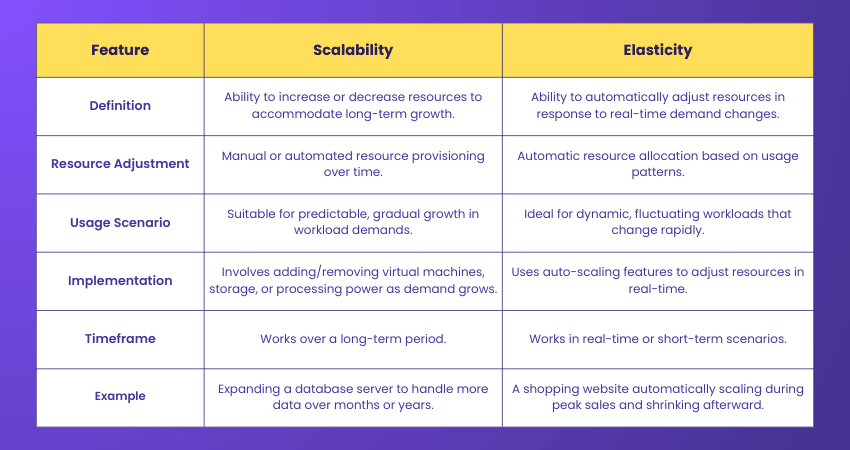
Explain the difference between scalability and elasticity in Cloud Computing?
Here are the key differences between scalability and elasticity in Cloud Computing:
What is the career progression and salary growth for a Cloud Engineer?
The career progression for a Cloud Engineer typically starts with an entry level position, such as Cloud Support Engineer or Cloud Developer, where the focus is on understanding Cloud platforms and technologies. At this stage, developing core Cloud Engineer skills such as networking, security, and scripting is essential.
After gaining experience, one can progress to Cloud Architect or Senior Cloud Engineer, where responsibilities include designing Cloud solutions and managing large scale Cloud deployments. At higher levels, roles such as Cloud Solutions Architect, Cloud Engineer Manager, or Cloud Consultant become available, where leadership, strategic planning, and complex system architecture are key components.
Regarding salary growth, it varies by experience, location, and specialisation.

Vishnu Sankar is a Senior Content Writer with 5+ years of experience across content development, software development, web development and system administration. His technical background and professional training support his expertise in IT and Tech, while his extensive research and writing experience covers Project Management and Health and Safety.
View Detail

 If you wish to make any changes to your course, please


