Who should attend this ISO 55001 Lead Auditor Training Course?
The ISO 55001 Lead Auditor Training Course is designed for those who wish to learn the entire knowledge and abilities necessary to conduct and lead Asset Management System audits in accordance with the ISO 55001 Standard. Here are the professionals who will especially benefit from taking the ISO 55001 Lead Auditor Training Course:
- Asset Managers
- Experienced Internal Auditors
- Quality and Compliance Managers
- Consultants
- Management System Representatives
- Operational and Maintenance Managers
- Risk Managers
- Third-Party Auditors
Prerequisites of the ISO 55001 Lead Auditor Training Course
There are no formal prerequisites for attending this ISO 55001 Lead Auditor Training Course.
ISO 55001 Lead Auditor Training Course Overview
ISO 55001 stresses the importance of asset management through whole life cycle stages. Since organizations are seeking for a better asset management system, the ISO 55001 indispensable to correct measures. This training takes place to enable the individuals to detect these systems with the right skills as this was done in the line with organizational goals and international standards.
ISO 55001 proficiency is one of the critical factors to consider especially for the purpose of having legitimate and proper asset management systems which achieve the desired results through efficiency and effectiveness. The people who have utilize their expertise auditors, asset managers and quality assurance practitioners should strive to realize this standard. This institutional of practices from knowledge of asset management will keep on growing, of which to success of the organization will contribute highly.
The 5-day training is intended to give delegates skills-based auditing process according to ISO/TS 55001 international standards. Course attendees will be capable of performing audits that deliberately build a culture of results-oriented thinking and make the asset management systems more effective. Herewith, the latter must be aligned with the organization's strategy. This hands-on knowledge is a part and parcel of every auditor who possesses the specialization in Asset management.
Course Objectives
- To understand the principles and processes of effective asset management as per ISO 55001
- To acquire the skills necessary to conduct and lead ISO 55001 audit processes
- To learn the techniques for managing an audit team and audit program
- To develop the ability to assess compliance with ISO 55001 and identify areas for improvement
- To understand the application of asset management within different organizational contexts
At the completion of the course, participants will be given a certificate that acknowledges their expertise in ISO 55001 audits This certification attests to their expertise in asset system administration and their ability to enhance an organization's performance as they excel at asset optimization and risk management.
Benefits of ISO 55001 Lead Auditor Course
The ISO 55001 Lead Auditor Course focuses on auditing Asset Management Systems (AMS) against ISO 55001 requirements. It covers audit principles, lifecycle evaluation, and governance review within asset management frameworks.
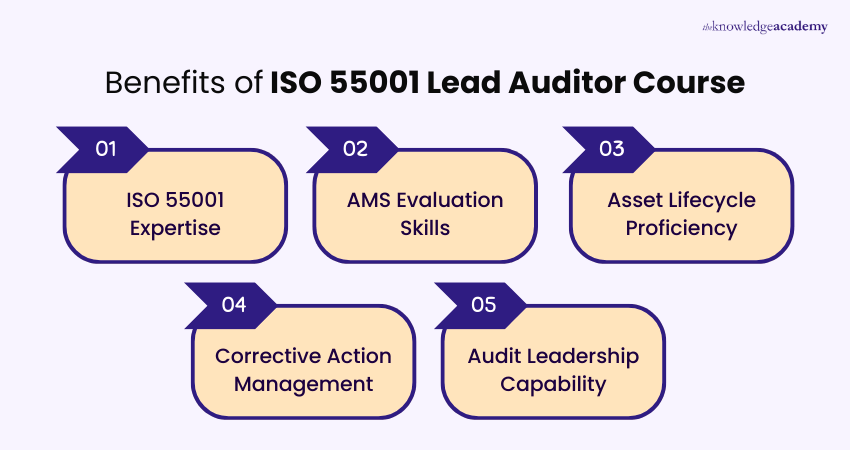
Here are the benefits of ISO 55001 Lead Auditor Training:
- ISO 55001 Expertise: Build the capability to interpret ISO 55001 terms, concepts, and scope requirements accurately during Asset Management System audits.
- AMS Evaluation Skills: Develop the ability to evaluate Asset Management System performance, including alignment with Strategic Asset Management Plans and organizational objectives.
- Asset Lifecycle Proficiency: Gain practical competence to audit asset planning, acquisition, operation, maintenance, and disposal across the complete asset lifecycle.
- Corrective Action Management: Learn to assess nonconformities, verify corrective and preventive actions, and support continual improvement within asset management systems.
- Audit Leadership Capability: Strengthen the ability to lead audit teams, manage audit engagements, and communicate findings clearly to stakeholders and management.




 If you miss out, enquire to get yourself on the waiting list for the next day!













 If you wish to make any changes to your course, please


