


 Top Rated Course

We may not have the course you’re looking for. If you enquire or give us a call on +44 1344 203 999 and speak to our training experts, we may still be able to help with your training requirements.
Strategic Thinking in Business Planning: Explained
William Brown 26 February 2026Unlock the power of Strategic Thinking in Business Planning with our insightful blog. Discover how this essential approach empowers organisations to navigate challenges, seize opportunities, and achieve long-term success. Explore the importance of Strategic Thinking and the process of Strategic Thinking.

Training Outcomes Within Your Budget!
We ensure quality, budget-alignment, and timely delivery by our expert instructors.
Table of Contents
Do you want to learn how to plan and execute successful Business Strategies? If so, you need to master Strategic Thinking. Strategic Thinking is a way of thinking that helps you to see the big picture, anticipate future trends and opportunities, and create innovative solutions for complex problems. Strategic Thinking in Business Planning is a way of thinking that helps you see the big picture, anticipate future trends and opportunities, and create innovative solutions for complex problems. Explore this blog, where you will learn how forward-looking, critical, and creative thinking play pivotal roles in shaping effective strategies.
Table of Content
1) What is Strategic Thinking
a) Importance of Strategic Thinking in Business Planning
2) The process of Strategic Thinking
3) Tools and techniques for Strategic Thinking
4) Conclusion
What is Strategic Thinking?
Strategic Thinking is the process of stepping back from the day-to-day operations of a business analysis and taking a broader, long-term view. It involves analysing the current state of the business, setting clear objectives, and then figuring out the best way to achieve those objectives. This process is deeply connected with Business Policy and Strategic Management, as it aligns business goals with long-term strategies. It's like looking at a map to plan a journey; you need to know where you are, where you want to go, and the best route to get there.
Importance of Strategic Thinking in Business Planning
Strategic Thinking is essential for several reasons:
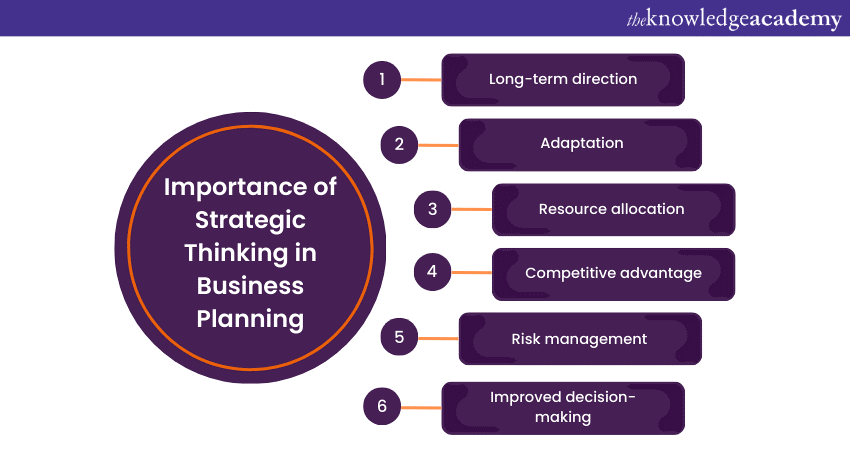
a) Long-term direction: It helps a business define its long-term goals and vision. Without a strategic plan, a company might drift without a clear destination.
b) Adaptation: In a constantly changing business environment, Strategic Thinking allows a company to adapt to new challenges and opportunities. It's like having a flexible roadmap that can be adjusted as needed.
c) Resource allocation: It helps in allocating resources like time, money, and talent more effectively. By focusing on what's most important, a business can use its resources wisely.
d) Competitive advantage: Strategic Thinking enables a business to stay ahead of the competition. It helps in identifying unique selling points and ways to stand out in the market.
e) Risk management: By anticipating potential risks and having plans to mitigate them, Strategic Thinking reduces the chances of major setbacks.
f) Improved decision-making: It provides a structured framework for making decisions. This helps in avoiding impulsive or short-term choices and encourages well-considered, informed decisions.
The process of Strategic Thinking
The process of Strategic Thinking involves a structured approach to developing a long-term plan for a business or organisation, often using a Business Plan Template Guide. Here's a more detailed explanation of the steps involved in the process of Strategic Thinking:
a) Environmental analysis: This is the first step in the process. It involves a comprehensive assessment of the external environment in which the business operates. This includes analysing market trends, studying competitors, understanding economic conditions, and considering any other factors that could impact the business. The goal is to gather data and insights that will inform strategic thinking vs. operational thinking decisions, as both approaches play a crucial role in shaping a company’s future direction.
b) Setting clear objectives: Once the external environment is understood, the next step is to set clear and specific objectives. These objectives define what the business wants to achieve over a certain period. Objectives should be SMART (Specific, Measurable, Achievable, Relevant, and Time-bound) to provide a clear sense of direction.
c) Identifying core competencies: It's essential to identify the strengths and weaknesses of the business, often referred to as its core competencies. This step involves an internal assessment of what the company does well and where it might have weaknesses. Knowing these core competencies helps guide strategic decisions and capitalise on strengths.
d) Generating strategic options: With objectives in mind and an understanding of core competencies, the next step is to brainstorm and explore different strategic options. This is a creative process that involves considering various approaches to achieving the defined objectives. Think of it as plotting different routes on a map to reach a destination.
Get ready for your interview with our top Business Analyst Interview Questions!
e) Evaluating and selecting strategies: After generating a list of strategic options, the business needs to evaluate each one. This evaluation involves considering various factors, including feasibility, potential risks, alignment with the business's strengths, and their potential to achieve the defined objectives. The best-fit strategy is then chosen based on this evaluation.
f) Developing an actionable plan: Once a strategy is selected, it's time to create a detailed plan for its execution. This plan outlines the specific steps, resources, and timelines required to execute the chosen strategy. It essentially breaks down the strategy into actionable tasks and responsibilities, ensuring effective strategy execution.
g) Communication and alignment: Effective communication is crucial. The chosen strategy and the accompanying plan need to be communicated to all relevant stakeholders within the organisation. This ensures that everyone is aligned and understands their role in implementing the strategy.
h) Monitoring and adaptation: Becoming a Corporate Trainer involves understanding that strategic thinking is an ongoing process. It requires continuous monitoring of progress and the business's external environment. If circumstances change or new opportunities or challenges arise, the business should be prepared to adapt its strategy accordingly.
Unlock your potential with the BCS Advanced International Diploma in Business Analysis Course – Take the next step towards becoming a master in your field today!
Tools and Techniques for Strategic Thinking in Business
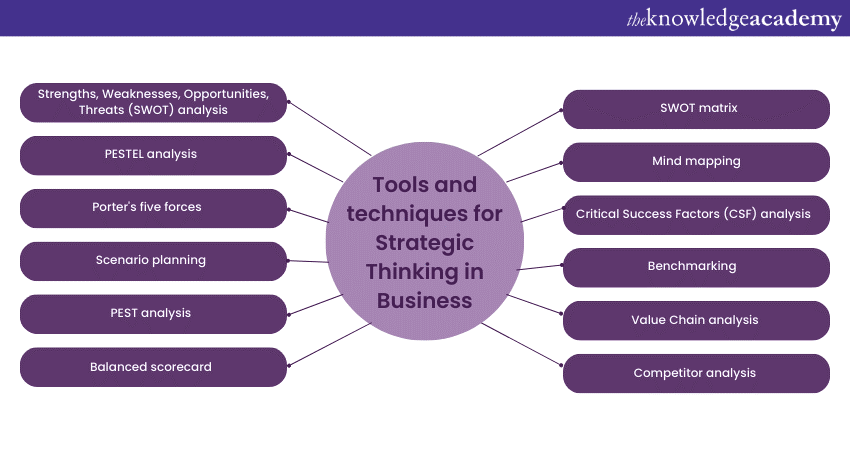
Tools and techniques for Strategic Thinking in Business are essential for making informed decisions, analysing the competitive landscape, and identifying opportunities and challenges. Understanding the distinction between Corporate Strategy vs Business Strategy is crucial when applying these tools effectively. Here are some commonly used tools and techniques for Strategic Thinking:
a) Strengths, Weaknesses, Opportunities, Threats (SWOT) analysis: SWOT analysis is a fundamental tool that helps businesses assess their internal strengths and weaknesses and external opportunities and threats. This analysis provides a clear snapshot of the current state of the business and guides strategic planning.
b) PESTEL analysis: PESTEL stands for Political, Economic, Social, Technological, Environmental, and Legal factors. This tool helps businesses analyse the macro-environment and identify external forces that could impact their operations and strategies.
c) Porter's five forces: Developed by Michael Porter, this business analysis framework assesses the competitive forces within an industry, including the threat of new entrants, the bargaining power of suppliers and buyers, the threat of substitutes, and the intensity of rivalry. It helps in understanding the industry's attractiveness and competitive dynamics.
d) Scenario planning: Scenario planning involves creating multiple plausible future scenarios and assessing how each would impact the business. It's a way to prepare for various possible outcomes and develop strategies to adapt to changing circumstances.
e) PEST analysis: PEST stands for Political, Economic, Social, and Technological factors. Similar to PESTEL analysis, this tool focuses on the external environment and helps identify critical factors that can affect a business's strategy.
f) Balanced scorecard: The Balanced Scorecard is a performance measurement framework that goes beyond financial metrics. It includes four perspectives: financial, customer, internal processes, and learning and growth. It helps align strategies with an organisation's mission and vision.
Dive into the Detailed Case Study of Business Analysis.
g) SWOT matrix: A SWOT matrix is a visual representation of a SWOT analysis. It categorises strengths, weaknesses, opportunities, and threats into a matrix, making it easier to identify strategic priorities.
h) Mind mapping: Mind mapping is a creative technique that helps in visually organising and connecting ideas. The benefits of Mind Mapping include its ability to facilitate brainstorming and generate innovative strategic options.
i) Critical Success Factors (CSF) analysis: Critical Success Factors (CSF) analysis identifies the essential factors that a business must focus on to achieve its objectives. It helps in prioritising strategic efforts.
j) Benchmarking: Benchmarking involves comparing the performance of your business or specific processes to industry leaders or competitors. It provides insights into areas that need improvement and areas where your business excels.
k) Value Chain analysis: Value chain analysis helps businesses understand the activities and processes that create value for customers. It can identify areas for cost reduction or differentiation.
l) Competitor analysis: Analysing competitors' strategies, strengths, and weaknesses can provide valuable insights for shaping your own strategic plans.
Explore the Key Roles and Responsibilities of a Business Analyst Today!
Conclusion
Strategic Thinking in Business Planning is like having a roadmap for a successful journey. It helps you plan for the long term and make smart decisions. By using business analysis tools and techniques like SWOT analysis and scenario planning, you can navigate the business world effectively. Remember, Strategic Thinking in Business Planning is not a one-time thing; it's an ongoing process that helps your business adapt and thrive in a changing world.
Unlock your potential with the BCS Certificate in Business Analysis Practice Training and chart a course for success in the world of Business Analysis!
Frequently Asked Questions

William Brown


Senior Business Analyst and Strategic Advisor
William Brown is a senior business analyst with over 15 years of experience driving process improvement and strategic transformation in complex business environments. He specialises in analysing operations, gathering requirements and delivering insights that support effective decision making. William’s practical approach helps bridge the gap between business goals and technical solutions.
View Detail
Upcoming Business Analysis Resources Batches & Dates
Date
 BCS Certificate in Business Analysis Practice
BCS Certificate in Business Analysis Practice
Tue 7th Apr 2026
BCS Certificate in Business Analysis Practice
Tue 5th May 2026
BCS Certificate in Business Analysis Practice
Mon 1st Jun 2026
BCS Certificate in Business Analysis Practice
Mon 6th Jul 2026
BCS Certificate in Business Analysis Practice
Mon 3rd Aug 2026
BCS Certificate in Business Analysis Practice
Tue 1st Sep 2026
BCS Certificate in Business Analysis Practice
Mon 5th Oct 2026
BCS Certificate in Business Analysis Practice
Mon 2nd Nov 2026
BCS Certificate in Business Analysis Practice
Mon 7th Dec 2026

 If you wish to make any changes to your course, please


