


 Top Rated Course

We may not have the course you’re looking for. If you enquire or give us a call on +44 1344 203 999 and speak to our training experts, we may still be able to help with your training requirements.
12 Key Benefits of Mind Mapping for Students and Professionals
William Brown 15 July 2026Mind mapping enhances productivity by improving creativity, memory retention, and problem-solving through structured visual thinking and idea organisation. It helps simplify complex ideas and supports better planning. It is widely used in learning, project management, and decision-making.

Training Outcomes Within Your Budget!
We ensure quality, budget-alignment, and timely delivery by our expert instructors.
Table of Contents

Struggling to organise your thoughts or brainstorm effectively? Uncover how the Benefits of Mind Mapping can revolutionise your idea management and project planning. Picture yourself streamlining processes, sparking creativity, and boosting productivity—all with a simple yet powerful technique.
Mind Mapping offers a clear, structured approach to handling complex information, benefiting both your personal and professional life. Dive into this blog to explore the Benefits of Mind Mapping and see how Mind Mapping can transform your planning and problem-solving strategies. Ready to dive in? Let’s go!
Table of Contents
1) What Is Mind Mapping?
2) Key Benefits of Mind Mapping
a) Boosts Creativity
b) Supports Problem-solving
c) Engages Learning
d) Clarifies Complex Ideas
e) Facilitates Concept Mastery
3) Mind Map Examples for Students and Professionals
4) Conclusion
What Is Mind Mapping?
Mind mapping is a visual technique used to organise information around a central idea. It involves creating a diagram where key concepts branch out from a main topic, making it easier to understand relationships and structure thoughts clearly.
Unlike traditional note-taking, mind mapping uses keywords, images, and connections to represent ideas, helping individuals see the bigger picture and think more creatively. It is widely used for brainstorming, planning, and problem-solving because it improves learning, communication, and idea generation.
Key Benefits of Mind Mapping
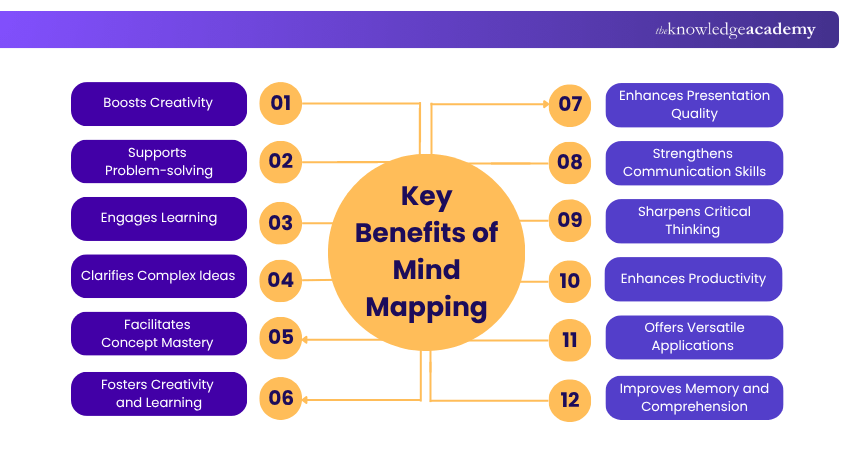
Mind Mapping is a powerful tool that boosts creativity and enhances problem-solving by visually organising ideas. It improves learning and memory, making information easier to understand and retain. Additionally, following a Mind Mapping Guide helps clarify complex concepts, sharpens critical thinking, and increases productivity by enabling users to prioritise tasks effectively.
Versatile and effective, it’s invaluable for brainstorming, project management, and communication. This makes it an essential technique for achieving goals efficiently in both personal and professional contexts.
1) Boosts Creativity
Mind Mapping enhances creativity by encouraging free-flowing thinking and idea exploration. Its visual structure helps connect different concepts, making it easier to discover new perspectives and innovative solutions.
Unlike traditional linear notes, Mind Maps support flexible thinking, allowing ideas to branch out naturally. This makes them highly effective for brainstorming, where the focus is on generating a wide range of ideas without limitations.

2) Supports Problem-solving
Mind Mapping supports problem-solving by helping you break complex issues into smaller, manageable parts. This visual structure makes it easier to understand relationships between ideas and identify patterns that may not be obvious at first.
By organising information clearly, it allows you to explore different solutions and evaluate them effectively. This structured yet flexible approach helps in making better decisions and finding practical, well-rounded solutions.
3) Engages Learning
Mind Mapping is an active learning technique that involves engaging with the material in a more meaningful way. Rather than passively reading or listening, Mind Mapping encourages you to process and organise information. This makes it easier to understand and retain.
This interactive approach to learning is particularly beneficial for students. It helps them to see the big picture while also focusing on important details. By using Mind Maps, learners can improve their comprehension and recall, leading to better academic performance.
4) Clarifies Complex Ideas
Mind Mapping helps simplify complex ideas by breaking them into smaller, easy-to-understand parts. Its visual layout organises information clearly, making it easier to see how different concepts are connected.
This structured approach improves understanding and helps you process information more effectively. It also makes it easier to explain complicated ideas to others in a clear and organised way.
Enhance your analytical and problem-solving skills with our Business Analyst Courses – Sign up today!
5) Facilitates Concept Mastery
Mind Mapping is a powerful tool for mastering new concepts. It visually organises information and allows you to see the relationships between different ideas, making it easier to understand and remember. This is useful in academic and professional settings, where mastering complex topics is often required. By using Mind Maps, you can deepen your knowledge about the subject matter and retain the information for longer periods.
6) Fosters Creativity and Learning
The combination of creativity and learning is one of the unique strengths of Mind Mapping. By engaging both the creative and analytical sides of the brain, Mind Mapping fosters a more holistic approach to learning. This dual engagement helps to reinforce the material, making it easier to recall and apply in different contexts.
7) Enhances Presentation Quality
Presentations are more impactful when they are clear, concise, and engaging. Mind Mapping helps to achieve this by allowing you to organise your thoughts and ideas in a logical sequence.
By visually outlining your presentation, you can ensure that your message is clear and that all relevant points are covered. This not only makes your presentation more effective but also helps to keep your audience engaged and interested.
8) Strengthens Communication Skills
Effective communication is important in both personal and professional settings. Mind Mapping helps to strengthen your communication skills by enabling you to organise your thoughts and ideas clearly before sharing them with others.
Whether you’re writing a report or giving a presentation, Mind Mapping helps you structure your message effectively. It also makes conversations clearer and easier to follow by organising your thoughts in a logical way. This leads to more effective communication and ensures that your ideas are conveyed accurately.
9) Sharpens Critical Thinking
Critical thinking involves analysing information, identifying patterns, and making informed decisions. Mind Mapping sharpens these skills by allowing you to visually organise and evaluate information. By mapping out your thoughts, you can see the connections between different ideas and identify any gaps or inconsistencies.
This helps you to think more critically and make better decisions. Whether you’re analysing data, solving a problem, or planning a project, Mind Mapping can enhance your critical thinking abilities.
10) Enhances Productivity
By organising your thoughts and ideas visually, you can work more efficiently and effectively. Mind Maps help you to prioritise tasks, set goals, and track progress, making it easier to stay focused and on track. This leads to increased productivity and ensures that you are making the most of your time and resources.
Whether you’re managing a project, writing a report, or planning your day, Mind Mapping can help you to work smarter, not harder.
Join our Business Process Mapping Training and learn how to visualise and improve workflows – Register now!
11) Offers Versatile Applications
One of the great Benefits of Mind Mapping is its versatility. Mind Maps can be used for various applications, from brainstorming and problem-solving to project management and planning.
Whether you’re working on a personal project or a professional task, Mind Mapping can be adapted to suit your needs. Its flexibility makes it an invaluable tool for anyone looking to improve their organisation, creativity, and productivity.
12) Improves Memory and Comprehension
Mind Mapping improves memory and understanding by involving various areas of the brain. The visual aspect of Mind Maps enhances the retention and retrieval of information, facilitating memory. Furthermore, when you structure information in a manner that is coherent to you, Mind Mapping enhances your comprehension of the content.
This is especially advantageous for students and professionals who require to remember vast quantities of information. Utilising Mind Maps can enhance memory and understanding, resulting in improved learning results.
Mind Map Examples for Students and Professionals
Mind Mapping can be used in many practical ways by both students and professionals to organise ideas, improve understanding, and plan effectively. It helps connect thoughts, support brainstorming, and make complex information easier to manage.
For Students: Students often use Mind Maps to simplify learning and improve memory. Common examples include:
1) Note-taking: Organising key points from lectures using keywords and visual branches
2) Essay Planning: Structuring ideas, arguments, and research for assignments
3) Revision Maps: Summarising topics for exams to improve recall
4) Brainstorming Projects: Generating ideas for presentations or group work
For Professionals: Professionals use Mind Maps to enhance productivity and decision-making. Examples include:
1) Project Planning: Breaking down tasks, timelines, and goals visually
2) Strategy Development: Mapping out business ideas and action plans
3) Meeting Notes: Capturing and organising discussions clearly
4) Problem-solving: Exploring solutions by connecting related ideas
These examples show how Mind Mapping works as a flexible tool for organising thoughts, improving communication, and supporting both academic and professional success.
Conclusion
Mind Mapping is a powerful tool with many benefits, including enhanced creativity, problem-solving, productivity, and memory. Whether you’re tackling a complex project at work or planning personal goals, this technique offers a clear, structured approach to managing information. By incorporating the Benefits of Mind Mapping into your routine, you’ll find yourself better equipped to handle challenges and seize opportunities with confidence.
Transform the way you think, organise, and create by joining our Mind Mapping Training. Enhance your creativity, problem-solving skills, and productivity today!
Frequently Asked Questions
What Are the Common Mistakes in Mind Mapping?

Common mistakes in Mind Mapping include adding too much information, using long sentences instead of keywords, and creating poorly structured maps. Focusing too much on design rather than content can also reduce clarity, making the map less effective for organising ideas.
What Are the Disadvantages of Using a Mind Map?
Mind Mapping can have some limitations, especially for beginners. It may feel overwhelming and messy if too many ideas are added without a clear structure. It can also be time-consuming and may not suit people who prefer linear notes. In some cases, tools or software can add extra cost.

William Brown


Senior Business Analyst and Strategic Advisor
William Brown is a senior business analyst with over 15 years of experience driving process improvement and strategic transformation in complex business environments. He specialises in analysing operations, gathering requirements and delivering insights that support effective decision making. William’s practical approach helps bridge the gap between business goals and technical solutions.
View Detail

 If you wish to make any changes to your course, please


