


 Top Rated Course

We may not have the course you’re looking for. If you enquire or give us a call on +918037244591 and speak to our training experts, we may still be able to help with your training requirements.
How Difficult is the PMI-PBA Exam in 2026? Explained in Detail
David Evans 30 April 2026Are you trying to build a career in Project Management? Read this blog on PMI-PBA Exam Difficulty to learn everything to gain your dream certification.

Training Outcomes Within Your Budget!
We ensure quality, budget-alignment, and timely delivery by our expert instructors.
Table of Contents
The PMI-PBA certification is a globally recognised credential that demonstrates a Business Analyst's proficiency in the field of business analysis. The certification is provided by the Project Management Institute (PMI), a leading professional association for Project Management professionals, the exam for PMI-PBA serves as a comprehensive assessment of a Business Analyst's knowledge, skills, and abilities. If you are an aspiring Business Analyst, it is necessary to know the details and the PMI-PBA Exam Difficulty level.
Business analysts can distinguish themselves in the competitive job market by earning the PMI-PBA certification. The certification showcases their commitment to professional development and dedication to staying updated with industry best practices.
Table of Contents
1) Examination details of PMI-PBA
2) PMI-PBA Exam Difficulty level
a) Exam topics
b) Real world application
c) Time management
d) Continuous updates
3) Conclusion
Examination Details of PMI-PBA
The Project Management Institute-Professional in Business Analysis (PMI-PBA) Exam, is a certification exam designed for Business Analysts. It is offered by PMI - a renowned professional association for Project Management professionals. The Benefits of PMI-PBA Certification Exam offer valuable insights into its impact on career growth. Let's look into various aspects of the exam for PMI-PBA.
Exam Format
The exam for PMI-PBA consists of multiple-choice questions that test the candidate's understanding of these topics. The questions assess the candidate's ability to apply business analysis concepts and techniques to real-world scenarios. The exam evaluates the candidate's knowledge of industry standards, best practices, and approaches to Business Analysis.

Eligibility
In order to qualify for the exam, PMI has established certain prerequisites that candidates must fulfil. These prerequisites entail a mixture of educational and professional experience in business analysis.
|
Eligibility criteria |
Description |
|
Educational requirements |
Secondary degree (high school diploma, associate's degree, or equivalent) OR Global equivalent (diploma, certificate, or degree from an accredited educational institution) |
|
Professional experience requirements |
Minimum 4,500 hours of business analysis experience within the past eight consecutive years and minimum 2,000 hours of participating in project teams within the past eight consecutive years. OR Minimum 7,500 hours of business analysis experience within the past eight consecutive years. |
|
General education or experience hours |
Minimum 35 contact hours of formal education in business analysis (e.g., workshops, training programs, or academic courses) |
Register for our PMP® Training Courses to improve your project management skills today!
PMI-PBA Exam Difficulty Level
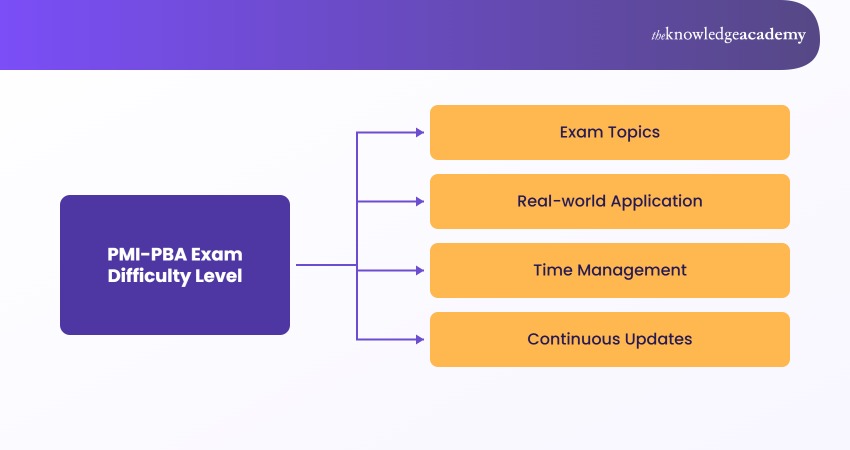
Passing PMI PBA Exam requires overcoming its well-known challenging nature. It demands a deep understanding of business analysis practices and the ability to apply them in real-world scenarios. However, with proper preparation and a structured study timetable, you can significantly improve your chances of success. Several factors contribute to the perceived difficulty of the exam, including:
1) Exam Topics
The exam content is based on the Examination Content Outline of PMI-PBA, which outlines the knowledge areas and tasks a Business Analyst should be familiar with. It covers various topics, including business analysis planning and monitoring, elicitation and collaboration, strategy analysis, and requirements analysis and design definition.
According to PMI, the exam covers certain domains which reflect the knowledge areas and tasks that business analysts need to be proficient in to fulfil their role successfully. The domains are as follows:
|
Domain |
Domain name |
Description |
|
Domain 1 |
Needs Assessment |
a) Identify business problems and opportunities b) Define project objectives and goals c) Conduct stakeholder analysis |
|
Domain 2 |
Analysis |
a) Develop a business analysis plan b) Identify and analyse business analysis activities and tasks c) Define requirements management processes |
|
Domain 3 |
Analysis |
a) Conduct requirements elicitation and analysis b) Identify and prioritise requirements c) Assess requirements feasibility and define solution scope |
|
Domain 4 |
Traceability and monitoring |
a) Establish and maintain requirements traceability b) Monitor requirements for changes and updates c) Manage requirements conflicts and issue |
|
Domain 5 |
Evaluation |
a) Evaluate solution performance and benefits b) Conduct post-implementation reviews c) Identify opportunities for improvement |
|
Domain 6 |
Tools and techniques |
a) Utilise business analysis tools and techniques b) Apply requirements management software c) Use modelling techniques for requirements visualisation |
|
Domain 7 |
Stakeholder engagement |
a) Identify and engage stakeholders b) Facilitate collaboration and communication c) Manage stakeholder expectations |
2) Real-world Application
The exam for PMI-PBA assesses candidates' ability to apply business analysis concepts and techniques to real-world scenarios. It goes beyond theoretical knowledge and requires candidates to demonstrate practical understanding through scenario-based questions. This aspect makes the exam challenging as candidates need to analyse complex situations, evaluate options, and make informed decisions within the context of business analysis.
3) Time Management
Time management is a significant challenge in the exam for PMI-PBA. Candidates must efficiently allocate their time across the questions, ensuring they have sufficient time to read and comprehend each scenario, analyse the options, and select the most appropriate answer.
Get the details on PMI-PBA vs PMP to choose the right path!
4) Continuous Updates
The field of business analysis is dynamic, with new methodologies, tools, and practices emerging regularly. The exam for PMI-PBA evolves to reflect these changes, ensuring that certified professionals stay current with the latest developments in the industry. Candidates must stay updated with the evolving field, study new concepts, and adapt their knowledge to meet the exam requirements.
Ready to progress in your business analysis career? Register in our PMI Professional In Business Analysis PMI PBA® Coursenow!
Conclusion
In conclusion, the PMI-PBA exam is a challenging yet rewarding certification for business analysts aiming to validate their expertise and advance their careers. The exam encompasses a broad range of knowledge areas and tasks, requiring candidates to grasp business analysis principles and practices. We hope we have helped you gain an understanding of the PMI-PBA Exam Difficulty level and the PMP Exam Changes.
Are you ready to elevate your Project Management career? Sign up for our PMP® Certification Training Course today!
Frequently Asked Questions
How Much Experience do you Need Before Taking the PMI-PBA Exam?

To be eligible for the PMI PBA exam, candidates typically need several years of professional business analysis experience, depending on their educational background. This requirement ensures you have hands on exposure to real world analysis practices before attempting the certification.Most candidates prepare for the PMI PBA exam over a period of three to six months, depending on their prior experience and familiarity with the exam domains. Consistent study and practical application are key to building confidence and exam readiness.
How Long Should You Study for the PMI-PBA Exam?
Most candidates prepare for the PMI PBA exam over a period of three to six months, depending on their prior experience and familiarity with the exam domains. Consistent study and practical application are key to building confidence and exam readiness.
What are the Other Resources and Offers Provided by The Knowledge Academy?
The Knowledge Academy takes global learning to new heights, offering over 3,000+ online courses across 490+ locations in 190+ countries. This expansive reach ensures accessibility and convenience for learners worldwide.
Alongside our diverse Online Course Catalogue, encompassing 17 major categories, we go the extra mile by providing a plethora of free educational Online Resources like Blogs, eBooks, Interview Questions and Videos. Tailoring learning experiences further, professionals can unlock greater value through a wide range of special discounts, seasonal deals, and Exclusive Offers.
What is The Knowledge Pass, and How Does it Work?
The Knowledge Academy’s Knowledge Pass, a prepaid voucher, adds another layer of flexibility, allowing course bookings over a 12-month period. Join us on a journey where education knows no bounds.
What are the Related Courses and Blogs Provided by The Knowledge Academy?
The Knowledge Academy offers various PMP® Courses, including the PMP® Certification Training, PMI Project Management Ready Training, and CAPM® Exam Prep Boot Camp Course. These courses cater to different skill levels, providing comprehensive insights into Portfolio Management.
Our Project Management Blogs cover a range of topics related to PMI-PBA Exam, offering valuable resources, best practices, and industry insights. Whether you are a beginner or looking to advance your Project Management skills, The Knowledge Academy's diverse courses and informative blogs have got you covered.

David Evans


Certified Project Trainer and Agile Delivery Expert
David Evans brings over a decade of hands-on experience in project delivery, Agile transformation, and team leadership. With a background in technology and business consulting, David has led cross-functional teams through Agile and Waterfall projects in both public and private sectors. He combines technical knowledge with practical insights to help readers navigate the challenges of modern project environments.

Upcoming Project Management Resources Batches & Dates
Date
 PMP® Certification Training Course
PMP® Certification Training Course
Mon 29th Jun 2026
PMP® Certification Training Course
Sat 4th Jul 2026, Sun 5th Jul 2026
PMP® Certification Training Course
Mon 6th Jul 2026
PMP® Certification Training Course
Mon 13th Jul 2026
PMP® Certification Training Course
Sat 18th Jul 2026, Sun 19th Jul 2026
PMP® Certification Training Course
Mon 20th Jul 2026
PMP® Certification Training Course
Mon 27th Jul 2026
PMP® Certification Training Course
Sat 1st Aug 2026, Sun 2nd Aug 2026
PMP® Certification Training Course
Mon 3rd Aug 2026
PMP® Certification Training Course
Mon 10th Aug 2026
PMP® Certification Training Course
Mon 17th Aug 2026
PMP® Certification Training Course
Sat 22nd Aug 2026, Sun 23rd Aug 2026
PMP® Certification Training Course
Mon 24th Aug 2026
PMP® Certification Training Course
Tue 1st Sep 2026
PMP® Certification Training Course
Sat 5th Sep 2026, Sun 6th Sep 2026
PMP® Certification Training Course
Mon 7th Sep 2026
PMP® Certification Training Course
Mon 14th Sep 2026
PMP® Certification Training Course
Sat 19th Sep 2026, Sun 20th Sep 2026
PMP® Certification Training Course
Mon 21st Sep 2026
PMP® Certification Training Course
Mon 28th Sep 2026
PMP® Certification Training Course
Sat 3rd Oct 2026, Sun 4th Oct 2026
PMP® Certification Training Course
Mon 5th Oct 2026
PMP® Certification Training Course
Mon 12th Oct 2026
PMP® Certification Training Course
Sat 17th Oct 2026, Sun 18th Oct 2026
PMP® Certification Training Course
Mon 19th Oct 2026
PMP® Certification Training Course
Mon 26th Oct 2026
PMP® Certification Training Course
Mon 2nd Nov 2026
PMP® Certification Training Course
Sat 7th Nov 2026, Sun 8th Nov 2026
PMP® Certification Training Course
Mon 9th Nov 2026
PMP® Certification Training Course
Mon 16th Nov 2026
PMP® Certification Training Course
Sat 21st Nov 2026, Sun 22nd Nov 2026
PMP® Certification Training Course
Mon 23rd Nov 2026
PMP® Certification Training Course
Mon 30th Nov 2026
PMP® Certification Training Course
Mon 7th Dec 2026
PMP® Certification Training Course
Sat 12th Dec 2026, Sun 13th Dec 2026
PMP® Certification Training Course
Mon 14th Dec 2026
PMP® Certification Training Course
Mon 21st Dec 2026

 If you wish to make any changes to your course, please


