
ISO 9001 Training

Online Instructor-led (1 days)

Classroom (1 days)

Online Self-paced (8 hours)

ISO 9001 Foundation Exam

ISO 9001 Foundation Course Outline

Module 1: Introduction  

  • Scope   
  • Normative References  
  • Terms and Definitions  

Module 2: Context of the Organisation  

  • Understanding the Organisation and Its Context   
  • Understanding the Needs and Expectations of Interested Parties   
  • Determining the Scope of the Quality Management System   
  • Quality Management System   

Module 3: Leadership  

  • Leadership and Commitment   
  • Quality Policy   
  • Roles, Responsibilities and Authorities   

Module 4: Planning  

  • Actions to Address Risks and Opportunities   
  • Quality Objectives and Planning to Achieve Them   
  • Planning of Changes   

Module 5: Support 

  • Resources   
  • Competence  
  • Awareness   
  • Communication   
  • Documented Information   

Module 6: Operation 

  • Operational Planning and Control   
  • Requirements for Products and Services   
  • Design and Development of Products and Services   
  • Control of Externally Provided Processes, Products and Services   
  • Production and Service Provision   
  • Release of Products and Services   
  • Control of Nonconforming Outputs   

Module 7: Performance Evaluation

  • Monitoring, Measurement, Analysis and Evaluation   
  • Internal Audit   
  • Management Review   

Module 8: Improvement  

  • Continual Improvement   
  • Nonconformity and Corrective Action 

Show moredown

Who should attend this ISO 9001 Foundation Training Course?

The ISO 9001 Foundation Training Course in India is suitable for individuals who are new to Quality Management Systems and ISO standards. This course is designed to provide a fundamental understanding of ISO 9001 principles and concepts. This ISO 9001 Certification Course can be beneficial to a wide range of professionals, including:

  • Quality Managers
  • Project Managers
  • Auditors
  • Business Analysts
  • HR Managers
  • Process Engineers
  • Compliance Officers

Prerequisites of the ISO 9001 Foundation Course

There are no formal prerequisites for this ISO 9001 Foundation Training Course. However, basic knowledge of Quality Management concepts and business processes can be beneficial for the delegates attending this ISO 9001 Certification Training.

ISO 9001 Foundation Course Overview

The ISO 9001 Foundation Course in India provides a fundamental understanding of ISO 9001, a globally recognized standard for Quality Management Systems (QMS). An ISO 9001 Certification is crucial for organizations seeking to enhance quality, customer satisfaction, and overall efficiency. This course serves as an indispensable introduction to ISO 9001, outlining its significance in ensuring compliance, quality assurance, and global competitiveness.

Proficiency in ISO 9001 Courses in India is essential for professionals across various industries, including Quality Managers, Auditors, Compliance Officers, and anyone involved in process improvement. ISO 9001 is a cornerstone for achieving consistent quality and customer satisfaction. Mastering this standard is a prerequisite for professionals aiming for organizational success.

This intensive 1-day ISO 9001 Foundation Course in India offers delegates a condensed yet thorough overview of the standard. Through interactive sessions, practical examples, and real-world case studies, delegates will gain a deep understanding of ISO 9001's principles, requirements, and implementation. By the end of the training, delegates will be well-prepared to support their organizations and drive improvements in quality management.

ISO 9001 Foundation Course Objectives

  • To learn the terminologies used in the Quality Management System (QMS)
  • To equip attendees with the knowledge to understand the framework and requirements of ISO 9001
  • To impart knowledge about the foundation for conducting or facilitating internal and external audits based on ISO 9001
  • To learn about Quality Management principles and benefits
  • To learn about the process, approach, and implementation
  • To implement the model and the process for classifying QMS

After completing this ISO 9001 Certification Course in India, delegates will possess a comprehensive understanding of the ISO 9001 Quality Management Systems, positioning them favorably for the ISO 9001 Certification. They will be able to assess, improve, and maintain a robust Quality Management System, ensuring compliance, customer satisfaction, and business excellence.

Show moredown

What’s Included in this ISO 9001 Foundation Course?

  • ISO 9001 Foundation Examination
  • World-Class Training Sessions from Experienced Instructors
  • ISO 9001 Foundation Certificate
  • Digital Delegate Pack

Show moredown

ISO 9001 Foundation Exam Information

To achieve the ISO 9001 Foundation, candidates will need to sit for an examination. The exam format is as follows: 

  • Question Type: Multiple Choice 
  • Total Questions: 30 
  • Total Marks: 30 Marks 
  • Pass Mark: 50%, or 15/30 Marks 
  • Duration: 40 Minutes  
  • Open Book/ Closed Book: Closed Book

Show moredown

Online Instructor-led (5 days)

Classroom (5 days)

Online Self-paced (40 hours)

ISO 9001 Lead Auditor Exam

ISO 9001 Lead Auditor Training Course Outline 

Module 1: Introduction 

  • Scope
  • Normative References
  • Terms and Definitions

Module 2: Context of the Organisation

  • Understanding the Organisation and Its Context
  • Understanding the Needs and Expectations of Interested Parties
  • Determining the Scope of the Quality Management System
  • Quality Management System

Module 3: Leadership

  • Leadership and Commitment
  • Quality Policy
  • Roles, Responsibilities and Authorities

Module 4: Planning

  • Actions to Address Risks and Opportunities
  • Quality Objectives and Planning to Achieve Them
  • Planning of Changes

Module 5: Support

  • Resources
  • Competence
  • Awareness
  • Communication
  • Documented Information

Module 6: Operation

  • Operational Planning and Control
  • Requirements for Products and Services
  • Design and Development of Products and Services
  • Control of Externally Provided Processes, Products and Services
  • Production and Service Provision
  • Release of Products and Services
  • Control of Nonconforming Outputs

Module 7: Performance Evaluation

  • Monitoring, Measurement, Analysis and Evaluation
  • Internal Audit
  • Management Review

Module 8: Improvement

  • Continual Improvement
  • Nonconformity and Corrective Action

Module 9: Fundamentals of Quality Management System Auditing

  • Purpose and Objectives of QMS Auditing
  • First-Party, Second-Party and Third-Party Audits
  • Quality Management System Audit Concepts
  • Role of Auditing in QMS Effectiveness

Module 10: Principles of Auditing

  • Integrity and Professional Conduct
  • Fair Presentation
  • Due Professional Care
  • Confidentiality and Independence

Module 11: Evidence-Based Auditing

  • Evidence-Based Audit Approach
  • Objective Evidence and Audit Evidence
  • Verification and Corroboration of Evidence
  • Sufficiency and Appropriateness of Audit Evidence

Module 12: Risk-Based Auditing

  • Risk-Based Audit Thinking
  • Identifying Audit Risks and Opportunities
  • Determining Audit Priorities
  • Integrating Risk Considerations into Audit Activities

Module 13: Audit Programme Management

  • Establishing Audit Programme Objectives
  • Determining Audit Programme Scope
  • Audit Programme Resources and Responsibilities
  • Monitoring and Reviewing the Audit Programme

Module 14: Audit Programme Planning

  • Determining Audit Frequency and Priorities
  • Considering Process Importance
  • Considering Previous Audit Results
  • Addressing Changes Affecting the Audit Programme

Module 15: Auditor Competence

  • Auditor Knowledge and Skills
  • QMS and Audit Competence
  • Maintaining Auditor Competence
  • Evaluating Auditor Performance

Module 16: Lead Auditor Responsibilities

  • Responsibilities of the Lead Auditor
  • Managing Audit Team Activities
  • Coordinating Audit Team Communication
  • Maintaining Objectivity and Impartiality

Module 17: Audit Team Selection and Management

  • Selecting Appropriate Auditors
  • Assigning Audit Responsibilities
  • Managing Auditor Independence
  • Coordinating Multi-Auditor Activities

Module 18: Audit Initiation

  • Establishing Initial Contact with the Auditee
  • Determining Audit Feasibility
  • Confirming Audit Objectives, Scope and Criteria
  • Establishing Audit Arrangements

Module 19: Audit Preparation

  • Reviewing Relevant QMS Information
  • Developing the Audit Plan
  • Preparing Audit Working Documents
  • Allocating Time and Audit Responsibilities

Module 20: Audit Objectives, Scope and Criteria

  • Establishing Audit Objectives
  • Defining Audit Scope and Boundaries
  • Determining Audit Criteria
  • Establishing Audit Evidence Requirements

Module 21: Opening the Audit

  • Purpose of the Opening Meeting
  • Confirming Audit Arrangements
  • Introducing the Audit Team and Responsibilities
  • Establishing Communication and Reporting Arrangements

Module 22: Conducting the Audit

  • Collecting Audit Evidence
  • Interviewing Relevant Personnel
  • Observing Processes and Activities
  • Reviewing Relevant Documented Information

Module 23: Process-Based Auditing

  • Understanding the Process Approach
  • Auditing Process Inputs and Outputs
  • Evaluating Process Sequence and Interaction
  • Assessing Process Performance and Controls

Module 24: Auditing Organisational Context and Leadership

  • Auditing Organisational Context
  • Auditing Interested Party Requirements
  • Auditing QMS Scope
  • Auditing Leadership and Quality Policy

Module 25: Auditing Planning and Support

  • Auditing Risks and Opportunities
  • Auditing Quality Objectives and Planning
  • Auditing Resources and Competence
  • Auditing Awareness, Communication and Documented Information

Module 26: Auditing Operational Processes

  • Auditing Operational Planning and Control
  • Auditing Customer and Product or Service Requirements
  • Auditing Design and Development
  • Auditing External Provider Controls

Module 27: Auditing Performance and Improvement

  • Auditing Monitoring, Measurement, Analysis and Evaluation
  • Auditing Customer Satisfaction
  • Auditing Internal Audit and Management Review
  • Auditing Continual Improvement and Corrective Action

Module 28: Audit Findings and Nonconformities

  • Identifying Conformity and Nonconformity
  • Evaluating Audit Findings Against Audit Criteria
  • Recording Objective Evidence
  • Formulating Clear and Defensible Findings

Show moredown

Who Should Attend This ISO 9001 Lead Auditor Course?

This ISO 9001 Lead Auditor Training is suitable for professionals who want to strengthen their knowledge of Quality Management System auditing and audit leadership. It is particularly relevant to professionals responsible for quality and organisational improvement, such as:

  • Quality Managers
  • Quality Assurance Managers
  • Internal Auditors
  • Lead Auditors
  • Compliance Managers
  • Quality Management Professionals
  • Process Improvement Managers
  • Audit Programme Managers

Prerequisites for the ISO 9001 Lead Auditor Course

There are no formal prerequisites to attend this course. However, prior knowledge of Quality Management Systems, ISO 9001 requirements, or auditing principles would be beneficial for delegates.

ISO 9001 Lead Auditor Course Overview

ISO 9001 Lead Auditor Training covers QMS requirements, auditing principles, audit programmes, evidence-based and risk-based auditing, and lead auditor responsibilities. It also explores audit preparation, process-based auditing, nonconformities, and audit findings.

Delegates develop skills in planning audits, evaluating evidence, assessing processes, coordinating audit teams, and documenting findings. They also strengthen their ability to apply risk-based thinking, maintain objectivity, and manage audits systematically.

This 5-Day course by The Knowledge Academy helps delegates build the capability required to lead Quality Management System audits effectively. They will be better equipped to evaluate conformity, manage audit teams, and communicate clear and defensible audit findings.

ISO 9001 Lead Auditor Training Course Objectives

  • To explain the key requirements and principles of ISO 9001
  • To apply auditing principles when planning and conducting QMS audits
  • To evaluate objective evidence and identify conformity and nonconformity
  • To plan and manage audit programmes using risk-based approaches
  • To lead audit teams and coordinate audit activities effectively
  • To assess organisational processes and formulate clear audit findings

Learning Outcomes of this ISO 9001 Lead Auditor Course

Upon completing this training, delegates will be able to plan, conduct, and manage quality management system audits using structured auditing approaches. They will also be better equipped to lead audit teams, evaluate objective evidence, assess process effectiveness, identify nonconformities, and communicate clear audit findings.

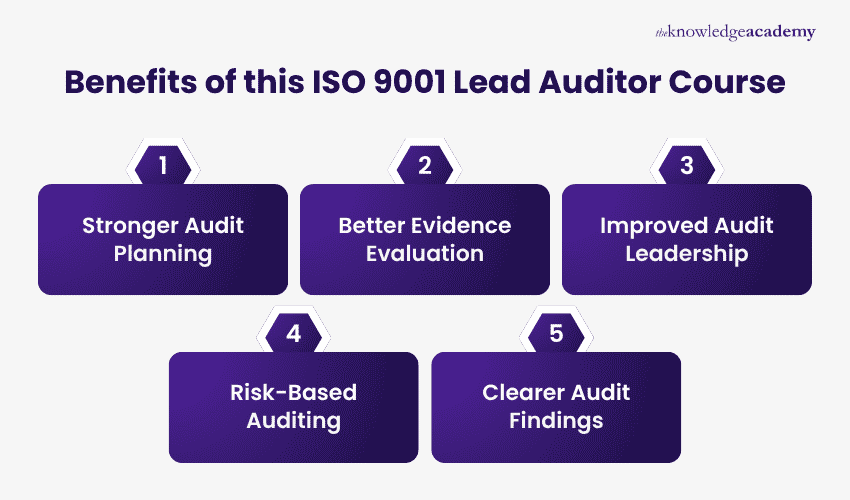
Benefits of this ISO 9001 Lead Auditor Course

This course helps delegates strengthen practical audit leadership, evidence evaluation, and Quality Management System assessment skills. Key benefits include:

ISO 9001 Lead Auditor Training benefits

  • Stronger Audit Planning: Structure audit objectives, scope, criteria, resources, and responsibilities effectively.
  • Better Evidence Evaluation: Assess objective evidence accurately to support reliable audit conclusions.
  • Improved Audit Leadership: Coordinate audit teams, assign responsibilities, and maintain objectivity throughout audits.
  • Risk-Based Auditing: Prioritise audit activities using risks, opportunities, process importance, and previous results.
  • Clearer Audit Findings: Identify conformity and nonconformity and communicate findings clearly and defensibly.

Show moredown

What’s Included in this ISO 9001 Lead Auditor Course?

  • ISO 9001 Lead Auditor Examination
  • World-Class Training Sessions from Experienced Instructors
  • ISO 9001 Lead Auditor Certificate
  • Digital Delegate Pack

Show moredown

ISO 9001 Lead Auditor Exam Information

This ISO 9001 Lead Auditor Exam assesses delegates’ understanding of Quality Management System auditing and lead auditor responsibilities. To achieve the ISO 9001 Lead Auditor Certification, delegates are required to successfully complete the examination. The format is as follows:

  • Question Type: Multiple Choice 
  • Total Questions: 30 
  • Total Marks: 30 Marks 
  • Pass Mark: 50%, or 15/30 Marks 
  • Duration: 40 Minutes
  • Open Book/ Closed Book: Closed Book

Show moredown

Online Instructor-led (2 days)

Classroom (2 days)

Online Self-paced (16 hours)

ISO 9001 Internal Auditor Exam

ISO 9001 Internal Auditor Training Course Outline

Module 1: Introduction

  • Scope
  • Normative References
  • Terms and Definitions

Module 2: Context of the Organisation

  • Understanding the Organisation and Its Context
  • Understanding the Needs and Expectations of Interested Parties
  • Determining the Scope of the Quality Management System
  • Quality Management System

Module 3: Leadership

  • Leadership and Commitment
  • Quality Policy
  • Roles, Responsibilities and Authorities

Module 4: Planning

  • Actions to Address Risks and Opportunities
  • Quality Objectives and Planning to Achieve Them
  • Planning of Changes

Module 5: Support

  • Resources
  • Competence
  • Awareness
  • Communication
  • Documented Information

Module 6: Operation

  • Operational Planning and Control
  • Requirements for Products and Services
  • Design and Development of Products and Services
  • Control of Externally Provided Processes, Products and Services
  • Production and Service Provision
  • Release of Products and Services
  • Control of Nonconforming Outputs

Module 7: Performance Evaluation

  • Monitoring, Measurement, Analysis and Evaluation
  • Internal Audit
  • Management Review

Module 8: Improvement

  • Continual Improvement
  • Nonconformity and Corrective Action

Module 9: Fundamentals of Quality Management System Auditing

  • Purpose and Objectives of QMS Auditing
  • First-Party, Second-Party and Third-Party Audits
  • Quality Management System Audit Concepts
  • Role of Auditing in QMS Effectiveness

Module 10: Principles of Auditing

  • Integrity and Professional Conduct
  • Fair Presentation
  • Due Professional Care
  • Confidentiality and Independence

Module 11: Evidence-Based Auditing

  • Evidence-Based Audit Approach
  • Objective Evidence and Audit Evidence
  • Verification and Corroboration of Evidence
  • Sufficiency and Appropriateness of Audit Evidence

Module 12: Risk-Based Auditing

  • Risk-Based Audit Thinking
  • Identifying Audit Risks and Opportunities
  • Determining Audit Priorities
  • Integrating Risk Considerations into Audit Activities

Module 13: Audit Programme Management

  • Establishing Audit Programme Objectives
  • Determining Audit Programme Scope
  • Audit Programme Resources and Responsibilities
  • Monitoring and Reviewing the Audit Programme

Show moredown

Who Should Attend this ISO 9001 Internal Auditor Training?

This ISO 9001 Internal Auditor Training is suitable for professionals involved in quality, compliance, auditing, and process improvement activities. It is particularly relevant to those responsible for reviewing Quality Management System processes and supporting internal audit activities, including:

  • Internal Auditors
  • Quality Officers
  • Quality Assurance Professionals
  • Compliance Officers
  • Quality Coordinators
  • Process Improvement Professionals
  • Operations Managers
  • Quality Management Professionals

Prerequisites for the ISO 9001 Internal Auditor Training

There are no formal prerequisites to attend this ISO 9001 Internal Auditor Training. However, a basic understanding of Quality Management Systems, ISO 9001 requirements, or organisational processes would be beneficial for delegates.

ISO 9001 Internal Auditor Training Overview

ISO 9001 Internal Auditor Training develops knowledge of Quality Management System requirements and the principles used when conducting internal audits. It covers audit fundamentals, auditing principles, evidence-based and risk-based auditing, and audit programme management.

Delegates will develop skills in evaluating audit evidence, applying audit principles, identifying risks, and reviewing organisational processes. They will also understand how audit programmes are structured and how findings support quality management activities.

This 2-Day course offered by The Knowledge Academy helps delegates conduct internal Quality Management System audits more effectively. They will be better equipped to assess evidence, identify audit priorities, and support improvements within organisational processes.

ISO 9001 Internal Auditor Training Course Objectives

  • To explain the key requirements and principles of ISO 9001
  • To identify the purpose and objectives of Quality Management System auditing
  • To apply auditing principles when evaluating organisational processes
  • To assess objective evidence using evidence-based auditing approaches
  • To identify audit risks and determine appropriate audit priorities
  • To understand audit programme objectives, scope, resources, and responsibilities

Learning Outcomes of this ISO 9001 Internal Auditor Training

Upon completing this ISO 9001 Internal Auditor Training, delegates will be able to support structured internal Quality Management System audits and evaluate relevant audit evidence. They will also be better equipped to apply risk-based thinking, identify audit priorities, assess QMS effectiveness, and contribute to continual improvement.

Show moredown

What’s Included in this ISO 9001 Internal Auditor Training?

  • ISO 9001 Internal Auditor Examination
  • World-Class Training Sessions from Experienced Instructors
  • ISO 9001 Internal Auditor Certificate
  • Digital Delegate Pack

Show moredown

ISO 9001 Internal Auditor Exam Information

To achieve the ISO 9001 Internal Auditor, candidates will need to sit for an examination. The exam format is as follows: 

  • Question Type: Multiple Choice 
  • Total Questions: 30 
  • Total Marks: 30 Marks 
  • Pass Mark: 50%, or 15/30 Marks 
  • Duration: 40 Minutes 
  • Open Book/ Closed Book: Closed Book

Show moredown

Online Instructor-led (3 days)

Classroom (3 days)

Online Self-paced (24 hours)

ISO 9001 Lead Implementer Exam

ISO 9001 Lead Implementer Training Course Outline

Module 1: Introduction

  • Scope
  • Normative References
  • Terms and Definitions

Module 2: Context of the Organisation

  • Understanding the Organisation and Its Context
  • Understanding the Needs and Expectations of Interested Parties
  • Determining the Scope of the Quality Management System
  • Quality Management System

Module 3: Leadership

  • Leadership and Commitment
  • Quality Policy
  • Roles, Responsibilities and Authorities

Module 4: Planning

  • Actions to Address Risks and Opportunities
  • Quality Objectives and Planning to Achieve Them
  • Planning of Changes

Module 5: Support

  • Resources
  • Competence
  • Awareness
  • Communication
  • Documented Information

Module 6: Operation

  • Operational Planning and Control
  • Requirements for Products and Services
  • Design and Development of Products and Services
  • Control of Externally Provided Processes, Products and Services
  • Production and Service Provision
  • Release of Products and Services
  • Control of Nonconforming Outputs

Module 7: Performance Evaluation

  • Monitoring, Measurement, Analysis and Evaluation
  • Internal Audit
  • Management Review

Module 8: Improvement

  • Continual Improvement
  • Nonconformity and Corrective Action

Module 9: Fundamentals of Quality Management System Auditing

  • Purpose and Objectives of QMS Auditing
  • First-Party, Second-Party and Third-Party Audits
  • Quality Management System Audit Concepts
  • Role of Auditing in QMS Effectiveness

Module 10: Principles of Auditing

  • Integrity and Professional Conduct
  • Fair Presentation
  • Due Professional Care
  • Confidentiality and Independence

Module 11: Evidence-Based Auditing

  • Evidence-Based Audit Approach
  • Objective Evidence and Audit Evidence
  • Verification and Corroboration of Evidence
  • Sufficiency and Appropriateness of Audit Evidence

Module 12: Risk-Based Auditing

  • Risk-Based Audit Thinking
  • Identifying Audit Risks and Opportunities
  • Determining Audit Priorities
  • Integrating Risk Considerations into Audit Activities

Module 13: Audit Programme Management

  • Establishing Audit Programme Objectives
  • Determining Audit Programme Scope
  • Audit Programme Resources and Responsibilities
  • Monitoring and Reviewing the Audit Programme

Module 14: Audit Programme Planning

  • Determining Audit Frequency and Priorities
  • Considering Process Importance
  • Considering Previous Audit Results
  • Addressing Changes Affecting the Audit Programme

Module 15: Auditor Competence

  • Auditor Knowledge and Skills
  • QMS and Audit Competence
  • Maintaining Auditor Competence
  • Evaluating Auditor Performance

Module 16: Lead Auditor Responsibilities

  • Responsibilities of the Lead Auditor
  • Managing Audit Team Activities
  • Coordinating Audit Team Communication
  • Maintaining Objectivity and Impartiality

Module 17: Audit Team Selection and Management

  • Selecting Appropriate Auditors
  • Assigning Audit Responsibilities
  • Managing Auditor Independence
  • Coordinating Multi-Auditor Activities

Module 18: Audit Initiation

  • Establishing Initial Contact with the Auditee
  • Determining Audit Feasibility
  • Confirming Audit Objectives, Scope and Criteria
  • Establishing Audit Arrangements

Module 19: Audit Preparation

  • Reviewing Relevant QMS Information
  • Developing the Audit Plan
  • Preparing Audit Working Documents
  • Allocating Time and Audit Responsibilities

Show moredown

Who Should Attend this ISO 9001 Lead Implementer Training?

This ISO 9001 Lead Implementer Training is suitable for professionals involved in quality management, auditing, compliance, and organisational improvement. It is particularly relevant to professionals responsible for supporting Quality Management System activities, including:

  • Quality Managers
  • Quality Assurance Managers
  • Compliance Managers
  • Internal Auditors
  • Quality Management Professionals
  • Process Improvement Managers
  • Audit Programme Managers
  • Operations Managers

Prerequisites for the ISO 9001 Lead Implementer Training

There are no formal prerequisites to attend this ISO 9001 Lead Implementer Training. However, prior knowledge of Quality Management Systems and ISO 9001 standards would be beneficial for delegates.

ISO 9001 Lead Implementer Training Overview

ISO 9001 Lead Implementer Training develops advanced knowledge of Quality Management System requirements and related auditing principles. It covers organisational context, leadership, planning, operations, evidence-based and risk-based auditing, audit programme management, and audit preparation.

Delegates will develop skills in evaluating audit evidence, identifying risks, establishing audit priorities, and understanding audit programme responsibilities. They will also gain knowledge of auditor competence, team coordination, audit initiation, and planning activities.

This 3-Day course offered by The Knowledge Academy helps delegates strengthen their understanding of ISO 9001 and Quality Management System activities. They will be better equipped to evaluate QMS requirements, support audit planning, assess evidence, and contribute to effective quality management practices.

ISO 9001 Lead Implementer Training Course Objectives

  • To explain the key requirements and principles of ISO 9001
  • To evaluate Quality Management System processes and audit evidence
  • To apply evidence-based and risk-based auditing principles
  • To plan audit programmes and determine suitable audit priorities
  • To understand auditor competence, responsibilities, and team coordination
  • To prepare audit activities by defining objectives, scope, criteria, and resources

Learning Outcomes of this ISO 9001 Lead Implementer Training

Upon completing this ISO 9001 Lead Implementer Training, delegates will understand key Quality Management System requirements and structured auditing approaches. They will also be able to evaluate audit evidence, identify audit risks, understand audit programme responsibilities, and support effective audit initiation and preparation activities.

Show moredown

What’s Included in this ISO 9001 Lead Implementer Training?

  • ISO 9001 Lead Implementer Examination
  • World-Class Training Sessions from Experienced Instructors
  • ISO 9001 Lead Implementer Certificate
  • Digital Delegate Pack

Show moredown

ISO 9001 Lead Implementer Exam Information 

To achieve the ISO 9001 Lead Implementer, candidates will need to sit for an examination. The exam format is as follows: 

  • Question Type: Multiple Choice 
  • Total Questions: 30 
  • Total Marks: 30 Marks 
  • Pass Mark: 50%, or 15/30 Marks 
  • Duration: 40 Minutes  
  • Open Book/ Closed Book: Closed Book

Show moredown

Not sure which course to choose?

Speak to a training expert for advice if you are unsure of what course is right for you. Give us a call on +918037244591 or Enquire.

What is ISO 9001?

ISO 9001 is a globally recognised standard for Quality Management Systems (QMS) that helps organisations establish consistent processes and meet applicable requirements. It focuses on improving quality management practices, operational effectiveness, and customer satisfaction.

The ISO 9001 Training by The Knowledge Academy helps professionals understand Quality Management System principles and their practical application. It develops knowledge that supports QMS implementation, auditing, documentation, performance evaluation, and continual improvement.

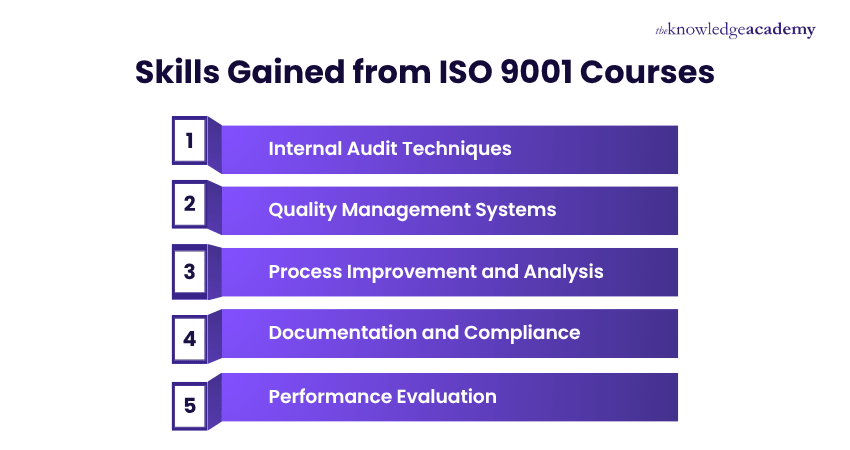
Skills Gained from ISO 9001 Training Courses

Skills Acquired from ISO 9001 Courses

Our ISO 9001 Courses help professionals develop practical knowledge for supporting, implementing, and evaluating Quality Management Systems. Key skills developed through the training include:

  • Internal Audit Techniques: Develop knowledge of planning, conducting, documenting, and supporting structured Quality Management System audits.
  • Quality Management Systems: Understand how QMS requirements support consistent processes, quality objectives, and organisational performance.
  • Process Improvement and Analysis: Develop the ability to evaluate processes, identify improvement opportunities, and support continual improvement.
  • Documentation and Compliance: Understand how documented information supports Quality Management System requirements and consistent organisational practices.
  • Performance Evaluation: Learn how monitoring, measurement, audits, and management reviews support QMS performance and improvement.

How does ISO 9001 Training Support Your Career and QMS Goals?

Our ISO 9001 Courses support professionals in building quality management knowledge that can strengthen career development and contribute to organisational QMS objectives. Key areas supported through the training include:

  • Career Development: Build relevant quality management knowledge that supports progression into quality, compliance, auditing, and operational roles.
  • QMS Contribution: Develop the understanding needed to support Quality Management System activities across different organisational functions.
  • Professional Confidence: Strengthen knowledge of ISO 9001 principles, requirements, and quality practices for greater confidence in quality-focused responsibilities.
  • Process Improvement: Build the ability to contribute to process consistency, continual improvement, and better organisational performance.
  • Quality Responsibilities: Develop knowledge that supports auditing, compliance, monitoring, and other quality management responsibilities.
  • Organisational Goals: Apply ISO 9001 knowledge to support quality objectives, customer satisfaction, and continual improvement initiatives.
Show more blue-arrow

Package deals for ISO 9001 Training

Our training experts have compiled a range of course packages on a variety of categories in ISO 9001 Training, to boost your career. The packages consist of the best possible qualifications with ISO 9001 Training, and allows you to purchase multiple courses at a discounted rate.

Swipe for more. Don’t miss out!

ISO 9001 Training FAQs

ISO 9001 Course proves that an organization meets international standards for quality management. It shows a commitment to consistent service, customer satisfaction, and continual improvement through a structured Quality Management System (QMS).
ISO 9001 Training helps professionals understand how to implement, audit, and maintain a QMS. It supports ISO 9001 Courses by improving quality control, increasing efficiency, reducing risks, and enhancing customer trust across various industries.
There are no formal requirements for ISO 9001 Courses. However, having a basic understanding of business processes and quality concepts can make it easier to follow the ISO 9001 Courses and apply the knowledge effectively.
To achieve recognition, your organization must implement a compliant Quality Management System and pass both Stage 1 and Stage 2 external audits conducted by an authorized body.
ISO 9001 Training helps organizations meet quality standards, gain customer confidence, and improve operations. It’s widely recognized and required in tenders, partnerships, and international markets as proof of quality assurance.
No formal prerequisites are required for most ISO 9001 Courses. However, familiarity with quality processes or ISO terminology can be helpful for better understanding the course material and real-world applications.
Each ISO 9001 Course includes instructor-led Training, a digital learning pack, practical exercises, and an exam. Depending on the course level, it may also include auditing techniques, QMS implementation methods, and exam tips.
ISO 9001 Courses duration depends on the course type. Foundation takes 1 day, Internal Auditor takes 2 days, Lead Implementer takes 3 days, and Lead Auditor training lasts for 5 days.
Yes, each ISO 9001 Course includes a final exam with multiple-choice questions. You need to score at least 50% to pass and receive your certificate of completion, which validates your skills.
ISO 9001 Courses cover quality principles, ISO clauses, internal auditing, risk management, QMS implementation, and compliance techniques. Advanced courses also include audit planning, reporting, and exam preparation.
Yes, we offer self-paced ISO 9001 Courses that allow delegates to access content anytime. This flexible learning model suits working professionals who want to study at their own convenience.
Start by reviewing ISO 9001 Standards, identifying quality gaps, and training your team through ISO 9001 Courses. Then, develop a QMS, conduct internal audits, and schedule a final audit with an authorized body.
Yes, we provide 24/7 support for all ISO 9001 Courses. Delegates can access help for technical issues, course content, or exam-related queries anytime during their training journey.
After completing ISO 9001 Courses, you can pursue roles such as Quality Manager, Internal Auditor, Compliance Officer, or QMS Consultant. These roles are in demand across industries like manufacturing, IT, healthcare, and logistics.
Yes, small businesses benefit greatly from ISO 9001 Courses by improving their processes, gaining customer trust, and meeting compliance needs. Training helps them build a strong QMS without needing large teams or budgets.
Start with ISO 9001 Courses to understand the standard. Assess your organization's current processes, build a QMS, perform internal audits, and correct issues before the final audit is scheduled.
ISO 9001 Certification must be renewed every three years. Surveillance audits are conducted annually, and a full re-evaluation is required in the third year to maintain compliance with the standard.
If you face access issues, contact our support team through email or live chat. We ensure that the ISO 9001 Course materials and portals are accessible throughout your learning duration.
Yes, upon passing the exam, you will receive an official certificate that confirms your understanding of quality management practices and your ability to apply them in real organizational settings.
ISO 9001 Courses teach a formal standard with specific requirements for QMS. Total Quality Management is a broader philosophy focused on continuous improvement without the structured audit and review process of ISO 9001.
The Knowledge Academy stands out as a prestigious training provider known for its extensive course offerings, expert instructors, adaptable learning formats, and industry recognition. It's a dependable option for those seeking this Certification.

The Knowledge Academy is one of the Leading global training provider for ISO 9001 Training.

The training fees for ISO 9001 Training in India starts from INR39995

Show more down

Why we're the go to training provider for you

icon

Best price in the industry

You won't find better value in the marketplace. If you do find a lower price, we will beat it.

icon

Trusted & Approved

Recognised by leading certification bodies, we deliver training you can trust.

icon

Many delivery methods

Flexible delivery methods are available depending on your learning style.

icon

High quality resources

Resources are included for a comprehensive learning experience.

barclays Logo
deloitte Logo
Thames Water Logo

"Really good course and well organised. Trainer was great with a sense of humour - his experience allowed a free flowing course, structured to help you gain as much information & relevant experience whilst helping prepare you for the exam"

Joshua Davies, Thames Water

santander logo
bmw Logo
Google Logo
cross

Exclusive Deals For Future Leaders!

friday-sale UP TO 60% OFF!

* WHO WILL BE FUNDING THE COURSE?

close

close

Thank you for your enquiry!

One of our training experts will be in touch shortly to go over your training requirements.

close

close

Press esc to close

close close

Back to course information

Thank you for your enquiry!

One of our training experts will be in touch shortly to go overy your training requirements.

close close

Thank you for your enquiry!

One of our training experts will be in touch shortly to go over your training requirements.