


 Top Rated Course

We may not have the course you’re looking for. If you enquire or give us a call on +33 805638382 and speak to our training experts, we may still be able to help with your training requirements.
Top 8 Organisational Behaviour Theories: A Complete Overview
William Brown 28 April 2026This comprehensive blog delves into the world of Organisational Behaviour. From the classic Scientific Management Theory to the modern X & Y Management Theory, these Organisational Behaviour Theories shape workplace dynamics. Continue reading this blog to understand how these frameworks drive organisational success.

Training Outcomes Within Your Budget!
We ensure quality, budget-alignment, and timely delivery by our expert instructors.
Table of Contents
Get ready to explore the world of Organisational Behaviour Theories through our blog! This is where we simplify the complex ideas behind how people behave at work, making it directly relevant to your daily work. We’ll also look at different leadership styles and how companies balance having rules and allowing creativity. This blog will help you understand the hidden forces that shape our workdays.
Table of Contents
1) What is Organisational Behaviour?
2) Organisational Behaviour Theories
a) Scientific Management Theory
b) Bureaucracy Theory
c) Hybrid Organisation Theory
d) Informal Organisational Theory
e) Five bases of Power Theory
f) Human Relations Management Theory
g) Process Management Theory
h) X & Y Management Theory
3) Importance of Organisational Behaviour Theories
4) Conclusion
What is Organisational Behaviour?
Organisational Behaviour is an interdisciplinary field of psychology, sociology, and anthropology. Its primary focus is to understand how individuals and groups behave within the context of an organisation.
This field examines human behaviour in the workplace, group dynamics, and the overall organisational structure. By analysing behaviour from various perspectives, including individual actions, group interactions, and structural influences, Organisational Behaviour seeks to enhance our understanding of how organisations function. The Features of Organisational Behaviour are key to unlocking the complexities of workplace interactions.

Organisational Behaviour Theories
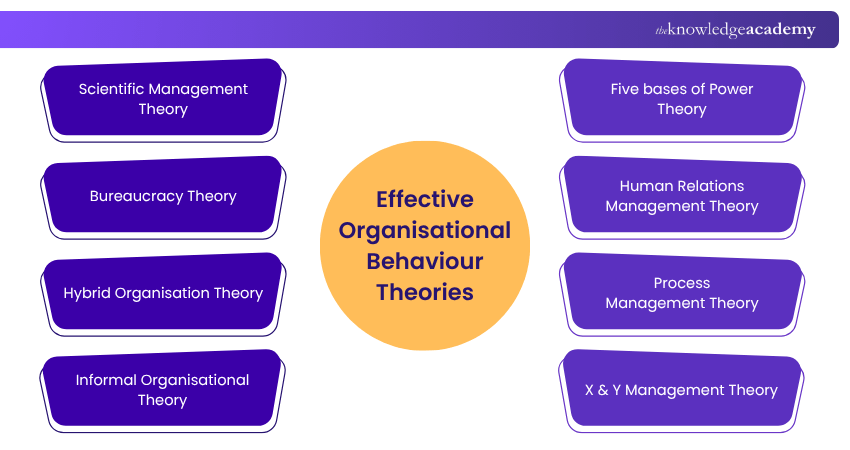
Organisational Behaviour Theories play a crucial role in guiding real-time evaluation and effective management of individuals within the workplace. Managers and human resources professionals benefit significantly from studying these theories, which provide valuable insights into employee behaviour, motivation, and performance. One such factor is Micromanagement, which can influence employee performance. Among the most influential and effective Organisational Behaviour Theories are: Among the most influential and effective Organisational Behaviour Theories are:
1) Scientific Management Theory
In 1909, Frederick Winslow Taylor published research that challenged the prevailing belief that encouraging people to work as hard as possible was the most effective way to boost productivity and optimise human resources. Instead, Taylor proposed a different approach.
His revolutionary idea was to break jobs down into simple tasks and promote collaboration between managers and workers. This was a departure from the norm at the time, where factory managers and employees had minimal interaction. Without standardisation, workers were primarily motivated by monetary incentives, leading them to work only as much as required.
Taylor advocated for rewarding workers based on their productivity levels, a concept that continues to influence management practices today. Over time, his theories transformed the professional landscape, fostering closer relationships between employees and managers. Managers now recognise the value of rewarding high-quality performance.
Taylor’s four key principles for business leaders include matching workers to tasks based on their capabilities and monitoring worker performance to guide them in working efficiently. His ideas have left a lasting impact on Organisational Behaviour and Management practices.
2) Bureaucracy Theory
In organisational settings, it’s evident that certain individuals wield more influence than others. Hierarchies exist, and people either strive to ascend the corporate ladder or are content with their current status. The Bureaucracy Theory centres around the concept of authority within an organisation. Three primary types of authority characterise organisational structures:
a) Charismatic authority: This power stems from a leader’s unique appeal or personal magnetism. Charismatic leaders inspire followers through their vision, personality, and ability to motivate.
b) Legal authority: Legal authority is conferred upon an individual based on their official position or rank within the organisational hierarchy. It derives from formal rules, regulations, and job descriptions.
c) Traditional authority: This arises from long-standing customs, beliefs, or historical traditions. Over time, people accept the legitimacy of this authority system, reinforcing its power.
3) Hybrid Organisation Theory
A hybrid organisation is a unique blend of social mission and commercial goals. Unlike traditional for-profit companies prioritising profit maximisation, hybrid organisations seek to create a positive social impact while remaining financially sustainable.
These organisations operate at the intersection of business and social purpose. Key characteristics of Hybrid Organisation Theory include:
a) Dual objectives: Hybrid organisations recognise that financial success and social impact are not mutually exclusive.
b) Social mission: These organisations are driven by a clear social or environmental purpose.
c) Innovative business models: Hybrids often adopt innovative business models that integrate social impact into their core operations.
d) Measuring impact: Hybrid organisations track financial performance (profits, revenue) and social impact (number of lives improved, environmental footprint).
4) Informal Organisational Theory
Have you observed how people naturally form connections within a workplace? Perhaps you work in payroll but have become friends with someone from marketing, who, in turn, knows someone in the legal department. Before you know it, you’re all sharing lunch.
Informal Organisational Theory acknowledges these hidden networks within formal company structures. These informal groupings can significantly influence performance—either positively or negatively.
5) Five bases of Power Theory
In Organisational Behaviour, power isn’t solely tied to titles—it thrives within relationships. To identify influential figures in your organisation, consider French and Raven’s Five bases Of Power Theory:
a) Legitimate power: Those with legitimate power hold official titles, such as team leaders, managers, or executives. Their authority stems from their position within the hierarchy.
b) Reward power: Individuals wield this power by rewarding others for meeting expectations. Whether through bonuses, promotions, or recognition, they motivate performance.
c) Expert power: Subject Matter Experts (SMEs) possess specialised knowledge and skills. Their expertise makes them go-to resources for problem-solving and learning. If you're interested in advancing your career, learning How to Become a Subject Matter Expert can elevate your professional value
d) Referent power: Derived from relational skills, referent power belongs to well-liked and respected individuals. They bridge gaps, foster collaboration, and build trust.
e) Coercive power: Coercive power arises from emotional manipulation, often through punishment. Those who wield it can influence behaviour through fear or consequences.
Elevate your skills with the BCS Certificate in Business Analysis Practice Course: Mastering business insight for success!
6) Human Relations Management Theory
These studies explored how social interactions between employees and managers impact business success. Key insights from the research include:
a) Personal investment: Companies benefit when they invest in their employees as individuals, recognising their humanity beyond mere productivity. Treating employees with care and respect fosters loyalty and commitment.
b) Rewards and recognition: Rewarding employees for their successes and skills enhances performance. Recognition, incentives, and a supportive work environment contribute to overall effectiveness.
c) Positive group dynamics: Team dynamics significantly influence morale. A cohesive, collaborative atmosphere promotes productivity and job satisfaction.
7) Process Management Theory
Henri Fayol, a French Mining Engineer turned Management Theorist, pioneered Process Management Theory, also known as “Administrative Theory.” Unlike earlier theories that emphasised worker efficiency, Fayol shifted the focus to the overall organisation and structure of work tasks. Let’s explore some key points about Process Management Theory:
a) Top-down approach: Fayol advocated a top-down approach to enhance organisational efficiency and decision-making. Effective management should guide the entire process.
b) Work groups and departments: Fayol proposed creating distinct work groups and departments, each responsible for unique activities. This division of labour streamlines operations.
c) Correlation with productivity: Fayol believed that well-organised management directly correlates with workers’ productivity. A smoothly functioning organisation leads to better outcomes.
8) X & Y Management Theory
Working in the 1950s and 1960s, Douglas McGregor developed the X&Y Management Theory. According to this theory, all managers and supervisors can be categorised into two distinct groups:
Theory X Managers:
a) Perception: These managers view employees negatively, believing they need external pressure to work hard. They tend to micromanage and closely monitor tasks.
b) Assumptions: Employees lack intrinsic motivation and must be controlled through strict supervision and discipline.
c) Approach: Theory X Managers emphasise compliance and often rely on carrot-and-stick methods.
Theory Y Managers:
a) Beliefs: Theory Y Managers hold a positive view of employees. They believe that individuals are inherently motivated to work.
b) Approach: These managers focus on empowering employees. They provide development opportunities, trust employees to handle tasks independently, and foster a collaborative work environment.
c) Team culture: Theory Y Managers create welcoming workplaces encouraging cohesion, cooperation, and mutual respect.
McGregor’s conclusion:
McGregor argued that Theory Y Managers achieve better results. Organisations can enhance morale, productivity, and profitability by combining a positive team environment with personalised growth opportunities.
Want to Improve Your Team Dynamics? Dive into the various Approaches of Organisational Behaviour today!
Importance of Organisational Behaviour Theories
For managers, grasping the elements of Organisational Behaviour has never been more crucial. These theories underpin a company’s competitiveness and success. Beyond economic compensation, employees consider various factors when deciding to stay, making it essential for companies to understand these variables.
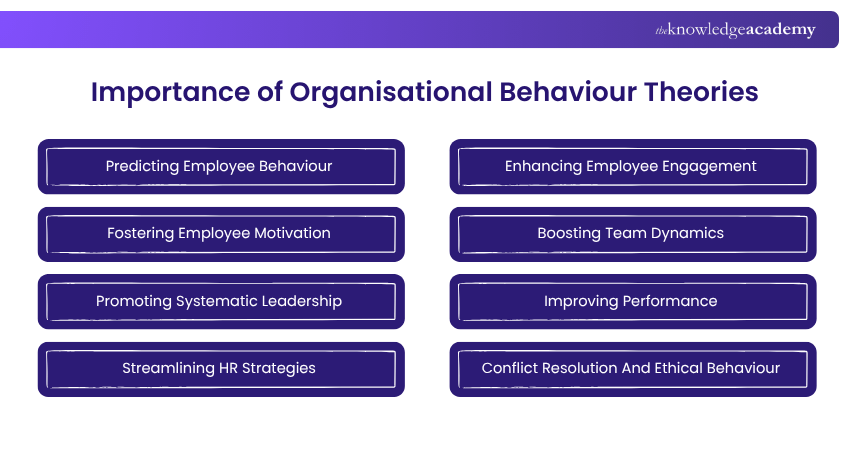
Here are the key reasons why Organisational Behaviour Theories matter in understanding and managing human behaviour within organisations:
Predicting employee behaviour
These theories help managers anticipate how individuals and groups behave within the organisation. Informed decisions, setting expectations, and scenario planning rely on understanding employee behaviour.
Fostering employee motivation
Managers can create supportive work environments by comprehending employee needs and applying motivational theories. Addressing these needs inspires higher engagement, commitment, and performance.
Promoting systematic leadership
Organisational Behaviour replaces guesswork with evidence-based study and research. Informed decision-making and effective leadership result from this systematic approach. Leadership in Organisational Behaviour plays a key role in applying these principles, guiding teams and fostering an environment of strategic decision-making.
Streamlining HR strategies
Insights from Organisational Behaviour Theories guide HR professionals. Tailoring recruitment, retention, and talent development efforts optimise workforce management.
Enhancing employee engagement
These theories provide tools to boost job satisfaction and engagement. Engaged employees are more productive and committed.
Boosting team dynamics
Understanding team dynamics enables effective teamwork. Managers can build and lead high-performing teams based on this knowledge.
Improving performance
Organisational Behaviour Theories identify factors hindering success. Addressing these leads to better corporate performance.
Conflict resolution and ethical behaviour
Underztanding conflict dynamics and ethical decision-making fosters a harmonious work environment.
In summary, Organisational Behaviour Theories empower managers to create thriving workplaces, enhance productivity, and uphold ethical standards.
Launch your career with confidence: BCS Foundation Certificate in Business Analysis Course - Your path to professional excellence!
Conclusion
Organisational Behaviour Theories serve as guiding lights for effective management. Organisations can create thriving workplaces by understanding human behaviour, fostering motivation, and promoting positive team dynamics. These theories empower leaders to make informed decisions, enhance productivity, and uphold ethical standards. As we navigate the ever-evolving corporate landscape, embracing Organisational Behaviour principles remains essential for success. If you're aiming for a leadership role, reviewing Subject Matter Expert Interview Questions can help you be prepared to demonstrate how you can apply these principles to manage teams effectively.
Embrace change with confidence: BCS Foundation Certificate in Business Change Course - Your catalyst for transformation!
Frequently Asked Questions
Why should managers study Organisational Behaviour Theories?

Managers benefit from understanding these theories because they predict employee behaviour, foster motivation, and guide decision-making. By applying these insights, managers can create positive work environments and enhance organisational performance.
How do Organisational Behaviour Theories impact HR strategies?
Organisational Behaviour Theories influence HR practices by providing insights into employee motivation, job satisfaction, and team dynamics. Tailoring HR strategies based on these theories optimises recruitment, retention, and talent development efforts.
What are the other resources and offers provided by The Knowledge Academy?
The Knowledge Academy takes global learning to new heights, offering over 3,000+ online courses across 490+ locations in 190+ countries. This expansive reach ensures accessibility and convenience for learners worldwide.
Alongside our diverse Online Course Catalogue, encompassing 19 major categories, we go the extra mile by providing a plethora of free educational Online Resources like Blogs, eBooks, Interview Questions and Videos. Tailoring learning experiences further, professionals can unlock greater value through a wide range of special discounts, seasonal deals, and Exclusive Offers.
What is the Knowledge Pass, and how does it work?
The Knowledge Academy’s Knowledge Pass, a prepaid voucher, adds another layer of flexibility, allowing course bookings over a 12-month period. Join us on a journey where education knows no bounds.
What are related Courses and blogs provided by The Knowledge Academy?
The Knowledge Academy offers various Business Analysis Courses, including BCS Foundation Certificate in Organisational Behaviour Course, BCS Practitioner Certificate in Requirements Engineering Course and BCS Certificate in Business Analysis Practice Course. These courses cater to different skill levels, providing comprehensive insights into Business Environment Analysis.
Our Business Analysis Blogs cover a range of topics offering valuable resources, best practices, and industry insights. Whether you are a beginner or looking to advance your skills, The Knowledge Academy's diverse courses and informative blogs have you covered.

William Brown


Senior Business Analyst and Strategic Advisor
William Brown is a senior business analyst with over 15 years of experience driving process improvement and strategic transformation in complex business environments. He specialises in analysing operations, gathering requirements and delivering insights that support effective decision making. William’s practical approach helps bridge the gap between business goals and technical solutions.
View Detail
Upcoming Business Analysis Resources Batches & Dates
Date
 BCS Foundation Certificate in Organisational Behaviour
BCS Foundation Certificate in Organisational Behaviour
Thu 23rd Jul 2026
BCS Foundation Certificate in Organisational Behaviour
Thu 17th Sep 2026
BCS Foundation Certificate in Organisational Behaviour
Thu 19th Nov 2026

 If you wish to make any changes to your course, please


