




We may not have the course you’re looking for. If you enquire or give us a call on 01344203999 and speak to our training experts, we may still be able to help with your training requirements.
Key Features of Organisational Behaviour: A Comprehensive Guide
ByNaveena VenkatesanLast updated on: 10 October 2026
Join us on a journey through the world of Organisational Behaviour (OB) and discover its impact on organisational effectiveness. We'll explore the essential features of organisational behaviour and how they shape the way organisations function. Let’s dive deeper and learn more about it!
What’s Inside This Blog
1. Explore the key features that shape organisational behaviour.2. Learn how psychology, sociology and other disciplines contribute to understanding workplace behaviour.3. Understand how OB examines behaviour at individual, team and organisational levels.4. Discover the role of research, systems thinking and adaptability in understanding workplace challenges.5. See how OB helps organisations address employee needs, improve management practices and achieve goals.
Some offices feel like a Monday morning, even on a Friday. Others somehow make a Monday feel exciting.
Same working hours. Similar job roles. Completely different atmosphere.
What creates this difference? It's not just the furniture, free coffee or colourful walls. It's the way people communicate, lead, collaborate and respond to challenges. Organisational behaviour examines these workplace dynamics, helping us understand the features that influence employee experiences and organisational performance. Let's explore its key features and discover how they shape the modern workplace!
Key Features of Organisational Behaviour
Organisational Behaviour (OB) has several key features that help explain how individuals and groups think, act and interact within a workplace. These features highlight the influence of human behaviour, organisational structure, leadership and workplace environments on overall performance.
Understanding them helps organisations improve teamwork, manage challenges and create a more productive working environment. Let's explore the key features of organisational behaviour:
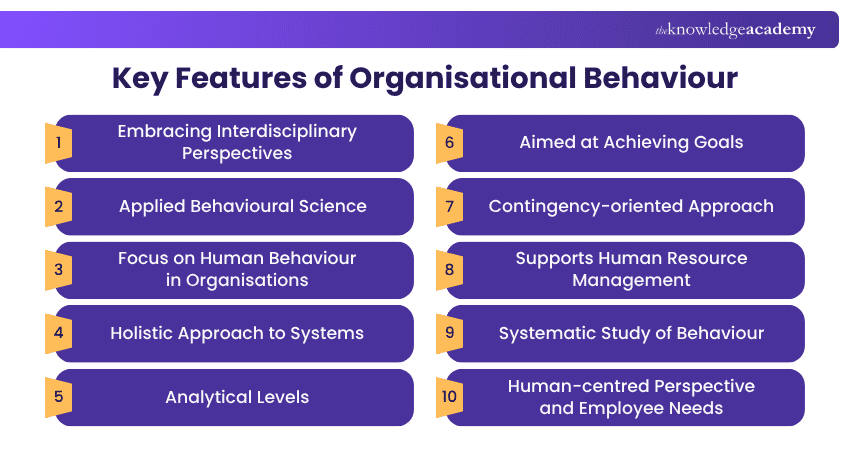
1) Embracing Interdisciplinary Perspectives
Organisational behaviour draws on insights from psychology, sociology, anthropology, and management to offer a comprehensive understanding of organisational dynamics. By integrating knowledge from diverse fields, OB provides holistic insights into how individuals, groups, and structures interact within organisations, facilitating informed decision-making and effective management practices.

2) Applied Behavioural Science
While its interdisciplinary nature explains where OB draws its knowledge from, its applied nature focuses on using that knowledge to address real workplace situations. OB applies behavioural theories and research to understand workplace challenges and improve organisational effectiveness.
3) Focus on Human Behaviour in Organisations
OB focuses on understanding how individuals and groups behave within organisational settings. It examines factors such as motivation, attitudes, perception, communication, leadership and group dynamics to understand how human behaviour influences workplace interactions and organisational outcomes.
4) Holistic Approach to Systems
Organisational behaviour views an organisation as a complete system where people, teams, processes and structures are interconnected. It examines how these elements influence one another and how changes in one area can affect the organisation as a whole. This holistic approach helps managers understand workplace challenges, improve coordination and make decisions that support overall organisational effectiveness.
5) Analytical Levels
OB analyses behaviour on a variety of levels, including the individual, group, and organisational levels. This enables specific measures and strategic decisions to promote desired results by enabling an in-depth knowledge of how elements at each level affect organisational performance.
Organisational Behaviour in Action
Imagine a team experiencing declining performance. At the individual level, motivation or workload may be contributing factors. At the group level, communication or conflict may be involved. At the organisational level, culture, structure or policies may influence the situation.
6) Aimed at Achieving Goals
OB helps organisations understand and manage workplace behaviour while supporting organisational goals and effectiveness. By aligning individual and organisational goals, OB can help direct efforts towards common objectives, driving organisational success and sustainability.
7) Contingency-oriented Approach
OB recognises that there is no single approach that works effectively in every organisational situation. Behaviour and management practices can vary depending on factors such as people, tasks, organisational culture and the working environment.
8) Supports Human Resource Management
OB provides useful insights for Human Resource Management (HRM), particularly in understanding employee behaviour, motivation, and performance. By understanding these dynamics, HR professionals can develop strategies to attract, retain, and develop talent, enhancing organisational effectiveness and competitiveness.
9) Systematic Study of Behaviour
OB uses systematic study and behavioural research to understand workplace behaviour and organisational processes. This evidence-informed approach helps managers analyse workplace situations and make more informed decisions rather than relying solely on intuition.
Trainer’s Insight
Organisational behaviour becomes most useful when insights lead to action. If engagement or performance declines, consider individual motivation, team dynamics and organisational factors before deciding on a solution.
10) Human-centred Perspective and Employee Needs
OB emphasises understanding employees' needs, behaviour, motivation and well-being in the workplace. By creating supportive working conditions and opportunities for growth, organisations can encourage employee satisfaction, engagement and performance.
This perspective also recognises the importance of employee well-being, job satisfaction and a supportive work environment. By considering employees' experiences and concerns, organisations can identify workplace issues and develop practices that better support their workforce.
Applying Organisational Behaviour in the Workplace
Before responding to a workplace behaviour issue, consider:
1. Have individual, group and organisational factors been examined?2. Is the decision supported by evidence rather than assumptions?3. Have employee needs and perspectives been considered?4. Does the approach fit the specific organisational context?5. Will the action support both people and organisational objectives?
Master key skills to confidently support and deliver successful business transformations with the Business Analysis Courses – Join now!

Naveena Venkatesan is a Content Editor with 2+ years of experience in content writing, editing and linguistic quality assurance. Her research, fact-checking and editorial experience enable her to develop accurate, accessible resources across Business Skills, Human Resources, and Accounting and Finance.
View Detail

 If you wish to make any changes to your course, please


