


 Top Rated Course

We may not have the course you’re looking for. If you enquire or give us a call on +44 1344 203999 and speak to our training experts, we may still be able to help with your training requirements.
Decision Making Skills: A Complete Guide for Professionals
The Knowledge Academy 05 March 2026Decision Making Skills support better choices by combining critical thinking, data analysis, emotional intelligence, and problem-solving in work and life. These skills are essential for professionals who need to evaluate information, solve complex problems, and take confident actions during uncertain situations.

Training Outcomes Within Your Budget!
We ensure quality, budget-alignment, and timely delivery by our expert instructors.
Table of Contents

Professionals face daily choices that shape their work, performance, and career growth. They need to be involved in a variety of tasks, from handling tight deadlines to solving complex problems. This is where cultivating strong Decision Making Skills is crucial since it helps to weigh options carefully and take actions that lead to better outcomes.
Professionals require clear thinking, sound judgement, and the ability to act with purpose in today’s fast-paced work environment. This is why developing effective Decision Making Skills is important to help you respond to challenges, reduce uncertainty, and make choices that support long-term success. In this blog, you will learn the key skills related to Decision Making, its types, process, and more.
Table of Contents
1) What are Decision Making Skills?
2) Types of Decision Making Skills
3) The Decision Making Process
4) How to Improve Decision Making Skills?
5) How to Demonstrate Decision Making Skills in an Interview?
6) Conclusion
What are Decision Making Skills?
Decision Making Skills are the abilities used to choose the best course of action from several alternatives in any situation. These skills involve critical thinking, problem-solving, analysis, and evaluation. Effective Decision Making requires understanding a situation, considering potential outcomes, weighing the risks and benefits, and confidently choosing the best solution.
Good Decision Makers can assess situations, avoid biases, and often use logical reasoning to reach conclusions that lead to positive results in both personal and professional contexts. These skills are crucial for leadership, management, and everyday life, helping individuals navigate complex situations with clarity and effectiveness, especially in supervisor decision-making.

Types of Decision Making Skills
Not every individual is equipped with all types of skills. These abilities can differ across Decision Makers. Let's discuss them in detail:
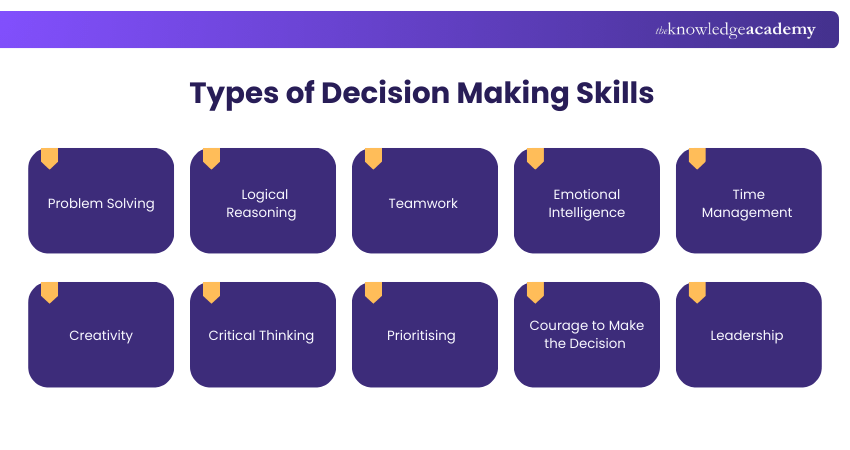
1) Problem Solving
Problem Solving is finding solutions to difficult or complex issues. It involves understanding the problem, brainstorming possible solutions, and choosing the best one. Good problem solving skills help you make effective decisions and overcome challenges. Practising them regularly improves your ability to handle unexpected situations.
2) Logical Reasoning
When it comes to Decision Making Skills, it’s necessary to review all pros and cons of the decision before taking any action on it. This skill is called reasoning. It is always suggested to reason with the present and the plan for the future while going through Decision Making Process. All available and relevant facts and data should be considered. So, the main motive of reasoning is to break down the options.
3) Teamwork
Team leaders need to engage their employees while making business decisions. Employees can express criticism of their ideas or devise new ideas that will enhance their Decision Making Skills. Consider an example of a marketing team led by a team leader, where they can exchange ideas to boost their sales revenue. They can also collaboratively work with other employees in the decision making process to convince them to buy into their decisions.
4) Emotional Intelligence
Emotional Intelligence is another key facet of Decision Making Skills. It makes people aware of their emotions and the ability to put them in a way that encourages action. Emotions lay the groundwork for inspiration regarding any action to be taken. The way you analyse problems is going to determine how well-informed you are when making the final decision.
5) Time Management
Time management is the ability to use your time efficiently and effectively. It involves planning, setting goals, and prioritising tasks to make the best use of your available time. Good time management skills help you meet deadlines and reduce stress. Practising time management regularly can improve your productivity and decision making abilities.
Learn how to think clearly and solve problems effectively with our Practical Thinking Course now!
6) Creativity
Creative minds can certainly improve their Decision Making Skills. Creativity should be used to get the full benefits of logical and emotional thinking and to reach a unique solution. Creativity is also a skill that can be acquired. Exchanging ideas with each other can enhance this skill to come up with short and long-term solutions.
You can use the interactions that you have with other people to enhance your creativity. But for this, it’s necessary that everyone’s voice is heard. This is why regular meetings, brainstorming sessions and conversations are suggested to maximise the level of creativity.
7) Critical Thinking
Critical thinking is the ability to analyse information and make a reasoned judgment. It involves evaluating evidence, recognising biases, and considering different perspectives. Good critical thinking skills help you make more informed and effective decisions. Regularly practising thinking can improve your problem-solving abilities and decision making process.
8) Prioritising
Prioritising is deciding which tasks or issues are most important and need attention first. It helps you manage your time and resources effectively. Good prioritising skills ensure that important tasks are completed on time. Practising regular prioritising can improve your productivity and decision making efficiency.
9) Courage to Make the Decision
Courage to make the decision means being brave enough to make choices, even when they are difficult or uncertain. It involves trusting your judgment and accepting the consequences of your decisions. Having courage in Decision Making helps you take decisive action and move forward. Building this courage over time can lead to better and more confident Decision Making.
10) Leadership
Leadership is the ability to guide, motivate, and inspire others towards achieving common goals. It involves making decisions that benefit the team and organisation. Good Leadership skills include effective communication, empathy, and the ability to delegate tasks. Practising leadership can enhance your decision-making abilities and help you manage teams more effectively.
Master the strategies to lead high-performing teams for exceptional success with our High-Performing Teams Training – join now!
The Decision-Making Process
Effective decisions follow a structured process that helps professionals understand the problem, evaluate options, and take action with confidence. Let's look at the key steps in the process below:
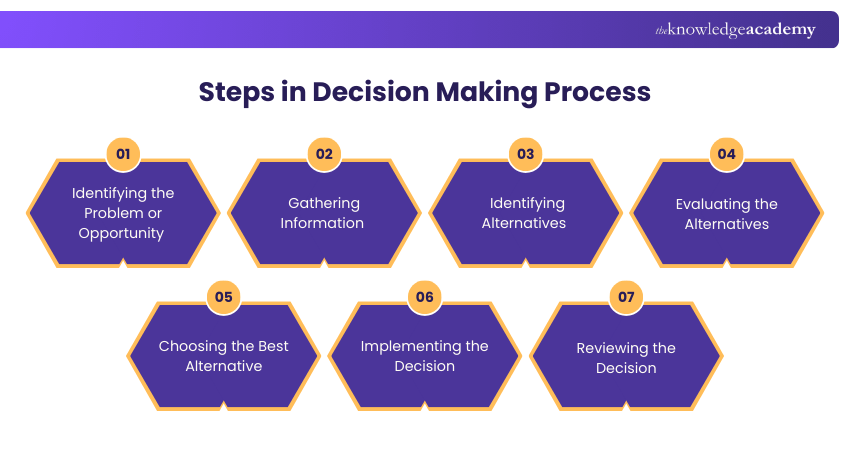
1) Identifying the Problem or Opportunity
Begin the process by clearly defining the problem or situation that requires a decision. When the issue is properly understood, finding the right solution becomes much easier. You can ask questions such as:
a) What problem needs to be solved?
b) What goal should this decision achieve?
c) How will success be measured?
These questions will help you gain clarity on the purpose of the decision and guide you towards possible solutions. A clearly defined problem leads to a more effective Decision Making.
2) Gathering Information
Strong decisions are based on accurate and complete information. Gather data that will help you understand the issues better. From here, consider both external and internal sources for gathering accurate and thorough information.
Look for past experiences, historical data, and previous attempts to solve a similar problem. Also, collect insights through market research, expert advice, or discussions with professionals. The more relevant information you have, the better prepared you will be for deciding.
3) Identifying Alternatives
Avoid choosing the first solution that comes to mind. Instead, explore multiple possible options. Different teams, stakeholders, or departments may have different needs. This is why considering alternatives ensures a more balanced decision.
Generating a range of solutions enables you to compare choices. This will help you select the decision that suits the objectives and constraints of the situation or problem. It leads to improved flexibility and increases the chance of finding the most impactful solution.
4) Evaluating the Alternatives
After identifying possible solutions, evaluate each alternative carefully. Compare how well each alternative solves the problem and supports your goals. You can use common methods to assess options, such as:
a) Creating a pros and cons list.
b) Conduct a Strengths Weaknesses Opportunities Threats (SWOT) Analysis.
c) Using a decision matrix.
These tools will help you analyse benefits, risks, and overall impact. This makes it easier to narrow down your choices. They also provide a structured way to compare options and support evidence-based decisions.
5) Choosing the Best Alternative
Now it is time to make the final decision. Consider the information gathered, the analysis conducted, and the impact on stakeholders. Sometimes the best solution may not be a single option but a combination of ideas.
Effective decision-making often requires creativity and flexible thinking. Avoid limiting yourself to fixed choices and focus on solutions that deliver the greatest overall benefit.
6) Implementing the Decision
After a decision is made, put it into action. Create a clear implementation plan and involve everyone to help them understand their roles and responsibilities. Monitor progress closely to ensure the decision is producing the expected results.
Once the plan is in motion, maintain clear communication and address any challenges that might arise along the way. Also, regular check-ins and progress reviews help to ensure that the implementation is on track.
7) Reviewing the Decision
After implementation, evaluate the outcome. Compare the results with the set criteria for success. You can ask questions, such as:
a) Did the decision solve the original problem?
b) What was the overall impact on the team or organisation?
c) Who benefited, and who may have been affected negatively?
Reviewing the outcomes helps to learn from experience. If the decision did not deliver the desired results, adjustments can be made. Also, continuous evaluation and improvement improve future Decision Making and adapting to changing situations.
Elevate your Leadership skills to lead with confidence and empower your team with our Leadership Skills Training - sign up now!
How to Improve Decision Making Skills?
Improving Decision Making Skills can significantly enhance both personal and professional life. Here are some effective strategies:
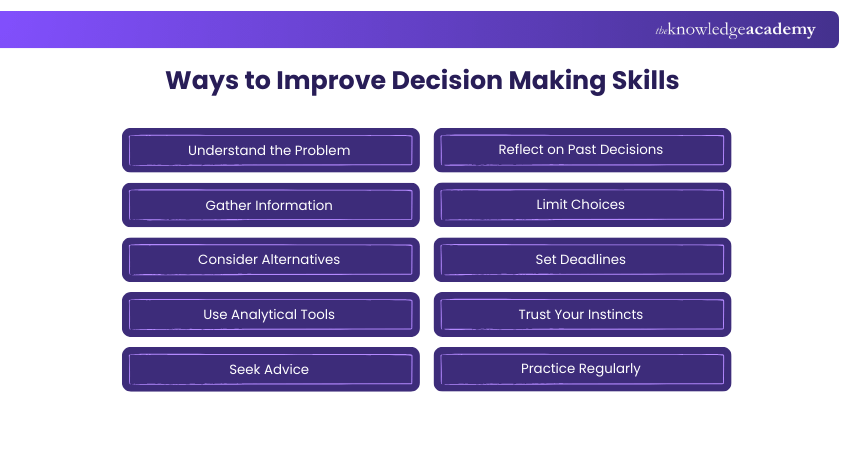
a) Understand the Problem: Clearly defining the problem helps in identifying the core issue. Breaking it down into parts can make it manageable. This clarity is crucial for effective decision making.
b) Gather Information: Collecting relevant data provides a solid foundation for your decision. It helps in understanding the context and potential outcomes. The more informed you are, the better your decisions will be.
c) Consider Alternatives: Identifying different options broadens your perspective. Evaluating the pros and cons of alternative helps in making a more informed choice. This step ensures you don’t overlook any potential solutions.
d) Use Analytical Tools: Techniques like SWOT analysis, along with other decision-making techniques, can systematically evaluate options. Decision matrices help in comparing different choices based on specific criteria. These tools provide a structured approach to decision-making.
e) Seek Advice: Asking for input from others can provide new insights. People with experience or expertise can offer valuable perspectives. This approach can lead to better decisions.
f) Reflect on Past Decisions: Analysing previous decisions helps in understanding what worked and what didn’t. This reflection provides valuable insights for future decisions. Learning from past experiences is key to improvement.
g) Limit Choices: Too many options can lead to decision paralysis. Narrowing down your choices to a manageable number simplifies the process. This focus helps in making quicker and more confident decisions.
h) Set Deadlines: Establishing a timeframe for making the decision helps in avoiding procrastination. Deadlines keep the process moving and ensure timely decisions. This discipline is crucial for effective decision making.
i) Trust Your Instincts: Sometimes, your gut feeling can guide you, especially when you have experience in the area. Intuition is a powerful tool in decision making. Trusting yourself can lead to confident and effective choices.
j) Practice Regularly: Like any skill, decision making improves with practice. Starting with smaller decisions and gradually taking on more complex ones builds confidence. Regular practice helps in honing your decision making abilities.
Transform your business strategies with cutting-edge innovation techniques in this Business Model Innovation Training – register now!
How to Demonstrate Decision-Making Skills in an Interview?
Demonstrating Decision Making Skills in an interview is crucial for showcasing your ability to handle complex situations effectively. Here are some tips to help you:
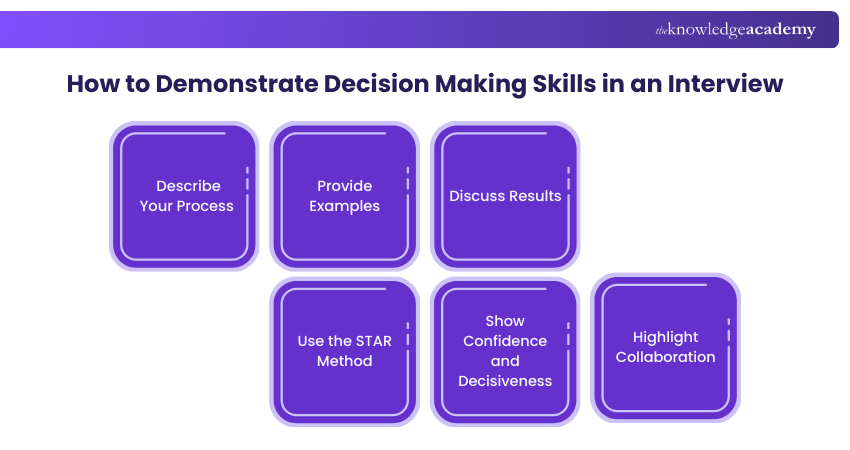
a) Describe Your Process: Explain the steps you take when making decisions. Mention how you gather information, evaluate options, and consider potential outcomes. This shows that you have a structured approach to decision making.
b) Provide Examples: Use decision-making examples from your past experiences to illustrate your Decision Making Skills. Describe a situation where you had to make a tough decision, the process you followed, and the outcome. This helps the interviewer see your skills in action.
c) Discuss Results: Highlight the positive results of your decisions. Whether it was solving a problem, improving efficiency, or achieving a goal, discussing the outcomes demonstrates the effectiveness of your decision making.
d) Use the STAR Method: Structure your answers using the Situation, Task, Action, Result (STAR) method. This helps in providing clear responses that are easy for the interviewer to follow.
e) Show Confidence and Decisiveness: Be confident in your responses and show that you can make decisions under pressure. Employers look for candidates who can handle uncertainty and make informed choices.
f) Highlight Collaboration: Mention how you involve others in the decision making process. This shows that you value teamwork and can leverage different perspectives to make better decisions.
Learn how to make important decisions effectively with our Decision Making Course. Join now!
Conclusion
Strong choices help to shape successful careers, effective teams, and thriving organisations. This is why developing Decision Making Skills is essential for helping professionals think clearly, act confidently, and respond wisely to challenges. With the right approach and practice, decision-making becomes a powerful skill that drives long-term growth and success.
Take the next step in developing your Leadership skills by registering for our Leadership Courses now!
Frequently Asked Questions
How Does Decision Making Influence Job Opportunities and Career Advancement?

Effective decision making enhances job opportunities and career advancement. It demonstrates problem-solving abilities, Leadership, and critical thinking. These are essential qualities that employers seek for higher roles and professional growth.
What Strategies Can Employees Use to Enhance Decision Making for Informed Choices at Work?
Employees can enhance decision making by improving critical thinking and seeking diverse perspectives. Using data-driven analysis, staying informed about industry trends, and practising problem-solving also help. Learning from past decisions fosters continuous improvement.
What are the Other Resources and Offers Provided by The Knowledge Academy?
The Knowledge Academy takes global learning to new heights, offering over 3,000+ online courses across 490+ locations in 190+ countries. This expansive reach ensures accessibility and convenience for learners worldwide.
Alongside our diverse Online Course Catalogue, encompassing 17 major categories, we go the extra mile by providing a plethora of free educational Online Resources like Blogs, eBooks, Interview Questions and Videos. Tailoring learning experiences further, professionals can unlock greater value through a wide range of special discounts, seasonal deals, and Exclusive Offers.
What is the Knowledge Pass, and How Does it Work?
The Knowledge Academy’s Knowledge Pass, a prepaid voucher, adds another layer of flexibility, allowing course bookings over a 12-month period. Join us on a journey where education knows no bounds.
What are the Related Courses and Blogs Provided by The Knowledge Academy?
The Knowledge Academy offers various Leadership Courses, including the Leadership Skills Training, High Performing Teams Training, and Decision Making Course. These courses cater to different skill levels, providing comprehensive insights into Decision Making Process.
Our Business Skills Blogs cover a range of topics related to Decision Making offering valuable resources, best practices, and industry insights. Whether you are a beginner or looking to advance your Decision Making Skills, The Knowledge Academy's diverse courses and informative blogs have got you covered.

The Knowledge Academy


Global Training Provider
The Knowledge Academy is a world-leading provider of professional training courses, offering globally recognised qualifications across a wide range of subjects. With expert trainers, up-to-date course material, and flexible learning options, we aim to empower professionals and organisations to achieve their goals through continuous learning.

Upcoming Business Skills Resources Batches & Dates
Date
 Successful People Management and Team Leadership
Successful People Management and Team Leadership
Fri 31st Jul 2026
Successful People Management and Team Leadership
Fri 16th Oct 2026

 If you wish to make any changes to your course, please


