


 Top Rated Course

We may not have the course you’re looking for. If you enquire or give us a call on +1 6474932992 and speak to our training experts, we may still be able to help with your training requirements.
What is Effective Communication: A Complete Guide
Charlotte Wilson 15 July 2026Effective Communication is the clear exchange of ideas and emotions, using verbal and non-verbal cues, active listening, and empathy to foster understanding. It helps build trust, strengthen relationships, and reduce misunderstandings in personal and professional settings. When done well, it promotes collaboration and success.

Training Outcomes Within Your Budget!
We ensure quality, budget-alignment, and timely delivery by our expert instructors.
Table of Contents
Ever had a conversation that ended with, “That’s not what I meant!” Or found yourself struggling to express your thoughts clearly in a meeting or text? We’ve all been there, trying to connect but somehow missing the mark. In a world filled with constant messages, learning how to communicate clearly isn’t just a skill; it’s a superpower.
In this blog, we’ll explore What is Effective Communication, why it matters, and its key principles. You’ll learn how to improve communication skills, apply the seven C’s, and see examples showing how clear communication leads to success. Let's get started!
Table of Contents
1) What is Effective Communication?
2) Key Principles of Effective Communication
3) How to Effectively Improve Communication Skills?
4) Benefits of Effective Communication
5) The Seven C’s of Effective Communication
6) How to be a More Effective Communicator?
7) What are Examples of Effective Communication?
8) Conclusion
What is Effective Communication?
Effective Communication involves clearly expressing thoughts, ideas, and emotions while ensuring the listener comprehends the intended message. It requires clarity, active listening, and adaptability, facilitating smooth exchanges in both personal and professional settings. Verbal Communication includes selecting the right words and tone, while non-verbal cues like body language and facial expressions.
Strong communication fosters trust, collaboration, and reduces misunderstandings. Whether in workplaces, relationships, or social interactions, being an effective communicator enhances teamwork, conflict resolution, and overall engagement. By understanding and responding to Social Cues, practising empathy, patience, and providing feedback, individuals can improve their communication skills and make more meaningful connections.
Why is Effective Communication Important?
Effective Communication plays a vital role in shaping how we connect, share ideas, and work with others every day. Here are some of the key reasons why it’s important in both personal and professional life:
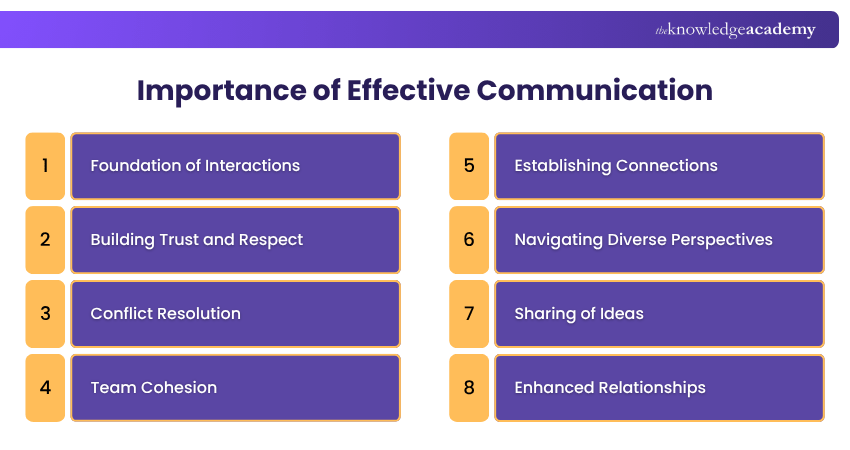
1) Foundation of Interactions: Effective Communication is the foundational element of all our interactions, serving as the bedrock upon which we build relationships, both personal and professional. However, the Language Barrier to Communication can pose challenges, hindering the clarity and effectiveness of these interactions.
2) Building Trust and Respect: It plays a crucial role in fostering an environment of mutual trust and respect, which are important essential components for any successful relationship.
3) Conflict Resolution: Effective Communication is indispensable in resolving conflicts, helping parties involved understand differing perspectives and find common ground.
4) Team Cohesion: In professional settings, it is vital to construct cohesive and collaborative teams, thereby contributing to a more balanced and productive workplace.
5) Establishing Connections: The ability to communicate effectively facilitates the establishment of fruitful and enduring connections, forming the basis of strong, resilient relationships.
6) Navigating Diverse Perspectives: It acts as a bridge, connecting diverse thoughts, emotions, and viewpoints, ensuring that messages are not just transmitted but are truly understood and valued.
7) Sharing of Ideas: Effective Communication encourages the free sharing of ideas and the establishment of a common ground, fostering an environment where mutual respect and understanding can flourish.
8) Enhanced Relationships: Recognising and harnessing the power of Effective Communication is essential for anyone seeking to navigate the complexities of Interpersonal Communication relationships and establish meaningful relationships.
Gain confidence in presenting ideas clearly and persuasively with our Public Speaking Course – Register today!
Key Principles of Effective Communication
The key Principles of Communication encompass clarity, Active Listening, and acknowledging non-verbal cues, forming the foundation for mutual understanding and successful interaction. These principles guide the way we convey and interpret messages, ensuring that our communications are clear, meaningful, and effective.
1) Clarity and Conciseness
At the heart of Effective Communication lies the principle of conveying messages with clarity and conciseness.
1) Simple Language: Employing straightforward and accessible language is critical. This practice eliminates ambiguity, creating an environment where messages are easily understood and interpreted by the audience.
2) Avoiding Jargon: When communicating with a diverse group, it becomes essential to either simplify or thoroughly explain any industry-specific terms, promoting a sense of inclusivity and comprehension among all participants.
3) Straight to the Point: Bypassing lengthy and unnecessary explanations helps maintain the integrity of the core message, thus reducing the risk of misunderstandings and sustaining the audience’s interest.
Adherence to clarity and conciseness eliminates ambiguity, fostering an environment of understanding and mutual respect. It sets the foundation for the receiver to interpret the message as intended, paving the way for productive conversations. Additionally, exploring Books to Improve Communication can further enhance these skills, ensuring more effective and meaningful exchanges.
2) Listening Actively
Listening actively is a multifaceted aspect of communication, requiring more than just hearing the spoken words.
1) Full Concentration: The act of concentrated listening to the speaker without interruptions produces significant improvements to interactions that create stronger bonds between participants.
2) Understanding and Responding: A listener should first understand verbal content along with emotional meaning and then deliver an appropriate response.
3) Remembering: Referring back to previously mentioned points through memory demonstrates complete engagement that strengthens relationships between message receivers and senders.
By embracing active listening, you can cultivate mutual understanding and respect, creating a dialogue that is as much about receiving as it is about transmitting information.
3) Non-verbal Communication
Non-verbal elements in communication often convey more information and insight than the actual spoken words.
1) Body Language: The importance of body language, including posture and gestures, is paramount. These non-verbal cues can either support or contradict the spoken message, hence the need for awareness and control.
2) Eye Contact: Maintaining appropriate eye contact signals interest and engagement, fostering a sense of trust and openness in the conversation.
3) Facial Expressions: Expressions like smiling, frowning, or raised eyebrows communicate a wide range of emotions, providing additional context to the spoken words.
Acknowledging the impact of non-verbal cues is essential, as they convey volumes about our intentions and feelings. Being aware of and proficient in Non-Verbal Communication enhances our ability to communicate effectively, ensuring our messages are comprehended in their entirety.
Understand cultural gestures, improving global communication with our Nonverbal Communication Training – Register today!
How to Effectively Improve Communication Skills?
Improving Communication skills means expressing yourself clearly and understanding others better. Small changes like listening well and choosing words wisely can make a big difference. Let’s explore simple ways to do it effectively:

1) Understand Your Audience
Before you speak or write, think about who you are talking to. Understanding your audience helps you choose the right words, tone, and examples so they can understand you easily. This makes your message more meaningful and engaging for them.
2) Find Your Professional Voice with Confidence
Speak clearly and with confidence. Use a friendly but respectful tone. A confident voice helps others trust what you say and makes your message stronger. Over time, this builds your credibility and influence.
3) Practice Active Listening
Good communication is not only about talking but also about listening carefully. Pay attention to what others say, don’t interrupt, and show that you understand by nodding or asking questions. This helps you respond thoughtfully and build trust.
4) Make Your Message as Clear and Concise
Say what you mean in simple words. Avoid long sentences or confusing details. A short and clear message is easier for everyone to follow. Always aim for true understanding, not just speaking.
5) Strengthen Your Writing and Editing Skills
When writing emails or reports, use short sentences and correct grammar. Read your message again to check for mistakes or unclear parts before sending it. Good writing shows professionalism and respect for your readers.
6) Choose the Right Communication Platform
Use the right way to share your message. For quick chats, use instant messages. For important details, choose emails or meetings. Selecting the right platform saves time and ensures your message reaches the right people.
Learn the art of executive presence and persuasive communication with our Executive Communication Training – Sign up soon!
Benefits of Effective Communication
Effective Communication plays a central role in shaping how we connect, collaborate, and grow. Whether in everyday interactions, close relationships, or professional environments, strong communication skills reduce confusion and create clarity. Below is a closer look at how it benefits different areas of life:
A) Effective Communication in General Life
In everyday life, Effective Communication helps people express their thoughts and understand others more clearly. It reduces unnecessary conflicts caused by assumptions or misinterpretations and makes daily interactions smoother.
It also improves social confidence. When individuals communicate openly and respectfully, they build stronger networks, gain mutual respect, and create meaningful connections in their communities.
B) Effective Communication in Personal Life
In personal life, communication is the foundation of trust and emotional connection. Open conversations allow partners, family members, and friends to share feelings honestly, resolve misunderstandings, and support one another during challenges.
It also strengthens emotional intimacy between people. When you actively listen and respond to others with empathy, relationships become healthier, more stable, and more fulfilling over time.
C) Effective Communication in Workplace
In the workplace, Effective Communication enhances teamwork and productivity. Clear instructions, constructive feedback, and transparent discussions help employees understand expectations and perform their roles efficiently.
It also supports leadership and collaboration. Managers who communicate clearly inspire trust, reduce workplace conflicts, and encourage innovation, ultimately contributing to organisational success.
The Seven C’s of Effective Communication
A great way to summarise the important factors of Effective Communication is with the seven C’s. The seven C’s of Effective Communication are as follows:
1) Concise: Keeping it short and simple for easy comprehension.
2) Clear: The message conveyed should be understood clearly. Simplicity of language can help avoid misinterpretation of the message.
3) Concrete: A sign of good communication is that it is actionable. Try to provide an actionable solution or a plan of action for your intended message.
4) Correct: Make sure the message you intend to convey is correct and avoid having factual or grammatical errors.
5) Complete: For the communication to be effective, it must be delivered completely. Make sure you convey the message you intend to completely, and do not spare the details.
6) Coherent: The message you convey should always be backed up by logic and conveyed in a reasonable order for your listener or reader to understand.
7) Considerate: When the message is delivered politely and respectfully, the receiver is more likely to receive it well and be more reciprocative.
How to be a More Effective Communicator?
To be a more effective communicator, focus on being clear, concise, and empathetic. Practice active listening, maintain good body language, and tailor your message to your audience. Avoid using jargon, ask questions to ensure clarity, and provide constructive feedback. Enhancing your emotional intelligence can help you develop your communication skills.
What are Examples of Effective Communication?
Here are some real-life examples that show how it works in practice:
1) During a Team Meeting: A manager listens to each team member’s input before summarising the discussion and agreeing on next steps.
2) In Customer Service: An employee uses calm, polite language to address a client’s concern and offers a clear solution.
3) In Personal Relationships: Two friends discuss a misunderstanding openly, listen to each other’s feelings, and resolve the issue respectfully.
4) In Emails or Reports: A professional writes short, clear sentences and avoids jargon to ensure everyone understands the message.
5) In Presentations: A speaker maintains eye contact, uses gestures, and speaks confidently to engage the audience.
Conclusion
Understanding What is Effective Communication is the key to building trust, resolving conflicts, and expressing ideas clearly. When you listen actively, speak with empathy, and stay mindful of tone and body language, you build stronger connections. Great communication is not just about talking; it is about being understood and making every interaction meaningful.
Gain the confidence to present ideas persuasively in any workplace scenario. Join our Communication Skills Course now!
Frequently Asked Questions
How Does Effective Communication Benefit Relationships, Both Personal and Professional?

Whether it is for business or your day-to-day life, communicating effectively can help build trust, resolve conflicts and facilitate healthy relationships. It encourages openness and understanding, allowing people to express their thoughts and emotions more clearly and respectfully.
Can Effective Communication Skills Be Learned and Improved Over Time?
Practice makes perfect and Effective Communication skills can be practised and significantly improved over time. Remember to remain consistent with your practice to see a significant improvement in your communication skills.

Charlotte Wilson


Soft Skills and Business Training Manager
Charlotte Wilson is an expert in soft skills development, with over 14 years of experience helping individuals and teams improve communication, productivity and emotional intelligence in the workplace. Her training content is focused on enhancing interpersonal effectiveness and fostering positive, collaborative environments across all levels of an organisation.
View Detail

 If you wish to make any changes to your course, please


