


 Top Rated Course

We may not have the course you’re looking for. If you enquire or give us a call on +1 6474932992 and speak to our training experts, we may still be able to help with your training requirements.
CCNA vs CCNP: Which is the Best Certification?
John Davies 28 October 2025CCNA and CCNP are both Cisco Certifications. CCNA is an associate-level certification that provides foundational knowledge, whereas CCNP is more advanced. It focuses on deeper skills like routing, switching, and troubleshooting. These certifications are valuable for roles in network support and engineering. Both boost your IT credibility.

Training Outcomes Within Your Budget!
We ensure quality, budget-alignment, and timely delivery by our expert instructors.
Table of Contents
Computer networks are essential for connecting businesses, organisations, and individuals. With rising demand for networking professionals, certifications like Cisco’s CCNA and CCNP have become key indicators of expertise. That led to the inevitable debate of CCNA vs CCNP and that has been prevalent for a while.
These certifications are highly valued in the networking industry and can lead to exciting career opportunities. In this blog, we will look at the differences, similarities, and career implications of CCNA and CCNP Certifications and help you decide which certification path to choose. Let's dive in!
Table of Contents
1) What is CCNA?
2) What is CCNP?
3) How do CCNA and CCNP Fit into the Cisco Certification Training?
4) CCNA vs CCNP: Differences
5) CCNA vs CCNP: Career Differences
6) CCNA and CCNP Exam Requirements
7) CCNA and CCNP Exam Difficulty
8) CCNA vs CCNP: Similarities
9) CCNA-level Job Opportunities and Salaries
10) CCNP-level Job Opportunities and Salaries
11) Is CCNA Better than CCNP?
12) Can I Pass CCNP Without CCNA?
13) Conclusion
What is CCNA?
The Cisco Certified Network Associate (CCNA) is one of the most popular entry-level certifications in the networking world. Offered by Cisco, this certification focuses on the basics of networking. It helps learners understand how networks operate, how devices communicate, and how to set up basic network infrastructure.
The CCNA certification is a great starting point for beginners who want to build a career in IT networking. It covers a wide range of topics, including CCNA and CCNA Security, such as IP addressing, routing and switching, security basics, and network troubleshooting.
Benefits of CCNA Certification
Acquiring a CCNA Certification comes with several benefits that can help professionals in the Information Technology (IT) industry progress in their careers. Here are some of the benefits of CCNA Certification:
1) Foundation-level Skills: Helps you understand core networking concepts.
2) Career Starter: Ideal for roles like Network Technician or Help Desk Engineer.
3) Industry Recognition: Cisco is a global leader, and CCNA is valued worldwide.
4) Boosted Job Opportunities: Many entry-level IT jobs list CCNA as a desired qualification.
5) Prepares for Higher Certifications: Serves as a stepping stone to CCNP or other Cisco certifications.

What is CCNP?
The Cisco Certified Network Professional (CCNP) is a more advanced certification aimed at experienced networking professionals. It builds on the knowledge from CCNA and dives deeper into complex topics such as advanced routing, switching, security, and troubleshooting.
The CCNP is ideal for professionals already working in networking who want to move into more senior roles or specialise in areas like enterprise networking, security, or data centres.
Benefits of CCNP Certification
CCNP Certifications provide an opportunity for networking professionals to specialise in specific domains and become expertise in that. Let’s look at some other benefits that come with obtaining the certification:
1) Advanced Networking Skills: Covers complex concepts for enterprise-level Network Management.
2) Higher Earning Potential: Opens doors to mid- and senior-level job roles.
3) Customised Paths: You can choose focus areas like CCNP Security, Enterprise, Collaboration, or Data Centre.
4) Real-world Applications: Prepares you for troubleshooting and designing advanced networks.
5) Stronger Career Progression: Gives you the credibility to apply for leadership or architectural roles in IT.
Troubleshoot complex network infrastructures with our CCNP (Cisco Certified Network Professional) Training – Register today!
How do CCNA and CCNP Fit Into the Cisco Certification Training?
CCNA and CCNP are integral components of the Cisco certification program, which is structured into five levels: entry, associate, professional, expert, and architect. Let's explore how CCNA and CCNP fit into this certification framework.

1) Entry Level: This is the foundational level of Cisco Certifications, typically designed for individuals who are new to networking. At this level, you may find certifications like the Cisco Certified Technician (CCT).
2) Associate Level: CCNA Certification is the ideal certification at the associate level. It is a fundamental networking certification that covers a broad range of networking topics, making it an excellent starting point for individuals entering the field.
3) Professional Level: Beyond the CCNA, you have the CCNP certification, which is part of the professional level. The CCNP Certification allows individuals to specialise in specific technology areas such as routing and switching, security, or wireless networking. It's an excellent choice for those who want to deepen their expertise in a particular domain.
4) Expert Level: The expert level of Cisco Certifications includes the prestigious Cisco Certified Internetwork Expert (CCIE) Certification. CCIE is a highly advanced and respected certification in the industry, and it is often seen as the pinnacle of Cisco's Certification program. CCNP serves as a preparatory step for those who aspire to attain CCIE status.
Achieving a CCIE Certification is a significant accomplishment and demonstrates a high level of expertise and skill in Cisco networking technologies. CCIE Certifications are available in various tracks, including routing and switching, security, and data centre, among others.
Overal, CCNA serves as the associate-level certification, while CCNP is part of the professional level, offering specialised knowledge in specific technology areas. Both CCNA and CCNP can be essential stepping stones for individuals who aim to attain the highly-regarded CCIE Certification, which is recognised as a mark of excellence in the field of Cisco networking.
CCNA vs CCNP: Differences
Both CCNA and CCNP are prestigious certifications offered by Cisco Systems. However, there are key factors that set them apart. Let’s explore the specific areas where these two certifications differ:
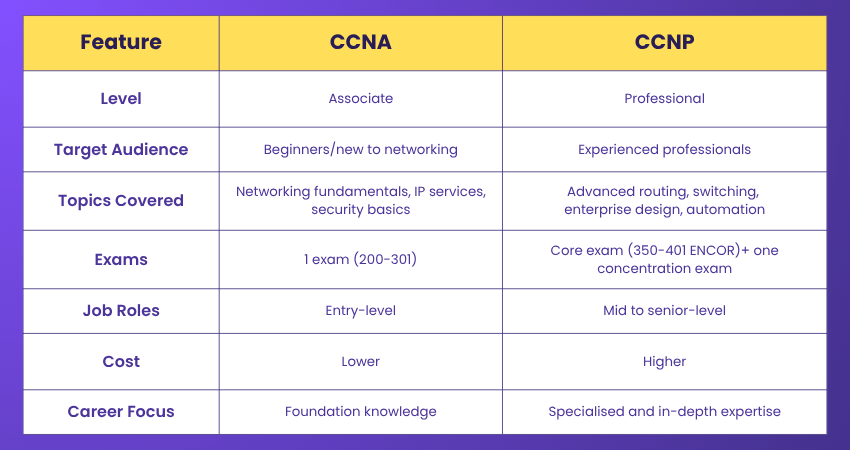
CCNA vs CCNP Career Differences
CCNA-certified professionals usually start in support or junior roles. These include working with small networks or assisting senior engineers. It’s perfect for getting into IT roles and gradually gaining experience.
On the contrary, CCNP-certified professionals are ready for high-level tasks. They can lead projects, design networks, and work with enterprise infrastructure. CCNP roles often involve decision-making, leading teams, and handling large-scale networks.
CCNA and CCNP Exam Requirements
Let's explore the exam requirements of both CCNA and CCNP Certifications:
CCNA Exam Requirements
The CCNA certification is basically designed for beginners. Cisco has since streamlined the CCNA into a single consolidated exam (200-301), which covers all foundational topics including networking, security, automation, and IP services.
1) Format: One exam
2) Duration: 120 minutes
3) Topics: Network access, IP connectivity, automation, security, and more
4) No prerequisites required
CCNP Exam Requirements
The CCNP certification is more advanced and focuses on professional-level networking skills. Previously, to sit for the CCNP exam, a valid CCNA certification was required.
1) Format: Two exams of one core + one concentration exam
2) Duration: Each around 120 minutes
3) Topics: Depends on the CCNP path (e.g., Enterprise, Security, Collaboration)
4) Prerequisites: Prior networking experience or CCNA-level knowledge
Learn the best practices for deployment with our CCNP Wireless Training – Join now!
CCNA and CCNP Exam Difficulty
Both CCNA and CCNP require passing an exam, but their difficulty levels vary based on your experience and knowledge. The CCNA exam is easier and suited for beginners, covering basic networking concepts. It allows simulator use during preparation, aiding hands-on practice.
The CCNP exam is more difficult, requiring deeper knowledge of advanced topics like routing and security. It’s ideal for experienced professionals with prior networking skills.
CCNA vs CCNP: Similarities
Although both CCNA and CCNP differ in multiple aspects, they have numerous similarities. Let's look at some of the similarities between both certifications:
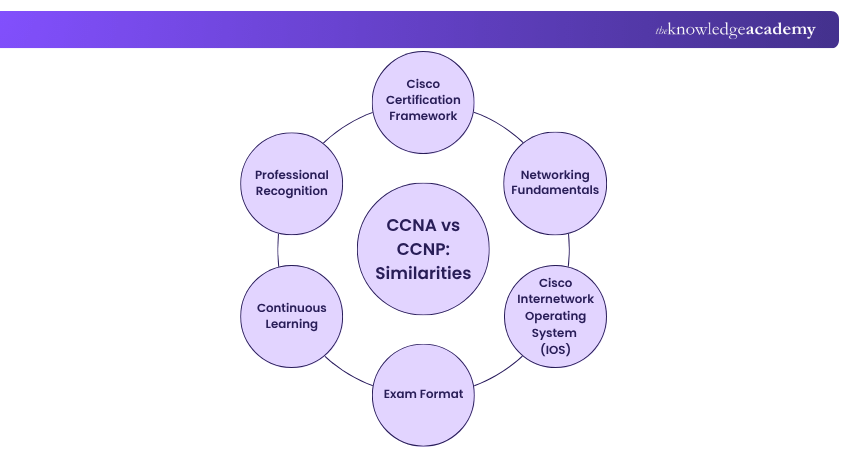
a) Cisco Certification Framework: CCNA and CCNP certifications are part of the Cisco certification framework, which is highly recognised and respected in the networking industry. Both certifications demonstrate your proficiency in Cisco technologies and validate your skills in working with Cisco networking equipment.
b) Networking Fundamentals: Both certifications require a solid understanding of networking fundamentals. While CCNA covers these concepts at an introductory level, CCNP assumes that candidates already possess a foundational knowledge of networking acquired through CCNA or equivalent experience.
c) Cisco Internetwork Operating System (IOS): Both involve hands-on experience with Cisco IOS, the operating system (OS) used on Cisco networking devices. Candidates are required to configure and troubleshoot network devices using Cisco IOS commands and features.
d) Exam Format: Both certifications consist of multiple exams that candidates need to pass to obtain the certification. The exams typically assess candidates' theoretical knowledge and their ability to apply that in practical scenarios and troubleshooting situations. The exam formats may include multiple-choice questions, simulations, and hands-on lab exercises.
e) Continuous Learning: Both certifications emphasise the importance of continuous learning and staying up to date with the evolving networking landscape. Cisco regularly updates its certification programs to align with industry advancements and technological changes which can be supported by studying CCNA books.
This encourages professionals holding CCNA or CCNP Certifications to engage in ongoing professional development and stay abreast of the latest networking trends and best practices.
f) Professional Recognition: Both certifications are widely recognised in the industry and can enhance your professional credibility. They prove your dedication to learning and mastering networking concepts and can differentiate you from others in the job market. Employers often value candidates with CCNA or CCNP Certifications, considering them knowledgeable and skilled networking professionals.
Manage and secure enterprise network systems with our Interconnecting Cisco Networking Devices Part 1 Course – Sign up soon!
CCNA-level Job Opportunities and Salaries
CCNA-certified professionals are eligible for a variety of positions, especially in support, infrastructure, and network administration. Below are some common job titles, with average annual salaries:
1) Help Desk Engineer
Help desk engineers offer technical assistance to users. They troubleshoot computer issues, update support tickets, and install software or hardware. Many work remotely or in office environments and serve as the first point of contact for IT-related queries. Their average salary is £40,000.
2) Network Technician
These professionals install and maintain network systems. They optimise networks based on company needs, educate users, and perform regular system updates to maintain performance and reliability. Their average salary is £43,000.
3) IT Security Specialist
With data breaches on the rise, IT security specialists are in demand. They monitor and secure company systems, research emerging threats, and implement security protocols including user access controls and risk management plans. Their average salary is £63,000.
4) Systems Administrator
System administrators manage servers and ensure that networked systems operate efficiently. Their duties include performing updates, recovering lost data, and installing cybersecurity defences. The average salary for this role is £62,000.
5) VOIP Engineer
Voice Over Internet Protocol (VOIP) engineers design and maintain voice communication systems that run over the internet. They also handle network capacity planning, troubleshoot call quality issues, and train users on protocols. They usually get an average salary of £69,000 for this role.
CCNP-level Job Opportunities and Salaries
CCNP holders are qualified for more complex and strategic IT positions. These roles involve designing, implementing, and securing enterprise networks and often come with leadership responsibilities and significantly higher pay. Here are the roles and its average annual salaries:
1) Network Analyst
Network analyst involves monitoring network protocols, evaluating router or switch performance, and optimising data flow and storage. They also provide IT support and advise cross-functional teams on suitable hardware/software upgrades. Their average annual salary is £82,561.
2) IT Manager
IT managers oversee the planning and implementation of tech solutions across an organisation. Responsibilities include negotiating vendor contracts, improving cybersecurity, aligning IT goals with business strategy, and managing technical teams. Their average salary is £76,605.
3) Network Engineer
Network engineers design, deploy, and maintain enterprise networks. They troubleshoot connectivity issues, manage firewalls and security, and support systems like VoIP and VPN. They often work with network technicians and report to system administrators or infrastructure leads. They get an average salary of £78,531 annually.
4) Systems Engineer
Systems engineers focus on building and refining IT systems to meet organisational needs. They work in diverse sectors software, robotics, civil engineering, etc. to design, integrate, and support hardware-software systems. Their average salary is £88,872.
5) Infrastructure Engineer
Infrastructure engineers are responsible for building and maintaining the foundational IT systems of a company. This includes server management, VPN setup, virtualisation, and system security. They also ensure scalability, reliability, and disaster recovery planning. Their average annual salary is £91,583.
Is CCNA Better than CCNP?
No. One is not better than the other. This is because they are intended toserve different purposes:
1) CCNA is better for beginners or those switching to networking
2) CCNP is better for professionals looking to upskill or take on leadership
If you're just starting out, begin with CCNA. If you already work in IT and want to move up, consider CCNP.
Can I Pass CCNP Without CCNA?
Cisco no longer requires CCNA as a prerequisite for CCNP. However, you should have CCNA-level knowledge before taking on the CCNP exam, or you may struggle with advanced topics.
If you’re experienced in networking but never got certified, you can skip straight to CCNP. But for most, it’s best to build your knowledge step by step.
Conclusion
Choosing between CCNA vs CCNP depends entirely on where you are in your career and where you want to go. CCNA is perfect for beginners looking to build strong networking foundations, while CCNP suits experienced professionals aiming for advanced roles and higher pay. Both are valuable and respected in the IT industry, so choose the one that aligns with your journey and helps you grow confidently in the networking field.
Discover the Cisco tools used in real-world IT environments with our CCNA Training – Begin your journey today!
Frequently Asked Questions
Is CCNA Being Discontinued?

No, the CCNA is not discontinued. However, Cisco did restructure the exam in 2020. Now, instead of multiple CCNA paths, there is one single CCNA (200-301) covering all the fundamentals in a streamlined way.
What Replaced CCNA?
The new CCNA (200-301) replaced the older separate tracks like CCNA Routing and Switching, CCNA Security, etc. It brings all essential networking knowledge into one certification, making it more flexible for today’s job roles.
What are the Other Resources and Offers Provided by The Knowledge Academy?
The Knowledge Academy takes global learning to new heights, offering over 3,000 online courses across 490+ locations in 190+ countries. This expansive reach ensures accessibility and convenience for learners worldwide.
Alongside our diverse Online Course Catalogue, encompassing 19 major categories, we go the extra mile by providing a plethora of free educational Online Resources like Blogs, eBooks, Interview Questions and Videos. Tailoring learning experiences further, professionals can unlock greater value through a wide range of special discounts, seasonal deals, and Exclusive Offers.
What is The Knowledge Pass, and How Does it Work?
The Knowledge Academy’s Knowledge Pass, a prepaid voucher, adds another layer of flexibility, allowing course bookings over a 12-month period. Join us on a journey where education knows no bounds.
What are the Related Courses and Blogs Provided by The Knowledge Academy?
The Knowledge Academy offers various CCNA Training, including CCNA Certification, CCNP Collaboration Training, and Interconnecting Cisco Networking Devices Part 1 Course. These courses cater to different skill levels, providing comprehensive insights into Virtual Networking.
Our IT Infrastructure & Networking Blogs cover a range of topics related to CCNA vs CCNP, offering valuable resources, best practices, and industry insights. Whether you are a beginner or looking to advance your Networking skills, The Knowledge Academy's diverse courses and informative blogs have got you covered.

John Davies


Cyber Security Governance & Assurance Specialist
John Davies is a cybersecurity expert specialising in governance, risk management, and compliance. With over 15 years in the field, he has led enterprise-wide security programmes across finance, healthcare and public sector organisations. His content provides practical guidance on building secure environments, managing risk and aligning with regulatory frameworks.

Upcoming IT Infrastructure & Networking Resources Batches & Dates
Date
 CCNA Certification
CCNA Certification
Mon 18th May 2026
CCNA Certification
Mon 10th Aug 2026
CCNA Certification
Mon 19th Oct 2026

 If you wish to make any changes to your course, please


